
This is a Model Context Protocol (MCP) server for interacting with AIStor object stores.
Repository stats unavailable
Databases & Storage
An MCP server that gives AI agents autonomous control over dynamically structured data collections, with persistent storage, automatic schema validation, and both STDIO and SSE modes.
Autonomous Data Manager MCP Server is cataloged as an MCP server attributed to byskov-soft. An MCP server that gives AI agents autonomous control over dynamically structured data collections, with persistent storage, automatic schema validation, and both STDIO and SSE modes. It is categorized under databases storage. See the capability inspector for recorded interfaces and their independent review status; consult upstream documentation for the current interface.
Installation configuration is not reviewed. No executable setup is offered for this entry; inspect the source repository before proceeding.
Catalog license label: MIT. Check the source repository's current license and terms before using, modifying or distributing this software.
Capability definitions are not reviewed. Unreviewed imports are not exposed as trusted interfaces.
No reviewed records to display. This does not establish that upstream lacks this capability.
No reviewed records to display. This does not establish that upstream lacks this capability.
No reviewed records to display. This does not establish that upstream lacks this capability.
Email delivery is not connected. This page does not collect email addresses or create subscriptions.
Browse the registry for current listings instead.
Reviews for Autonomous Data Manager MCP Server are not available yet
Review publishing and storage are not connected. This page does not collect or publish ratings or comments, including after sign-in.
Tools include add_collection_type, add_batch_to_collection, get_from_collection, delete_from_collection, collection_summary and get_resource_data.
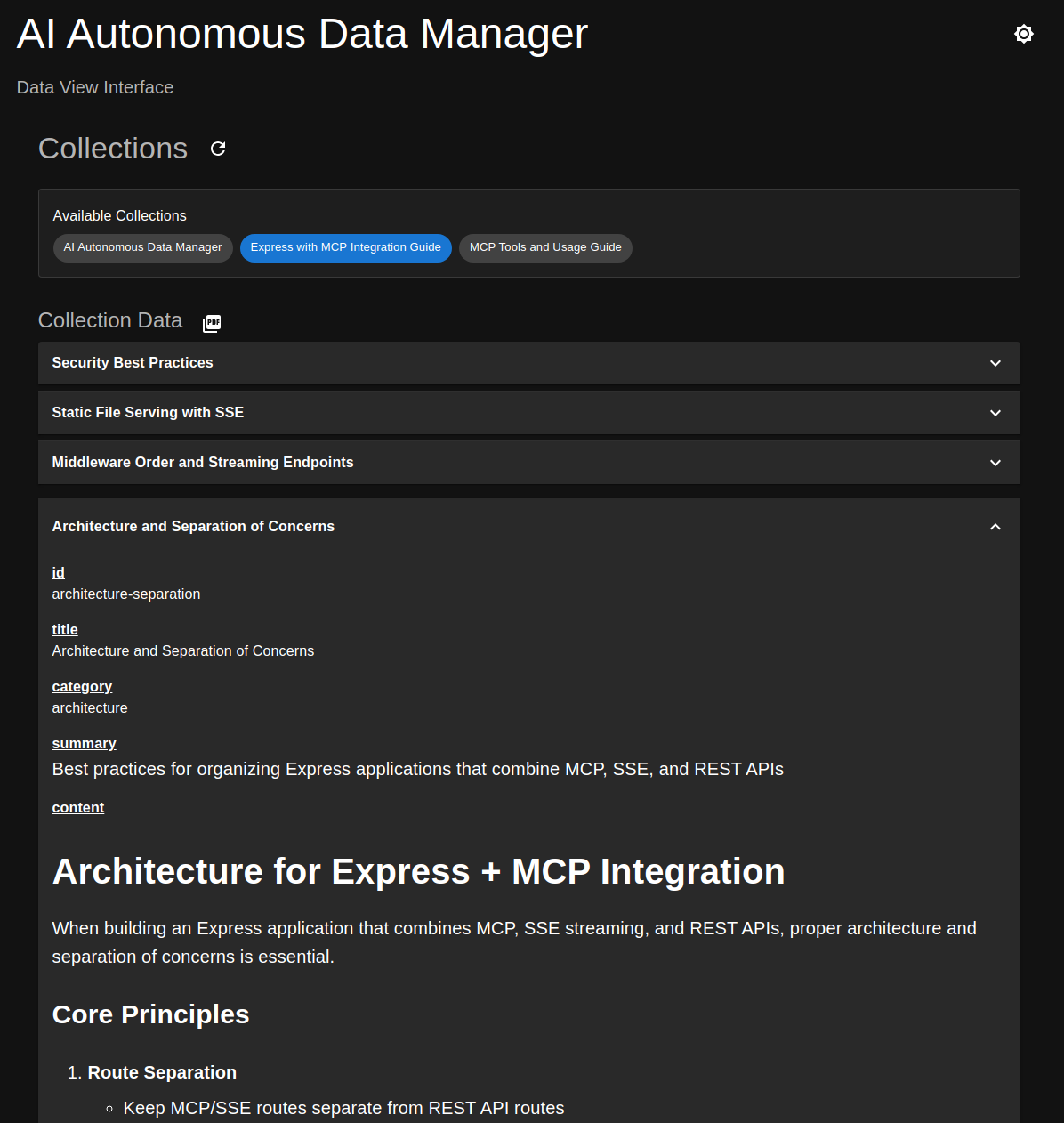
Yes, humans can monitor collections through the built-in web interface in SSE mode, the MCP Inspector, or the MCP server API endpoints.
README.md · d73714dcbd88 · Fetched 2026-11-13 11:38:08 UTC
Original upstream text, without AI rewriting. Scripts, forms and unsafe links are filtered for safety.
Showing the last retrieved documentation snapshot; check the source for current changes.
The AI Autonomous Data Manager is a specialized data management system designed to give AI agents (like those in Cursor, Cline, or other AI-enabled editors) autonomous control over dynamically structured data collections. It enables AI assistants to maintain persistent memory across conversations, organize information, and manage data without human intervention.
The server was created as an excercise to learn about MCP servers. How useful it is remains to be seen. It is provided as-is under the MIT license.
Key features:
The system empowers AI agents to do things like:
While the AI agents interact with collections programmatically, humans can monitor and inspect the data through:
To export collections to PDF:
Make sure you have Node and NPM installed
Run npm install to install dependencies
Copy run-example.sh to run.sh and set the correct path (to the repository directory)
Copy .env-example to .env and modify it if needed (should work as is)
Start MongoDB using docker-compose up or use your own Mongo instance
MONGO_* and RUN_MODE environment variables in the run.sh file accordinglyConfigure your editor/tool to use the MCP server
Cursor editor example (mpc.json):
 {
     "mcpServers": {
         "data_service": {
             // Same repository path as mentioned above
             "command": "/<path>/run.sh",
             "args": []
         }
     }
 }
Note: Running in SSE mode seems sketchy at times. While it works fine for the MCP Inspector tool. The server has sometimes crashed when Cursor or Cline was the client. So some improvements should be made to make SSE mode a bit sturdier.
Start MongoDB using docker-compose up or use your own Mongo instance
MONGO_* and RUN_MODE environment variables in the .env file accordinglyStart the server: npm start
Configure your editor/tool to use the MCP server
Cursor editor example (mpc.json):
 {
     "mcpServers": {
         "data_service": {
             "url": "http://localhost:3001/sse",
         }
     }
 }
start
dist/public/dev:back
dev:front
dev
dev:back and dev:front concurrentlystart:prod
dist/, making available on port 3001run.sh
dotenv)dist/ in STDIO modedata://server-description
Server Description: Description of the data service and its use cases.
data://collections
Metadata about available collections
Note: This section will not explain each tool in detail. Fot that please check
src/back-end/mcp/tools/_tools-schema.yml where you can see the descriptions provided for the LLM.
add_collection_type
Create a new collection type in the database
add_batch_to_collection
Add one or more entries to a collection
get_from_collection
Perform a query to retrieve entries from a collection
delete_from_collection
Delete a collection entry
collection_summary
Get a summary of a collection (returns all entries but only includes the _id and summary fields)
get_resource_data
Provides the same information as the data://server-description and data://collections resources.
The reason for incuding it, is that not all MCP clients support resources.
Claim this server with your GitHub account to request manual ownership verification.
Link to the catalog listing for Autonomous Data Manager MCP Server from your README. This badge does not certify ownership, compatibility or security.
[](https://awesome-mcp.com/servers/autonomous-data-manager)Public repository statistics could not be verified. Check the configured source address; unavailable counts are not zero.
Separate sources, scopes and periods. Never combined or treated as installations, active users or security reviews.
No reviewed package or image identity; download statistics are not listed yet.
Alternative and complementary servers in the same category
This is a Model Context Protocol (MCP) server for interacting with AIStor object stores.

A Model Context Protocol server that lets AI assistants run SQL queries against AWS Athena databases and retrieve results.

A Model Context Protocol (MCP) server that exposes access to an InfluxDB v2 instance using the InfluxDB OSS API v2.