Boomi MCP Server
Secure MCP server for Boomi Platform API integration with Claude Code
A production-ready Model Context Protocol (MCP) server that enables Claude Code and other MCP clients to interact with Boomi Platform APIs using OAuth 2.0 authentication and secure credential storage.


🌐 Live Service: https://boomi.renera.ai
Features
- 🔐 Google OAuth 2.0 - Secure authentication with consent screen
- 🔒 GCP Secret Manager - Encrypted per-user credential storage
- 👤 Multi-Profile Support - Store up to 10 Boomi account profiles per user
- 🌐 Web UI - Browser-based credential management
- ✅ Credential Validation - Test credentials before saving
- 🚀 Auto-Deploy - GitHub push → Cloud Build (pinned KB release) → Cloud Run
- 📦 MCP Tools - 29 tools spanning trading partners, processes, components, runtimes, deployments, schedules, account management, and more
- 📚 Boomi Docs KB - Optional retrieval-augmented
search_boomi_docs / read_boomi_doc_page tools backed by a pinned knowledge-base release
- ☁️ Cloud Native - Running on Google Cloud Run
Quick Start
For Users
-
Visit the Web UI: https://boomi.renera.ai
-
Login with Google - OAuth authentication
-
Add Boomi Credentials:
- Email: Your Boomi account email
- API Token: Your Boomi API token
- Account ID: Your Boomi account ID
- Profile Name: A name for this credential set (e.g., "production", "sandbox")
-
Connect Claude Code:
claude mcp add --transport http boomi https://boomi.renera.ai/mcp
-
Authorize - Browser opens for OAuth consent, click "Approve"
-
Use MCP Tools:
Show me my Boomi account information from the production profile
Architecture
┌──────────────┐
│    User      │
│  (Browser)   │
└──────┬───────┘
       │ 1. Visit https://boomi.renera.ai
       │ 2. Google OAuth Login
       ▼
┌──────────────────────────────────────┐
│      Boomi MCP Server (Cloud Run)    │
│  ┌────────────┐    ┌──────────────┐ │
│  │  Web UI    │    │  MCP Server  │ │
│  │ (FastAPI)  │    │  (FastMCP)   │ │
│  └────────────┘    └──────────────┘ │
└───────┬──────────────────┬───────────┘
        │                  │
        │ Store            │ Retrieve
        │ Credentials      │ Credentials
        ▼                  ▼
┌──────────────────────────────────────┐
│      GCP Secret Manager              │
│  boomi-mcp-{user-id}-{profile-name}  │
└──────────────────────────────────────┘
                    │
                    │ API Calls
                    ▼
             ┌──────────────┐
             │  Boomi API   │
             └──────────────┘
Watch: one request, end to end
The diagram above is the deployment topology. For the code path — what
actually happens between an MCP client calling query_components and Boomi
answering — this walkthrough follows a single request across the four
boundaries, explaining the Python where the trace reaches it.
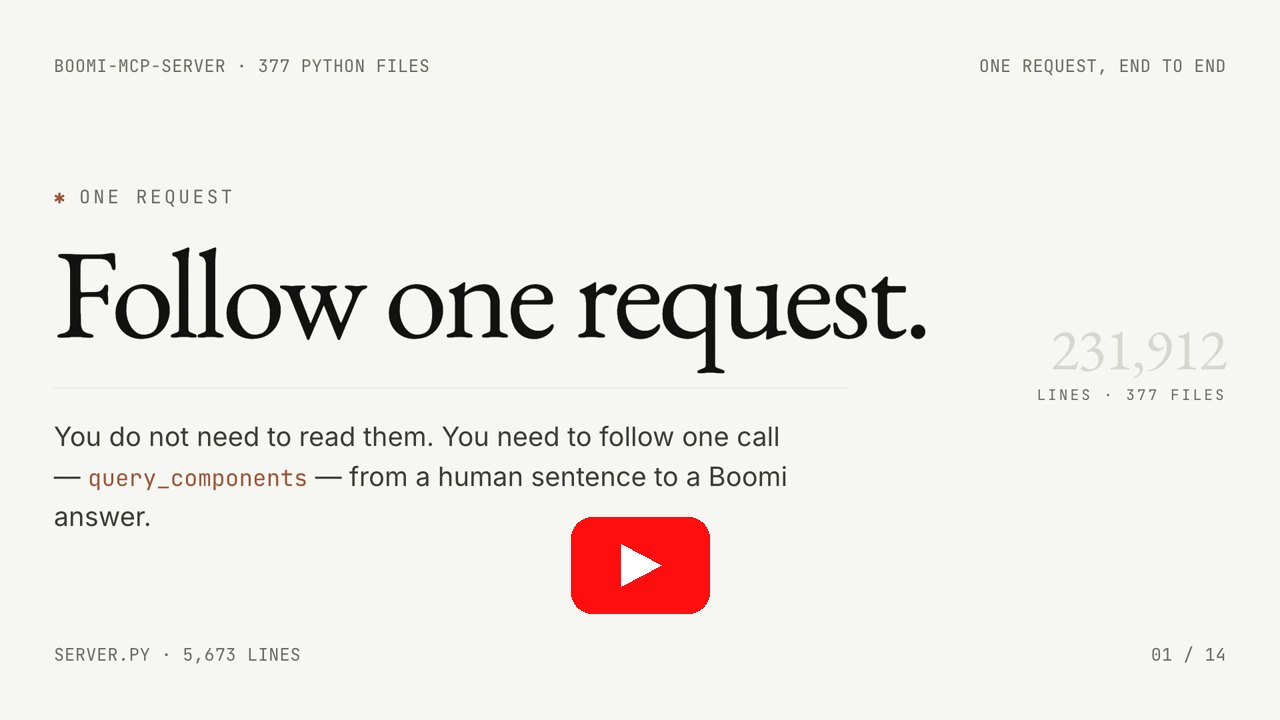
14 minutes. Covers the conditional import that gates tool registration,
@mcp.tool running at import time, the synchronous wrapper on AnyIO's worker
thread, json.loads at the trust boundary, credential resolution through
get_secret, and **params into the action router.
Line numbers shown in the video refer to main at the time of recording.
The server exposes 29 tools. All tools require an authenticated session and a
valid profile parameter pointing at a stored Boomi credential set.
Account & profile management
list_boomi_profiles() — list saved credential profiles for the current user.boomi_account_info(profile) — fetch account details for the named profile.set_boomi_credentials(...) / delete_boomi_profile(...) — credential CRUD.manage_account(...), manage_account_groups(...) — Boomi account admin.
Build, deploy, and operate integrations
manage_process (read-only process list/get), manage_component, analyze_component,
query_components, build_integration, get_schema_templatemanage_environments, manage_runtimes, manage_deployment,
execute_process, troubleshoot_execution, manage_schedules,
manage_listeners, manage_integration_packsmanage_trading_partner, manage_connector, manage_shared_resources,
manage_folders, monitor_platform
Escape hatches
invoke_boomi_api(...) — call any Boomi REST endpoint when no dedicated tool
exists.list_capabilities() — discoverability helper that summarizes all
registered tools.
Boomi Docs Knowledge Base (optional)
Registered only when the server starts with BOOMI_DOCS_ENABLED=true and a
populated KB at BOOMI_DOCS_DB_PATH:
search_boomi_docs(query, ...) — semantic search across the indexed
Boomi documentation corpus.read_boomi_doc_page(page_key) — fetch the full markdown for a specific
documentation page.- Resource
kb://boomi-docs/corpus — corpus manifest (release tag, page
count, generated-at metadata).
The KB corpus is built and released by
RenEra-ai/knowledge-base-builder
and embedded into the image at build time via
deploy/kb-release.env. See
KB Release Promotion below.
Cold-start behavior (operators). The heavy KB build (Chroma + embedding
model load) is deferred off the import path so the server binds its HTTP port
immediately — the docs tools are registered before the KB is ready. Every
docs call resolves readiness atomically and lands in one of three states:
- Normal block-then-serve — during a cold start up to
BOOMI_DOCS_WARMUP_MAX_WAITERS docs calls are admitted as long waiters and
block (bounded by BOOMI_DOCS_WARMUP_WAIT_SECONDS) until the build
finishes, then return real results. Production builds measure mean ~49s,
p95 ~58s, max ~63s, so admitted callers normally just see a slow first call.
- Overflow or a genuinely slow build — further concurrent calls (or an
admitted waiter whose bounded wait elapses) return
error: warming_up immediately with a retry_after_seconds hint derived
from the remaining share of BOOMI_DOCS_WARMUP_EXPECTED_SECONDS
(clamped 5–60; the floor once the estimate is exceeded).
- Failed build — all admitted waiters wake immediately with a sanitized
error: kb_unavailable; the build self-heals on a later call after
BOOMI_DOCS_WARMUP_RETRY_COOLDOWN (default 30s).
Tuning env vars (code defaults match cloudbuild.yaml; invalid values fall
back with an operator warning): BOOMI_DOCS_WARMUP_EAGER (default true — kick
the build on the first authenticated /mcp request),
BOOMI_DOCS_WARMUP_WAIT_SECONDS (default 65 — bounds an admitted waiter's
block, sized just above the measured build p95/max),
BOOMI_DOCS_WARMUP_EXPECTED_SECONDS (default 60 — drives the warming_up
retry-after hint), BOOMI_DOCS_WARMUP_MAX_WAITERS (default 4 — long-waiter
admission cap; overflow returns warming_up immediately). The
boomi.kb.warmup logger emits KB_WARMUP_STARTED/RETRY,
KB_RESOLVE_ADMITTED/OVERFLOW, KB_WARMUP_ELAPSED, and per-phase build
timings for observability.
Boomi Operational Gotchas KB (optional)
Registered only when the server starts with BOOMI_GOTCHAS_ENABLED=true. This is
a separate surface from the docs KB (operational field knowledge vs official
documentation) and is gated by its own independent flag:
search_boomi_gotchas(query, top_k=5, issue_ids=None) — search a curated
catalog of known Boomi silent-failure modes and field traps. Pass issue_ids
for a deterministic exact lookup by gotcha id (it takes precedence over
query). Empty/no-match behavior is explicit and never fabricates entries.- Resource
kb://boomi-operational-gotchas/catalog — the full catalog with each
entry's symptom, detection/frequency taxonomy, provenance, and
verification_status.
Unlike the docs KB, this catalog is stdlib-only: an in-repo curated dataset
with deterministic lexical ranking, no requirements-kb.txt / chromadb /
embedding dependency. Entries are curated summaries (OfficialBoomi BSD-2-Clause
material + local issue/architect-course triage), not verbatim copies, and carry a
verification_status (live_verified / docs_corroborated /
companion_unverified / course_unverified / disputed) so agents can weigh how
well-corroborated each claim is.
Deployment
Current Production Deployment
- Hosting: Google Cloud Run (us-central1)
- URL: https://boomi.renera.ai
- CI/CD: Automated via GitHub
- Region: us-central1
- Authentication: Google OAuth 2.0
CI/CD Pipeline
Automatic deployment on push to main branch:
GitHub Push → Cloud Build (cloudbuild.yaml) → Docker Build (KB pin) → Artifact Registry → Cloud Run
The pipeline is source-controlled in cloudbuild.yaml and
embeds a pinned Boomi Docs knowledge-base release into the image. The KB tag
lives in deploy/kb-release.env so every corpus
version change is a visible repo edit — builds must never use a floating
latest KB release.
- In
RenEra-ai/knowledge-base-builder, cut a manual workflow_dispatch
release (for example kb-13). The release must publish
boomi_knowledge_db.tar.gz as an asset.
- In this repo, bump the single line in
deploy/kb-release.env:
KB_RELEASE_TAG=kb-13
- Open a PR with that change and merge to
main.
- The Cloud Build trigger reads
cloudbuild.yaml, runs a curl -fI
preflight against the GitHub release asset, then builds the image with
--build-arg KB_RELEASE_TAG=$KB_RELEASE_TAG. A missing or empty pin
fails the build before any Docker work happens.
- Cloud Run is updated with
BOOMI_DOCS_ENABLED=true,
BOOMI_DOCS_DB_PATH=/app/kb/boomi_knowledge_db, and
BOOMI_DOCS_RELEASE_TAG=<tag>, which causes the server to register the
search_boomi_docs and read_boomi_doc_page tools plus the
kb://boomi-docs/corpus resource at startup.
Cloud Build Trigger Migration
The existing trigger 8623a6fa-3295-430a-b018-7c728ba941e8 was created from
an inline auto-generated config that did not pass KB_RELEASE_TAG and did
not set the KB runtime env vars. Point it at the source-controlled config
once:
gcloud builds triggers update github 8623a6fa-3295-430a-b018-7c728ba941e8 \
  --project=boomimcp \
  --region=global \
  --build-config=cloudbuild.yaml
After migration, every push to main runs the steps in cloudbuild.yaml
and a git log -- cloudbuild.yaml deploy/kb-release.env shows exactly which
KB version is live.
Manual Deployment
If you need to deploy manually (skips the GitHub trigger):
# Authenticate with GCP
gcloud auth login
gcloud config set project boomimcp

# Submit the same pipeline that the trigger runs.
# REPO_NAME and COMMIT_SHA are populated by Cloud Build only for
# trigger-driven runs, so pass them explicitly via --substitutions
# when submitting from the CLI.
gcloud builds submit \
  --config=cloudbuild.yaml \
  --substitutions="REPO_NAME=boomi-mcp-server,COMMIT_SHA=$(git rev-parse HEAD)"

# Or use the trigger by pushing
git push origin main
Configuration
Environment Variables (Cloud Run)
OAuth Proxy Persistence
Required for MCP OAuth flow to survive Cloud Run instance sleep/restart.
OAuth state is stored in MongoDB Atlas with Fernet encryption:
OIDC_CLIENT_ID          # Google OAuth client ID
OIDC_CLIENT_SECRET      # Google OAuth client secret
OIDC_BASE_URL           # https://boomi.renera.ai
SESSION_SECRET          # Session signing key for web UI
MONGODB_URI             # MongoDB Atlas connection string for OAuth state
JWT_SIGNING_KEY         # Stable key for signing MCP JWT tokens
STORAGE_ENCRYPTION_KEY  # Fernet key(s) for encrypting OAuth tokens at rest.
                        # Single value or comma-separated list (newest first)
                        # to enable zero-downtime key rotation via MultiFernet.
Authentication hardening (optional)
All four ship with safe defaults; override only when debugging or
performing a key rotation. See docs/oauth-migration-runbook.md for the
full rollback procedure.
BOOMI_RT_GRACE_SECONDS          # default 60. Window during which a just-
                                # rotated refresh token still returns the
                                # same new tokens (defeats one-time-use
                                # replay race). Set 0 to disable.
BOOMI_RT_GRACE_MAX_SIZE         # default 512. LRU capacity for the grace cache.
BOOMI_OAUTH_DIAGNOSTICS_DISABLE # default off (diagnostics ON). Set true to
                                # silence the three OAuth diagnostic log
                                # patches. BOOMI_OAUTH_DIAGNOSTICS=false
                                # also works as a back-compat opt-out.
BOOMI_AUTH_HEAL_CORRUPT_CLIENTS # default true. When get_client raises
                                # InvalidToken/ValidationError, delete the
                                # corrupted MongoDB doc so the client can
                                # re-register cleanly.
OAuth cache hardening (optional)
Closes the remaining Google-call and cross-instance gaps. All ship
with safe defaults; see docs/oauth-migration-runbook.md for the
rollout and rollback procedure.
BOOMI_TOKEN_CACHE_DISABLE           # default off (cache ON). Set true to
                                    # restore the per-tool-call Google
                                    # tokeninfo/userinfo round trip.
BOOMI_TOKEN_CACHE_TTL_SECONDS       # default 300. Upper bound on per-entry
                                    # TTL; caps Google-revocation latency.
BOOMI_TOKEN_CACHE_MAX_SIZE          # default 256. LRU capacity.
BOOMI_TOKEN_CACHE_SWR               # default false. Opt-in stale-while-
                                    # revalidate against short Google outages.
BOOMI_TOKEN_CACHE_SWR_WINDOW        # default 30. Seconds before expiry at
                                    # which SWR serves stale + refreshes.
BOOMI_TOKEN_CACHE_STALE_IF_ERROR_SECONDS  # default 0 (off); Cloud Run pins =0
                                    # (off). Opt in by raising it. When the
                                    # Google verifier returns None after a cache
                                    # entry expired, serve the last positive
                                    # token for this many seconds past expiry --
                                    # only while the token's own expiry is still
                                    # future. Note: the verifier returns None for
                                    # BOTH transient failures and explicit Google
                                    # rejections, so enabling this extends the
                                    # cache's revocation-latency window (see
                                    # BOOMI_TOKEN_CACHE_TTL_SECONDS) by up to this
                                    # many seconds. Negatives are never cached.

BOOMI_RT_GRACE_SHARED               # default true. Backs the refresh-token
                                    # grace cache with a MongoDB collection
                                    # (mcp-rt-grace, Fernet-encrypted) so
                                    # multi-replica deployments coalesce
                                    # rotations across instances.
BOOMI_RT_GRACE_SHARED_COLLECTION    # default mcp-rt-grace.
BOOMI_RT_GRACE_DISTRIBUTED_LOCK     # default false. Opt-in cross-instance
                                    # singleflight via mcp-rt-inflight-locks.
                                    # Enable only if logs show duplicate
                                    # orig_exchange calls within ms.
BOOMI_RT_GRACE_LOCK_TTL_SECONDS     # default 30. Auto-release safety bound.
BOOMI_RT_GRACE_LOCK_POLL_MS         # default 100. Follower poll interval.

BOOMI_RT_RECOVERY_ENABLED           # default true. Durable recovery of stale
                                    # refresh JWTs that still verify but whose
                                    # storage rows were deleted (hours/days
                                    # later). Uses an encrypted alias ledger
                                    # (mcp-rt-recovery) to mint fresh tokens.
BOOMI_RT_RECOVERY_MAX_AGE_SECONDS   # default 2592000 (30d, matches the sliding
                                    # refresh lifetime). Max durable alias
                                    # lifetime; older stale tokens must re-auth.
BOOMI_RT_RECOVERY_COLLECTION        # default mcp-rt-recovery.
BOOMI_RT_RECOVERY_MAX_HOPS          # default 64 (scaled with the 30d window).
                                    # Max alias-chain depth walked when resolving
                                    # a stale token to its latest live successor.
BOOMI_RT_REFRESH_JWT_LEEWAY_SECONDS # default 60. Clock-skew tolerance on the
                                    # refresh JWT exp, durable-recovery path only.
BOOMI_RT_SLIDING_REFRESH_EXPIRY     # default true. When upstream omits
                                    # refresh_expires_in, stamp the new FastMCP
                                    # refresh token with a fresh sliding window
                                    # (fixes the frozen 30-day expiry).
BOOMI_RT_SLIDING_REFRESH_TTL_SECONDS # default 2592000 (30d). Sliding lifetime.

BOOMI_AUTH_PROTECTION_STRICT        # default true in production / false in
                                    # local. Fail startup if an ENABLED shared-
                                    # grace or durable-recovery backend cannot
                                    # initialize, instead of silently degrading.
BOOMI_RT_PATCH_STRICT               # default true in production / false in
                                    # local. A FastMCP-contract incompatibility
                                    # raises instead of silently leaving
                                    # recovery/sliding unpatched.
The durable recovery layer (refresh_token_recovery_patch) is applied
inside the 60-second grace cache: the grace cache still serves immediate
replays, recovery handles hours/days-later stale tokens, and only then does the
real FastMCP rotation run. Recovery never replays an old cached access token —
it always mints a fresh access/refresh pair. Diagnostic events (logger
boomi.refresh_token_recovery): RT_DIAG event=rt_recovery_hit (a stale client
recovered) and event=rt_recovery_miss (an alias resolved but its successor
token is no longer live). To roll back, set BOOMI_RT_RECOVERY_ENABLED=false
(disables recovery) or BOOMI_RT_SLIDING_REFRESH_EXPIRY=false (restores
FastMCP's fixed-window behavior); mcp-rt-recovery entries expire via TTL, so
no data migration is needed.
User Credentials Storage
User Boomi API credentials are stored separately in GCP Secret Manager:
SECRETS_BACKEND         # gcp
GCP_PROJECT_ID          # boomimcp
- Format:
boomi-mcp-{user-id}-{profile-name}
- Example:
boomi-mcp-glebuar-at-gmail-com-production
- Encryption: At rest and in transit
- Access: IAM-controlled, audit logged
Boomi Docs Knowledge Base
Set on Cloud Run by cloudbuild.yaml to register the KB tools at startup:
BOOMI_DOCS_ENABLED       # true to register KB tools and resource
BOOMI_DOCS_DB_PATH       # /app/kb/boomi_knowledge_db (in-image corpus path)
BOOMI_DOCS_RELEASE_TAG   # operational marker, mirrors deploy/kb-release.env
When BOOMI_DOCS_ENABLED is unset or false, the KB module is not imported,
the requirements-kb.txt dependencies are not loaded, and the KB tools and
kb://boomi-docs/corpus resource are not registered.
MCP Stateless Transport (Workstream B — ENABLED in production)
BOOMI_MCP_STATELESS_HTTP=true is pinned in cloudbuild.yaml (since
2026-06-01). Production runs FastMCP streamable HTTP stateless, which
eliminates per-instance MCP sessions and the failure they caused: on a cold
start a stateful tool-call POST could lose its server→client response channel
(reaped, or stranded when a reconnect 404'd onto a second instance) and hang
until Cloud Run's 300s request timeout killed it. Statelessly each POST is a
self-contained request→response→terminate, so that hang and the post-redeploy
404 Session not found cannot occur.
BOOMI_MCP_STATELESS_HTTP   # PINNED true in cloudbuild.yaml. Builds the MCP app
                           # with stateless_http=true and skips the stream guard,
                           # session-manager binding, JWT-issuer binding, and
                           # session reaper (none apply without per-instance
                           # sessions). Set false to revert to stateful.
BOOMI_MCP_JSON_RESPONSE    # PINNED true in cloudbuild.yaml (since 2026-06-07).
                           # Honored ONLY in stateless mode; passes
                           # json_response=true so each POST tool result is a
                           # single buffered JSON response instead of SSE-on-POST.
                           # Required: SSE-on-POST large results stalled in the
                           # Cloud Run managed-domain-mapping proxy and hung the
                           # client indefinitely. Set false only to debug.
✅ Chosen: stateless=true / json_response=true (pinned 2026-06-07). The
earlier default json_response=false (SSE-on-POST) was found to stall large
tool results (e.g. a query_components action=get returning ~30 KB process
XML) in the Cloud Run managed-domain-mapping proxy — the response was never
delivered and the client hung with no error. Buffered JSON responses are
delivered reliably. As a backstop, component-XML reads are bounded by a
wall-clock deadline (BOOMI_COMPONENT_GET_DEADLINE_SECONDS, default 90s,
clamped 1–240) that returns a structured COMPONENT_GET_DEADLINE_EXCEEDED
error instead of hanging if the backend fetch itself stalls. The fix preserves
scale-to-zero (no min-instances). Startup logs state which POST framing is
active and whether the stream-guard env vars are inert in stateless mode.
Rollback is BOOMI_MCP_JSON_RESPONSE=false + redeploy. True-value convention:
true, 1, yes, on (case-insensitive).
Local Development
Prerequisites
- Python 3.11+
- Google Cloud SDK
- Access to GCP project with Secret Manager enabled
Setup
# Clone repository
git clone https://github.com/RenEra-ai/boomi-mcp-server.git
cd boomi-mcp-server

# Create virtual environment
python3 -m venv .venv
source .venv/bin/activate

# Install dependencies
pip install -r requirements.txt -r requirements-cloud.txt

# Configure environment
cp .env.example .env
# Edit .env with your OAuth credentials
Run Locally
# Set environment variables
export OIDC_CLIENT_ID="your-google-oauth-client-id"
export OIDC_CLIENT_SECRET="your-google-oauth-client-secret"
export OIDC_BASE_URL="http://localhost:8080"
export SESSION_SECRET="$(python3 -c 'import secrets; print(secrets.token_urlsafe(32))')"
export SECRETS_BACKEND=gcp
export GCP_PROJECT_ID=boomimcp

# Run server
python server_http.py
Visit http://localhost:8080 to access the web UI.
Project Structure
boomi-mcp-server/
├── server.py                  # Core MCP server (FastMCP, all tool definitions)
├── server_http.py             # HTTP wrapper with OAuth middleware
├── src/boomi_mcp/
│   ├── cloud_secrets.py       # Secret Manager backends (GCP/AWS/Azure)
│   ├── local_secrets.py       # Local filesystem secret backend
│   ├── sanitize.py            # Response sanitization helpers
│   ├── categories/            # Tool category groupings
│   ├── models/                # Pydantic models for SDK payloads
│   ├── utils/                 # Misc utilities
│   └── kb/                    # Boomi Docs knowledge-base (gated by BOOMI_DOCS_ENABLED)
│       ├── service.py         # Search + page retrieval over Chroma corpus
│       ├── manifest.py        # kb://boomi-docs/corpus resource
│       └── errors.py          # KB-specific exception types
├── templates/                 # Jinja2 web UI templates (credentials, login, ...)
├── static/                    # Web UI static assets
├── tests/                     # Unit + integration tests (incl. tests/kb)
├── docs/                      # Specs, plans, runbooks
├── agents/                    # Subagent configs (boomi-qa-tester, ...)
├── examples/                  # Usage examples
├── scripts/                   # Operational scripts
├── local_atom/                # Helpers for the local-atom dev profile
├── requirements.txt           # Core dependencies (FastMCP, ...)
├── requirements-cloud.txt     # Cloud provider SDKs
├── requirements-kb.txt        # KB dependencies (chromadb, sentence-transformers)
├── Dockerfile                 # Multi-stage Docker build (KB pin via ARG)
├── cloudbuild.yaml            # Cloud Build pipeline (pinned KB release)
├── deploy/
│   └── kb-release.env         # Pinned knowledge-base release tag
└── README.md                  # This file
Security Features
Authentication & Authorization
- ✅ Google OAuth 2.0 with PKCE
- ✅ OAuth consent screen (prevents confused deputy attacks)
- ✅ Session-based authentication with cryptographic signing
- ✅ Per-user credential isolation
Data Protection
- ✅ HTTPS-only (enforced by Cloud Run)
- ✅ Credentials encrypted at rest (GCP Secret Manager)
- ✅ Credentials encrypted in transit (TLS)
- ✅ No credentials in environment variables
- ✅ Audit logging via Cloud Logging
Access Control
- ✅ IAM-based access to secrets
- ✅ Profile limit (10 per user)
- ✅ Credential validation before storage
- ✅ Automatic session expiration
Monitoring & Logs
View Logs
# Recent logs
gcloud run services logs read boomi-mcp-server \
  --region us-central1 --limit 50 --project boomimcp

# Follow logs in real-time
gcloud run services logs tail boomi-mcp-server \
  --region us-central1 --project boomimcp

# Check service status
gcloud run services describe boomi-mcp-server \
  --region us-central1 --project boomimcp
Cloud Console
Troubleshooting
Cannot Connect to MCP Server
- Check service is running:
curl https://boomi.renera.ai/
-
Verify OAuth consent was completed:
- Browser should open during
claude mcp add
- Click "Approve" on consent screen
- Check for success message
-
Check Claude Code MCP configuration:
claude mcp list
Credentials Not Saving
- Verify all fields are filled in web UI
- Check credential validation passes
- Review browser console for errors (F12)
- Check server logs for error messages
API Errors
-
Verify Boomi credentials are correct:
- Email should be registered in Boomi
- API token should be valid
- Account ID should match your account
-
Test credentials directly:
curl -u "BOOMI_TOKEN.email@example.com:your-token" \
  "https://api.boomi.com/api/rest/v1/YOUR_ACCOUNT_ID/Account/YOUR_ACCOUNT_ID"
Contributing
Contributions are welcome! Please:
- Fork the repository
- Create a feature branch (
git checkout -b feature/amazing-feature)
- Commit your changes (
git commit -m 'Add amazing feature')
- Push to the branch (
git push origin feature/amazing-feature)
- Open a Pull Request
Technical Details
FastMCP Version
Currently pinned to FastMCP 3.1.1 in requirements.txt. Includes:
- OAuth consent screen
- Session middleware support
- Google OAuth provider
- Server branding (custom icons, site URL)
Session Management
- Uses
SessionMiddleware from Starlette
- Session secret stored in GCP Secret Manager
- Sessions persist across requests via cryptographically signed cookies
- Max age: 1 hour (configurable)
Profile Management
- Maximum 10 profiles per user
- Profile names are required (no default profile)
- Profile names must be unique per user
- Examples: "production", "sandbox", "dev", "staging"
Resources
License
MIT License - see LICENSE file for details.
Support
For issues, questions, or feature requests:
- Open an issue on GitHub
- Include relevant logs (with secrets redacted)
- Describe your environment and steps to reproduce
Acknowledgments
Last Updated: 2026-05-18
Status: ✅ Production (Stable)
Version: FastMCP 3.1.1


