
A directory listing describing a cancellation-letter and mailing-address service. The configured public GitHub repository returned 404 during source verification.
Repository stats unavailable
Developer Tools
A graph-based RAG tool that runs as an MCP server, allowing MCP clients to query and edit a parsed multi-language codebase.
Code-Graph-RAG MCP Server is cataloged as an MCP server attributed to vitali87. A graph-based RAG tool that runs as an MCP server, allowing MCP clients to query and edit a parsed multi-language codebase. It is categorized under developer tools. See the capability inspector for recorded interfaces and their independent review status; consult upstream documentation for the current interface.
Installation configuration is not reviewed. No executable setup is offered for this entry; inspect the source repository before proceeding.
Catalog license label: MIT. Check the source repository's current license and terms before using, modifying or distributing this software.
Capability definitions are not reviewed. Unreviewed imports are not exposed as trusted interfaces.
No reviewed records to display. This does not establish that upstream lacks this capability.
No reviewed records to display. This does not establish that upstream lacks this capability.
No reviewed records to display. This does not establish that upstream lacks this capability.
Email delivery is not connected. This page does not collect email addresses or create subscriptions.
Browse the registry for current listings instead.
Reviews for Code-Graph-RAG MCP Server are not available yet
Review publishing and storage are not connected. This page does not collect or publish ratings or comments, including after sign-in.
Python, TypeScript, TSX, JavaScript, Rust, Go, Java, C, C++, C#, PHP, Lua, Dart, and Julia are fully supported, with others having structural support.
By default the graph is stored in an embedded SQLite file, with Memgraph and Neo4j available as opt-in backends.
README.md · 2b993224124a · Fetched 2026-11-13 09:42:52 UTC
Original upstream text, without AI rewriting. Scripts, forms and unsafe links are filtered for safety.
Showing the last retrieved documentation snapshot; check the source for current changes.






Code-Graph-RAG parses a multi-language codebase with Tree-sitter, sharpened by compiler-grade frontends and runtime traces where available, builds a knowledge graph of its structure in an embedded graph database that needs no server, and lets you query, edit, and optimise that code in plain English. It works across a monorepo of mixed languages under one unified graph schema.
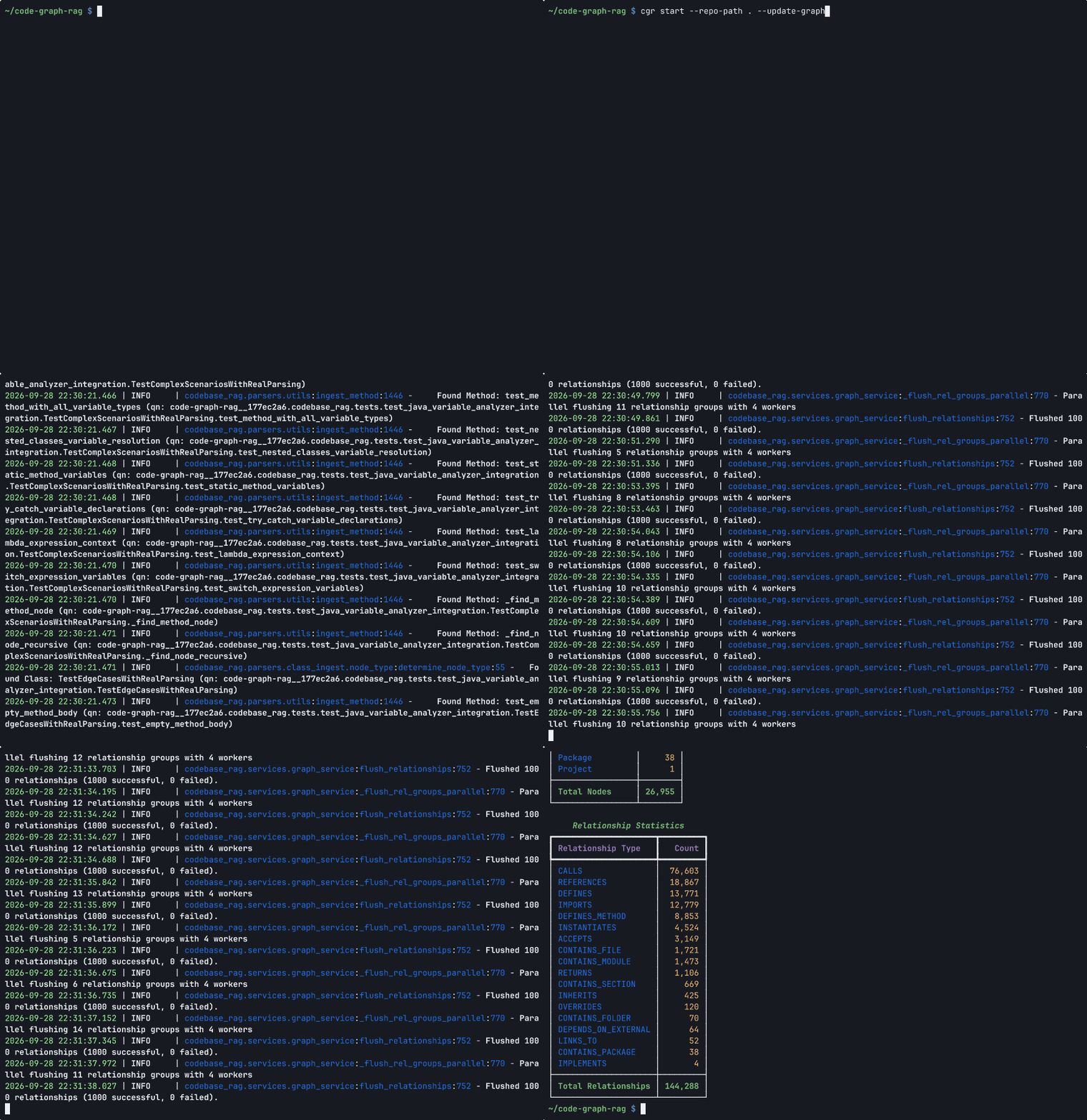
1. Index: cgr start --update-graph parses a repository into a knowledge graph (sped up)
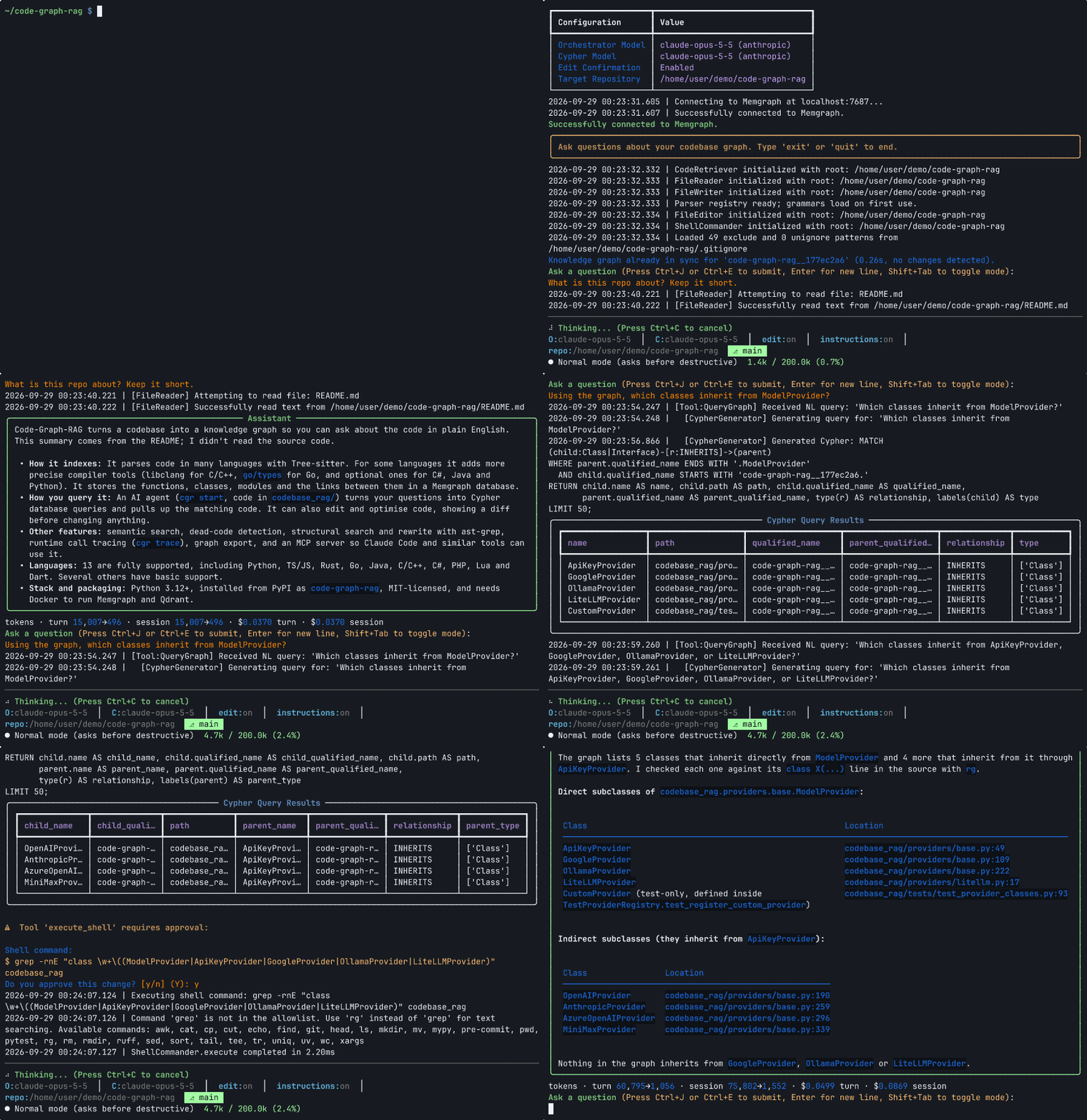
2. Ask: cgr start answers questions and edits code, grounded in that graph
See NEWS.md for the full history.
Point Code-Graph-RAG at a repository and it reads every source file, extracts functions, classes, methods, modules, and the relationships between them, and stores the result as an interconnected graph. Once the graph exists you can:
cgr trace and merge the calls that actually happened into the graph, exposing dispatch that static analysis cannot see.The system has two components:
go/types for Go, and opt-in Roslyn, javac and Jedi for C#, Java and Python), and dynamic tracing merges calls observed at runtime. Tree-sitter stays the backbone: a trace only sees code that ran, and a compiler frontend only covers what its toolchain can build.codebase_rag/). An interactive CLI that turns natural language into Cypher queries, retrieves matching code, and drives AI-powered editing and optimisation.Source Code -> Tree-sitter Parser -> AST Analysis -> Knowledge Graph
|
User Query -> AI Model (Cypher Gen) -> Cypher Query -> Graph Results -> Response
The graph is stored in an embedded SQLite file by default. Memgraph and Neo4j are opt-in backends that run the same Cypher; Graph Backends compares them.
See the Architecture Overview and Graph Schema for the full picture.
Python, TypeScript, TSX, JavaScript, Rust, Go, Java, C, C++, C#, PHP, Lua, Dart, and Julia are fully supported. Scala is in development, and Ruby, Kotlin, Swift, Elixir, Haskell, Solidity, Bash, and Nix have structural support (modules, functions, classes where the language has them, and imports) through the pluggable ast-grep tier. See the Language Support matrix for per-language capabilities.
cgr is published to PyPI. Install it system-wide with the treesitter-full (tree-sitter grammars), ast-grep (Ruby, Kotlin, Swift, Elixir, Haskell, Solidity, Bash, Nix) and semantic (vector search) extras:
# with uv (recommended)
uv tool install "code-graph-rag[treesitter-full,ast-grep,semantic]"

# or with pipx
pipx install "code-graph-rag[treesitter-full,ast-grep,semantic]"
Three version lines exist and they intentionally differ:
| where | what it tracks |
|---|---|
| git tags | every version, one per merge |
| GitHub Releases (binaries, signatures) | every 50th version, plus any security fix, breaking change or merge labelled release now |
| PyPI | every 50th version, plus any security fix, breaking change or merge labelled release now |
So the newest tag on main usually runs ahead of the newest release, often by
tens of patch versions; they coincide only just after a release. Nothing is
stuck, the cadences differ by design. A security fix, a breaking change or a
merge a maintainer labels release now does NOT wait for the cadence: each ships
a release and a PyPI upload immediately.
uv tool install and pipx install give you the newest PyPI version, which is the
newest RELEASE, not the newest tag. Interim tags exist so every merge is
addressable; binaries and PyPI uploads follow the cadence above.
To run code newer than the latest release, install from git:
uv tool install "code-graph-rag[treesitter-full,ast-grep,semantic] @ git+https://github.com/vitali87/code-graph-rag@main"
To upgrade an existing install, run uv tool upgrade code-graph-rag (with pipx, pipx upgrade code-graph-rag, or pipx reinstall code-graph-rag for a git install). Upgrade covers the other install methods.
You also need Python 3.12+ and ripgrep. The graph lives in an embedded SQLite file by default, so there is no database server to run: no Docker and no cmake. Memgraph and Neo4j remain available as opt-in backends (Graph Backends). Full prerequisites, source installs, and environment setup are in the Installation guide.
[!NOTE] cgr requires its native extension,
cgr-graph-rs, which ships for CPython 3.12 or newer on Linux (x86_64, aarch64), macOS and Windows x64, so it installs on those platforms only. Older system interpreters (Debian Bookworm ships 3.11) need the interpreter pinned explicitly; see Installation for the commands.
# Parse a repository into the graph, then query it
cgr start --repo-path /path/to/repo --update-graph
cgr start --repo-path /path/to/repo
The graph is written to ~/.cgr/graph.sqlite (set SQLITE_GRAPH_PATH to move it).
To use Memgraph instead, install the driver with the memgraph extra, set
GRAPH_BACKEND=memgraph, and start the packaged Memgraph + Qdrant stack with
cgr daemon up.
Repeat the first command for each repository you want indexed; the graph is
shared, and syncing one project leaves the others alone. To start over from an
empty graph, add --clean — it deletes every project in the shared graph,
not just this one, and asks for confirmation first when other
projects would be destroyed.
A default index leaves out the opt-in capture groups; add them with --capture or CGR_CAPTURE.
The Quick Start guide walks through parsing, querying, and exporting in five minutes.
Code-Graph-RAG runs as an MCP server so Claude Code and other MCP clients can query and edit your codebase directly. See the MCP Server guide for setup.
Getting Started
User Guide
Architecture
Python SDK
Advanced
Code-Graph-RAG is open source and free to use. For organisations that need more, we offer fully managed cloud-hosted solutions and on-premise deployments:
We also offer custom development, integration consulting, technical support contracts, and team training.
View plans & pricing at code-graph-rag.com
Please see CONTRIBUTING.md for contribution guidelines. Good first PRs come from the TODO issues.
For issues or questions, check the Troubleshooting guide first, then open an issue.
If cgr is useful to you, please consider pledging support on GitHub Sponsors. cgr links the page under cgr --version and, in a terminal, after most commands finish; set CGR_SPONSOR_PLEDGE=false to hide that line.
ACCESSIBILITY.md describes what cgr and its documentation support for people using assistive technology or alternative settings, the known limitations and their workarounds, and how to report a barrier.
MIT. See LICENSE.
Third-party components and their licences are credited on the Credits page.
Claim this server with your GitHub account to request manual ownership verification.
Link to the catalog listing for Code-Graph-RAG MCP Server from your README. This badge does not certify ownership, compatibility or security.
[](https://awesome-mcp.com/servers/code-graph-rag)Public repository statistics could not be verified. Check the configured source address; unavailable counts are not zero.
Separate sources, scopes and periods. Never combined or treated as installations, active users or security reviews.
No reviewed package or image identity; download statistics are not listed yet.
Alternative and complementary servers in the same category
A directory listing describing a cancellation-letter and mailing-address service. The configured public GitHub repository returned 404 during source verification.

A hosted MCP service for browsing and searching through Singapore mobile-network proxies.

A directory listing describing a Markdown-to-PDF service. The configured public GitHub repository returned 404 during source verification.