
A stateless streamable HTTP MCP server for interacting with the official source of government spending data.
Repository stats unavailable
Finance & Analytics
A Python library that turns SEC EDGAR filings into typed structured data and ships a local MCP server (plus an agent skill) in its ai extra.
EdgarTools — SEC EDGAR filing library with a local MCP server is cataloged as an MCP server attributed to dgunning. A Python library that turns SEC EDGAR filings into typed structured data and ships a local MCP server (plus an agent skill) in its ai extra. It is categorized under finance crypto. See the capability inspector for recorded interfaces and their independent review status; consult upstream documentation for the current interface.
Installation configuration is not reviewed. No executable setup is offered for this entry; inspect the source repository before proceeding.
Catalog license label: MIT License. Check the source repository's current license and terms before using, modifying or distributing this software.
Capability definitions are not reviewed. Unreviewed imports are not exposed as trusted interfaces.
No reviewed records to display. This does not establish that upstream lacks this capability.
No reviewed records to display. This does not establish that upstream lacks this capability.
No reviewed records to display. This does not establish that upstream lacks this capability.
Email delivery is not connected. This page does not collect email addresses or create subscriptions.
Browse the registry for current listings instead.
Reviews for EdgarTools — SEC EDGAR filing library with a local MCP server are not available yet
Review publishing and storage are not connected. This page does not collect or publish ratings or comments, including after sign-in.
The library's MCP server runs locally in your own process; a separate hosted connector is offered by edgar.tools.
An identity contact email is required on every request; no key, signup or rate-limit tier is needed.
No; it is free and MIT-licensed, runs in your own process with no API key or vendor quota, while respecting SEC's fair-access limit.
README.md · eeed365eb0b4 · Fetched 2026-11-13 13:16:58 UTC
Original upstream text, without AI rewriting. Scripts, forms and unsafe links are filtered for safety.
Showing the last retrieved documentation snapshot; check the source for current changes.





EdgarTools is a Python library for SEC EDGAR filings as structured data: financial statements, insider trades, fund holdings, proxy statements and dozens of other filing types, through one consistent Python API. SEC publishes every filing since 1994 for free, and almost none of it is ready to use; EdgarTools turns a filing into a typed Python object. Free and open source, MIT-licensed.
Docs · Cheat sheet · Agents: Skill · MCP server · Hosted: edgar.tools
EdgarTools 6.0 needs Python 3.11 or newer and renames or removes some 5.x APIs. Read Upgrading to 6.0 before you upgrade, and Upgrading to 6.1 for what changed since.
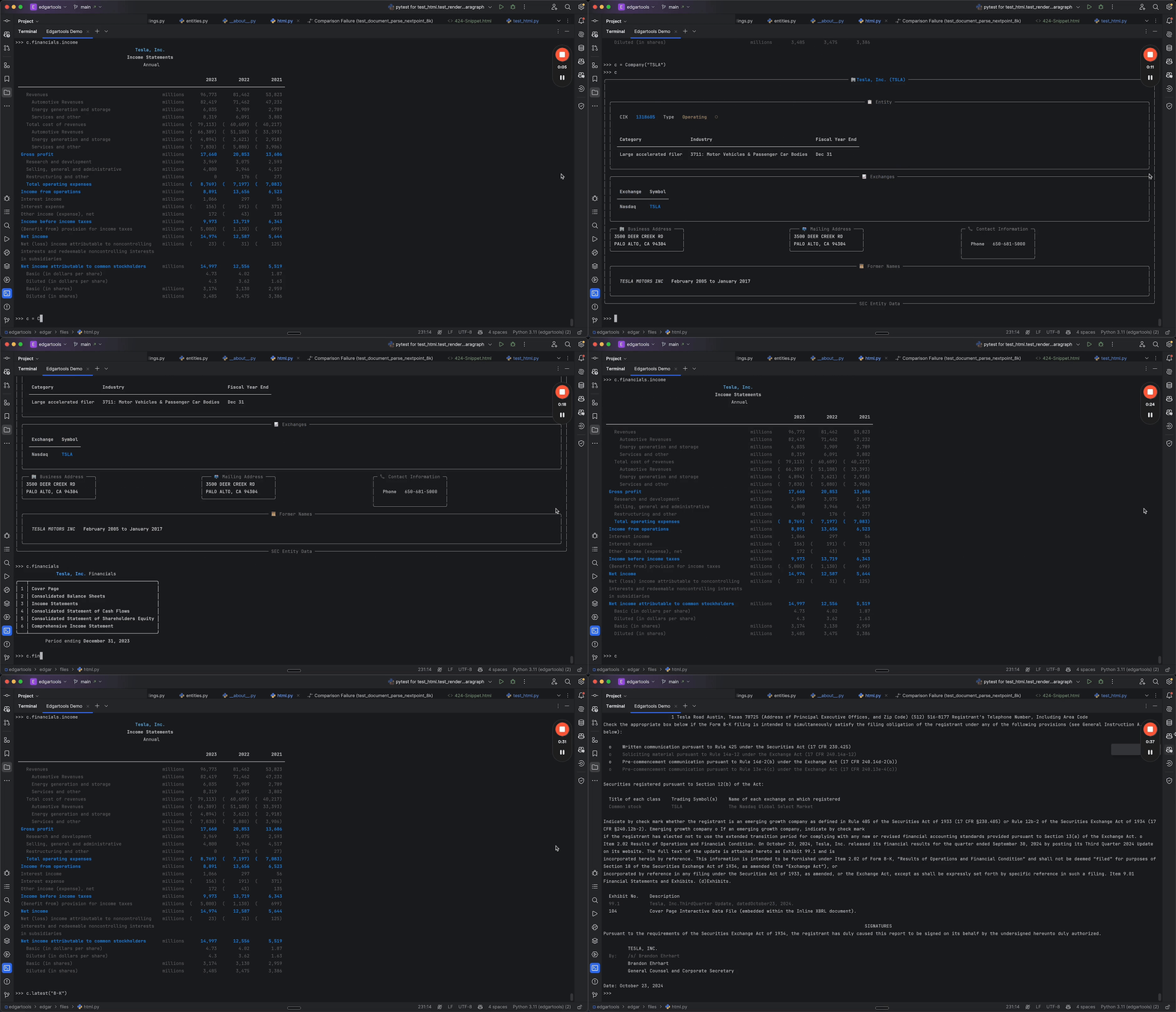
1. Install. The package is edgartools; the module you import is edgar. Python 3.11+.
uv add edgartools # or: pip install edgartools
2. Identify yourself to the SEC. EDGAR requires a contact email on every request. There is no key, signup or rate-limit tier.
from edgar import Company, set_identity

set_identity("your.name@example.com")
3. Get data.
# Five fiscal years of standardized income statement, from XBRL
Company("NVDA").income_statement(periods=5)
#> Total Revenue $215.9B $130.5B $60.9B
data.sec.gov gives you JSON facts and filing indexes. Everything past that is your code. EdgarTools does that part:
It runs in your own process, MIT-licensed, with no API key and no vendor quota; SEC's fair-access limit of 10 requests a second still applies, and EdgarTools keeps to it.
Search the text of every filing since 2001, not just form types and dates.
from edgar import search_filings

# Every 10-K filed since 2025 that mentions tariffs
results = search_filings("tariff", forms="10-K", start_date="2025-01-01")
hit = results[0]
hit.accession_number, hit.form, hit.filed, hit.company  # a hit's fields; filed is the filing date
hit.get_filing()  # the Filing behind a hit, ready for .obj() or .markdown()

# Structured: 8-Ks that reported a cybersecurity incident (Item 1.05) in 2025
search_filings(forms="8-K", items="1.05", start_date="2025-01-01", end_date="2025-12-31")
#> 19 total
Company("MSFT").income_statement(periods=10) # also .balance_sheet() and .cash_flow_statement()
Pick rows by their standardized label, never by position: the first row of an income statement is not always total revenue.
import pandas as pd

revenue = {
    ticker: Company(ticker).income_statement(periods=3, as_dataframe=True)
            .set_index("label").filter(like="FY").loc["Total Revenue"] / 1e9
    for ticker in ["JPM", "PFE", "CAT"]
}
pd.DataFrame(revenue).round(1)  # $ billions
#> FY 2025 182.4 62.6 67.6
nvda = Company("NVDA")
nvda.get_ttm_revenue()                                 # the last four quarters, summed
nvda.income_statement(period="quarterly", periods=8)   # discrete quarters; Q4 is derived from the 10-K
filing = Company("NVDA").latest("10-K")
filing.markdown()          # the whole filing as markdown

tenk = filing.obj()
tenk.risk_factors          # Item 1A as text
tenk["Item 1C"]            # any Item by number
from edgar import find, get_current_filings, get_filings

get_filings(2025, 4, form="10-K")   # every 10-K filed in Q4 2025
get_current_filings()               # the live feed, as SEC posts it
find("0000320193-25-000079")        # an accession number, CIK or ticker


thirteenf = Company("BRK.A").get_filings(form="13F-HR").latest().obj()
thirteenf.holdings  # one row per security: Issuer, Cusip, Ticker, SharesPrnAmount, Value, ...
Institutional Holdings guide →

form4 = Company("TSLA").get_filings(form="4").latest().obj()
form4.to_dataframe()  # buys, sells, grants and exercises

from edgar import Fund

Fund("VOO").get_portfolio()  # the latest N-PORT holdings as a DataFrame
eightk = find("0001045810-26-000073").obj()  # NVIDIA, 2026-08-26
eightk.items      # ['Item 2.02', 'Item 9.01']
eightk.earnings   # the EX-99.1 press release tables, parsed
EdgarTools is this library: free, MIT-licensed, running in your own Python process. edgar.tools is the hosted platform built on it: the same parsing, kept running and current, with every answer cited to its filing. You are not paying for the parsing; you are paying for it to be run and answerable. No feature is ever removed from the library to sell the platform.
| If you want to… | Use |
|---|---|
| Build something that runs: pipelines, backfills, backtests, model corpora, notebooks, custom joins, anything repeated across hundreds of names or run inside your own network | The library |
| Ask, not build: what the companies you cover filed and what changed since last time, who sold, who holds it, one person across every company they touch, screens across a universe, alerts, cited answers to forward or share with a team. From a browser, a phone, Excel, Claude or ChatGPT, or an agent that cannot run Python | edgar.tools. Free account to start |
| Own a maintained dataset (insider trades, 13F, BDC portfolios, material events), every row traceable to its filing, without running the pipeline | edgar.tools data licensing |
| Fetch one known filing or one JSON document, once, from a script | Neither: call EDGAR directly |
Both have an MCP server: the library's runs locally (see AI Integration below), and edgar.tools' is hosted at app.edgar.tools/mcp. Attach one per client, not both: they overlap and split your assistant's routing.
EdgarTools ships an agent skill and a local MCP server, both in the ai extra. For an assistant that cannot run Python, use the hosted connector from the section above instead.
pip install "edgartools[ai]"
python -c "from edgar.ai import install_skill; install_skill()"  # the skill, for Claude Code and Claude Desktop
The MCP server works with any MCP client. For Claude Desktop, add it to claude_desktop_config.json:
{
  "mcpServers": {
    "edgartools": {
      "command": "uvx",
      "args": ["--from", "edgartools[ai]", "edgartools-mcp"],
      "env": {
        "EDGAR_IDENTITY": "Your Name your.email@example.com"
      }
    }
  }
}
uvx needs uv; without it, pip install "edgartools[ai]" and run python -m edgar.ai. Setup for other clients: MCP server guide · Skill guide.
The SEC changes filing formats and ships a new XBRL taxonomy every year. Sponsorship is what keeps the parsers current and pays for new ones as new disclosures appear.


EdgarTools is distributed under the MIT License.
Claim this server with your GitHub account to request manual ownership verification.
Link to the catalog listing for EdgarTools — SEC EDGAR filing library with a local MCP server from your README. This badge does not certify ownership, compatibility or security.
[](https://awesome-mcp.com/servers/edgartools)Public repository statistics could not be verified. Check the configured source address; unavailable counts are not zero.
Separate sources, scopes and periods. Never combined or treated as installations, active users or security reviews.
No reviewed package or image identity; download statistics are not listed yet.
Alternative and complementary servers in the same category
A stateless streamable HTTP MCP server for interacting with the official source of government spending data.

A hosted, remote MCP server for Fortnox that lets AI assistants answer questions from a company's bookkeeping and propose changes for approval before writing them.

OptimistFi is a read-only remote MCP server that provides perpetual futures market data, perps prop firm rules and pricing, and US equity investment research.