genealogy-mcp — find your family history with any AI assistant
Русская версия




An MCP server that turns Claude, ChatGPT, Cursor or any MCP-capable assistant into a
careful genealogist. It knows where the records of your ancestors are (171 archives and databases across Russia and
the former USSR, Europe, the British Isles, the USA and Latin America), how to search them (name variants,
transliterations, old spelling, the Julian calendar), and when a find really is your person — so the assistant gives
you working links and a plan instead of confident guesses.
Built from years of real research for an open family archive powered by
gene_archive: parish registers, revision lists, WWI and WWII databases,
repression files, emigration records — and every trap we fell into along the way. The story behind it:
an article on Habr (in Russian).
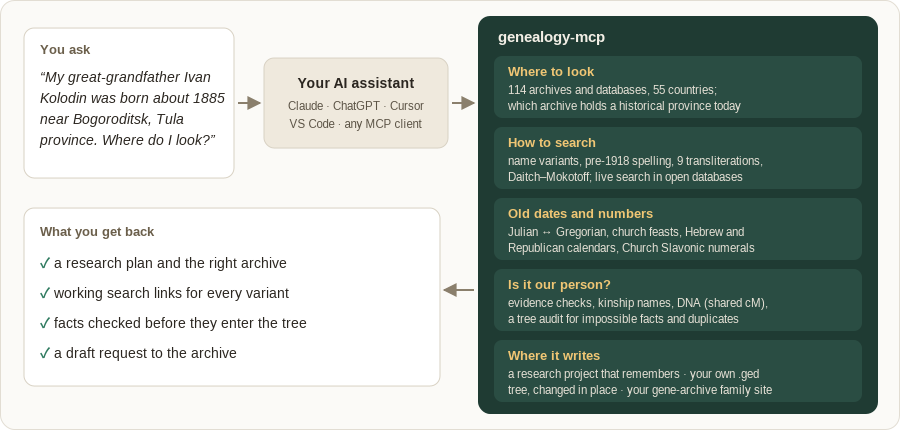
At a glance
- 171 archives and databases in 55 countries, each with what it holds and how to search it well — and which
archive holds the records of a historical province today (borders moved; the answer is often not the obvious one).
- 31 tools for the real work of a genealogist: name variants and 9 transliteration systems, Daitch–Mokotoff,
Julian, Hebrew and French Republican calendars, dates by church feasts, Church Slavonic numerals, kinship in three
languages, DNA, evidence checks, a tree audit, live search in open databases, archive request drafts.
- It works on your tree, not beside it. Point it at the
.ged file from MyHeritage, Ancestry, Gramps or RootsMagic
and it reads, searches and changes it in place — only the changed lines, everything else byte for byte, a copy kept,
every change shown first. Or at a gene-archive family website: changes go
through the site's checks, logs and git history.
- It remembers. Sources with full citations, open leads and every search — "nothing found" included — so nobody
searches the same place twice.
- Honest by design. A namesake is not a relative: a find is linked only with two independent facts beyond the name.
- Private. Runs on your computer; goes online only for a search you ask for, and only to that one site.
- Any assistant: Claude Desktop (one-click install), Claude Code, ChatGPT, Cursor, VS Code, Windsurf, Cline.
- Guides in English, Russian and Ukrainian, the main ones also in Spanish, Portuguese, Polish and German.
Quick start
Claude Desktop: download genealogy-mcp-<version>.mcpb from the
latest release and open it.
Claude Code: claude mcp add genealogy -- uvx genealogy-mcp.
Anything else: uvx genealogy-mcp as the server command (details in Install).
Then just ask: "Help me find my great-grandfather. Here is what I know…"
What you can ask
My great-grandfather Ivan Kolodin was born about 1885 near Bogoroditsk, Tula province. Where do I look?
The assistant makes a plan for Russia 1880–1945, reads the record guides, builds the name forms (Колодин / Колодина /
Колодинъ / Kolodin / Kołodin…), gives you search links for FamilySearch, the Internet Archive full text and the
Russian war databases, tells you which archive holds the parish registers and drafts the request.
Is this baptism record the same Ivan? It says «Іоаннъ, father Петръ, 1887, Сынково».
check_match compares fact by fact with name variants and age tolerance: two independent facts beyond the name →
confirmed; one → probable; a contradiction → find a third document.
What is my grandmother's cousin's daughter to me? И как это по-русски?
kinship → «троюродная сестра… / first cousin once removed» — in Russian, English and Romanian, with the expected DNA share.
Check my tree. (a GEDCOM from Ancestry, MyHeritage, Gramps, Geni…)
audit_tree finds the impossible (born after the mother's death, a mother aged 10, death before birth), possible
duplicates and gaps — a to-do list for the next search.
The register says he was born «на Покров» 1885, the year is written ҂аѡ҃пе.
cyrillic_numerals reads the year (1885), feast_date gives 1 October (Julian) = 13 October 1885.
We share 230 cM with a match on MyHeritage. Who could she be?
dna_match: second cousin, first cousin twice removed, half first cousin… — and why only documents can decide.
Where are the parish registers of Volhynia governorate now?
where_are_records: the state archives of Zhytomyr (the consistory), Rivne and Volyn — borders moved, so it is not
always the archive of today's region.
Remember what we found, and continue next week.
A research project on your computer: people, sources with full citations, open leads and a log of every search —
including "nothing found" — so nobody searches the same place twice. GEDCOM in and out.
Write what we found into our family site.
If your family archive is a gene-archive site, give the project tools the
path of its folder: the assistant reads the archive itself — who is missing, which dates have no document — and every
change it makes goes through the site's own checks, lands in its corrections and research logs, is committed to git
under your name and rebuilds the site. It shows the change first and writes only after your yes.
Here is my tree — add what we found.
Or give it the GEDCOM file of the tree you keep in MyHeritage, Ancestry, Gramps, RootsMagic, Family Historian or
webtrees: the assistant reads it, searches it and changes it in place. Only the lines of what changed are rewritten —
your program's own tags, photos, notes and the header stay byte for byte; it shows those lines before writing, keeps a
copy of the file, and keeps the search log, leads and corrections in a file next to it. Then import the file back into
your program (Family Historian and webtrees work on GEDCOM directly). Files not in UTF-8 are read-only.
Why use it
Most genealogy MCP servers connect the assistant to one service or one file. genealogy-mcp gives it the research
method around them — where to look, how to search, how to read and weigh what it finds — and works on your own tree
file too. It runs happily next to a server for a service you use, such as a FamilySearch client.
Everything runs on your computer. The server goes online only when the assistant runs a live search
(search_online, search_book_pages, place_history), and then sends that query to that one site.
Coverage
- Worldwide: FamilySearch (records and the catalogue of unindexed images), Internet Archive full text, MyHeritage,
Geni, WikiTree, Find a Grave, BillionGraves, Arolsen Archives, Yad Vashem, JewishGen, Matricula, Geneanet, Wikipedia.
- Russia and the USSR: Yandex Archive, archive guides, VGD forum, Pamyat Naroda, OBD Memorial, gwar.mil.ru,
Road of Memory, Immortal Regiment, Open List, Immortal Barrack, Returned Names, PSTGU martyrs, NashiPredki,
metricabook.ru, Rodovod, Presidential and National Electronic Libraries, historical libraries, old maps, church
history, RIA-1914, regional archives, ZAGS, TsAMO, RGVIA, RGIA, GARF.
- Ukraine, Belarus, Moldova, Romania, Poland, the Baltics: national archive portals and catalogues, TsDIAK,
genealogica.ro, Genealogy of Bessarabia, deportari.org, Cartea Memoriei, the Moldavian censuses of 1772–1774,
Geneteka, Szukajwarchiwach, epaveldas, Raduraksti, the Estonian archives.
- Europe: ICRC WWI prisoners, CWGC, Volksbund, ScotlandsPeople, FreeBMD, Irish civil and census records, Archion,
GenWiki, FranceArchives, Mémoire des hommes, Antenati, PARES, Digitarq, Open Archives (NL), Belgian State Archives,
Riksarkivet, Digitalarkivet, Danish Family Search, HisKi, Finnish Digital Archive, Hungaricana, Acta Publica (Czechia),
Bulgarian state archives, FreeCEN, FreeREG, The National Archives, GRO, Welsh Newspapers.
- Germany and German-speaking lands: WWI casualty lists, GEDBAS, Online-OFB, German Digital Library, Bundesarchiv,
Baltic Biographical Lexicon, Black Sea Germans (Odessa3), Poznań Project, Metryki.
- Jewish genealogy: JRI-Poland, Gesher Galicia, LitvakSIG, JewishGen, Yad Vashem, Steve Morse One-Step tools.
- Caucasus and Central Asia: National Archives of Georgia, the central state archives of Kazakhstan, Uzbekistan,
Kyrgyzstan, Tajikistan and Turkmenistan.
- The Americas: FamilySearch Latin America, AGN Mexico, Arquivo Nacional and Museu da Imigração (Brazil),
Hemeroteca Digital, CEMLA and AGN (Argentina), Archivo Nacional (Chile), NARA, Ellis Island, Chronicling America,
USGenWeb, Library and Archives Canada, BAnQ (Quebec), Pier 21.
- Australia and New Zealand: Trove, National Archives of Australia, Papers Past, New Zealand BDM.
Record guides in English, Russian and Ukrainian, the main ones also in Spanish, Portuguese, Polish and German.
Install
Claude Desktop, one click: download genealogy-mcp-<version>.mcpb from the
latest release and open it — Claude Desktop installs
it and asks where to keep your research projects.
For the other ways you need uv (it fetches Python and the
package by itself).
Claude Desktop, by hand — Settings → Developer → Edit Config, add:
{
  "mcpServers": {
    "genealogy": {
      "command": "uvx",
      "args": ["genealogy-mcp"]
    }
  }
}
Claude Code:
claude mcp add genealogy -- uvx genealogy-mcp
Cursor (~/.cursor/mcp.json), Windsurf, Cline — the same mcpServers block as for Claude Desktop.
VS Code (.vscode/mcp.json): {"servers": {"genealogy": {"command": "uvx", "args": [ …same… ]}}}.
Docker: docker build -t genealogy-mcp . then docker run -i --rm genealogy-mcp (stdio) or
docker run --rm -p 8000:8000 genealogy-mcp --http --host 0.0.0.0 (HTTP at /mcp).
Your gene-archive site as the project: install the server together with gene-archive —
pip install "genealogy-mcp[site]" or uvx --from "genealogy-mcp[site]" genealogy-mcp (the gene command is found
on PATH or next to the server's Python; elsewhere set GENE_CMD), then name the folder in GENEALOGY_MCP_SITES (or in the Claude Desktop extension settings), or just give its path
to the assistant. GENE_AUTHOR sets the name in the git history (default: git config user.name).
Your tree in a GEDCOM file as the project: give the assistant the path of the .ged file (or name it in
GENEALOGY_MCP_SITES). Copies are kept as tree.ged.bak (before the last change) and tree.before-genealogy-mcp.ged
(before the first); the log lives in tree.ged.research.json.
Clients that connect over HTTP (ChatGPT connectors, remote agents): run
genealogy-mcp --http --host 0.0.0.0 --port 8000 behind HTTPS and add https://your-host/mcp.
In HTTP mode audit_tree takes the GEDCOM text only, never a file path.
The package is on PyPI and in the official MCP Registry (io.github.igormel81/genealogy-mcp): uvx genealogy-mcp installs and runs it.
Research workflow
Start from project_view: policy, local sources, active questions and owner tasks. Work
from family documents and the civil registry through existing records to primary sources,
then secondary leads. project_policy configures limits and archive-request preferences
per project. Leads have a next step; source checks distinguish no hits from an inaccessible
site. Custom archive folders without site.json are readable without converting or
changing them. See workflow, policy and source checks.
The 171 catalogue entries are recommendations, not 171 live connectors. Six services
support search_online; Wikidata supplies place history. Other sources need a browser
or documents supplied by the user. Gallica page search and event evidence are described in
books and event citations.
Resources: genealogy://sources (the catalogue), genealogy://guide/research/{en|ru} (a full research guide),
genealogy://guide/prompts/{en|ru} (ready requests for each step), genealogy://records/{topic}, genealogy://glossary.
Prompts: start research, check a find, transcribe a record, write to an archive.
Privacy and honesty
- The server sends nothing anywhere by itself. A live search (
search_online, search_book_pages, place_history) sends the query — names,
years, place — to the one site searched. Research projects are files on your computer
(~/Documents/genealogy-mcp or GENEALOGY_MCP_HOME); on a shared HTTP server they are switched off.
- The assistant you use is a separate service with its own privacy policy — think before pasting details about living
people.
- Letters are drafts: you check and send them.
- The rules the assistant gets: cite the original, keep conflicting versions, mark guesses as "probably", never link a
namesake without evidence.
Benchmark
evals/tasks.json holds 35 questions with checkable answers: dates by church feasts, Julian, Hebrew and Republican
calendars, Cyrillic numerals, Daitch–Mokotoff, Moldovan surnames, DNA, kinship, old terms, archives of historical
provinces and borders by year, evidence checks, ages that cannot be one person,
record history. evals/check_tools.py runs in CI and checks that the tools answer all of them correctly.
evals/run.py asks a Claude model the same questions without the server and with it and scores both
(needs an API key; it costs money, so it is run by hand: Actions → Benchmark).
Contributing
See CONTRIBUTING.md for source fields and contribution guidelines.
A source is missing or a link moved? Edit tools/make_sources.py, run python3 tools/make_sources.py and
python3 -m unittest discover tests, open a pull request. Record guides live in src/genealogy_mcp/guides.py.
See also
- gene_archive — an open-source engine for a family archive website:
tree, stories, documents, map, GEDCOM, an online editor and relatives' comments.
MIT License.



