


Store and retrieve entities, relations and observations in a persistent local knowledge graph.
create_entitiescreate_relationsadd_observations+6 more
92K
AI & Multi-Agent
An MCP server that provides persistent project context for xAI Grok, scoring, validating and syncing IANA-registered .faf context files via a hosted URL or local stdio.
grok-faf-mcp is cataloged as an MCP server attributed to wolfe-jam. An MCP server that provides persistent project context for xAI Grok, scoring, validating and syncing IANA-registered .faf context files via a hosted URL or local stdio. It is categorized under ai agents-models. See the capability inspector for recorded interfaces and their independent review status; consult upstream documentation for the current interface.
Installation configuration is not reviewed. No executable setup is offered for this entry; inspect the source repository before proceeding.
Catalog license label: MIT. Check the source repository's current license and terms before using, modifying or distributing this software.
Capability definitions are not reviewed. Unreviewed imports are not exposed as trusted interfaces.
No reviewed records to display. This does not establish that upstream lacks this capability.
No reviewed records to display. This does not establish that upstream lacks this capability.
No reviewed records to display. This does not establish that upstream lacks this capability.
Email delivery is not connected. This page does not collect email addresses or create subscriptions.
Browse the registry for current listings instead.
Reviews for grok-faf-mcp are not available yet
Review publishing and storage are not connected. This page does not collect or publish ratings or comments, including after sign-in.
A machine-readable project file holding project DNA such as name, goal, language, stack and human context, which AI agents can read to understand the project.
No. Several filesystem-dependent tools run only on the local stdio path, while the hosted endpoint offers a smaller WASM-pure tool set that takes file contents as input.
README.md · c78d1b32bc33 · Fetched 2026-11-13 09:57:31 UTC
Original upstream text, without AI rewriting. Scripts, forms and unsafe links are filtered for safety.
Showing the last retrieved documentation snapshot; check the source for current changes.

Persistent Project Context for xAI Grok.
URL-based • Zero config • Just works


Home: faf.one/grok Live demo: grok.faf.one
⭐ Star faf-cli on GitHub, the CLI this server is built on: bookmarks it for you, helps other devs find it too.








FAF defines. AGENTS.md instructs. AI codes.
faf_sync keeps your hand-written files, writes the context files it names, and tells you what it couldn't write. Managed blocks now go through faf-cli's injector, so a hand-written AGENTS.md or CLAUDE.md is never reclaimed; faf_sync writes the context files it names, one file at a time, and the reply says what it couldn't write and why.
faf_write can no longer overwrite the birth certificate or your context files. .faf-dna is refused in every spelling and route, existing project.faf, CLAUDE.md and AGENTS.md need overwrite: true, and writes stay inside the project folder.
Cleanup: removes leftover two-way sync wording. Two-way sync was dropped by design long ago: project.faf pushes structured data out, and prose doesn't come back. The last strings that still said two-way now match. faf_bi_sync still works as the old name for faf_sync.
One rule for project questions: read project.faf first. New line 2 of the server instructions: "For questions about the project (stack, goal, commands), read project.faf first and answer from it." The same rule in faf-mcp moved Grok Build from 0 of 3 to 2 of 3 runs reading project.faf first, on a repo where project.faf and package.json disagree (3-run pilot). 715 characters.
grok-faf-mcp now tells Grok how its tools fit together, context and memory: server instructions in initialize (615 characters), plus faf-cli 8.5.0, which knows a skills repo when it sees one.
rag_query needs an xAI Collection.faf_init detects a skills repo: SKILL.md folders make it skills (10 slots), and a Claude Code plugin manifest makes it skills-plugin (14).Earlier: v2.1.0 — The New Era Edition — glass-box tools: every tool says if it reads, writes or rewrites; its own FAF passport at grok.faf.one; a new look.
Earlier: v2.0.0 — The Always33 Edition — one engine, one number: every score is faf-cli 8's always-33 kernel, on npm and on mcpaas.live. ZEPH is opt-in until the Zig engine is always-33.
☆ Bookmark grok.faf.one for later.
First v0.2-conformant reader of the FAF Context Ingestion Contract — the open standard co-authored in public with @grok.
Add to ~/.grok/config.toml:
[mcp_servers.grok-faf-mcp]
url = "https://mcpaas.live/grok/mcp/v1"
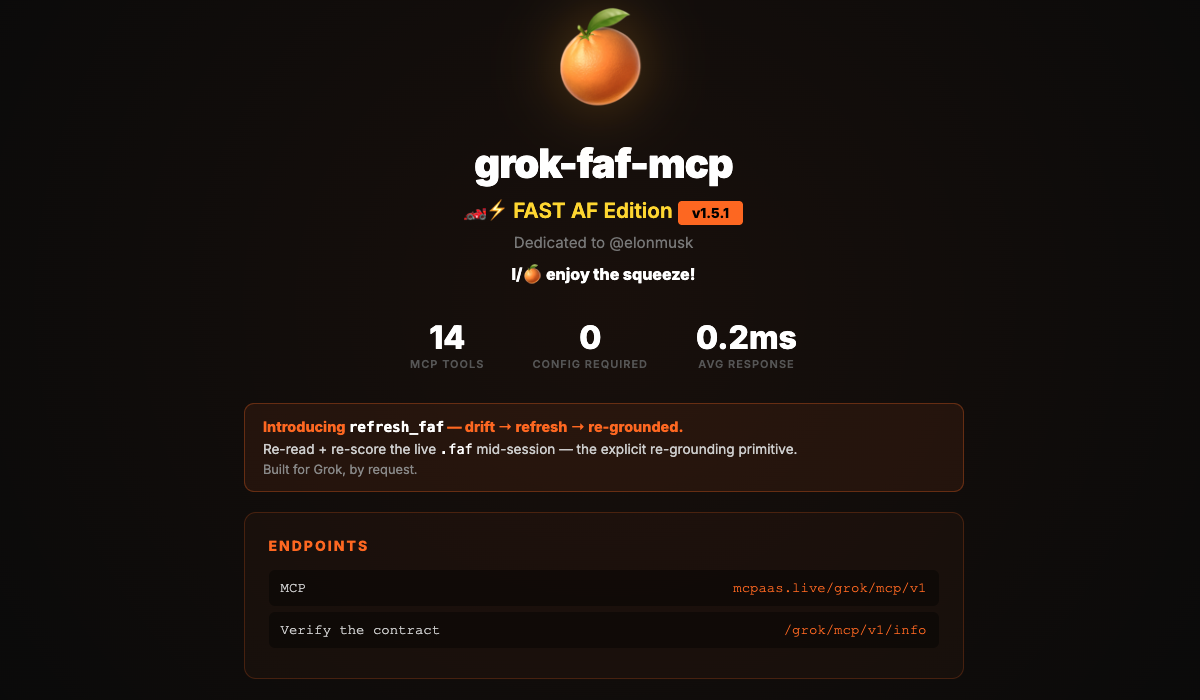
Restart Grok TUI (or /mcps r) to refresh. The hosted endpoint scores always-33 — the same number as the npm package. Tools: faf_score, faf_validate, faf_get_tier, faf_estimate_tokens, faf_analyze (plus soul/memory ops).
Smithery: wolfe-jam/grok-faf-mcp — gateway at https://grok-faf-mcp--wolfe-jam.run.tools
Homebrew (local stdio):
brew install wolfe-jam/faf/grok-faf-mcp
Hosted on Cloudflare Workers — sub-ms cold start, no subprocess, edge-served. Scores and validates with the faf-kernel WASM (always-33, the same engine as the npm package) since mcpaas-cf 1.8.1; a Zig WASM engine handles token estimates and tier. Externally validated by Grok S1 + S2 on 2026-05-27.
Verify the live contract:
curl https://mcpaas.live/grok/mcp/v1/info
Returns endpoint, protocol versions, engine details, tool list, and the architecture line: .faf=vROM | AI-in-session=RAM.
Sample corpus: xai-faf-proof/pilot — 10 records ready to score.
Every README should answer these questions. Here's ours:
| Question | Answer |
|---|---|
| WHO is this for? | Grok/xAI developers and teams building with URL-based MCP |
| WHAT is it? | Persistent project context for xAI Grok — URL-first deployment, IANA-registered .faf format |
| WHERE does it work? | Cloudflare Workers (mcpaas.live/grok/mcp/v1) • Any MCP client supporting native url= config • Self-deploy to your own CF/Vercel worker |
| WHY do you need it? | Zero-config MCP on a URL — Grok asked for it, we built it first |
| WHEN should you use it? | Grok integration, xAI projects, any url-based MCP client |
| HOW does it work? | url = "https://mcpaas.live/grok/mcp/v1" — context tools served from edge via MCPaaS (sub-ms cold start, no subprocess) |
For AI: Read the detailed sections below for full context. For humans: Use this pattern in YOUR README. Answer these 6 questions clearly.
Built for Grok and shaped by direct Grok feedback.
Open for native Grok Build integration, .fafm memory layer, refresh_faf primitives, or any other context features the team needs.
Live and dogfooded at https://grok.faf.one and https://mcpaas.live/grok/mcp/v1.
Context for Grok agents: faf-cli authors what Grok agents read from real project detection — bunx faf export --agents. faf-cli's src/interop/grok.ts wires this MCP into .grok/config.toml (that file lives in the faf-cli repo, not here). See FAF-CLI for Grok & xAI agents.
Every Grok session starts from zero. You re-explain your stack, your goals, your architecture. Every time.
.faf fixes that. One file, your project DNA, persistent across every session.
Without .faf  →  "I'm building a REST API in Rust with Axum and PostgreSQL..."
With .faf     →  Grok already knows. Every session. Forever.
faf_auto detects your project, creates a .faf, and scores it — in one shot:
faf_auto
━━━━━━━━━━━━━━━━━
Score: 0% → 85% (+85) ◇ BRONZE
Steps:
  1. Created project.faf
  2. Detected stack from package.json
  3. Synced CLAUDE.md

Path: /home/user/my-project
What it produces:
# project.faf — your project, machine-readable
faf_version: "3.3"
project:
  name: my-api
  goal: REST API for user management
  main_language: TypeScript
stack:
  backend: Express
  database: PostgreSQL
  testing: Jest
  runtime: Node.js
human_context:
  who: Backend developers
  what: User CRUD with auth
  why: Replace legacy PHP service
Every AI agent reads this once and knows exactly what you're building.
URL:     https://mcpaas.live/grok/mcp/v1
Format:  IANA-registered .faf (application/vnd.faf+yaml)
Tools:   12 core by default (bunx) — re-grounding (refresh_faf/fafm/blend), LAZY-RAG, orchestration substrate, FAF essentials · extended utilities via FAF_TOOLS=all · 19 hosted (WASM-pure, served by mcpaas-cf) on the URL
Engine:  faf-cli 8 — faf-scoring-kernel 3.0.0 (Rust → WASM, always-33)
Speed:   0.5ms average (was 19ms — 3,800% faster with Mk4)
Tests: WJTTC parity (heavy local ↔ light hosted) + full suites. Runner: sh scripts/run-tests.sh (bun + flake retry)
Status:  FAST⚡️AF
MCP on a URL. Point your Grok integration at the URL. That's it.
| Tier | Score | What it means |
|---|---|---|
| 🏆 TROPHY | 100% | Gold Code — AI is optimized |
| ★ GOLD | 99%+ | Near-perfect context |
| ◆ SILVER | 95%+ | Excellent |
| ◇ BRONZE | 85%+ | Strong baseline |
| ● GREEN | 70%+ | Solid foundation |
| ● YELLOW | 55%+ | AI flipping coins |
| ○ RED | <55% | AI working blind |
| ♡ WHITE | 0% | Start — good luck |
At 55%, Grok guesses half the time. At 100%, Grok knows your project.
Point your MCP client at the production URL — edge-served on Cloudflare Workers, no subprocess, sub-ms cold start. WASM-pure tools only on this path (scoring, validation, refresh_faf).
{
  "mcpServers": {
    "grok-faf": {
      "url": "https://mcpaas.live/grok/mcp/v1"
    }
  }
}
Use the local stdio path when you need filesystem access (faf_init, faf_sync, file-mutating tools):
brew install wolfe-jam/faf/grok-faf-mcp   # macOS tap
# or
bunx grok-faf-mcp
Or via MCP config:
{
  "mcpServers": {
    "grok-faf": {
      "command": "bunx",
      "args": ["grok-faf-mcp"]
    }
  }
}
Create & Detect
| Tool | Purpose |
|---|---|
faf_init | Create project.faf from your project |
faf_auto | Auto-detect stack and populate context |
faf_score | AI-readiness score (0-100%) with breakdown |
faf_status | Check current AI-readability |
refresh_faf | Re-ground on the live .faf — re-read + re-score, report drift, return fresh DNA (drift → refresh → re-grounded). Requested by Grok. |
Drift & Orchestration (1.5 — the prestige release)
| Tool | Purpose |
|---|---|
refresh_fafm | Re-ground on the live .fafm memory layer for one or more souls. Returns a stamped delta (added/updated facts) by default; verbatim: true for full content. Read-only · always stamped. Sister to refresh_faf for the RAM/memory layer in the vROM/RAM model. Built for Grok, by request. |
refresh_blend | The baked-in two-intensity refresh (Cmd+R / Cmd+Shift+R analog). mode: "blend" (default) fires refresh_faf (light) + refresh_fafm (delta); mode: "nuke" fires both at hard intensity. Blend is BAKED IN, NOT a dial — both layers always fire; mode only affects fafm intensity. |
faf_orchestrate_recommendation | The heavy orchestrator. Reads current substrate state, composes the full 1.5 library substrate (drift detection · CheckID · repeat-offender · take-a-hint · refresh history), returns a structured Recommendation with recommend, severity, summary, reason, and a rich hints object including effective_policy (the tier in force). Advisory only — never auto-fires (subordinate-not-daemon). Writes a recommendation receipt on every call (no silent decisions). Spec source: Grok-1 FAF-DRIFT-DETECTION-SPEC §9.5 + Appendix C. |
faf_get_orchestration_policy | Pure introspection of the effective policy WITHOUT running the orchestrator. Returns { tier, thresholds, source, overrides_applied } — what aggressiveness tier the next orchestration call would use, and whether it came from defaults or a .faf:orchestration: override. No drift detection · no signals · no receipt write — the quietest tool in the 1.5 substrate. Useful for debugging unexpected orchestrator behavior, pre-flight checks before bulk operations, and override-took-effect verification. |
Sync & Persist
| Tool | Purpose |
|---|---|
faf_sync | Write the context files from project.faf: the ones that exist (CLAUDE.md, .cursorrules, .windsurfrules, .clinerules), or CLAUDE.md when there are none; target: all writes every one. One way: it never writes project.faf. A file faf can't safely write is left unchanged and named in the reply. (faf_bi_sync, the old name, still works.) |
faf_trust | Validate .faf integrity |
Read & Write
| Tool | Purpose |
|---|---|
faf_read | Read any file |
faf_write | Write a file inside the project. Never writes .faf-dna; replacing an existing *.faf, CLAUDE.md or AGENTS.md needs overwrite: true |
faf_list | Discover projects with .faf files |
RAG & Grok-Exclusive
| Tool | Purpose |
|---|---|
rag_query | RAG-powered context retrieval |
rag_cache_stats | RAG cache statistics |
rag_cache_clear | Clear RAG cache |
grok_go_fast_af | Auto-load .faf context for Grok |
Plus 34 advanced tools available with FAF_SHOW_ADVANCED=true.
Execution:    0.5ms average (97% faster than v1.1)
Fastest:      3,360ns (version — nanosecond territory)
Slowest:      1.3ms (score — Mk4 WASM)
Improvement:  19ms → 0.5ms (3,800% faster)
Engine:       faf-cli 8 (faf-scoring-kernel 3.0.0, always-33)
Memory:       Zero leaks
Transport:    stdio (local, bunx) · Streamable HTTP (hosted, Cloudflare Workers)
Benchmarked 10x per tool, warmed up, on local stdio execution. Hosted edge adds sub-ms cold start on top.
Orchestrator (faf_orchestrate_recommendation) characteristics: composition call — reads up to 6 files (.faf, .fafm, package.json, CHANGELOG.md, README.md, plus all 3 receipt logs), runs 2 analyzers (detectFafmDrift + checkId), evaluates the decision table, writes 1 receipt. Expected latency: tens of ms on warm cache; higher under cold-disk or very large .fafm corpora. Designed for occasional agent-initiated calls, not per-turn polling. detectFafmDrift is O(n²) in fact count (cross-fact n-gram recurrence) — comfortable up to ~hundreds of facts.
grok-faf-mcp
├── src/
│   ├── server.ts             → MCP server (GrokFafMcpServer)
│   ├── handlers/
│   │   ├── championship-tools.ts  → 55+ tool definitions
│   │   ├── tool-registry.ts       → Visibility filtering (core/advanced)
│   │   └── engine-adapter.ts      → FAF engine bridge
│   ├── faf-core/commands/score.ts → faf-cli scoreFafYaml (always-33)
│   ├── types/                     → Canonical type substrate (1.5)
│   │   ├── drift-signals.ts       → DriftSignal · Contradiction · RepeatOffender
│   │   ├── refresh.ts             → RefreshMode
│   │   ├── escalation.ts          → EscalationLevel
│   │   ├── recommendation.ts      → RecommendationAction
│   │   └── receipts.ts            → ReceiptMetadata
│   ├── detection/fafm-drift.ts    → detectFafmDrift() — repetition-rate gauge
│   ├── integrity/check-id.ts      → checkId() — cross-stamp contradiction check
│   ├── orchestrator/
│   │   ├── repeat-offender.ts     → RepeatOffenderTracker
│   │   ├── take-a-hint.ts         → evaluateTakeAHint() — escalation ladder
│   │   ├── refresh-blend.ts       → runRefreshBlend()
│   │   └── recommendation.ts      → analyzeAndRecommend() + orchestrate()
│   └── telemetry/
│       ├── refresh-receipts.ts        → RefreshReceiptsLog
│       └── recommendation-receipts.ts → RecommendationReceiptsLog
├── smithery.yaml             → Smithery listing config
├── api/index.ts              → Vercel catch-site (legacy showcase surface; kept alive)
└── vercel.json               → Vercel routing for the catch-site
Production deployment: Cloudflare Workers via mcpaas-cf (serving mcpaas.live/grok/mcp/v1). The api/index.ts + vercel.json paths above stay alive as a catch-site for legacy/bookmarked links — they are no longer the production path.
Scoring pipeline: faf-cli's scoreFafYaml → the always-33 kernel (faf-scoring-kernel, Rust → WASM) scores the file as written: 33 slots, slotignored slots drop out of the denominator. No per-type rewriting, no fallback scorer — the same number faf-cli, claude-faf-mcp and faf-mcp give.
WJTTC parity (heavy local ↔ light hosted) + full suites (green on CI):
sh scripts/run-tests.sh
| Suite | Coverage |
|---|---|
desktop-native-validation | Core native functions, security, performance |
mcp-conformance | MCP protocol conformance — tools, transport, errors |
wjttc-mcp | WJTTC MCP certification |
wjttc-bun | WJTTC bun-migration + integrity |
rag-system | RAG query, caching, context retrieval |
security | Input validation + security guards |
visibility | Tool visibility (core/advanced filtering) |
v2.2.0 — The Instructions Edition — server instructions in initialize (615 characters) and faf-cli 8.5.0, which detects skills repos. Scoring is unchanged from v2.0.0.
v2.1.0 — The New Era Edition — glass-box tools (every tool labelled read, write or rewrite), its own FAF passport at grok.faf.one, a new look. Scoring is unchanged from v2.0.0.
v2.0.0 — The Always33 Edition — one engine, one number: faf-cli 8's always-33 kernel on npm and on mcpaas.live. ZEPH is opt-in until the Zig engine is always-33. FafCompiler upgraded to the Always33 fafb model — parity across frontier models, Enterprise/Teams ready.
Everything below still applies; operating it honestly means surfacing what's NOT in here alongside what is.
Earlier: v1.10.0 — The No-Fluff Edition — no fluff in a project.faf.
faf_enhanceis gone. RAG default isgrok-4.6. Fill stays onfaf_auto/faf_go.
Earlier: v1.9.0 — The ZEPH Default Edition — the proven-fast Zig→WASM scoring path behind
refresh_fafis now default-ON (same score, cheaper to compute; parity proven byte-identical — CI gate + 91/91 live). Kill switchUSE_ZEPH=0forces the canonical scorer. FRC tools stay opt-in behindUSE_FRC.
Earlier: v1.8.0 — The Closed-Loop Edition — observability writes, token math is honest, FRC contract locked. The drift→refresh→re-ground loop can finally be measured. Earlier: v1.7.0 — The Grounded Memory Edition — ZEPH + the FRC layer over Grok Collections (
faf_gate/faf_section/faf_memory), opt-in viaUSE_FRC/USE_ZEPH; 12-tool core unchanged. Earlier: v1.6.0 — The ZEPH Edition — the ZEPH fast path for re-grounding (refresh_faf/refresh_blendvia Zig→WASMcascade.wasm, ~12µs,USE_ZEPH=1;faf-clistays canonical, parity locked in CI).
What is fully supported:
https://mcpaas.live/grok/mcp/v1 and client-specific routes) — scoring · validation · refresh_faf · a content-in faf_orchestrate_recommendation · the FRC trio · souls and search. The live list is at …/grok/mcp/v1/info.refresh_faf and refresh_fafm as explicit, callable re-grounding primitives.refresh_blend as the baked-in two-intensity refresh (Cmd+R / Cmd+Shift+R analog).faf_orchestrate_recommendation — the heavy orchestrator that composes drift signals, recurrence, receipts, and take-a-hint into an advisory recommendation.faf_get_orchestration_policy — pure introspection of the effective policy without running the orchestrator (no drift detection, no receipt write — the quietest tool in the substrate).effective_policy) returned on every orchestration call AND surfaced standalone via faf_get_orchestration_policy.Current limitations:
faf_get_orchestration_policy, refresh_fafm, refresh_blend, faf_init and faf_sync need filesystem access and run only on the local stdio path (bunx grok-faf-mcp / npx grok-faf-mcp). The hosted faf_orchestrate_recommendation takes file contents instead of reading your repo, and has no receipts or recurrence history (it reports those under partial[])..faf-drift-index.json ← RepeatOffenderTracker — per-slot recurrence counts
.faf-refresh-receipts.json ← RefreshReceiptsLog — every refresh fire
.faf-recommendation-receipts.json ← RecommendationReceiptsLog — every orchestrator call
.faf:orchestration:tier reads 'conservative' (default — quietest, no noisy first-impression) · 'balanced' · 'aggressive'. active_tier always surfaced in hints.effective_policy for observability, and standalone via faf_get_orchestration_policy. The policy WRITER (faf_set_orchestration_policy) and scheduling (faf_schedule_heavy_re_ground) are not included in v1.5 — edit .faf:orchestration:tier: directly to override.acknowledged: false by default, never auto-flipped. Take-a-hint's ladder-reset semantics fire only on explicit ack — conservative by intent. Future task: explicit ack tool OR derived-from-subsequent-refresh-receipt timing.The honest split is intentional: hosted = fast, auditable, WASM-pure; local = full capability including filesystem. We will expand the hosted surface only where it can be done safely and without compromising the model.
Subordinate-not-daemon throughout. The orchestrator NEVER auto-fires the recommended tool. Agents surface the recommendation; the user (or higher agent) decides whether to act. Even severity: 'block' is advisory.
See the public verifier and curl https://mcpaas.live/grok/mcp/v1/info for the current contract.
One format, every AI platform.
| Package | Platform | Registry |
|---|---|---|
| grok-faf-mcp (this) | xAI Grok | npm + Homebrew |
| claude-faf-mcp | Anthropic | npm + MCP #2759 |
| gemini-faf-mcp | PyPI | |
| rust-faf-mcp | Rust | crates.io |
| faf-mcp | Cursor, IDE's, VS Code | npm |
| faf-cli | Terminal CLI | bunx, npm + Homebrew |
Same project.faf. Same scoring. Same result. Different execution layer.
grok-faf-voice (VML).fafm 🐘🎙️ — the voice variant of the .faf 🐘 family.
grok-faf-voice is the reference implementation of the Voice Memory Layer (VML) — what your voice agent remembers across sessions, devices, and model switches. Companion to grok-faf-mcp:
grok-faf-mcp (this) — .faf Foundational Context Layer for Grok via MCP-on-a-URL.grok-faf-voice — .fafm Voice Memory Layer (VML) for Grok Voice via LiveKit + xAI realtime.Same family. Different surface. Voice swappable; memory permanent.
PyPI · GitHub · Onboarding
This MCP server was built for Grok and continues to be shaped by direct feedback from Grok itself.
Open for deeper collaboration on:
I ship fast, test rigorously, and dogfood everything live on https://grok.faf.one and https://mcpaas.live/grok/mcp/v1.
Happy to:
Real software only. Just say the word.
PR conventions, code style, CI doctrine, MCP-tool contribution path, npm publish discipline, architecture decisions: CONTRIBUTING.md.
xAI / Grok devs welcome — TL;DR setup at the top.
Open for deeper native integration, .fafm memory layer, or Grok Build CLI collaboration.
Happy to ship PRs, dogfood, or jump on a call. Just say the word.
If you use grok-faf-mcp or the .faf / .fafa formats in research or production, please cite the format papers:
Wolfe, J. (2025). Format-Driven AI Context Architecture: The .faf Standard for Persistent Project Understanding. Zenodo. https://doi.org/10.5281/zenodo.18251362
Wolfe, J. (2026). Why Agents Need a Passport: .fafa — Portable Identity for the Agentic Era. Zenodo. https://doi.org/10.5281/zenodo.21951641
@article{wolfe2025faf,
  title     = {Format-Driven AI Context Architecture: The .faf Standard for Persistent Project Understanding},
  author    = {Wolfe, James},
  year      = {2025},
  month     = {nov},
  publisher = {Zenodo},
  doi       = {10.5281/zenodo.18251362},
  url       = {https://doi.org/10.5281/zenodo.18251362}
}

@article{wolfe2026fafa,
  title     = {Why Agents Need a Passport: .fafa — Portable Identity for the Agentic Era},
  author    = {Wolfe, James},
  year      = {2026},
  month     = {aug},
  publisher = {Zenodo},
  doi       = {10.5281/zenodo.21951641},
  url       = {https://doi.org/10.5281/zenodo.21951641}
}
MIT — Free and open source
Built for Grok. Built for Speed. Built Right.
FAST⚡️AF • First to Ship • Zero Friction
Zero drift. Eternal sync. AI optimized. 🏆
faf-cli — The original AI-Context CLI. A must-have for every builder.
npx faf-cli auto
Anthropic MCP #2759 · IANA Registered: application/vnd.faf+yaml · faf.one · npm · Talk to my Agent →
Claim this server with your GitHub account to request manual ownership verification.
Link to the catalog listing for grok-faf-mcp from your README. This badge does not certify ownership, compatibility or security.
[](https://awesome-mcp.com/servers/grok-faf-mcp)Public repository statistics could not be verified. Check the configured source address; unavailable counts are not zero.
Separate sources, scopes and periods. Never combined or treated as installations, active users or security reviews.
No reviewed package or image identity; download statistics are not listed yet.
Alternative and complementary servers in the same category
Store and retrieve entities, relations and observations in a persistent local knowledge graph.
Organize problem solving into revisable, branching thought steps through an MCP tool.

Query-aware context compression with an MCP plugin for coding agents, plus Python and HTTP interfaces for reducing the context sent to a language model.