







Store and retrieve entities, relations and observations in a persistent local knowledge graph.
create_entitiescreate_relationsadd_observations+6 more
92K
AI & Multi-Agent
An agent memory system whose server exposes retain, recall and reflect operations to MCP clients through a per-bank Model Context Protocol endpoint.
Hindsight agent memory server with a built-in MCP endpoint is cataloged as an MCP server attributed to vectorize-io. An agent memory system whose server exposes retain, recall and reflect operations to MCP clients through a per-bank Model Context Protocol endpoint. It is categorized under ai agents-models. See the capability inspector for recorded interfaces and their independent review status; consult upstream documentation for the current interface.
Installation configuration is not reviewed. No executable setup is offered for this entry; inspect the source repository before proceeding.
Catalog license label: MIT. Check the source repository's current license and terms before using, modifying or distributing this software.
Capability definitions are not reviewed. Unreviewed imports are not exposed as trusted interfaces.
No reviewed records to display. This does not establish that upstream lacks this capability.
No reviewed records to display. This does not establish that upstream lacks this capability.
No reviewed records to display. This does not establish that upstream lacks this capability.
Email delivery is not connected. This page does not collect email addresses or create subscriptions.
Browse the registry for current listings instead.
Reviews for Hindsight agent memory server with a built-in MCP endpoint are not available yet
Review publishing and storage are not connected. This page does not collect or publish ratings or comments, including after sign-in.
Memories live in banks, each an isolated memory store for one user, agent or project, with strict isolation so no cross-bank leakage occurs.
Observations are consolidated, deduplicated beliefs built in the background from related retained facts, each keeping its supporting evidence and proof count and being refined as new evidence arrives.
README.md · 4692afd54184 · Fetched 2026-11-13 09:43:17 UTC
Original upstream text, without AI rewriting. Scripts, forms and unsafe links are filtered for safety.
Showing the last retrieved documentation snapshot; check the source for current changes.
Hindsight™ is an agent memory system built to create smarter agents that learn over time. Most agent memory systems focus on recalling conversation history. Hindsight is focused on making agents that learn, not just remember.
It eliminates the shortcomings of alternative techniques such as RAG and knowledge graph and delivers state-of-the-art performance on long term memory tasks.
🆕 Introducing Hindsight Models: decision, rerank and embedding models built for agent memory. Open weights on Hugging Face, or hosted on Hindsight Inference. Read the post →
Contents
Hindsight is the most accurate agent memory system ever tested according to benchmark performance. It has achieved state-of-the-art performance on the LongMemEval benchmark, widely used to assess memory system performance across a variety of conversational AI scenarios. The current reported performance of Hindsight and other agent memory solutions as of January 2026 is shown here:
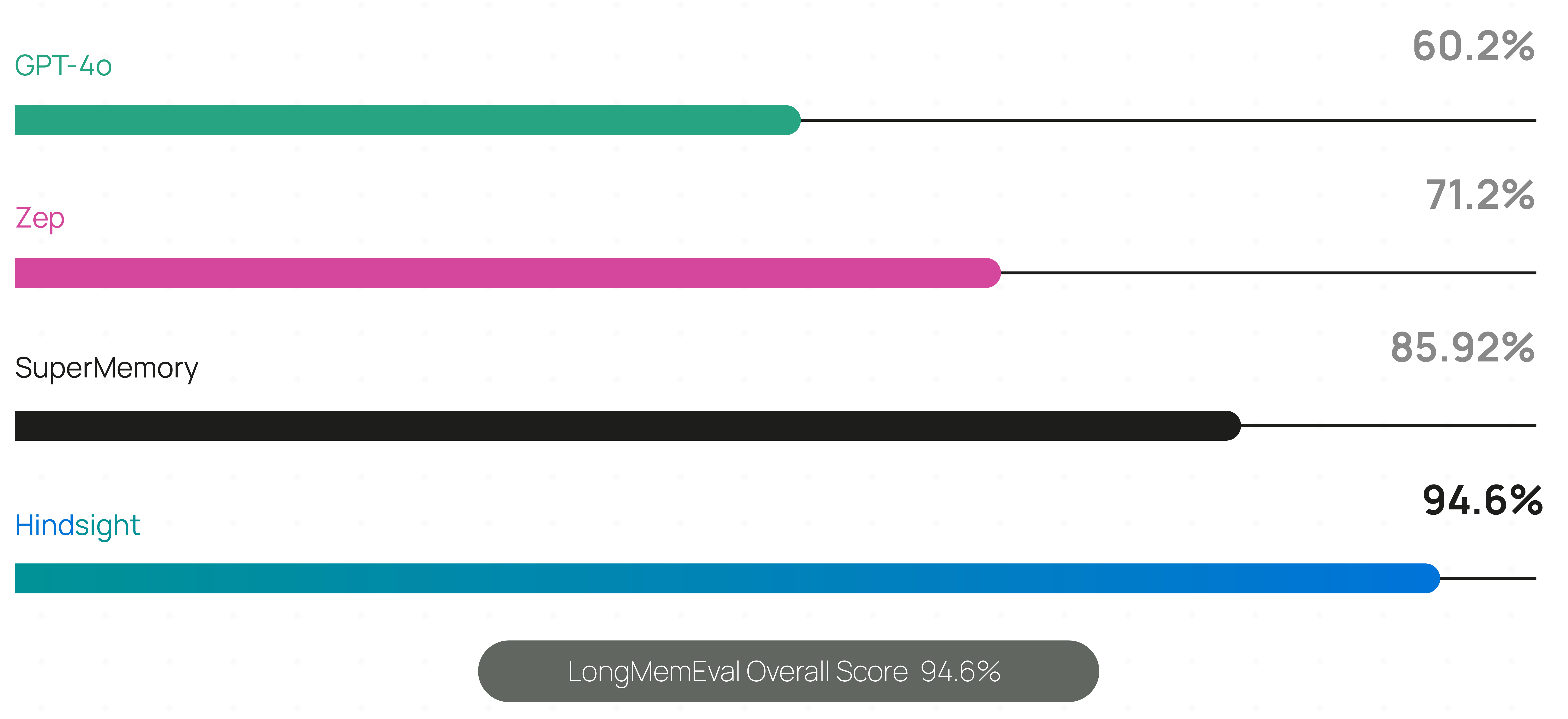
Live, continuously updated results — including per-model accuracy, latency and cost — are published at benchmarks.hindsight.vectorize.io.
The benchmark performance data for Hindsight has been independently reproduced by research collaborators at the Virginia Tech Sanghani Center for Artificial Intelligence and Data Analytics and The Washington Post. Other scores are self-reported by software vendors.
Hindsight is being used in production at Fortune 500 enterprises and by a growing number of AI startups.
🤖 Using a coding agent? Install the Hindsight documentation skill for instant access to docs while you code:
npx skills add https://github.com/vectorize-io/hindsight --skill hindsight-docsWorks with Claude Code, Cursor, and other AI coding assistants.
export OPENAI_API_KEY=sk-xxx

docker run -it --pull always --name hindsight --restart unless-stopped -p 8888:8888 -p 9999:9999 \
  -e HINDSIGHT_API_LLM_API_KEY=$OPENAI_API_KEY \
  -v hindsight-data:/home/hindsight/.pg0 \
  ghcr.io/vectorize-io/hindsight:latest
Hindsight works with 25+ LLM providers via HINDSIGHT_API_LLM_PROVIDER — hosted (openai, anthropic, gemini, groq, bedrock, vertexai, minimax, deepseek, atlas, meta, …), fully local (ollama, lmstudio, llamacpp), any OpenAI-compatible endpoint, and gateways (litellm, litellmrouter) that reach the rest. Existing subscriptions work too: openai-codex (ChatGPT Plus/Pro), claude-code (Claude Pro/Max), cursor (Cursor) and github-copilot (GitHub Copilot) need no API key. See supported models.
export OPENAI_API_KEY=sk-xxx
export HINDSIGHT_DB_PASSWORD=choose-a-password
cd docker/docker-compose
docker compose up
Oracle AI Database is also supported for enterprise deployments with full feature parity. See the storage documentation for details.
pip install hindsight-api
export HINDSIGHT_API_LLM_API_KEY=sk-xxx

hindsight-api
helm install hindsight oci://ghcr.io/vectorize-io/charts/hindsight \
  --set api.llm.provider=openai \
  --set api.llm.apiKey=sk-xxx \
  --set postgresql.enabled=true
Hindsight Cloud is the hosted option: managed infrastructure that scales automatically, plus a dashboard, backups, team collaboration and a 99.9% uptime SLA. Billing is usage-based with free credits to start — no fixed monthly or per-seat fee. Point any client at https://api.hindsight.vectorize.io with your API key and skip the deployment entirely.
Compare self-hosted, Cloud and Enterprise → · Sign up →
All options, including Windows and air-gapped setups, are covered in the installation guide.
pip install hindsight-client -U                                  # Python
npm install @vectorize-io/hindsight-client                        # Node.js / TypeScript
go get github.com/vectorize-io/hindsight/hindsight-clients/go     # Go
curl -fsSL https://hindsight.vectorize.io/get-cli | bash          # CLI
from hindsight_client import Hindsight

client = Hindsight(base_url="http://localhost:8888")

# Retain: Store information
client.retain(bank_id="my-bank", content="Alice works at Google as a software engineer")

# Recall: Search memories
client.recall(bank_id="my-bank", query="What does Alice do?")

# Reflect: Generate disposition-aware response
client.reflect(bank_id="my-bank", query="Tell me about Alice")
const { HindsightClient } = require('@vectorize-io/hindsight-client');

const main = async () => {
  const client = new HindsightClient({ baseUrl: 'http://localhost:8888' });

  await client.retain('my-bank', 'Alice loves hiking in Yosemite');

  const results = await client.recall('my-bank', 'What does Alice like?');
  console.log(results);
}

main();
Full reference: Python · Node.js · Go · CLI · REST API
| Platform | Docker | Bare Metal (pip) | Embedded DB (pg0) |
|---|---|---|---|
| Linux (x86_64, ARM64) | ✅ | ✅ | ✅ |
| macOS (Apple Silicon / arm64) | ✅ | ✅ | ✅ |
| macOS (Intel / x86_64) | ✅ | ⚠️ | ✅ |
| Windows (x86_64) | ✅ | ✅ | ✅ |
⚠️ Intel Macs: use hindsight-all-slim — see the installation guide for details.
pip install hindsight-all -U
On Intel (x86_64) Macs, install hindsight-all-slim instead — see Supported Platforms.
import os
from hindsight import HindsightServer, HindsightClient

with HindsightServer(
    llm_provider="openai",
    llm_model="gpt-5-mini",
    llm_api_key=os.environ["OPENAI_API_KEY"]
) as server:
    client = HindsightClient(base_url=server.url)
    client.retain(bank_id="my-bank", content="Alice works at Google")
    results = client.recall(bank_id="my-bank", query="Where does Alice work?")
A Node.js equivalent and a daemon CLI are also available.
The easiest way to add memory to an existing agent is the LLM Wrapper. Swap your LLM client for a wrapped one — memories are then stored and retrieved automatically on every call, with no other changes to your code.
pip install hindsight-litellm
from openai import OpenAI
from hindsight_litellm import wrap_openai

# Wrap your existing LLM client and you're done.
# Defaults to Hindsight Cloud; pass hindsight_api_url for a self-hosted server.
client = wrap_openai(
    OpenAI(),
    bank_id="user-123",
    hindsight_api_url="http://localhost:8888",
)

# Hindsight recalls relevant memories before the call
# and retains the conversation after it.
response = client.chat.completions.create(
    model="gpt-5-mini",
    messages=[{"role": "user", "content": "What do you know about me?"}],
)
wrap_anthropic() does the same for the Anthropic SDK, and every setting — bank, recall budget, fact types, reflect instead of recall — can be overridden per call with hindsight_* kwargs. LiteLLM sits underneath, so the same integration covers 100+ models. See the LiteLLM integration.
If you need explicit control over when memories are stored and recalled, use the SDKs or REST API directly instead.
60+ integrations — most need no code changes.
| Coding agents | Claude Code · Codex · Cursor · GitHub Copilot · opencode · Cline · Aider · Zed · Continue · Roo Code · OpenHands |
| Agent frameworks | LangGraph / LangChain · LlamaIndex · CrewAI · Pydantic AI · OpenAI Agents SDK · Google ADK · Agno · Strands · AutoGen · Microsoft Agent Framework · Vercel AI SDK · Haystack |
| No-code / low-code | n8n · Zapier · Dify · Flowise |
| Apps & tools | ChatGPT · Perplexity · Obsidian · Pipecat · Vapi |
One package gives CLI coding agents long-term project memory: a per-repo bank built automatically from git history and past sessions, injected into the agent as it starts working, plus curated pages covering architecture, conventions and in-flight work.
npx @vectorize-io/hindsight-coding-agents install all          # every detected agent, wired natively
npx @vectorize-io/hindsight-coding-agents install claude-code  # or just one
Supports Claude Code, Codex CLI, Cursor CLI, GitHub Copilot CLI, opencode, Kilo CLI, Cline CLI, Antigravity CLI, Devin CLI, pi, Prime Agent, Grok Build and DeepSeek Harness. Ingestion is automatic — there is no setup command. See the coding agents integration.
Every server ships a built-in Model Context Protocol endpoint, one per bank, enabled by default:
http://localhost:8888/mcp/{bank_id}/
Point any MCP client at it to expose retain, recall and reflect as tools. See the MCP server docs.
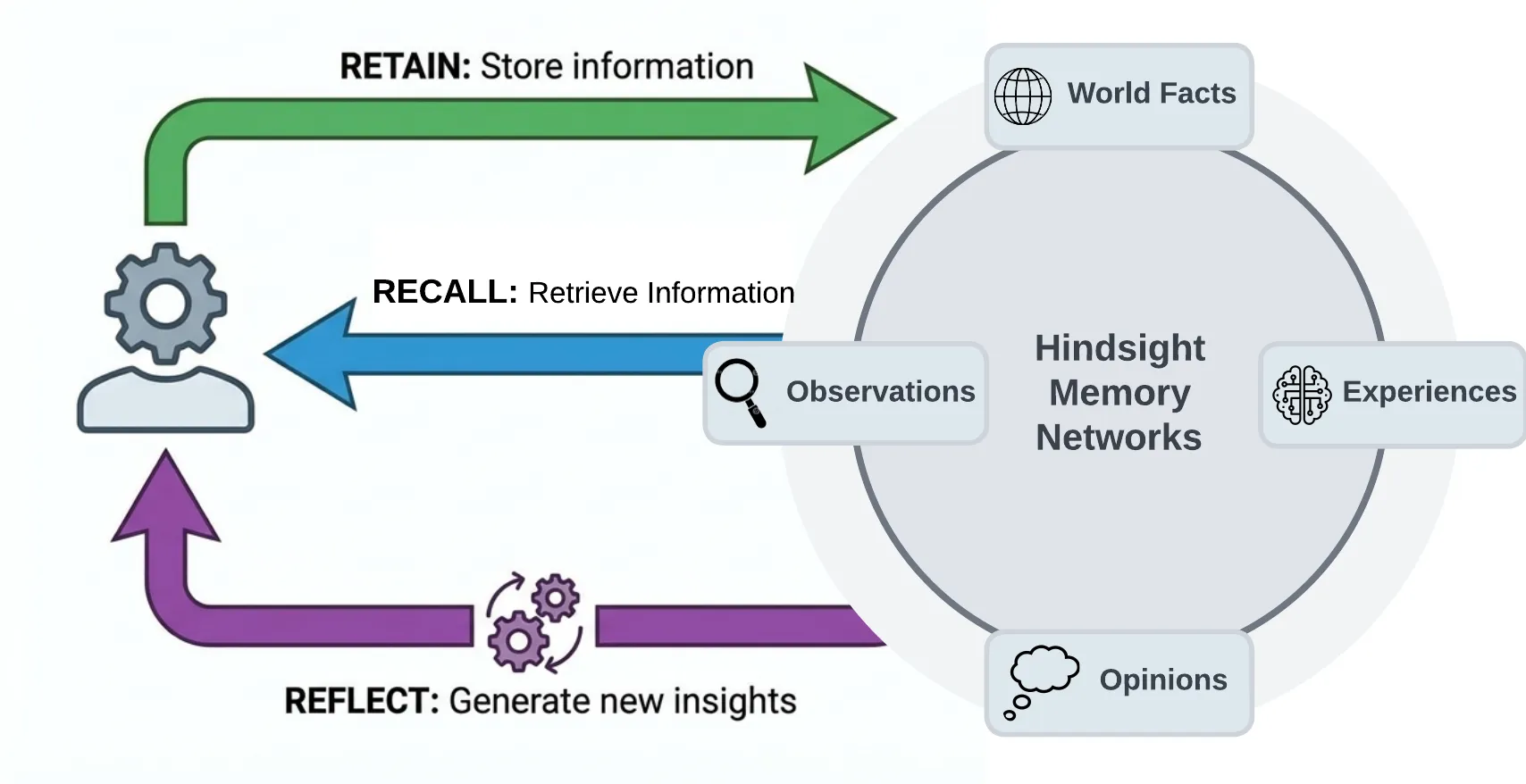
Most agent memory implementations rely on basic vector search or sometimes use a knowledge graph. Hindsight uses biomimetic data structures to organize agent memories in a way that is more like how human memory works:
Memories live in banks. When memories are added, they are pushed into either the world facts or the experiences pathway, then represented as a combination of entities, relationships, and time series with sparse/dense vector representations to aid in later recall.
The retain operation is used to push new memories into Hindsight. It tells Hindsight to retain the information you pass in as an input.
client.retain(
    bank_id="my-bank",
    content="Alice got promoted to senior engineer",
    context="career update",
    timestamp="2025-06-15T10:00:00Z",
)
Behind the scenes, retain uses an LLM to extract key facts, temporal data, entities, and relationships. It passes these through a normalization process to transform extracted data into canonical entities, time series, and search indexes along with metadata. These representations create the pathways for accurate memory retrieval in the recall and reflect operations.
The recall operation is used to retrieve memories. These memories can come from any of the memory types (world, experiences, etc.)
client.recall(bank_id="my-bank", query="What does Alice do?")
client.recall(bank_id="my-bank", query="What happened in June?")   # temporal
Recall performs 4 retrieval strategies in parallel:
The individual results are merged, ordered by relevance using reciprocal rank fusion and a cross-encoder reranking model, then trimmed as needed to fit within the token limit.
The reflect operation performs a more thorough analysis of existing memories. This allows the agent to form new connections between memories and build a more thorough understanding of its world — or to answer a question that needs deep thinking rather than lookup.
client.reflect(bank_id="my-bank", query="What should I know about Alice?")
For example, reflect supports use cases such as:
Retained facts don't stay a flat pile. In the background, Hindsight consolidates related facts into observations — deduplicated beliefs the bank has built up over time. Each observation keeps its supporting evidence with exact quotes and a proof count, and is refined rather than overwritten when new evidence arrives, so new information strengthens, weakens or extends an existing belief instead of silently replacing it.
A mental model is a standing answer to a question about a bank ("What are this user's preferences?"). You define the question once; Hindsight writes the answer, stores it, and rewrites it in the background as the bank learns more. Reading one is a database read — no retrieval, no LLM call — so an agent can boot with a page of settled knowledge instead of rediscovering it every session.
Pages are mental models with the mechanics hidden: living documents a bank writes about itself, organized in folders like a wiki, searchable, and projectable onto disk as ordinary markdown. Supply a name and a question; every other decision is a default you can override.
Most of what a memory system does between storing and recalling is small judgments: is this fact new, which of these memories matter for the question, could this change a page. A decision model answers those directly, with a typed answer instead of text to parse, so Hindsight sends far fewer of them to your LLM. Turn it on and recall, consolidation, reflect and pages use it.
| Model | What it does | Size | License |
|---|---|---|---|
hs-decide-1-flash | Decision model: the judgments inside recall, consolidation, reflect and pages | 0.8B | Apache 2.0 |
hs-rerank-1 | Reranker: orders recalled memories by relevance | 114M | MIT |
hs-embed-1 | Embeddings: 384-dimensional vectors for search | 112M | MIT |
All three read eight languages. Run them yourself, or use them hosted on Hindsight Inference:
hindsight-admin cloud login
export HINDSIGHT_API_DECISION_MODEL_PROVIDER=hindsight
Decision models docs → · Launch post →
A bank is an isolated memory store — one "brain" for one user, agent, or project. Isolation is strict: no cross-bank leakage. Banks carry background context and disposition traits (skepticism, literalism, empathy) that shape how reflect reasons over their memories, and can be created from declarative bank templates.
Two more things worth knowing:
[REDACTED:github_token]) or blocks the item before it reaches storage. Docs →Hindsight is built to support conversational AI agents as well as agents that are intended to perform tasks autonomously. The ideal use case for Hindsight are agents that require a blend of these features such as AI employees that need to handle open-ended tasks, change behavior based on user feedback, and learn to perform complex tasks to automate work at a level that approximates a human work. Hindsight can be used with simple AI workflows like those built with n8n and other similar tools, but may be overkill for such applications.
One of the simpler use cases you can use Hindsight for is to personalize AI chatbots and other conversational agents by storing and recalling memories associated with individual users.
The requirements for this use case usually look something like this:
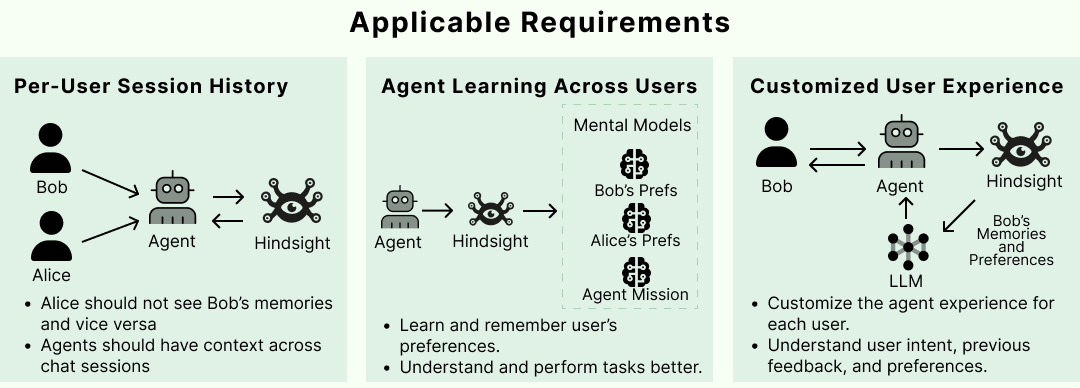
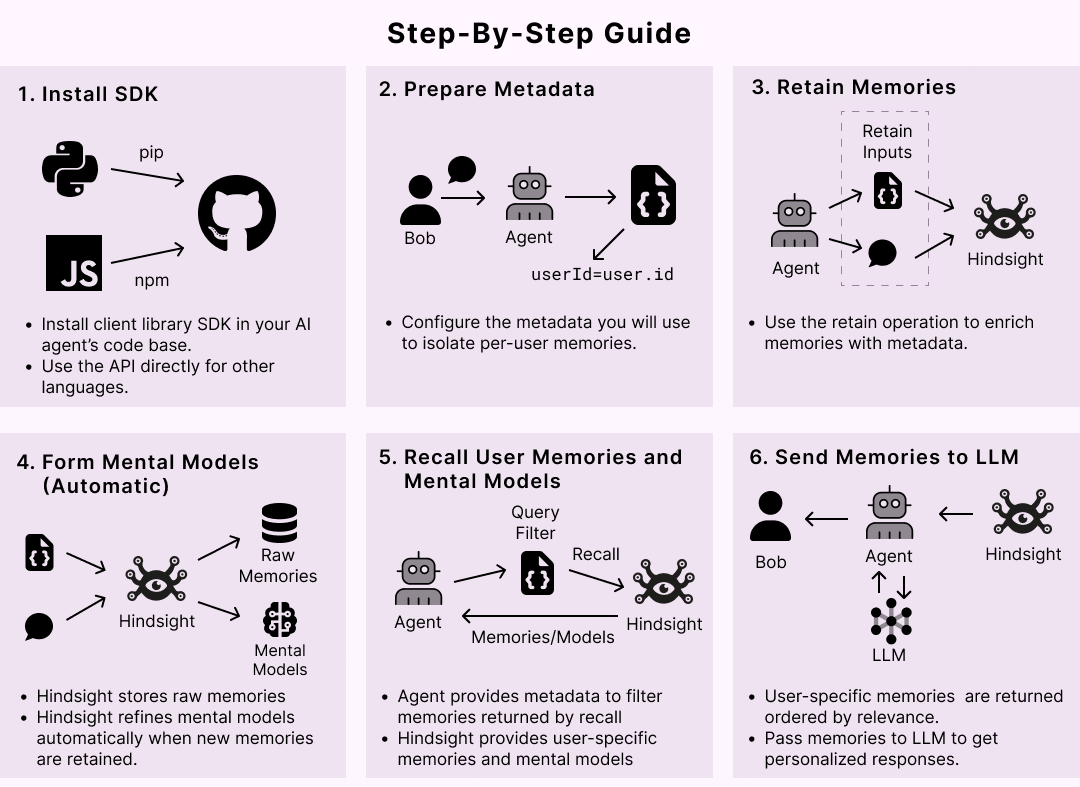
Satisfying these requirements in Hindsight is straightforward. When new user inputs and tool calls are ingested into Hindsight using the retain operation, custom metadata can be used to enrich the new memories. Metadata provides a convenient way to isolate memories that need to be restricted to a given user. Once these are fed into the retain operation, any raw memories and mental models that get created can be filtered when retrieving relevant memories.
More patterns in the Cookbook and Best Practices.
| Storage | PostgreSQL + pgvector, or Oracle AI Database 23ai with full feature parity — storage |
| Configuration | Hierarchical: global env vars → per-tenant → per-bank — configuration |
| Monitoring | Prometheus metrics and dashboards for LLM calls, tokens and latency — monitoring |
| Operations | Admin CLI for migrations, bank repair and stuck operations — admin CLI |
| Events | Webhooks for retain, consolidation and refresh lifecycle events — webhooks |
| Extensibility | Tenant, auth and storage extension points — extensions |
| Managed | Skip all of it with Hindsight Cloud — managed, usage-based, 99.9% uptime SLA |
Documentation:
Clients:
Community:
See CONTRIBUTING.md.
MIT — see LICENSE
Built by Vectorize.io
Claim this server with your GitHub account to request manual ownership verification.
Link to the catalog listing for Hindsight agent memory server with a built-in MCP endpoint from your README. This badge does not certify ownership, compatibility or security.
[](https://awesome-mcp.com/servers/hindsight)Public repository statistics could not be verified. Check the configured source address; unavailable counts are not zero.
Separate sources, scopes and periods. Never combined or treated as installations, active users or security reviews.
No reviewed package or image identity; download statistics are not listed yet.
Alternative and complementary servers in the same category
Store and retrieve entities, relations and observations in a persistent local knowledge graph.
Organize problem solving into revisable, branching thought steps through an MCP tool.

Query-aware context compression with an MCP plugin for coding agents, plus Python and HTTP interfaces for reducing the context sent to a language model.