
A Rust CAD application with an MCP server for creating, inspecting and rendering drawings, either headlessly or through a connection to the desktop app.
8K
Media & Design
A Model Context Protocol server that exposes a tool for generating placeholder image URLs from placehold and lorem-picsum providers.
MCP Image Placeholder Server is cataloged as an MCP server attributed to husniadil. A Model Context Protocol server that exposes a tool for generating placeholder image URLs from placehold and lorem-picsum providers. It is categorized under media design. See the capability inspector for recorded interfaces and their independent review status; consult upstream documentation for the current interface.
Installation configuration is not reviewed. No executable setup is offered for this entry; inspect the source repository before proceeding.
Catalog license label: MIT License. Check the source repository's current license and terms before using, modifying or distributing this software.
Capability definitions are not reviewed. Unreviewed imports are not exposed as trusted interfaces.
No reviewed records to display. This does not establish that upstream lacks this capability.
No reviewed records to display. This does not establish that upstream lacks this capability.
No reviewed records to display. This does not establish that upstream lacks this capability.
Email delivery is not connected. This page does not collect email addresses or create subscriptions.
Browse the registry for current listings instead.
Reviews for MCP Image Placeholder Server are not available yet
Review publishing and storage are not connected. This page does not collect or publish ratings or comments, including after sign-in.
It supports placehold for simple placeholder images and lorem-picsum for real images as placeholders.
It returns a URL string of the generated image.
README.md · f92b72b07a8f · Fetched 2026-11-13 11:08:20 UTC
Original upstream text, without AI rewriting. Scripts, forms and unsafe links are filtered for safety.
Showing the last retrieved documentation snapshot; check the source for current changes.
This is a Model Context Protocol (MCP) server that provides a tool for generating placeholder images from different providers.
placehold: Provides simple placeholder imageslorem-picsum: Provides real images as placeholder imagesuv package managerThe server exposes one tool:
image_placeholderGenerate a placeholder image URL based on specified parameters.
Parameters:
provider: The image provider to use (placehold or lorem-picsum)width: The width of the image (1-10000)height: The height of the image (1-10000)Returns:
Example Usage:
# Generate a 300x200 placeholder image
url = image_placeholder(provider="placehold", width=300, height=200)

# Generate a 500px square lorem-picsum image
url = image_placeholder(provider="lorem-picsum", width=500)
claude_desktop_config.json:
{
    "mcpServers": {
        "image-placeholder": {
            "command": "uv",
            "args": [
                "--directory",
                "/ABSOLUTE/PATH/TO/PROJECT",
                "run",
                "main.py"
            ]
        }
    }
}
Features sectionMCP Servers sectionAdd new MCP server buttonimage-placeholdercommanduv --directory /ABSOLUTE/PATH/TO/PROJECT run main.pyAdd ↵ buttonIf the tool is not detected, use absolute path of the uv command, e.g.
/ABSOLUTE/PATH/TO/uv --directory /ABSOLUTE/PATH/TO/PROJECT run main.py
Prompt:
Create a new directory named "example" and a file named output.html.

Then create a single modern looking page using tailwindcss: https://unpkg.com/@tailwindcss/browser@4

Show a nice header, content, and footer, showing a photo gallery.

Save this into output.html
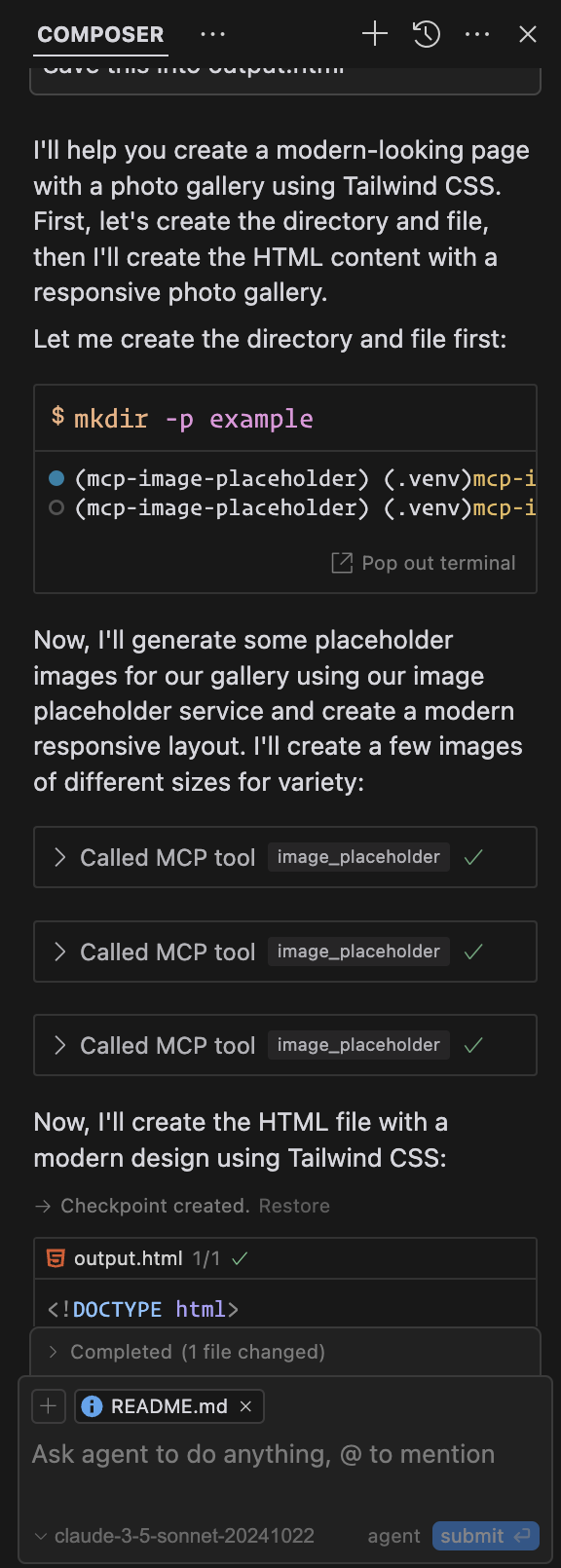
Output: Example Output (Cursor)
Claim this server with your GitHub account to request manual ownership verification.
Link to the catalog listing for MCP Image Placeholder Server from your README. This badge does not certify ownership, compatibility or security.
[](https://awesome-mcp.com/servers/mcp-image-placeholder)Public repository statistics could not be verified. Check the configured source address; unavailable counts are not zero.
Separate sources, scopes and periods. Never combined or treated as installations, active users or security reviews.
No reviewed package or image identity; download statistics are not listed yet.
Alternative and complementary servers in the same category
A Rust CAD application with an MCP server for creating, inspecting and rendering drawings, either headlessly or through a connection to the desktop app.

Liquid Composer is a browser-based Liquid Glass icon design tool that offers a local MCP server for agent-driven icon workflows.

agent-media makes short drama series and other short vertical videos from Claude, ChatGPT or Codex through one MCP connection, with OAuth sign-in and no API keys.