
A Model Context Protocol server built on Huawei Cloud services that enables AI assistants to operate Huawei Cloud resources within conversational workflows, supporting ECS, OBS, GaussDB, and other cloud products.

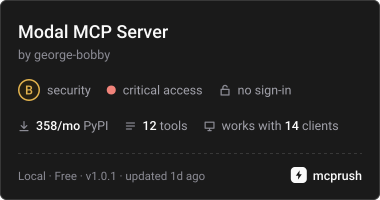
An MCP server that manages Modal from Claude Code or any MCP client, covering apps, containers, logs, volumes, secrets and costs, plus deploying and running your own Modal apps.
Modal MCP Server is cataloged as an MCP server attributed to george-bobby. An MCP server that manages Modal from Claude Code or any MCP client, covering apps, containers, logs, volumes, secrets and costs, plus deploying and running your own Modal apps. It is categorized under cloud devops. See the capability inspector for recorded interfaces and their independent review status; consult upstream documentation for the current interface.
Installation configuration is not reviewed. No executable setup is offered for this entry; inspect the source repository before proceeding.
Catalog license label: Not specified. Check the source repository's current license and terms before using, modifying or distributing this software.
Capability definitions are not reviewed. Unreviewed imports are not exposed as trusted interfaces.
No reviewed records to display. This does not establish that upstream lacks this capability.
Email delivery is not connected. This page does not collect email addresses or create subscriptions.
Browse the registry for current listings instead.
Reviews for Modal MCP Server are not available yet
Review publishing and storage are not connected. This page does not collect or publish ratings or comments, including after sign-in.
No. It runs your local modal CLI and uses the profile and credentials already on your machine, so there are no extra tokens to manage.
Because modal serve endpoints stop when the command returns; the server instead offers deploy_modal_app to get an endpoint that stays up.
The server can do anything your Modal login can, so the README advises auto-approving only the four read-only tools and keeping the rest behind an approval prompt.
README.md · b2a85e1d6c4c · Fetched 2026-11-13 12:53:12 UTC
Original upstream text, without AI rewriting. Scripts, forms and unsafe links are filtered for safety.
Showing the last retrieved documentation snapshot; check the source for current changes.
Manage Modal from Claude Code or any MCP client: apps, containers, logs, volumes, secrets and costs, plus deploying and running your own Modal apps.
It runs your local modal CLI, so it uses the profile and credentials already on your
machine. There are no extra tokens to manage.
Log in to Modal once (this writes ~/.modal.toml):
modal setup
Add the server to Claude Code:
claude mcp add mcp-modal -- uvx mcp-modal@latest
Or share it with your team through a .mcp.json in the project root:
{
"mcpServers": {
"mcp-modal": { "command": "uvx", "args": ["mcp-modal@latest"] }
}
}
uvx caches a tool after its first run, so a plain uvx mcp-modal never updates.
@latest checks PyPI on every launch. Pin an exact version (mcp-modal@1.0.0) when every
machine must run the same build.
uvmodal setupuv and have modal installed in
its virtualenv| Tool | What it does |
|---|---|
list_modal_resources | Read-only lookup of apps, app_history, containers, volumes, volume_files, secrets, environments or profile |
get_modal_logs | Fetch or follow logs for an app or a container |
search_modal_logs | Grep logs and return each match with surrounding lines |
analyze_modal_costs | Rank spend by app, environment or resource, explain a cost spike, or show the bill and rates |
deploy_modal_app | modal deploy, returning the live endpoint URLs |
run_modal_app | modal run a function or entrypoint and collect its output |
manage_modal_app | Stop an app, or roll it back to an earlier version |
manage_modal_container | Run a command in a container, or stop it |
manage_modal_volume | Create, delete or rename a volume |
modal_volume_files | Upload, download, copy or remove files in a volume |
manage_modal_secret | Create or delete a secret (values are redacted from all output) |
inspect_modal_secret | List the key names inside a secret, never its values (starts a short container) |
Each tool's full arguments are in its MCP schema, so your client shows them. Common ones:
env targets a Modal environment.
Leave it out to use the profile's default.profile runs a single call against another profile in ~/.modal.toml, for example
list_modal_resources(resource="apps", profile="work"). Your default profile is not
changed.Tips:
since and until. since on its own fetches
everything from then until now. search_modal_logs(prefilter=True) filters on Modal's
side when the logs are too large to fetch.modal serve tool, because its endpoints stop when the command returns. Use
deploy_modal_app to get an endpoint that stays up.Four ready-made workflows. In Claude Code they appear as /mcp__mcp-modal__<name>:
debug_modal_app: work out why an app is failing, from logs, containers and deploy
historydeploy_and_verify: deploy an app, then check it is actually healthyreview_modal_account: find idle apps, stray containers and orphaned volumes or secretsinvestigate_modal_costs: trace a cost increase down to the app, resource and hourThe server can do anything your Modal login can. Let your client auto-approve the four
read-only tools (list_modal_resources, get_modal_logs, search_modal_logs,
analyze_modal_costs), and keep the rest behind an approval prompt. In particular:
deploy_modal_app and run_modal_app execute local Python code.modal_volume_files can upload any local file (put) or overwrite one (get with
force).manage_modal_secret with from_dotenv or from_json reads a local file and stores
its contents in a Modal secret.manage_modal_container with exec runs arbitrary commands in a container.Every tool declares MCP read-only and destructive hints so clients can tell these apart.
Names and paths are passed after -- or as --option=value, so a value starting with -
can never act as a CLI flag.
Set these in the env block of your MCP client config:
| Variable | Default | Effect |
|---|---|---|
MCP_MODAL_ALLOWED_LOCAL_PATHS | unset (no limit) | :-separated directories that modal_volume_files and manage_modal_secret may read from or write to |
MCP_MODAL_MAX_OUTPUT_CHARS | 40000 | Character limit per text field in a response. 0 turns the limit off |
When output is cut, the response sets output_capped: true and keeps both the start and
the end of the text.
Every tool returns JSON with success. On failure it also has error, plus the command
that ran and its stdout/stderr when available. On success:
list_modal_resources returns its items under apps, history, containers,
volumes, contents, secrets or environments. Lists longer than 200 items are cut,
and omitted_items says how many were left out. resource="profile" returns
active_profile and profiles instead.message, command, stdout and stderr.logs or output. truncated: true means the command was still
running when the timeout hit.match_count (an exact count over the whole fetched log) and
matches, which are line-numbered context blocks with each matching line marked >.Claim this server with your GitHub account to request manual ownership verification.
Link to the catalog listing for Modal MCP Server from your README. This badge does not certify ownership, compatibility or security.
[](https://awesome-mcp.com/servers/mcp-modal)Public repository statistics could not be verified. Check the configured source address; unavailable counts are not zero.
Separate sources, scopes and periods. Never combined or treated as installations, active users or security reviews.
No reviewed package or image identity; download statistics are not listed yet.
Alternative and complementary servers in the same category

A Model Context Protocol server built on Huawei Cloud services that enables AI assistants to operate Huawei Cloud resources within conversational workflows, supporting ECS, OBS, GaussDB, and other cloud products.

An MCP server that exposes the Coolify v4.3.1 REST API so AI clients can manage applications, databases, services, servers, deployments, and more.

A deprecated Model Context Protocol server for interacting with Kong Konnect APIs, enabling AI assistants to query and analyze Kong Gateway configurations, traffic, and analytics.