
A directory listing describing a cancellation-letter and mailing-address service. The configured public GitHub repository returned 404 during source verification.
Repository stats unavailable
Developer Tools
An MCP server that exposes MD5 and SHA-256 hashing tools so LLMs and MCP clients can compute cryptographic hashes of text.
MCP server for MD5 and SHA-256 hashing is cataloged as an MCP server attributed to kanad13. An MCP server that exposes MD5 and SHA-256 hashing tools so LLMs and MCP clients can compute cryptographic hashes of text. It is categorized under developer tools. See the capability inspector for recorded interfaces and their independent review status; consult upstream documentation for the current interface.
Installation configuration is not reviewed. No executable setup is offered for this entry; inspect the source repository before proceeding.
Catalog license label: MIT License. Check the source repository's current license and terms before using, modifying or distributing this software.
Capability definitions are not reviewed. Unreviewed imports are not exposed as trusted interfaces.
No reviewed records to display. This does not establish that upstream lacks this capability.
No reviewed records to display. This does not establish that upstream lacks this capability.
No reviewed records to display. This does not establish that upstream lacks this capability.
Email delivery is not connected. This page does not collect email addresses or create subscriptions.
Browse the registry for current listings instead.
Reviews for MCP server for MD5 and SHA-256 hashing are not available yet
Review publishing and storage are not connected. This page does not collect or publish ratings or comments, including after sign-in.
The server supports MD5 and SHA-256 hashing, each available as a separate tool.
README.md · 3829d3df8343 · Fetched 2026-11-13 12:51:44 UTC
Original upstream text, without AI rewriting. Scripts, forms and unsafe links are filtered for safety.
Showing the last retrieved documentation snapshot; check the source for current changes.
A Model Context Protocol (MCP) server for MD5 and SHA-256 hashing. This server enables LLMs to process cryptographic requests efficiently.
The server offers 2 tools:
calculate_md5: Computes the MD5 hash of a given text.calculate_sha256: Computes the SHA-256 hash of a given text.The server is designed to be used with MCP clients like VS Code Copilot Chat, Claude for Desktop, and other LLM interfaces that support the Model Context Protocol.
If you are new to the concept of Model Context Protocol (MCP), then you can use these resources:
hashing-mcp-server package?
hashing-mcp-server?
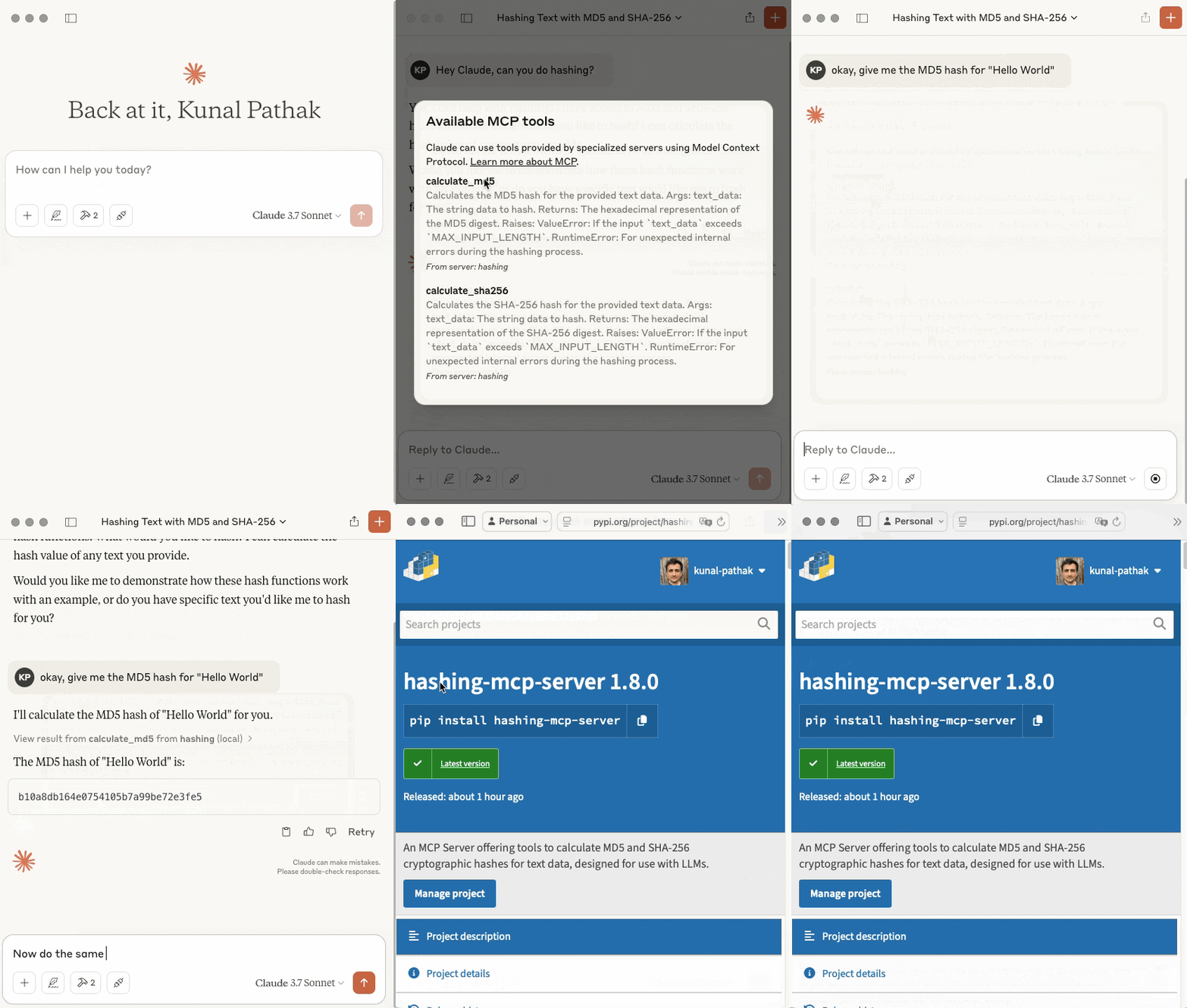
The gif below shows how the MCP server processes requests and returns the corresponding cryptographic hashes.
I have used Claude Desktop as an example, but it works equally well with other MCP clients like VSCode.
venv, uv).uv (recommended) or pip, Docker (optional, for testing build).This is the simplest way to run the server without managing Python environments directly.
1. Get the Docker Image:
Pull from Docker Hub (Easiest):
docker pull kunalpathak13/hashing-mcp-server:latest
2. Configure Your MCP Client:
Configure your client to use docker run.
VS Code (settings.json):
// In your VS Code settings.json (User or Workspace)
"mcp": {
    "servers": {
        "hashing-docker": { // Use a distinct name if needed
            "command": "docker",
            "args": [
                "run",
                "-i",      // Keep STDIN open for communication
                "--rm",    // Clean up container after exit
                "kunalpathak13/hashing-mcp-server:latest" // Change the tag to your version if needed e.g. "hashing-mcp-server:X.Y.Z"
            ]
        }
    }
}
Claude Desktop (claude_desktop_config.json):
{
	"mcpServers": {
		"hashing-docker": {
			"command": "docker",
			"args": [
				"run",
				"-i",
				"--rm",
				"kunalpathak13/hashing-mcp-server:latest" // Change the tag to your version if needed e.g. "hashing-mcp-server:X.Y.Z"
			]
		}
	}
}
Other Clients: Adapt according to their docs, using docker as the command and run -i --rm IMAGE_NAME as arguments. Refer to their official documentation for precise configuration steps:
3. Test the Integration:
Once configured, interact with your MCP client (VS Code Chat, Claude Desktop, etc.). Ask questions designed to trigger the hashing tools:
The client should start the Docker container in the background using the command you provided, send the request, receive the hash result, and display it.
Use this method if you prefer not to use Docker or for development purposes.
1. Set Up Environment & Install:
# Create a dedicated directory and navigate into it
mkdir my_mcp_setup && cd my_mcp_setup

# --- Create & Activate Virtual Environment (Choose ONE method) ---
# Method A: Using uv (Recommended):
uv venv
source .venv/bin/activate # Linux/macOS
# .venv\Scripts\activate # Windows

# Method B: Using standard venv:
# python -m venv .venv
# source .venv/bin/activate # Linux/macOS
# .venv\Scripts\activate # Windows
# ---

# --- Install the package (within the active venv, choose ONE method) ---
# Method A: Using uv:
uv pip install hashing-mcp-server

# Method B: Using pip:
# pip install hashing-mcp-server
# ---
2. Find the Executable Path:
With the virtual environment active, find the full, absolute path to the installed script:
# On Linux/macOS:
which hashing-mcp-server
# Example Output: /home/user/my_mcp_setup/.venv/bin/hashing-mcp-server

# On Windows (Command Prompt/PowerShell):
where hashing-mcp-server
# Example Output: C:\Users\User\my_mcp_setup\.venv\Scripts\hashing-mcp-server.exe
Copy the full path displayed in the output.
3. Configure Your MCP Client:
Use the absolute path you copied in the client configuration.
VS Code (settings.json):
// In your VS Code settings.json (User or Workspace)
"mcp": {
    "servers": {
        // You can name this key anything, e.g., "hasher" or "cryptoTools"
        "hashing": {
            // Paste the full, absolute path you copied here:
            "command": "/full/path/to/your/virtualenv/bin/hashing-mcp-server"
            // No 'args' needed when running the installed script directly
        }
    }
}
(Replace the example path with your actual path)
Claude Desktop (claude_desktop_config.json):
{
	"mcpServers": {
		"hashing": {
			// Paste the full, absolute path you copied here:
			"command": "/full/path/to/your/virtualenv/bin/hashing-mcp-server"
		}
	}
}
(Replace the example path with your actual path)
Other Clients: Follow their specific instructions, providing the full absolute path found in step 2 as the command.
4. Test the Integration:
Once configured, interact with your MCP client (VS Code Chat, Claude Desktop, etc.). Ask questions designed to trigger the hashing tools: - "Use the calculate_md5 tool on 'hello world'." - "Compute the SHA256 hash for the text 'MCP rocks'."
The client should start the server script using the absolute path you provided, send the request, receive the hash result, and display it.
Follow these steps if you want to modify the server code or contribute.
1. Clone the Repository:
git clone https://github.com/kanad13/MCP-Server-for-Hashing.git
cd MCP-Server-for-Hashing
2. Set Up Development Environment:
# Create & Activate Virtual Environment (using uv recommended)
uv venv
source .venv/bin/activate # Linux/macOS
# .venv\Scripts\activate # Windows

# Install in editable mode with development dependencies
uv pip install -e ".[dev]"
(This installs the package such that code changes in src/ take effect immediately without reinstalling. It also installs tools defined in [project.optional-dependencies.dev] like pytest)
3. Running Locally During Development: Ensure your development virtual environment is active. You can run the server using:
# Run the installed script (available due to -e flag)
hashing-mcp-server
Or execute the module directly:
python -m hashing_mcp.cli
(You might temporarily configure your MCP client to point to the executable path within this specific development .venv for integrated testing)
4. Running Tests: Ensure your development virtual environment is active:
pytest
(For project maintainers)
The release process (building, testing, tagging, pushing to PyPI and Docker Hub) is automated by the build_and_push.sh script located in the repository root.
Prerequisites for Running the Script:
source .venv/bin/activate or .venv\Scripts\activate).uv (or pip), twine, git, docker.docker login.TWINE_USERNAME=__token__ and TWINE_PASSWORD=pypi-... environment variables or ~/.pypirc.origin by default) and the Docker Hub repository (kunalpathak13/hashing-mcp-server by default).Release Steps:
version field in pyproject.toml is updated to the correct new version number.chmod +x build_and_push.shsource .venv/bin/activate (or equivalent)../build_and_push.shlatest), push Docker images, create Git tag, push Git tag.This project is licensed under the MIT License - see the LICENSE file for details.
Claim this server with your GitHub account to request manual ownership verification.
Link to the catalog listing for MCP server for MD5 and SHA-256 hashing from your README. This badge does not certify ownership, compatibility or security.
[](https://awesome-mcp.com/servers/mcp-server-for-hashing)Public repository statistics could not be verified. Check the configured source address; unavailable counts are not zero.
Separate sources, scopes and periods. Never combined or treated as installations, active users or security reviews.
No reviewed package or image identity; download statistics are not listed yet.
Alternative and complementary servers in the same category
A directory listing describing a cancellation-letter and mailing-address service. The configured public GitHub repository returned 404 during source verification.

A hosted MCP service for browsing and searching through Singapore mobile-network proxies.

A directory listing describing a Markdown-to-PDF service. The configured public GitHub repository returned 404 during source verification.