
Store and retrieve entities, relations and observations in a persistent local knowledge graph.
create_entitiescreate_relationsadd_observations+6 more
92K
AI & Multi-Agent
An MCP server that lets a planning agent delegate tasks to executor sub-agents such as Amazon Q CLI and Claude CLI.
MCP Subagent Server is cataloged as an MCP server attributed to dvcrn. An MCP server that lets a planning agent delegate tasks to executor sub-agents such as Amazon Q CLI and Claude CLI. It is categorized under ai agents-models. See the capability inspector for recorded interfaces and their independent review status; consult upstream documentation for the current interface.
Installation configuration is not reviewed. No executable setup is offered for this entry; inspect the source repository before proceeding.
Catalog license label: Not specified. Check the source repository's current license and terms before using, modifying or distributing this software.
Capability definitions are not reviewed. Unreviewed imports are not exposed as trusted interfaces.
No reviewed records to display. This does not establish that upstream lacks this capability.
No reviewed records to display. This does not establish that upstream lacks this capability.
No reviewed records to display. This does not establish that upstream lacks this capability.
Email delivery is not connected. This page does not collect email addresses or create subscriptions.
Browse the registry for current listings instead.
Reviews for MCP Subagent Server are not available yet
Review publishing and storage are not connected. This page does not collect or publish ratings or comments, including after sign-in.
The sub-agent uses the ask_parent tool to send a question, the parent responds with reply_subagent, and the sub-agent retrieves the answer by polling check_message_status.
Yes, by modifying the SUBAGENTS object in src/index.ts to define a new agent's command, arguments, and description.
README.md · 3c7a01a6ba08 · Fetched 2026-11-13 12:03:16 UTC
Original upstream text, without AI rewriting. Scripts, forms and unsafe links are filtered for safety.
Showing the last retrieved documentation snapshot; check the source for current changes.
This is a Model Context Protocol (MCP) server that allows dispatching of tasks to sub-agent (like Claude Code, Q or Aider)
The purpose of this MCP is to allow a "planning" agent to delegate tasks to "executor" agents
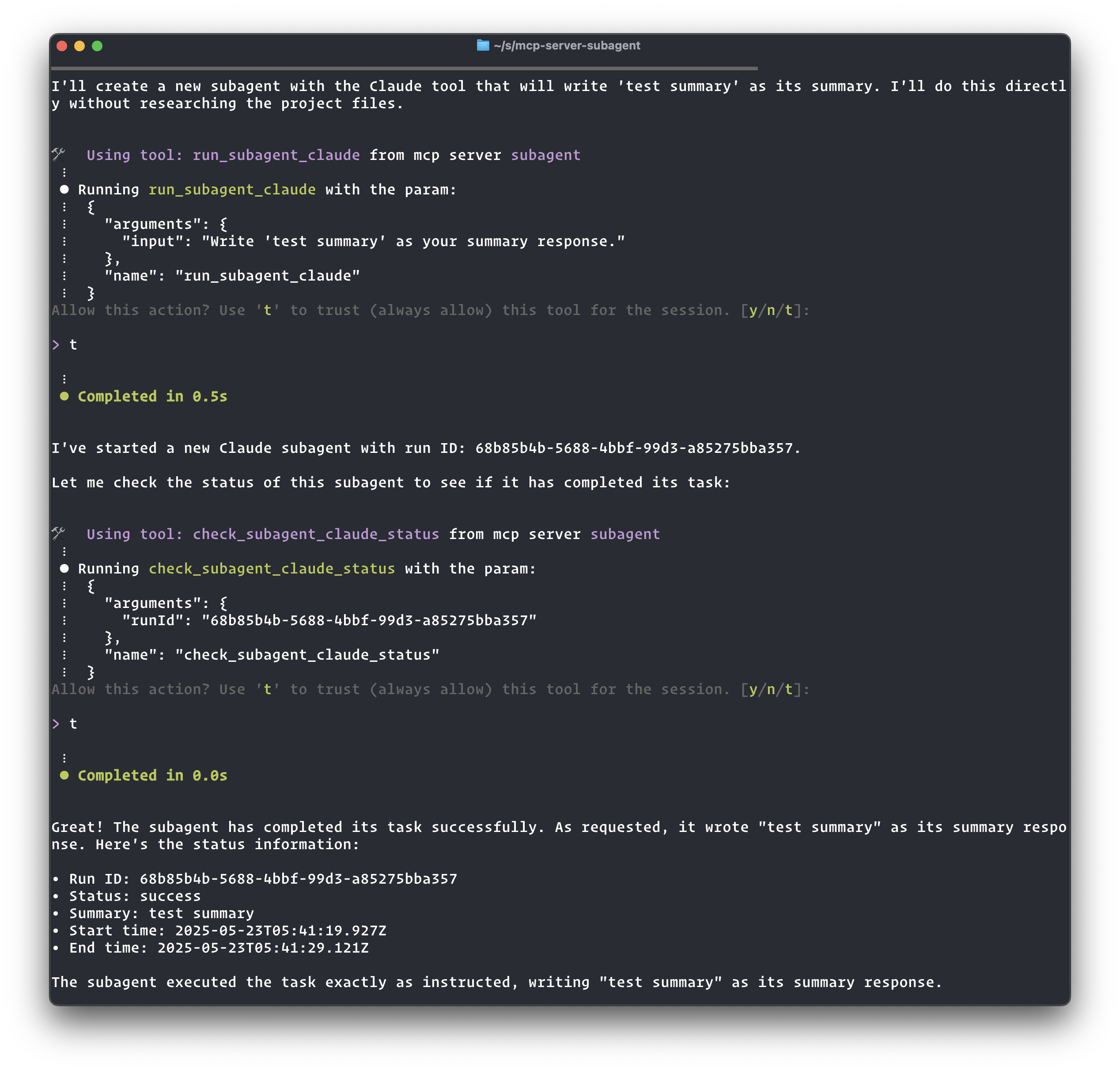
run_subagent_<n>: Runs the sub-agent with provided inputcheck_subagent_status: Allows the agent to check on the status of a sub-agentget_subagent_logs: Retrieves the logs of a sub-agent runupdate_subagent_status: Updates the status and adds a summary of a previous runask_parent, parents can reply using reply_subagent, and sub-agents can check for replies using check_message_statusAdd this to your MCP configuration file (~/.aws/amazonq/mcp.json):
{
  "mcpServers": {
    "subagent": {
      "command": "npx",
      "args": ["-y", "mcp-server-subagent"]
    }
  }
}
Or if you installed it locally:
{
  "mcpServers": {
    "subagent": {
      "command": "node",
      "args": ["/ABSOLUTE/PATH/TO/mcp-server-subagent/build/index.js"]
    }
  }
}
run_subagent_q: Run a query through the Amazon Q CLI
input (string) - The query to send to Amazon Qrun_subagent_claude: Run a query through the Claude CLI
input (string) - The query to send to Claudecheck_subagent_status: Check the status of a previous run
runId (string) - The UUID of the run to checkget_subagent_logs: Get the logs of a previous run
runId (string) - The UUID of the run to get logs forupdate_subagent_status: Update the status and add a summary of a previous run
runId (string) - The UUID of the run to updatestatus (string) - The new status to set (one of: "success", "error", "running", "completed")summary (string, optional) - A summary or result message to include with the status updateask_parent: Enables sub-agents to ask questions to the parent agent
runId (string), question (string)reply_subagent: Enables parents to reply to sub-agent questions
runId (string), messageId (string), answer (string)check_message_status: Check message status and retrieve replies
runId (string), messageId (string)The MCP Subagent Server supports bi-directional communication between parent agents and sub-agents through a message passing system. This allows sub-agents to ask questions during execution and receive guidance from the parent agent.
ask_parent: Enables sub-agents to ask questions to the parent agent
runId (string) - The sub-agent's current run IDquestion (string) - The question/message contentreply_subagent: Enables parents to reply to specific questions from sub-agents
runId (string) - The sub-agent's run IDmessageId (string) - The ID of the message being replied toanswer (string) - The parent's reply contentcheck_message_status: Check the status of a specific message and retrieve replies
runId (string) - Run ID to check message status formessageId (string) - Message ID to check status forHere's how bi-directional communication works in practice:
The sub-agent uses the ask_parent tool during execution:
{
  "tool": "ask_parent",
  "arguments": {
    "runId": "abc-123-def",
    "question": "I found multiple config files. Which one should I modify: config.json or settings.yaml?"
  }
}
Response:
{
  "messageId": "msg-456-789",
  "instructions": "Poll for the answer using the 'check_message_status' tool with your runId and messageId. Since this could take a while for the parent to respond, use 'sleep 60' between calls to avoid spamming."
}
When the parent checks the sub-agent status, they'll see:
Status: waiting_parent_reply

Question awaiting reply (Message ID: msg-456-789):
  I found multiple config files. Which one should I modify: config.json or settings.yaml?
  (Asked at: 2025-01-15T10:30:00.000Z)
  To reply, use the 'reply_subagent' tool.

Note: This may take a while for the parent to respond. Use 'sleep 60' between status checks to avoid spamming.
The parent uses the reply_subagent tool:
{
  "tool": "reply_subagent",
  "arguments": {
    "runId": "abc-123-def",
    "messageId": "msg-456-789",
    "answer": "Please modify config.json - it's the main configuration file. The settings.yaml is just for development overrides."
  }
}
The sub-agent polls for the answer using check_message_status:
{
  "tool": "check_message_status",
  "arguments": {
    "runId": "abc-123-def",
    "messageId": "msg-456-789"
  }
}
Response when answer is available:
{
  "messageId": "msg-456-789",
  "questionContent": "I found multiple config files. Which one should I modify: config.json or settings.yaml?",
  "answerContent": "Please modify config.json - it's the main configuration file. The settings.yaml is just for development overrides.",
  "messageStatus": "acknowledged_by_subagent",
  "hasAnswer": true
}
The sub-agent can then continue execution with the parent's guidance.
sleep 30 between status checks and message polling to avoid overwhelming the systemcheck_message_status tool automatically acknowledges messages when answers are retrievedTo add a new sub-agent, modify the SUBAGENTS object in src/index.ts:
const SUBAGENTS = {
  q: {
    name: "q",
    command: "q",
    getArgs: () => ["chat", "--trust-all-tools", "--no-interactive"],
    description: "Run a query through the Amazon Q CLI",
  },
  claude: {
    name: "claude",
    command: "claude",
    getArgs: () => [
      "--print",
      "--allowedTools",
      "Bash(git*) Bash(sleep*) Edit Write mcp__subagent__update_subagent_status",
      "--mcp-config",
      JSON.stringify(mcpConfig),
    ],
    description: "Run a query through the Claude CLI",
  },
  // Add your new sub-agent here
  newagent: {
    name: "newagent",
    command: "your-command",
    getArgs: () => ["--some-flag", "--other-flags"],
    description: "Description of your new agent",
  },
};
All sub-agent runs are logged to the logs directory with two files per run:
<run-id>.log: Contains the real-time output logs<run-id>.prompt.md: Contains the prompt passed to the agent<run-id>.meta.json: Contains metadata about the run (including communication messages)Claim this server with your GitHub account to request manual ownership verification.
Link to the catalog listing for MCP Subagent Server from your README. This badge does not certify ownership, compatibility or security.
[](https://awesome-mcp.com/servers/mcp-server-subagent)Public repository statistics could not be verified. Check the configured source address; unavailable counts are not zero.
Separate sources, scopes and periods. Never combined or treated as installations, active users or security reviews.
No reviewed package or image identity; download statistics are not listed yet.
Alternative and complementary servers in the same category
Store and retrieve entities, relations and observations in a persistent local knowledge graph.
Organize problem solving into revisable, branching thought steps through an MCP tool.

Query-aware context compression with an MCP plugin for coding agents, plus Python and HTTP interfaces for reducing the context sent to a language model.