
This is a Model Context Protocol (MCP) server for interacting with AIStor object stores.
Repository stats unavailable
Databases & Storage
An MCP server built with the Azure SDK for Go and the MCP Go SDK that exposes tools for interacting with Azure Cosmos DB.
Go-based MCP server for Azure Cosmos DB is cataloged as an MCP server attributed to abhirockzz. An MCP server built with the Azure SDK for Go and the MCP Go SDK that exposes tools for interacting with Azure Cosmos DB. It is categorized under databases storage. See the capability inspector for recorded interfaces and their independent review status; consult upstream documentation for the current interface.
Installation configuration is not reviewed. No executable setup is offered for this entry; inspect the source repository before proceeding.
Catalog license label: Not specified. Check the source repository's current license and terms before using, modifying or distributing this software.
Capability definitions are not reviewed. Unreviewed imports are not exposed as trusted interfaces.
No reviewed records to display. This does not establish that upstream lacks this capability.
No reviewed records to display. This does not establish that upstream lacks this capability.
No reviewed records to display. This does not establish that upstream lacks this capability.
Email delivery is not connected. This page does not collect email addresses or create subscriptions.
Browse the registry for current listings instead.
Reviews for Go-based MCP server for Azure Cosmos DB are not available yet
Review publishing and storage are not connected. This page does not collect or publish ratings or comments, including after sign-in.
It supports both Streamable HTTP and Stdio transports, and can run locally as an HTTP server or stdio process, or be deployed to a remote endpoint.
It uses the DefaultAzureCredential from the Azure SDK for Go, supporting environment variables, managed identity, or Azure CLI login. The local emulator uses key-based authentication instead.
No. It is described as an experimental learning tool demonstrating how to combine the Azure Go SDK and MCP Go SDK, not a replacement for those projects.
README.md · ff774e86f9ef · Fetched 2026-11-13 10:29:41 UTC
Original upstream text, without AI rewriting. Scripts, forms and unsafe links are filtered for safety.
Showing the last retrieved documentation snapshot; check the source for current changes.
This is a Go based implementation of an MCP server for Azure Cosmos DB using the Azure SDK for Go and the official MCP Go SDK.
It works with the Azure Cosmos DB service and the vNext emulator, and exposes the following tools for interacting with Azure Cosmos DB:
⚠️ This project is not intended to replace the Azure MCP Server or Azure Cosmos DB MCP Toolkit. Rather, it serves as an experimental learning tool that demonstrates how to combine the Azure Go SDK and MCP Go SDK to build AI tooling for Azure Cosmos DB.
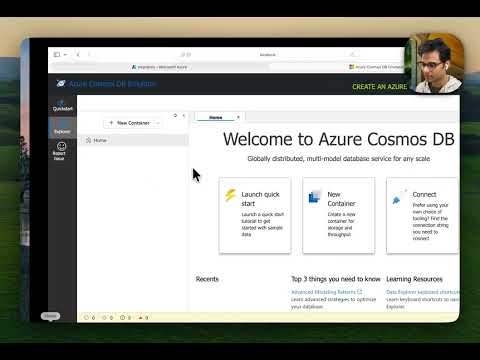
▶️ Here is a demo using GitHub Copilot CLI, but same would work with Agent Mode in Visual Studio Code, or any other MCP compatible tool (Claude Code, etc.):
To start with, clone the GitHub repo and build the binary:
git clone https://github.com/abhirockzz/mcp_cosmosdb_go
cd mcp_cosmosdb_go

go build -o mcp_azure_cosmosdb_go main.go
Note: The MCP server uses the DefaultAzureCredential implementation from the Azure SDK for Go to authenticate with Azure Cosmos DB. This means that you can authenticate using various methods, including environment variables, managed identity, or Azure CLI login, among others.
This ^ is not applicable to the local emulator since it uses a well known key-based authentication.
This MCP server supports both Streamable HTTP and Stdio transports. You can run the MCP server in two modes:
stdio processThanks to Streamable HTTP support, you can easily run this MCP server as an HTTP server locally on your machine.
Login using Azure CLI (az login), or the Azure Developer CLI (azd auth login). Since the MCP server uses DefaultAzureCredential, it will authenticate as the identity logged in to the Azure CLI or the Azure Developer CLI.
The user principal (identity) you are logged in with should have permissions (control and data plane) to execute CRUD operations on database, container, and items.
🌐 HTTP server
Start the server:
export COSMOSDB_MCP_SERVER_MODE=http
./mcp_azure_cosmosdb_go
This will start the server on port 9090 by default. You can change the port by setting the PORT environment variable.
How you configure the MCP server will differ based on the MCP client/tool you use. For VS Code you can follow these instructions on how to configure this server using a mcp.json file.
Here is an example of the mcp.json configuration for the HTTP server:
{
  "servers": {
    "mcp_azure_cosmosdb_go_http": {
      "type": "http",
      "url": "http://localhost:9090"
    }
  }
  //other MCP servers...
}
Change the port if you have configured a different one.
🖥️ Stdio server
Here is an example of the mcp.json configuration for the stdio mode:
{
  "servers": {
    "mcp_azure_cosmosdb_go_stdio": {
      "type": "stdio",
      "command": "./mcp_azure_cosmosdb_go"
    }
  }
  //other MCP servers...
}
Once you have configured the MCP server in your tool, you can start using it to interact with Azure Cosmos DB (just like in the demo shown above). For other tools like Claude Code, Claude Desktop, etc., refer to their respective documentation on how to configure an MCP HTTP/stdio server.
Large Language Models (LLMs) are non-deterministic by nature and can make mistakes. Always validate the results and queries before making any decisions based on them.
For both the cases, if you want to use the vNext emulator, make sure its already running on your machine - docker run -p 8081:8081 -p 1234:1234 mcr.microsoft.com/cosmosdb/linux/azure-cosmos-emulator:vnext-preview
You can also deploy this MCP server to any cloud service (like Azure App Service, Azure Container Apps, etc.) and expose it as an HTTP(s) endpoint. The Azure service should support Managed Identity, and the MCP server will automatically pick up the credentials using the DefaultAzureCredential implementation.
⛔️ This execution mode is not recommended. Use this only for testing purposes. This is because, although MCP server can access Azure Cosmos DB securely using Managed Identity, it does not authenticate (or authorize) clients yet - anyone who can access the endpoint can execute operations on your Cosmos DB account.
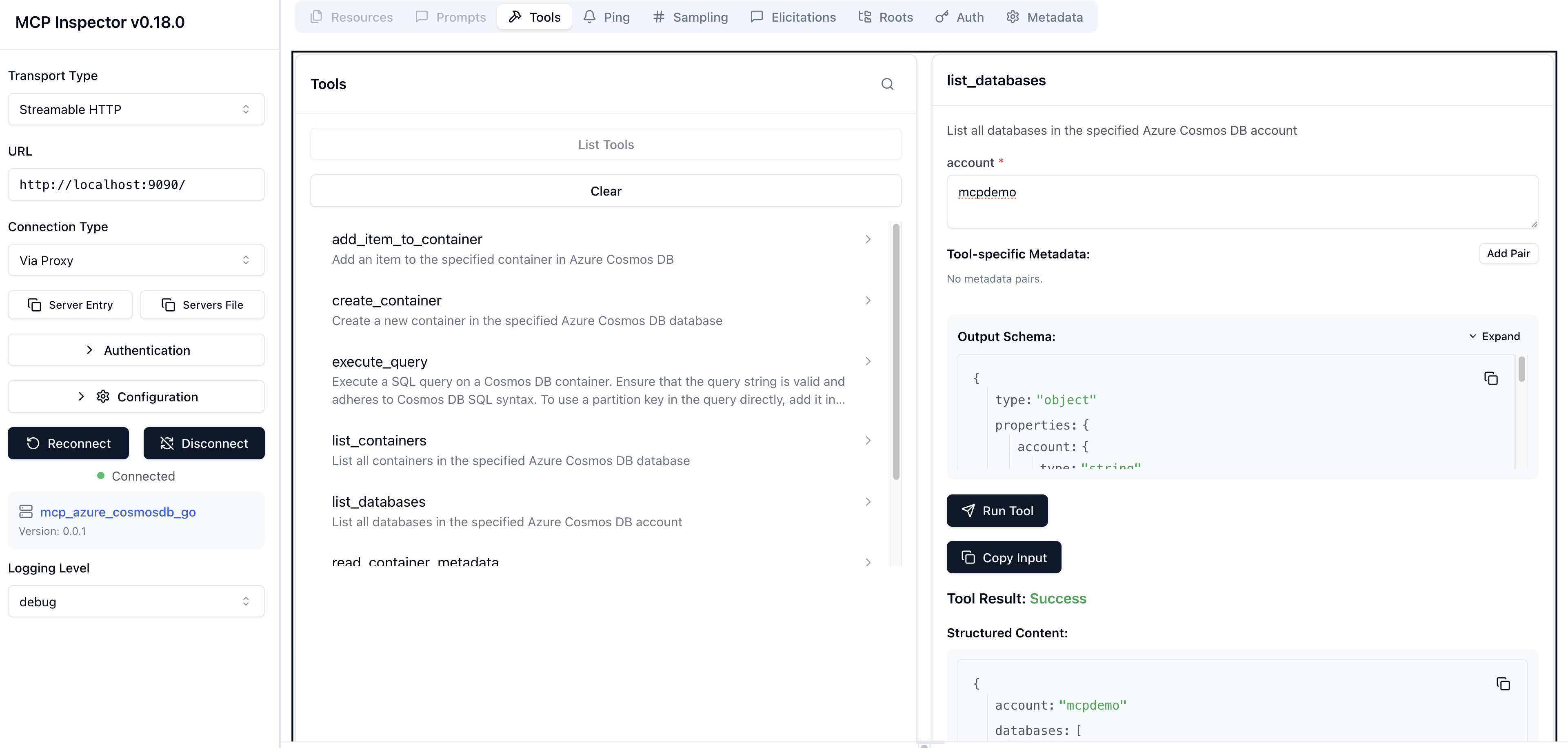
Use MCP inspector - make mcp_inspector
Claim this server with your GitHub account to request manual ownership verification.
Link to the catalog listing for Go-based MCP server for Azure Cosmos DB from your README. This badge does not certify ownership, compatibility or security.
[](https://awesome-mcp.com/servers/mcp_cosmosdb_go)Public repository statistics could not be verified. Check the configured source address; unavailable counts are not zero.
Separate sources, scopes and periods. Never combined or treated as installations, active users or security reviews.
No reviewed package or image identity; download statistics are not listed yet.
Alternative and complementary servers in the same category
This is a Model Context Protocol (MCP) server for interacting with AIStor object stores.

A Model Context Protocol server that lets AI assistants run SQL queries against AWS Athena databases and retrieve results.

A Model Context Protocol (MCP) server that exposes access to an InfluxDB v2 instance using the InfluxDB OSS API v2.