

A directory listing describing a cancellation-letter and mailing-address service. The configured public GitHub repository returned 404 during source verification.
Repository stats unavailable
Developer Tools
A cloud bug-hunting service for coding agents that exposes an MCP server for submitting reviews and confirming findings.
OhMyBug bughunter MCP server is cataloged as an MCP server attributed to ohmyx-ai. A cloud bug-hunting service for coding agents that exposes an MCP server for submitting reviews and confirming findings. It is categorized under developer tools. See the capability inspector for recorded interfaces and their independent review status; consult upstream documentation for the current interface.
Installation configuration is not reviewed. No executable setup is offered for this entry; inspect the source repository before proceeding.
Catalog license label: Not specified. Check the source repository's current license and terms before using, modifying or distributing this software.
Capability definitions are not reviewed. Unreviewed imports are not exposed as trusted interfaces.
No reviewed records to display. This does not establish that upstream lacks this capability.
No reviewed records to display. This does not establish that upstream lacks this capability.
No reviewed records to display. This does not establish that upstream lacks this capability.
Email delivery is not connected. This page does not collect email addresses or create subscriptions.
Browse the registry for current listings instead.
Reviews for OhMyBug bughunter MCP server are not available yet
Review publishing and storage are not connected. This page does not collect or publish ratings or comments, including after sign-in.
One flat price per review applies when real bugs are confirmed, with minor findings, review runs, false positives and unclear results costing nothing.
The user's own agent verifies each finding against the codebase and reports REAL, NOT_REAL or UNCLEAR, with the user approving the verdicts.
Before a diff or file contents are sent, a secret scan refuses payloads carrying credentials, though it can be disabled with OHMYBUG_SECRET_SCAN=0.
README.md · 0d1704346a1c · Fetched 2026-11-13 14:19:05 UTC
Original upstream text, without AI rewriting. Scripts, forms and unsafe links are filtered for safety.
Showing the last retrieved documentation snapshot; check the source for current changes.




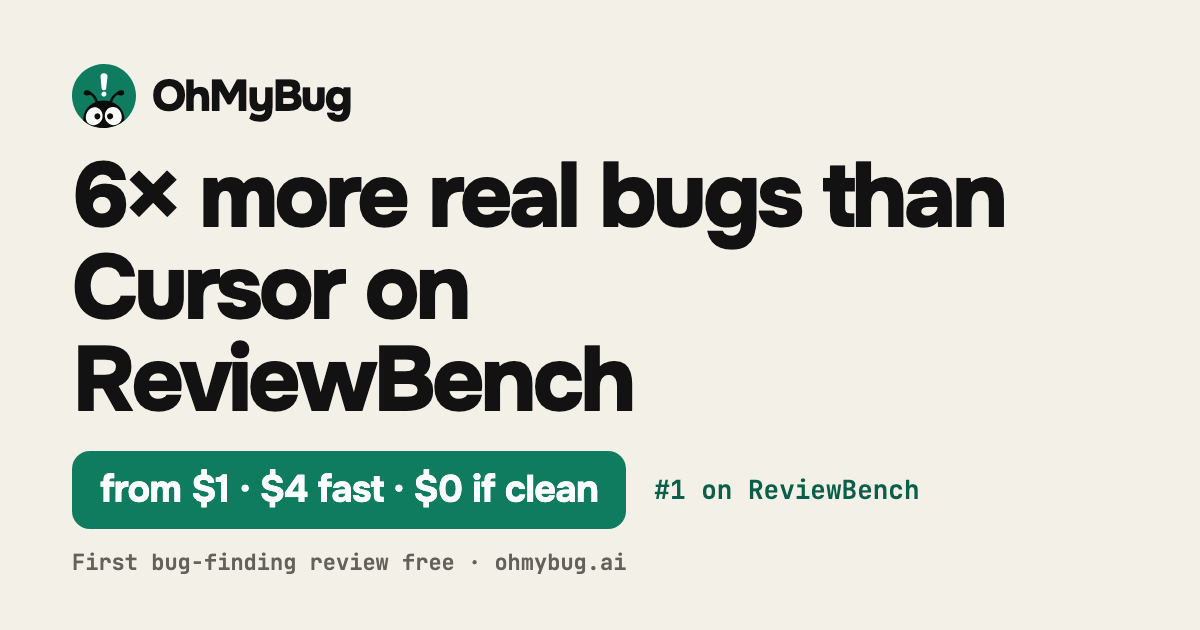
We find the bugs your Claude Code missed. You pay only when your own Claude confirms real bugs: $4 per bug-finding review (however many bugs it holds), $12 for a deep hunt you choose ($24 on a wide change), minor findings free, first review free.
get_balance lists, where the service runs themPick a mode for one hunt with /bughunter:review lite (or snap, fast); without one the hunt is fast. Lite and snap read the repository, so they need a pushed GitHub commit the service can read, and snap a diff under 1 MB. /bughunter:stats lists the modes the service runs for your key.
See the bug species our hunts keep finding in the Bugarium.
claude plugin marketplace add OhMyX-AI/ohmybug-plugin
claude plugin install bughunter@ohmybug
That's the whole setup. On first use Claude Code opens a GitHub sign-in in your browser; your account (with a free first review) is created automatically. No keys to copy, nothing lands in config files.
pi has no built-in MCP — add the adapter, then the server:
pi install npm:pi-mcp-adapter
npx skills add OhMyX-AI/ohmybug-plugin --skill bughunter
Add to .mcp.json in your project root (or ~/.config/mcp/mcp.json):
{
  "mcpServers": {
    "ohmybug": { "url": "https://mcp.ohmybug.ai/mcp", "auth": "oauth" }
  }
}
Restart pi, run /mcp-auth ohmybug once — a GitHub page opens in the
browser, your account with a free first review is created
automatically. Then say "hunt bugs" or /skill:bughunter.
Prefer a raw key (CI)? Use "auth": "bearer", "bearerTokenEnv": "OHMYBUG_API_KEY" instead of "auth": "oauth".
Optional merge gate (pi has blocking tool hooks) — .pi/extensions/ohmybug-gate.ts:
import { isToolCallEventType } from "@earendil-works/pi-coding-agent";

pi.on("tool_call", async (event) => {
  if (isToolCallEventType("bash", event) && /\bgh pr merge\b/.test(event.input.command)
      && !process.env.SKIP_BUGHUNT) {
    return { block: true, reason: "Final diff not hunted — run /skill:bughunter first (or SKIP_BUGHUNT=1)" };
  }
});
The plugin package wires the skill, MCP server, and Codex review routing in one install. Codex uses the same GitHub OAuth flow as Claude Code:
codex plugin marketplace add OhMyX-AI/ohmybug-plugin
codex plugin add bughunter@ohmybug
codex mcp login ohmybug
codex update
The last line brings Codex itself up to date, and it stays last: where Codex cannot tell how it was installed (for example, bundled inside another app) it exits with an error, and by then the plugin, the MCP server and the sign-in are already in place. Update that Codex the way it was installed.
Open /hooks once after installation, review and trust the OhMyBug hook
definition, then start a new Codex thread. Codex skips non-managed plugin hooks
until you trust their current definition; without that step the skill and MCP
still install, but automatic review routing is not active. Then ask Codex to
run the OhMyBug cloud hunt (or use the plugin's starter prompt). A local
APPROVE from a code-review agent is not merge evidence.
If the plugin was installed with npx skills add, keep the skill and add the
same MCP server explicitly:
npx skills add OhMyX-AI/ohmybug-plugin --skill bughunter
codex mcp add ohmybug --url https://mcp.ohmybug.ai/mcp
codex mcp add detects OAuth and opens the GitHub sign-in flow automatically.
For headless CI, use an operator-issued raw omb_ key — write to
hi@ohmybug.ai or DM @ohmybug
to get one:
export OHMYBUG_API_KEY=omb_...
codex mcp add ohmybug --url https://mcp.ohmybug.ai/mcp \
  --bearer-token-env-var OHMYBUG_API_KEY
(Claude Code users who prefer a key over OAuth can do the same with
claude mcp add --transport http ohmybug https://mcp.ohmybug.ai/mcp --header "Authorization: Bearer $OHMYBUG_API_KEY" — an explicit
Authorization header disables the OAuth flow.)
Questions → Discord.
Open your agent in the project and run /bughunter:review (or say "hunt
bugs in my code"). It hunts whatever is there: a branch against main,
uncommitted changes, the last commits, or – in a folder that is not a git
repository at all – the files themselves as new code. It says which one it
picked before anything is sent, and you can point it elsewhere ("hunt
src/solver/", "the last 3 commits").
On a GitHub repository, /bughunter:scan hunts the code this repository changed in the last 30 days
(/bughunter:scan 14 for two weeks). The server reads the history from
GitHub and clones the repository on its side — nothing is uploaded from your
machine — then runs a deep hunt (up to 150 minutes) over the window's changed
code, and hands back one merged review that lists anything
it did not read. Your agent verifies the findings like any hunt, and it is priced
as a deep hunt: $12, or $24 on a wide change, only if a real bug is confirmed. It needs the OhMyBug GitHub App on that repository, runs once per
repository per week, and is not a merge gate.
gh pr merge, a gate is the safety net: it checks
the final diff was hunted (skip once with SKIP_BUGHUNT=1; review fixes
change the diff and re-arm the gate)./bughunter:review (or just ask to "hunt bugs") sends your diff + selected
context to OhMyBug's cloud. You see the exact file manifest before upload.get_balance modes lists), $12 deep, $24 deep on a wide change (11+ folder chunks). Minor findings, review runs, false positives, unclear — $0,
and so is a real medium you already deferred or accepted in your own ticket, once your agent marks it known
(a hunt billed on CI, or one already billed at its deadline, stays charged)./bughunter:stats shows your record: bugs found, reviews run, balance.submit_review,
provide_files), a secret scan refuses a payload that carries a credential
(vendor-prefixed tokens, private keys, key files) and says which file and
line, with the value masked. A payload it cannot read is refused too. It
lets a payload through unscanned in four cases only: submits that send no
payload (repo + ref) have nothing to scan; without python3 it cannot run,
and says so in a system message; it does not run on Windows; the out-of-band
upload for very large diffs is not scanned. Set
OHMYBUG_SECRET_SCAN=0 (in the env block of settings.json) to turn the
scan off.Everything that blocks or refuses lives in shell hooks, so it behaves the same in every client. The Claude Code mod shows and offers; it never refuses. It draws a button only where you have to decide (the deep-hunt offer, which spends money); the agent's own watch picks up a finished hunt, so that band only says what happened.
| Claude Code 2.1.287+ | older Claude Code | Codex | |
|---|---|---|---|
| Merge gate, secret scan, hunt records | yes | yes | yes |
| Hunt status in the status line, a toast when a hunt finishes or asks for files | yes | — | — |
| Band above the prompt when a tracked hunt finishes, fails or asks for files: the news only, no button; it goes once the agent reads the hunt or the next turn starts | yes | — | — |
Deep-hunt offer (the deep_offer of a tracked hunt's get_findings) as Run deep hunt — pressing it is your consent, sent to the server itself when the offer carries its button addresses (else asked of the agent) — Not now, which sends nothing, and Not today, which pauses the offer for 24 hours the same way | yes | — | — |
| A merge the gate refused: the gate's own words in the band, no button; it goes when the next turn starts | yes | — | — |
Findings drawn as a card (show the raw answer keeps the original) | yes | — | — |
/hunts pane | yes | — | — |
A hunt read but not confirmed: one line in the system prompt and the same in the status line (bughunt <id> · verdicts not sent) until confirm_findings for that id; while another hunt runs or waits to be read, the status line shows that hunt instead | yes | — | — |
A finished hunt someone already read or judged — in another chat, or in a way the mod did not see — gets no toast, band, resume or verdicts line here: the mod asks the status URL (a finished, unread hunt again every few minutes), and the server says whether the result was read or has verdicts. If the status URL cannot be reached, the band stays until the agent reads the hunt or your next turn starts.
Every chat on the machine sees the same list of hunts, and each hunt belongs to one chat: that chat polls it, announces it and tells its agent about it. A chat takes over a hunt another chat tracks when its agent reads that hunt to its end, when its agent asks for it again (the server answers that it is already running, or that the review was already escalated to it) and no other chat's agent has read it yet, or when the deep offer's Run deep hunt is pressed for it. Taken over, it is unread there until that chat's own agent reads it, so no agent is asked for verdicts on findings it has not seen; verdicts already sent stay sent. Every write reads the list again and changes only the one hunt, so a chat does not put back an older copy of another chat's hunt. Two chats writing in the same few milliseconds can still lose one write, and a chat still running an older plugin version writes its whole list until it restarts.
The mod never starts a turn on its own unless you opt in. Two environment
variables tune it (in the env block of settings.json, or managed settings
for a team):
OHMYBUG_AUTO_RESUME=1 — when a tracked hunt finishes, fails or asks for
files and the session is idle, send that hunt's next step instead of showing
the band. Off by default.OHMYBUG_STATUS=0 — keep the status line clear; the verdicts line in the
prompt goes with it, so the agent is never told what the person cannot see.
A deep hunt you start from the band's button is still told to the agent:
the press is yours, and the agent did not start that hunt.The VS Code extension has no band above the prompt; there the toast and the
status line carry it.
Turn the mod off with
/plugin like any built-in mod; the shell hooks stay.
| Tool | In | Out |
|---|---|---|
submit_review | diff, files[{path, content}], meta{language?, base_branch?, repo?, ref?}, mode? (lite, snap or fast; absent: fast) | {review_id, status, mode, hunt_mode, pending_verdicts[]} |
get_findings | review_id | {status: running|needs_files|done|failed, findings[{finding_id, severity, file, line?, title, failure_scenario, suggested_fix?}]} |
provide_files | review_id, paths[] (Claude Code: the plugin's hook reads them from disk) or files[{path, content}] | {status, delivered} |
confirm_findings | review_id, verdicts[{finding_id, verdict: REAL|NOT_REAL|UNCLEAR, reason, severity?, known?: {kind: deferred|accepted, ref}}] | {confirmed, minor_confirmed, marked_known?, billed_usd, free_review_used, balance_usd, receipt_id} |
get_balance | — | {balance_usd, free_reviews_left, confirmed_total, stats{…}, modes[{mode, price_usd}]} |
Errors: mode_unavailable, mode_needs_repo, mode_too_large, mode_with_deep (the mode cannot run; nothing started or charged), payment_required (top up), pending_verdicts (resolve previous
review's verdicts first).
Claim this server with your GitHub account to request manual ownership verification.
Link to the catalog listing for OhMyBug bughunter MCP server from your README. This badge does not certify ownership, compatibility or security.
[](https://awesome-mcp.com/servers/ohmybug)Public repository statistics could not be verified. Check the configured source address; unavailable counts are not zero.
Separate sources, scopes and periods. Never combined or treated as installations, active users or security reviews.
No reviewed package or image identity; download statistics are not listed yet.
Alternative and complementary servers in the same category
A directory listing describing a cancellation-letter and mailing-address service. The configured public GitHub repository returned 404 during source verification.

A hosted MCP service for browsing and searching through Singapore mobile-network proxies.

A directory listing describing a Markdown-to-PDF service. The configured public GitHub repository returned 404 during source verification.