
A directory listing describing a cancellation-letter and mailing-address service. The configured public GitHub repository returned 404 during source verification.
Repository stats unavailable
Developer Tools
An open-source MCP server that turns LLMs into condition monitoring assistants for reliability engineers, providing evidence-based vibration diagnostics with ISO-cited severity.
Predictive Maintenance MCP Server is cataloged as an MCP server attributed to lgdimaggio. An open-source MCP server that turns LLMs into condition monitoring assistants for reliability engineers, providing evidence-based vibration diagnostics with ISO-cited severity. It is categorized under developer tools. See the capability inspector for recorded interfaces and their independent review status; consult upstream documentation for the current interface.
Installation configuration is not reviewed. No executable setup is offered for this entry; inspect the source repository before proceeding.
Catalog license label: MIT. Check the source repository's current license and terms before using, modifying or distributing this software.
Capability definitions are not reviewed. Unreviewed imports are not exposed as trusted interfaces.
No reviewed records to display. This does not establish that upstream lacks this capability.
No reviewed records to display. This does not establish that upstream lacks this capability.
No reviewed records to display. This does not establish that upstream lacks this capability.
Email delivery is not connected. This page does not collect email addresses or create subscriptions.
Browse the registry for current listings instead.
Reviews for Predictive Maintenance MCP Server are not available yet
Review publishing and storage are not connected. This page does not collect or publish ratings or comments, including after sign-in.
No. No diagnosis is inferred from filenames or statistical parameters alone; a fault indication requires matching spectral evidence.
Raw vibration data stays local; only computed results flow to the LLM.
The server implements ISO 13374, ISO 20816-3, and MIMOSA OSA-CBM.
README.md · 4e9847d68529 · Fetched 2026-11-13 09:29:57 UTC
Original upstream text, without AI rewriting. Scripts, forms and unsafe links are filtered for safety.
Showing the last retrieved documentation snapshot; check the source for current changes.


Give your AI assistant evidence-based vibration diagnostics — machinery fault detection, ISO-cited severity, and diagnostic reports built to support and accelerate expert decision-making.
An open-source MCP server that turns LLMs into condition monitoring assistants for reliability engineers. Its core design rule: the server refuses to guess. No diagnosis is ever inferred from filenames or statistical parameters alone — a fault indication requires matching spectral evidence. Every severity claim cites ISO 20816-3, and the evaluative wording in reports is authored by the server, not improvised by the model. The AI orchestrates the analysis and presents the evidence — detected fault frequencies, matched fault patterns, severity zones — while the final judgment stays with the engineer. Also available as a Claude Code plugin with 9 diagnostic skills.
| You are | Start here |
|---|---|
| Reliability / maintenance engineer — diagnostics in plain language, no coding | Quick Start below · then Engineer's guide for your own data, manuals and workflows |
| AI / MCP developer — run, integrate, and extend the server | Developer's Quickstart · Installation |
| Researcher / evaluator — how the numbers are measured | Benchmark Methodology · Benchmark below |
Point the AI at a vibration signal → get the evidence behind the fault — detected frequencies, matched fault patterns, ISO-cited severity — to support your call.
| You say | The AI does |
|---|---|
| "What does the vibration say about this bearing?" | Loads the signal, tests each characteristic fault line against the noise floor of the envelope spectrum, reports what the evidence is consistent with and what it cannot exclude, cites the ISO 20816-3 severity zone |
| "Generate a full diagnostic report" | Produces an interactive HTML report with charts, fault markers, and server-authored severity wording |
| "Extract specs from test_pump_manual.pdf and diagnose the signal" | Reads the equipment manual, looks up the bearing model, calculates expected fault frequencies, tests each of them in the signal's envelope spectrum |
| "Train an anomaly detector on my healthy baselines, then flag anomalies" | Trains a model on your normal data, scores new signals, flags outliers for your review |
| "What changed on pump P-101 since the baseline?" | Reads the asset's recorded history, compares the latest acquisitions with the declared reference, and reports each indicator's change with the criterion it applied |
The AI doesn't guess: it calls 48 specialized MCP endpoints (44 tools + 4 prompts) running locally on your machine. These counts describe the main branch; tools listed under Unreleased in the CHANGELOG are not yet in the published PyPI package. Every signal is referenced by a single signal_id handle from load to report. Your data never leaves your infrastructure.
Full endpoint reference, grouped by category: Tool Catalog.
One route, from a fresh clone to a first diagnosis in Claude Desktop. You need Git, uv (it fetches Python 3.11 by itself) and Claude Desktop.
1. Clone the repository. The 20 sample signals come with the clone, not with the PyPI package or with the source ZIP and tarball archives generated from this revision: real bearing measurements from the MathWorks rolling-element bearing dataset, healthy baselines plus inner and outer race faults, each with its companion metadata (data/README.md).
git clone https://github.com/LGDiMaggio/predictive-maintenance-mcp.git
cd predictive-maintenance-mcp
2. Install and connect. On Windows, one script creates the environment, installs the server and writes the Claude Desktop entry (clones inside OneDrive or other synced folders are handled):
powershell -ExecutionPolicy Bypass -File setup_claude.ps1
uv venv .venv --python 3.11
uv pip install --python .venv/bin/python .
Add this entry to ~/Library/Application Support/Claude/claude_desktop_config.json, with the absolute path of your clone in place of /path/to/predictive-maintenance-mcp. If a predictive-maintenance entry is already there, replace it:
{
  "mcpServers": {
    "predictive-maintenance": {
      "command": "/path/to/predictive-maintenance-mcp/.venv/bin/python",
      "args": ["-m", "predictive_maintenance_mcp"],
      "env": { "PDM_PROJECT_DIR": "/path/to/predictive-maintenance-mcp" }
    }
  }
}
PDM_PROJECT_DIR tells the server where the sample signals and the reports live. Keep every path absolute: Claude Desktop launches servers with a minimal PATH.
3. Restart and check. Quit Claude Desktop completely (File, then Quit) and start it again. In a new chat ask:
"List the available vibration signals."
The 20 included signals should appear. If they do not, see INSTALL.md, Troubleshooting.
4. First diagnosis. Try:
"Load real_train/OuterRaceFault_1.csv. The shaft runs at 1500 rpm: check the bearing against the fault frequencies declared in its metadata, assess the ISO severity and generate the envelope report."
What comes back is the server's evidence, not the model's opinion: in the envelope spectrum the outer-race and inner-race lines both stand above the local noise floor, each with a further line of its own, so the evidence of this single spectrum is consistent with more than one fault type, and the check lists both with their levels without singling either out, while neither the ball nor the cage line stands above the floor; the ISO 20816-3 severity zone of the broadband velocity, with the machine group and support type the assessment assumed; and the path of an HTML report in reports/ with those frequencies marked on the envelope spectrum. The call on the machine stays with you.
The file name carries the fault label, but the server never reads names. Ask which frequencies matched and with what deviation: the answer rests on the spectrum alone.
Use your own data. Put a single-column CSV without a header row where the server can read it (a folder of yours under data/signals/, or an absolute path), add a <name>_metadata.json next to it with sampling_rate and signal_unit (for example "g"), and ask for the analysis stating the shaft speed. Details and traps: Use Your Own Data.
Other clients: Claude Code, VS Code, Cursor and any other MCP client: INSTALL.md, Manual Setup.
A blind, reproducible benchmark of the bearing check on the public CWRU Bearing Data Center dataset (12 kHz drive-end subset: 60 fault records + 4 normal baselines). Fault labels never reach the system under test — signals enter under opaque ids, a separate scorer is the only label reader, and blindness, checksum integrity, and determinism are enforced by CI-run guard tests, not prose. Results are stratified by the per-record diagnosability grades of the Smith & Randall (2015) reference study, so records that study found undiagnosable by any classical method are reported separately instead of inflating or deflating the headline.
On the records the reference study grades clearly diagnosable (Y1+Y2, 44 records), the line tested for the labelled fault stood above the local noise floor on 44/44, and the labelled fault was supported, with a further line of its own, on 44/44. Another fault type was supported as well on 44/44; the check listed several types, the labelled one among them, on 44/44 and singled out no fault type on 44/44. The labelled fault was the first candidate listed, by level over the noise floor, on 40/44 (9/9 on the textbook-signature Y1 stratum); that order is not a ranking of likelihood, and the check names no fault from it. Of the 4 normal baselines, 1 gave no indication and 3 listed bearing candidates, 1 of them singling out one fault type: counts on these recordings, not a specificity rate.
The numbers above are read from the committed, re-runnable artifact (results.json) and drift-guarded by CI: every value is bound to its key in the artifact, and a mismatch fails the build. Methodology, blind protocol, and honest-benchmarking notes: docs/benchmark-methodology.md. Reproduce with:
python -m benchmarks.cwru all
The project includes a plugin for Claude Code with domain-specific skills that activate automatically during conversation.
/plugin marketplace add LGDiMaggio/predictive-maintenance-mcp
/plugin install predictive-maintenance@predictive-maintenance-marketplace
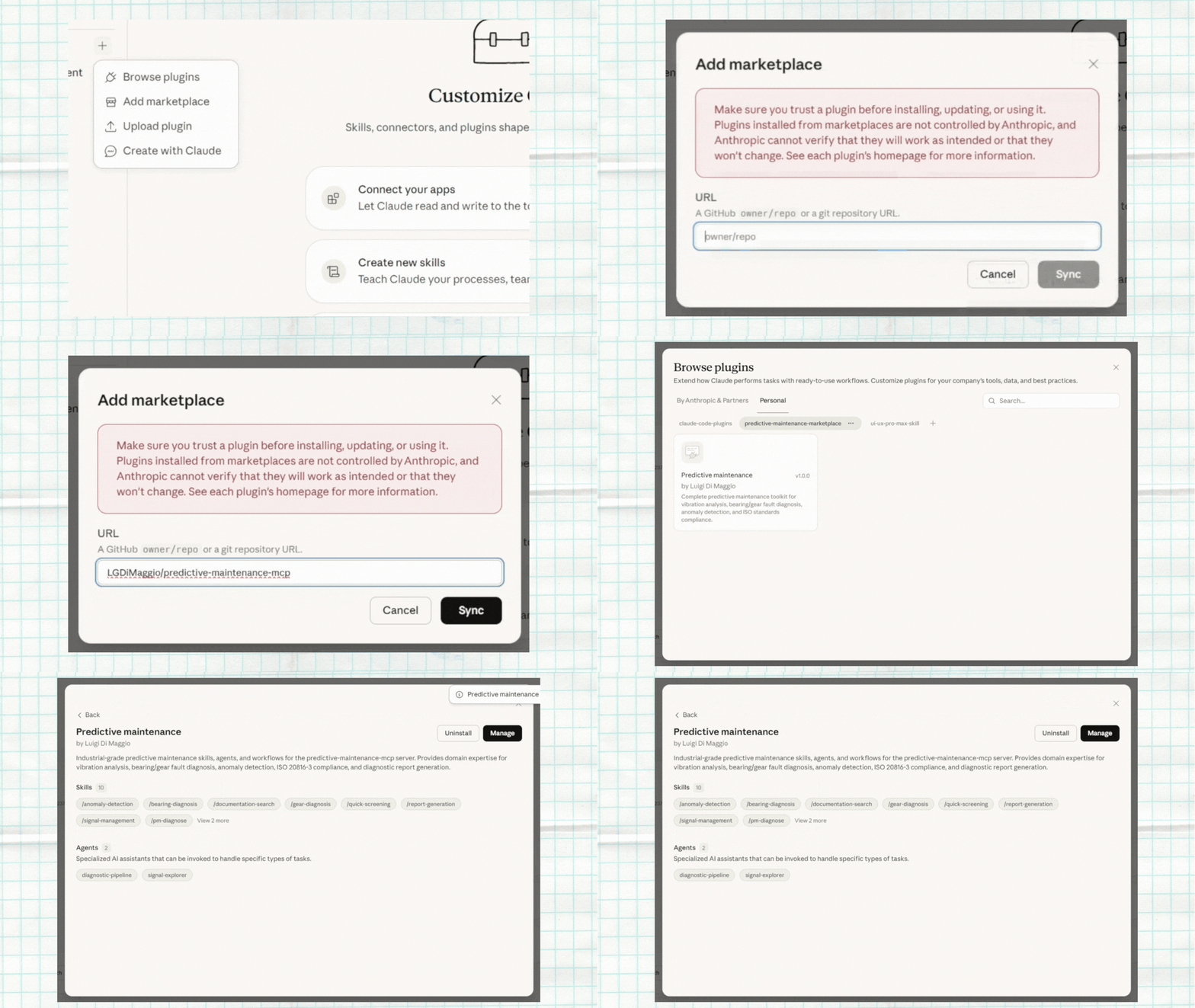
The plugin adds 9 skills that activate automatically based on context (bearing-diagnosis, gear-diagnosis, quick-screening, report-generation, anomaly-detection, signal-management, documentation-search, prognostics, experimental shaft-order-evidence), 2 agents that run multi-step diagnostic workflows end-to-end and hand you the evidence (diagnostic-pipeline, signal-explorer), and 3 commands for quick entry points (/pm-diagnose, /pm-screen, /pm-report).
Full skill, agent, and command reference: Plugin README.
All analysis tools generate interactive HTML reports you can open in any browser — pan, zoom, hover for details. Also supports structured Word (.docx) exports.
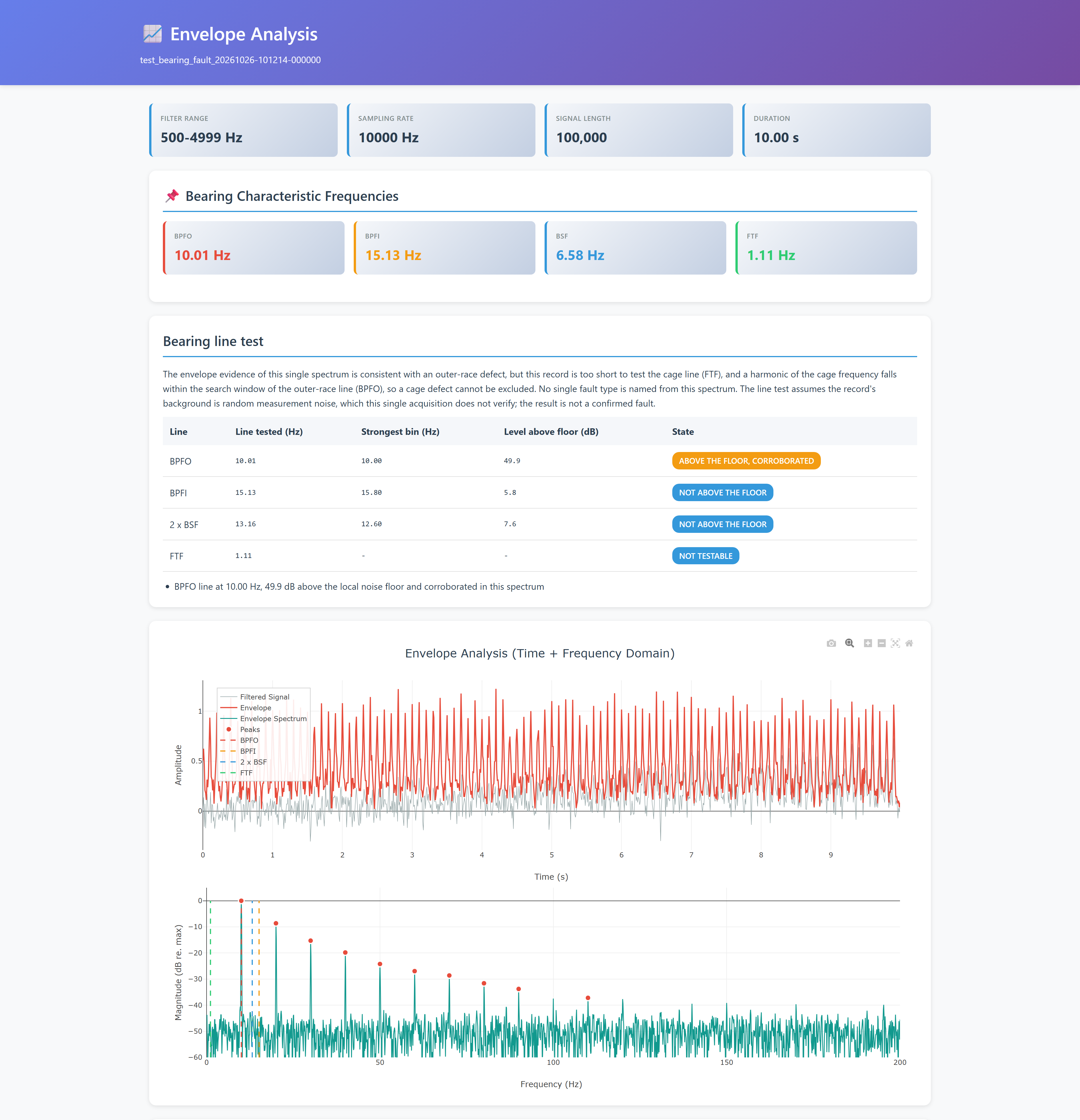
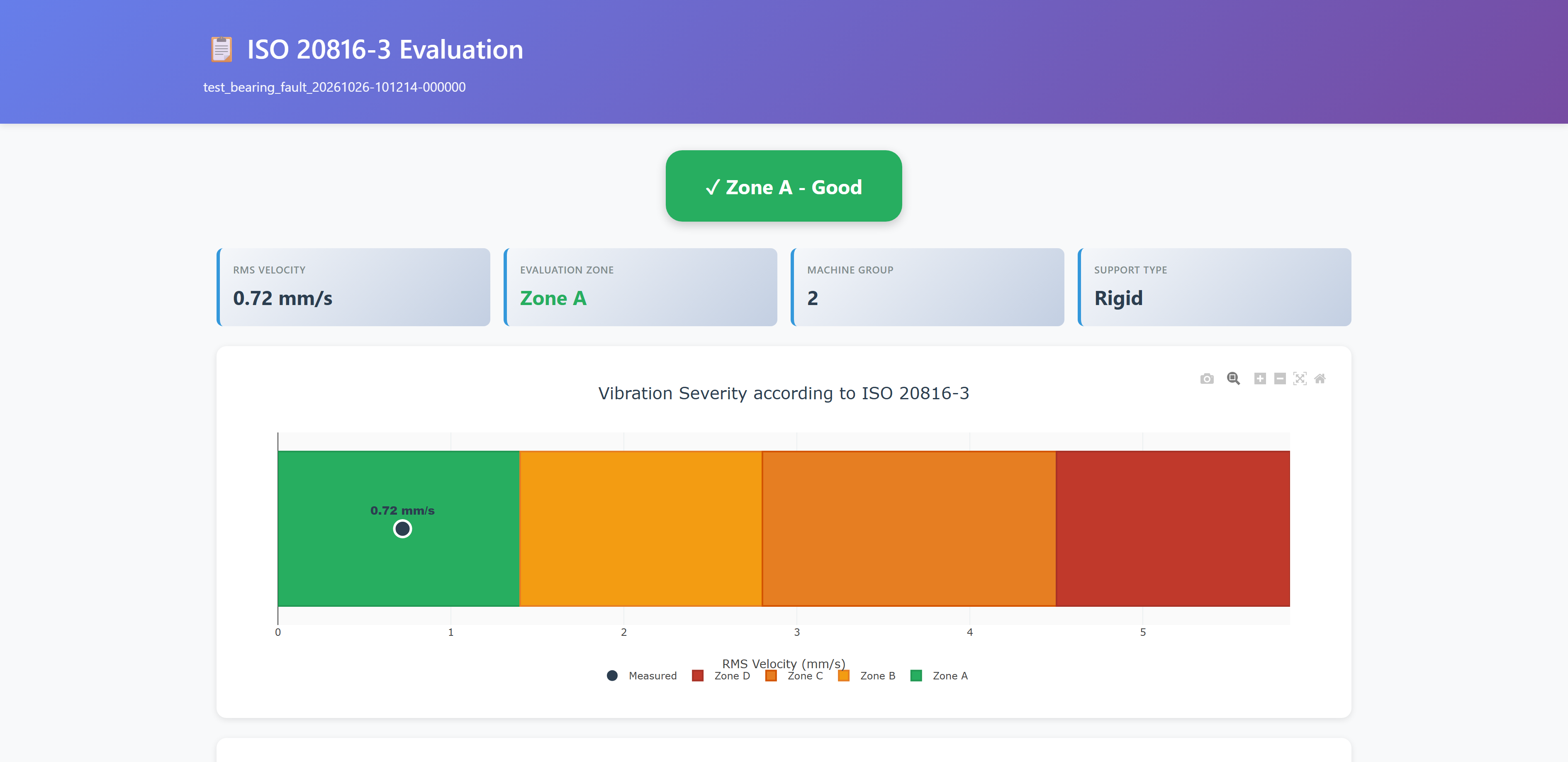
Both examples were generated from a synthetic test signal with the generate_test_signal tool. They show what the reports contain; the Zone A result does not describe a real machine.
| Report Type | What it shows |
|---|---|
| Frequency spectrum | Peak detection, harmonic markers |
| Envelope analysis | Bearing fault frequency matching |
| Severity assessment | Vibration health zones (ISO 20816-3) |
| Word document | Full diagnostic narrative with embedded charts |
| PCA visualization | Multi-signal anomaly clustering |
| Feature comparison | Side-by-side signal feature analysis |
A single diagnosis answers "what does this signal show". The asset health ledger answers "what changed on this machine since the reference": every measurement loaded with a declared identity (asset, measurement point, acquisition instant, operating conditions) is recorded in a local append-only ledger with its derived indicators, compared with the healthy baseline the engineer declares, and judged against the reference band with the rule it applied stated in the result. Four tools carry the workflow: declare_measurement_point, declare_healthy_baseline, get_asset_history and assess_asset_change. Contract and operations: Adapter Guide · worked flow: Examples · reference adapter: STWIN.box.
          YOU (natural language)
               │
               v
     LLM (Claude, GPT, Ollama...)
     understands intent, selects tools
               │
               v  ── Model Context Protocol ──
    ┌──────────────────────────────┐
    │    Predictive Maintenance    │
    │         MCP Server           │
    │                              │
    │  Signal Analysis    Reports  │
    │  Fault Detection    ML       │
    │  Severity Rating    RAG Docs │
    └──────────────────────────────┘
               │
               v
       YOUR DATA (stays local)
    signals · manuals · models
The codebase follows a modular architecture organized around the ISO 13374 Six-Block Diagnostic standard — signal acquisition, processing, diagnostics, prognostics, and decision support as separate sub-packages. Standards implemented: ISO 13374, ISO 20816-3, MIMOSA OSA-CBM. Module-level detail: Architecture guide.
Key design choices:
| Guide | For |
|---|---|
| Engineer's guide | After the first diagnosis: your own data, machine manuals, workflows |
| Quickstart for Developers | Understand MCP, extend the server |
| Tool Catalog | Every MCP endpoint, grouped by category |
| Adapter Guide | Bring vendor/DAQ raw data in via explicit declarations |
| Plugin README | Claude Code plugin installation and usage |
| HTTPS Deployment | Docker + HTTPS for enterprise environments |
| Ollama Guide | Use with local LLMs (fully air-gapped) |
| Architecture | ISO 13374 block mapping and module design |
| Benchmark Methodology | How the CWRU diagnostic benchmark is measured |
| Examples | Complete diagnostic workflows |
| Installation | Detailed setup and troubleshooting |
| Contributing | How to contribute (all skill levels welcome) |
| Changelog | Version history |
85%+ test coverage, enforced as a CI minimum, across Windows, macOS, and Linux (Python 3.11 & 3.12) — the current measured figure is on the codecov badge above.
pytest                                  # run all tests
pytest --cov=src --cov-report=html      # with coverage report
20+ test files covering signal analysis, fault detection, severity assessment, ML models, report generation, RAG search, and real bearing fault data validation.
signal_id handleIdeas? Open a discussion or create an issue.
I'd genuinely love to know. Whether you ran it on real machinery or just tried the sample data, drop a line in Discussions — one sentence about your machine or use case is enough. Real-world feedback directly shapes what gets built next.
claude-stwinbox-diagnostics — Extends this project by connecting a physical edge sensor (STEVAL-STWINBX1) to Claude via MCP, with Claude Skills for guided condition monitoring. Same analysis engine, real hardware, operator-friendly reports.
Contributions welcome from everyone — not just programmers. Domain experts, technical writers, and testers are equally valued. See CONTRIBUTING.md for paths tailored to your background.
Quick start: browse Issues for good first issue or help wanted labels.
@software{dimaggio_predictive_maintenance_mcp_2025,
  title   = {Predictive Maintenance MCP Server},
  author  = {Di Maggio, Luigi Gianpio},
  year    = {2025},
  version = {0.13.0},
  url     = {https://github.com/LGDiMaggio/predictive-maintenance-mcp},
  doi     = {10.5281/zenodo.17611542}
}
MIT, see LICENSE. The sample data in data/ is licensed separately under CC BY-NC-SA 4.0 (non-commercial); its attribution and terms are in data/LICENSE. For commercial use, replace it with your own machinery data.
MCP Python SDK (descended from FastMCP) · Model Context Protocol by Anthropic · Sample data by Eric Bechhoefer, redistributed by MathWorks · Core development assisted by Claude
An open-source predictive maintenance AI agent and condition monitoring copilot — built to support reliability engineers and the developer community.
Claim this server with your GitHub account to request manual ownership verification.
Link to the catalog listing for Predictive Maintenance MCP Server from your README. This badge does not certify ownership, compatibility or security.
[](https://awesome-mcp.com/servers/predictive-maintenance-mcp)Public repository statistics could not be verified. Check the configured source address; unavailable counts are not zero.
Separate sources, scopes and periods. Never combined or treated as installations, active users or security reviews.
No reviewed package or image identity; download statistics are not listed yet.
Alternative and complementary servers in the same category
A directory listing describing a cancellation-letter and mailing-address service. The configured public GitHub repository returned 404 during source verification.

A hosted MCP service for browsing and searching through Singapore mobile-network proxies.

A directory listing describing a Markdown-to-PDF service. The configured public GitHub repository returned 404 during source verification.