
A stateless streamable HTTP MCP server for interacting with the official source of government spending data.
Repository stats unavailable
Finance & Analytics
A hosted and local MCP server exposing RiskModels equity risk model tools such as factor decomposition, return attribution, portfolio analysis, and ETF hedge ratios to AI agents.
RiskModels MCP server for equity risk analysis is cataloged as an MCP server attributed to bluewatercorp. A hosted and local MCP server exposing RiskModels equity risk model tools such as factor decomposition, return attribution, portfolio analysis, and ETF hedge ratios to AI agents. It is categorized under finance crypto. See the capability inspector for recorded interfaces and their independent review status; consult upstream documentation for the current interface.
Installation configuration is not reviewed. No executable setup is offered for this entry; inspect the source repository before proceeding.
Catalog license label: Not specified. Check the source repository's current license and terms before using, modifying or distributing this software.
Capability definitions are not reviewed. Unreviewed imports are not exposed as trusted interfaces.
No reviewed records to display. This does not establish that upstream lacks this capability.
No reviewed records to display. This does not establish that upstream lacks this capability.
No reviewed records to display. This does not establish that upstream lacks this capability.
Email delivery is not connected. This page does not collect email addresses or create subscriptions.
Browse the registry for current listings instead.
Reviews for RiskModels MCP server for equity risk analysis are not available yet
Review publishing and storage are not connected. This page does not collect or publish ratings or comments, including after sign-in.
It uses OAuth 2.1 with PKCE, and connection allows either an API key or an OAuth2 JWT as bearer token.
Yes, the tools return data and never place orders or change your account.
The local stdio server has 25 tools, while the hosted endpoints have 26, adding an artifact rendering tool.
README.md · 6785cb6bdbcf · Fetched 2026-11-13 12:31:21 UTC
Original upstream text, without AI rewriting. Scripts, forms and unsafe links are filtered for safety.
Showing the last retrieved documentation snapshot; check the source for current changes.
RiskModels provides clean dividend-adjusted total returns, factor risk decomposition, return attribution, and ETF-executable hedge ratios for US equities — over REST, a typed SDK, and a built-in MCP server. The dataset is simulation-grade: it covers on the order of 16,000 US stocks across the full historical panel, while at each month end the model’s headline universe is the largest ~3,000 by market cap—the set the API surfaces for everyday returns, risk, and hedging.
Post-regression outputs (hedge ratios, explained-risk decompositions, and related L1–L3 series) are served from the first date whose full estimation window is covered: hedge ratios from 2010-12-08, explained-risk shares and stock variance from 2011-12-07, L* residual levels from 2013-01-01. Split- and dividend-adjusted returns (the inputs to the rolling regressions) begin 2006-01-04. The API is AI-agent ready, including a built-in Model Context Protocol (MCP) server for seamless integration with LLMs.




This repository is the authoritative public API reference for the RiskModels equity risk model API, featuring:
examples/This repository is an Agent Plugins package: plugin.json and mcp.json at the repository root. The plugin connects Cursor to the hosted RiskModels MCP server. It contains no code that runs on your machine and no credentials.
| File | What it declares |
|---|---|
plugin.json | Plugin riskmodels 1.0.0, Apache-2.0 |
mcp.json | One server, riskmodels: Streamable HTTP at https://riskmodels.app/api/mcp/openai |
riskmodels MCP server. Its tools appear once you sign in.The server uses OAuth 2.1 with PKCE. Cursor handles the flow, and nothing goes in the plugin files:
riskmodels server, the server asks for sign-in and Cursor opens a browser at riskmodels.app.riskmodels_get_my_positions reads that book.Ask in Cursor's agent chat:
Decompose NVDA's risk with RiskModels and give me the ETF hedge for a $100,000 position.
The agent calls riskmodels_decompose for the market / sector / subsector / stock-specific split of NVDA's variance and the hedge ratio at each level. Then it calls riskmodels_decompose again with a dollar amount to turn those ratios into dollar trades in SPY and the sector and subsector ETFs. The numbers are live model output as of the latest trading day.
The Claude plugin (claude-plugin/) and the local developer MCP server (.cursor/mcp.json, mcp/) are separate and unchanged.
sdk/notebooks/riskmodels_aom_colab.ipynbUse these only for integrations and tooling:
| What | URL |
|---|---|
REST base (OpenAPI servers) | https://riskmodels.app/api |
Deployed OpenAPI JSON (same spec as OPENAPI_SPEC.yaml) | https://riskmodels.app/openapi.json |
| Interactive API reference (this portal) | /api-reference |
Important: The hostname api.riskmodels.app is not used for the public API or machine-readable docs. Older links or docs that mention it should be treated as obsolete; use riskmodels.app (apex) as above.
The RiskModels API provides institutional-grade equity risk analysis:
Data coverage: ~16,000 US stocks in the historical panel; ~3,000 largest by market cap at each month end for headline outputs. Updated daily. Hedge ratios: 2010-12-08 through present. Explained risk: 2011-12-07 through present. L* levels: 2013-01-01 through present. Adjusted return series: 2006-01-04 through present.
RiskModels is designed to be useful for real portfolio work, not just descriptive analytics:
For a deeper explanation of the engine design choices behind these claims, see the methodology docs and API reference.
Prefer the Python SDK over raw REST for agent-native workflows — ticker resolution, semantic field normalization, validation with instructional errors, and LLM-ready context formatting are built in.
Install (PyPI):
pip install riskmodels-py
# Optional — xarray cube from batch Parquet/CSV:
# pip install riskmodels-py[xarray]
# Optional — snapshot PDF rendering:
# pip install riskmodels-py[pdf]
Quickstart:
from riskmodels import RiskModelsClient, to_llm_context

client = RiskModelsClient.from_env()
pa = client.analyze({"NVDA": 0.4, "AAPL": 0.6})
print(to_llm_context(pa))
Snapshot generation (institutional PDF reports):
from riskmodels.snapshots import get_data_for_r1, render_r1_to_pdf

client = RiskModelsClient.from_env()
data = get_data_for_r1("NVDA", client)       # fetch → R1Data (caches to JSON)
render_r1_to_pdf(data, "NVDA_R1_Risk.pdf")   # render → PDF (~0.3s, no API)
Documentation:
Charts below are generated from live API data (get_rankings + MAG7 L3 batch metrics) via scripts/generate_readme_assets.py. Set RISKMODELS_API_KEY (free tier is sufficient), run the script from the repo root, then commit ./assets/ and ./public/docs/readme/.
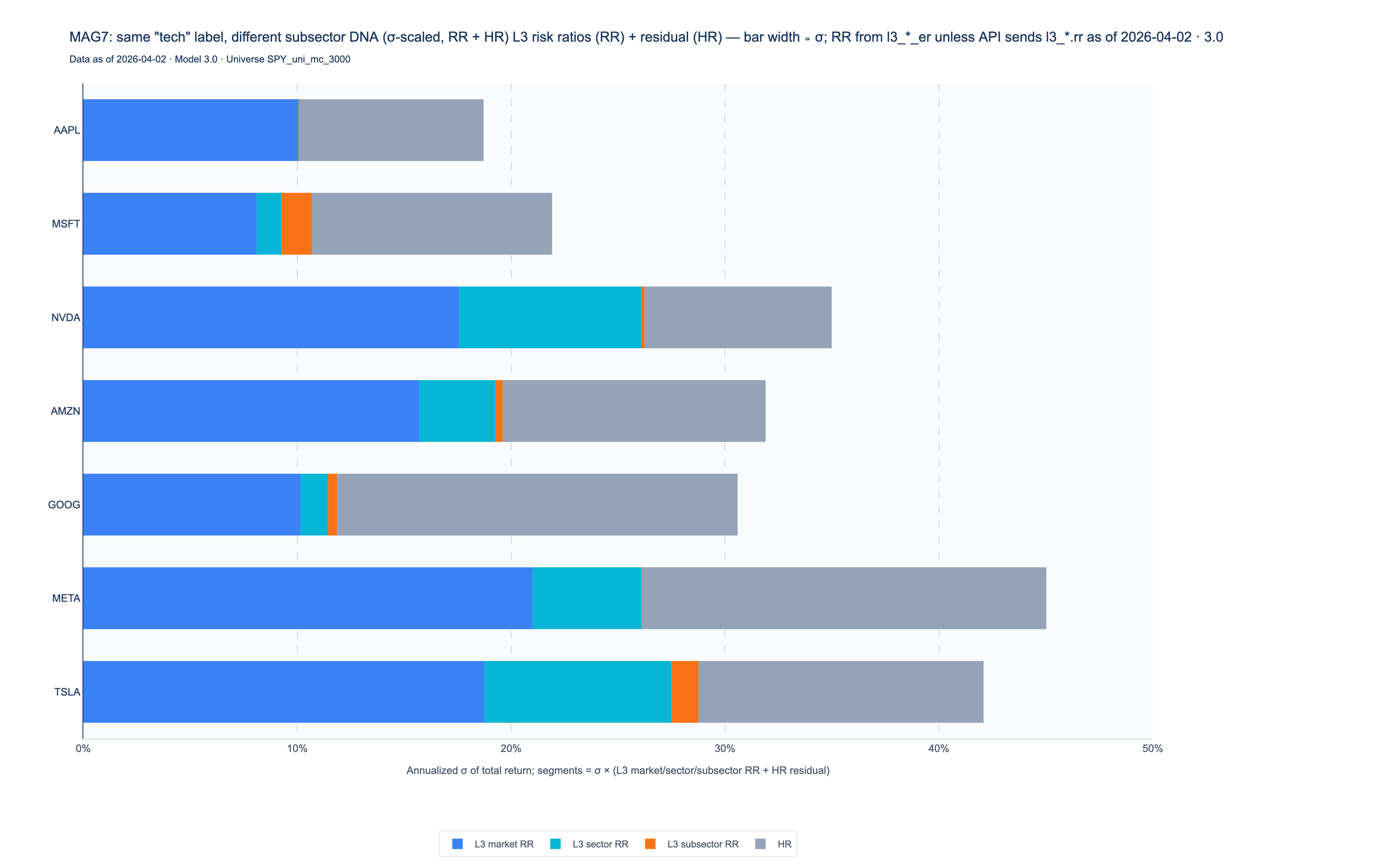
Same “tech” label, different subsector DNA — bar length ∝ annualized σ; segments = σ × L3 market/sector/subsector risk ratios + residual (HR share). POST /batch/analyze via SDK save_mag7_l3_sigma_rr_png
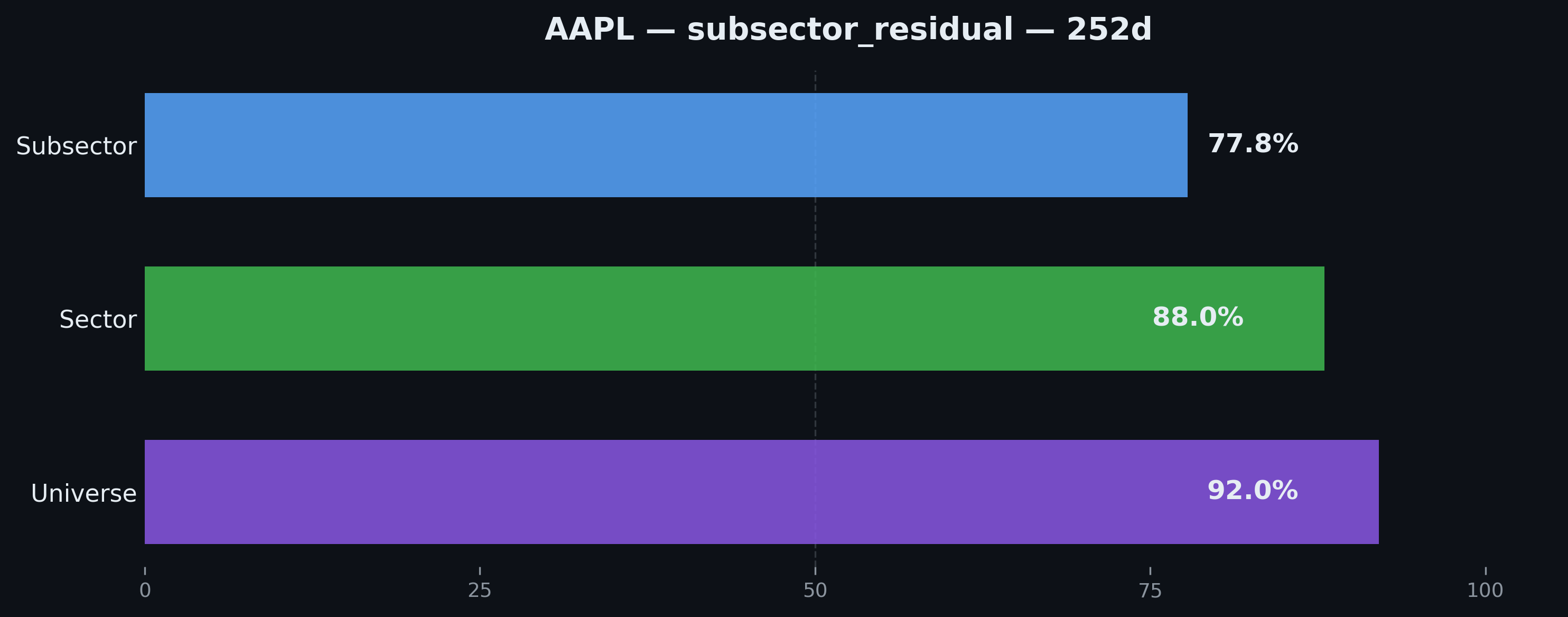
Universe / sector / subsector rank percentile breakdown
RiskModels includes a first-class MCP (Model Context Protocol) server, enabling AI agents to directly query risk data and perform factor analysis.
MCP Connection (hosted API):
https://riskmodels.app/api/mcp/api/mcp/openai and /api/mcp/sse remain supportedhttps://riskmodels.app/.well-known/mcp.json (see OPENAPI_SPEC.yaml)Local MCP server (mcp/ in this repo, @riskmodels/mcp 2.0.0) — stdio transport for Cursor / Claude Desktop / Zed. Tool set 2.0 is one registry shared with the hosted endpoints: 25 tools locally, 26 hosted (adds riskmodels_render_artifact):
riskmodels_get_stock_snapshot, riskmodels_decompose, riskmodels_compare, riskmodels_get_returns, riskmodels_get_return_attribution, riskmodels_get_residual_returns, riskmodels_get_residual_signal, riskmodels_get_macro_correlation, riskmodels_get_fundamentals, riskmodels_analyze_portfolio, riskmodels_get_portfolio_risk_snapshot, riskmodels_portfolio_exposure, riskmodels_decompose_selection_vs_drift, riskmodels_get_my_positions, riskmodels_get_rankings, riskmodels_screen_rankings, riskmodels_get_cohorts, riskmodels_get_peers, riskmodels_search, riskmodels_resolve_security_identity, riskmodels_get_filer, riskmodels_get_fund, riskmodels_get_etf, riskmodels_get_benchmark_fit, riskmodels_get_factor_returns.
The REST catalog, response schemas and OpenAPI spec are MCP resources (riskmodels:///capabilities, riskmodels:///schemas/{path}, riskmodels:///openapi). Tool list, prices and the 1.x → 2.0 migration table: mcp/README.md. Outside MCP, call the REST API or the Python SDK (riskmodels-py).
See mcp/README.md for install and config.
Anthropic Claude (Managed Agents vs Messages API): internal engineering design for optional cloud-hosted agents, billing, and compliance — see docs/ANTHROPIC_CLOUD_AGENTS.md.
riskmodels)The npm package in cli/ installs the riskmodels binary: config, SQL query (billed API or direct Supabase), schema introspection, balance, and static agent manifests.
Install from npm:
npm install -g riskmodels
riskmodels --help
Develop from this repo:
cd cli
npm ci
npm run build
npm run install:global   # optional: npm link for local testing
Publish to npm (maintainers): procedure is documented in the private BWMACRO monorepo (docs/RISKMODELS_CLI_NPM_PUBLISHING.md), not here. Only publish from the cli/ directory — the repo root Next.js app is not published to npm.
This repo now includes a Next.js developer portal with:
# Install dependencies
npm install

# Option A: Copy env template and fill in Supabase/Stripe keys manually
cp .env.example .env.local

# Option B: Use Doppler (recommended for team consistency)
# Ensure `doppler login` is done, then:
doppler secrets download --no-file --format env > .env.local

# Generate OpenAPI JSON for Redoc
npm run build:openapi

# Run dev server
npm run dev
Screenshot Capture Hygiene:
When capturing site screenshots for audit or documentation:
npm run build must complete without errorshttp://localhost:3000 and confirm pages render (not "Internal Server Error")python3 capture_site.py (requires Playwright)The script will skip pages returning HTTP 500 or containing "Internal Server Error" content. Screenshots with server errors should never be committed to the repository.
Environment Management with Doppler:
This repo uses Doppler for secrets management. The doppler.yaml is pre-configured for the erm3 project:
# Verify setup (should show project: erm3, config: dev)
doppler setup

# List all secrets
doppler secrets

# Get a specific secret
doppler secrets get STRIPE_SECRET_KEY

# Export dev secrets to .env.local for curl testing and local dev
npm run doppler:env

# Push production secrets to Vercel (requires vercel login + project link)
npm run vercel:sync-env:doppler
For curl/API testing with Doppler secrets:
# 1. Export secrets to .env.local
npm run doppler:env

# 2. Source them for your shell session
source .env.local

# 3. Use in curl commands
curl -H "Authorization: Bearer $RISKMODELS_API_SERVICE_KEY" \
  https://riskmodels.app/api/health
See DEPLOYMENT.md for detailed Vercel/Doppler integration.
Visit http://localhost:3000
# Build for production
npm run build

# Start production server
npm start
Deployment: See DEPLOYMENT.md for Vercel setup, env vars, and Supabase/Stripe config.
RiskModels_API/
├── app/                      # Next.js app
│   ├── api/                  # API routes (REST)
│   ├── page.tsx              # Hero landing page
│   ├── layout.tsx            # Root layout with Navbar/Footer
│   ├── docs/[[...slug]]/     # MDX docs renderer
│   ├── api-reference/        # Redoc OpenAPI viewer
│   ├── examples/             # Code examples showcase
│   └── quickstart/           # Quickstart guide
├── components/               # React components (new)
│   ├── Navbar.tsx
│   ├── Footer.tsx
│   ├── Hero.tsx
│   ├── CodeBlock.tsx
│   └── Logo.tsx
├── content/docs/             # MDX content (new)
│   ├── api.mdx
│   └── authentication.mdx
├── cli/                      # Command-line CLI (`riskmodels`)
├── sdk/                      # Python SDK (`riskmodels-py`) source
│   └── riskmodels/snapshots/ # Snapshot PDF pipeline (R1 shipped, R2–P4 planned)
├── examples/                 # Runnable examples
│   ├── python/
│   └── typescript/
├── mcp/                      # MCP (Model Context Protocol) server
├── public/                   # Static assets (new)
│   ├── transparent_logo.svg
│   └── openapi.json          # Generated from OPENAPI_SPEC.yaml
├── styles/                   # Global styles (new)
├── lib/                      # Utilities (new)
├── OPENAPI_SPEC.yaml         # Canonical OpenAPI spec
├── README_API.md             # API reference (source for content/docs/api.mdx)
├── AUTHENTICATION_GUIDE.md   # Auth guide (source for content/docs/authentication.mdx)
├── SEMANTIC_ALIASES.md       # Field definitions
└── package.json              # Next.js deps (new)
hsl(217, 91%, 60%)), zinc/slate dark palette| Document | Description |
|---|---|
| README_API.md | Complete API overview, endpoints, key concepts |
| API_TERMS.md | API Terms of Service (riskmodels.net/terms/api) |
| PLAID_HOLDINGS_UX.md | Plaid connection flow and holdings API user experience |
| AUTHENTICATION_GUIDE.md | Bearer token, OAuth2, Supabase JWT, rate limits |
| DOCS_PROCESS.md | Process for adding new documentation |
| SEMANTIC_ALIASES.md | Field definitions, units, formulas |
| RESPONSE_METADATA.md | _agent block, response headers, pricing |
| ERROR_SCHEMA.md | Error codes and recovery patterns |
| OPENAPI_SPEC.yaml | OpenAPI 3.0.3 specification (v3.0.0-agent) |
| docs/SNAPSHOT_ROADMAP.md | Snapshot suite roadmap, ADRs, and implementation phases |
| docs/SNAPSHOT_CONTENT_MAP.md | 8-page content spec with wireframes and JSON schemas |
| docs/SNAPSHOT_FRONTEND_ARCH.md | Pure-Matplotlib rendering pipeline architecture |
We welcome pull requests, especially to improve the OpenAPI spec — clearer descriptions, better schemas, and more examples help everyone.
OPENAPI_SPEC.yaml are encouragedexamples/content/docs/See LICENSE for details.
© 2026 Blue Water Macro Corp. All rights reserved.
Claim this server with your GitHub account to request manual ownership verification.
Link to the catalog listing for RiskModels MCP server for equity risk analysis from your README. This badge does not certify ownership, compatibility or security.
[](https://awesome-mcp.com/servers/riskmodels_api)Public repository statistics could not be verified. Check the configured source address; unavailable counts are not zero.
Separate sources, scopes and periods. Never combined or treated as installations, active users or security reviews.
No reviewed package or image identity; download statistics are not listed yet.
Alternative and complementary servers in the same category
A stateless streamable HTTP MCP server for interacting with the official source of government spending data.

A hosted, remote MCP server for Fortnox that lets AI assistants answer questions from a company's bookkeeping and propose changes for approval before writing them.

OptimistFi is a read-only remote MCP server that provides perpetual futures market data, perps prop firm rules and pricing, and US equity investment research.