

Store and retrieve entities, relations and observations in a persistent local knowledge graph.
create_entitiescreate_relationsadd_observations+6 more
92K
AI & Multi-Agent
A local-first MCP server that records decisions, attempts, facts and outcomes, then supplies relevant experience back to agent sessions.
ShadowGraph MCP Server is cataloged as an MCP server attributed to lilara-ai. A local-first MCP server that records decisions, attempts, facts and outcomes, then supplies relevant experience back to agent sessions. It is categorized under ai agents-models. See the capability inspector for recorded interfaces and their independent review status; consult upstream documentation for the current interface.
Installation configuration is not reviewed. No executable setup is offered for this entry; inspect the source repository before proceeding.
Catalog license label: MIT. Check the source repository's current license and terms before using, modifying or distributing this software.
Capability definitions are not reviewed. Unreviewed imports are not exposed as trusted interfaces.
No reviewed records to display. This does not establish that upstream lacks this capability.
No reviewed records to display. This does not establish that upstream lacks this capability.
No reviewed records to display. This does not establish that upstream lacks this capability.
Email delivery is not connected. This page does not collect email addresses or create subscriptions.
Browse the registry for current listings instead.
Reviews for ShadowGraph MCP Server are not available yet
Review publishing and storage are not connected. This page does not collect or publish ratings or comments, including after sign-in.
Full is the default with 35 tools (36 with a verifier), Compact has 16 tools, and the opt-in Workflow Profile has 20 tools adding review signals, confidence evidence, status transitions and supersession.
Canonical memory stays in a private local store, starts project-only, and wider sharing must be explicitly enabled and can be revoked.
README.md · a4b473f2c5b6 · Fetched 2026-11-13 14:12:00 UTC
Original upstream text, without AI rewriting. Scripts, forms and unsafe links are filtered for safety.
Showing the last retrieved documentation snapshot; check the source for current changes.
Carry useful development experience into the next agent session.
ShadowGraph records what worked, what failed, and why a decision was made—then supplies relevant experience when you continue working. The demonstrated automatic paths are the Windows Codex terminal wrapper and, in print mode, Claude Code CLI hooks on Windows, after one-time setup in projects you enroll.

Get started · Supported workflows · Release & downloads · Documentation
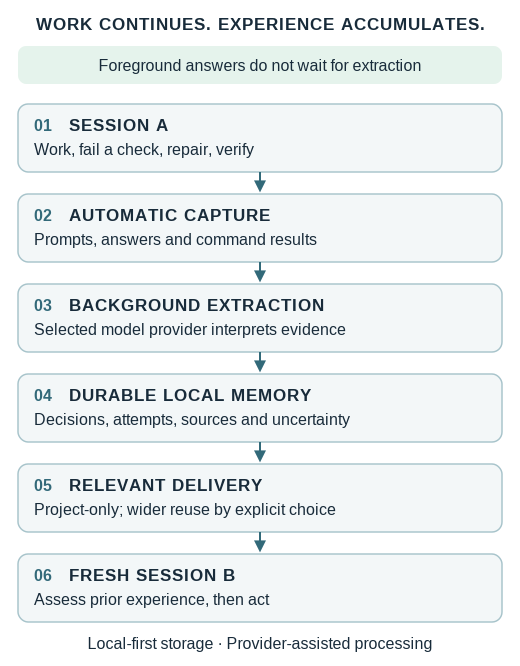
After setup, work normally. Memory processes in the background; reuse follows your project and sharing choices. Editable diagram.
In a bounded Windows demonstration, an agent ran a parser check that failed because empty fields were missing. It removed a filtering step and reran the unchanged check successfully. Its explanation included the rejected alternative: reconstructing empty fields later would lose their original positions and add complexity.
The wrapper captured the actual command results and explanation. A fresh session working on a differently delimited reader received the relevant experience automatically, identified it as prior-session evidence before its first command, and preserved empty fields in its implementation. Its check passed.
This demonstrates one working path, not perfect recall. Extraction can be delayed: two ordinary tasks completed while earlier memory was still pending, then processing recovered automatically. No memory reminder or manual extraction command was needed.
gpt-6.1-sol; other executor versions and API-key/provider overrides are not supported by this profile.The Codex executor is a separate prerequisite distributed as @openai/codex. ShadowGraph itself is not published to npm. Installing ShadowGraph alone does not enable automatic memory.
Run in PowerShell 7+. The version is pinned; the release includes SHA256SUMS.txt for the tarball.
npm install --global https://github.com/LiLara-AI/shadowgraph/releases/download/v0.44.4/shadowgraph-unified-plugin-0.44.4.tgz

$executorDir = Join-Path $env:LOCALAPPDATA 'ShadowGraph-Codex-0.161.0'
npm install --prefix $executorDir @openai/codex@0.161.0
$codexExe = (Get-ChildItem (Join-Path $executorDir 'node_modules/@openai') -Filter codex.exe -Recurse | Select-Object -First 1).FullName
& $codexExe --version
& $codexExe login status
If needed, use & $codexExe login and complete Codex's normal sign-in yourself. Select the native codex.exe, not an npm shim. Setup checks its version, binary identity and account route. Do not copy authentication files.
Run this from the project directory you want to enroll. Choose a descriptive project name; demo is an example.
$memoryHome = Join-Path $env:LOCALAPPDATA 'ShadowGraph-Codex-Memory'
$setupFile = Join-Path $env:LOCALAPPDATA 'shadowgraph-codex-setup.json'
@{
  executable = $codexExe
  hostMode = 'workspace'
  projects = @(@{ project = 'demo'; cwd = (Get-Location).Path })
} | ConvertTo-Json -Depth 5 | Set-Content -Encoding utf8 $setupFile

shadowgraph-codex.cmd setup --config $setupFile --home $memoryHome
shadowgraph-codex.cmd status --home $memoryHome
Persistent setup asks for genuine owner consent at your terminal. Review the project, executor and provider scope before confirming. Workspace permissions and managed execution rules still apply. PowerShell 7 writes this JSON as UTF-8 without a byte-order mark.
From the enrolled project, launch:
$memoryHome = Join-Path $env:LOCALAPPDATA 'ShadowGraph-Codex-Memory'
shadowgraph-codex.cmd run --home $memoryHome
Enter ordinary task prompts, one line per turn. Launch the same command again for a fresh session. Relevant memory is supplied before each new turn; you do not need to say “remember” or “search memory.” Only work launched through this wrapper is observed.
Answers appear without waiting for extraction. Pending memory retries while the wrapper is open and on later launches. Closing it stops the bounded worker; there is no permanent background daemon. For configuration, pending-state troubleshooting and limits, see the Codex guide.
| Experience | What stays attached |
|---|---|
| Decisions | Chosen approach, alternatives, reasons and conditions for reconsideration |
| Attempts and outcomes | What was tried and the observed result; inferred causes remain distinct |
| Evidence | Source quotations, captured command results and provenance |
| Current state | Corrections and supersession, while retaining history |
| Uncertainty | Model-proposed interpretation, missing conditions and limits of the evidence |
Stored records are inspectable. A model interpretation is not independently verified truth, and a useful lesson is not automatically valid in every project.
Memory starts project-only. You can explicitly share selected enrolled projects, select all currently permitted projects, exclude sources, revoke wider sharing, or pause the integration. Capture scope and read sharing are separate choices.
# From an enrolled project; use the same private home as setup.
shadowgraph-codex.cmd share --home $memoryHome --mode selected --projects demo,shared-library
shadowgraph-codex.cmd share --home $memoryHome --mode all-permitted --exclude confidential-project
shadowgraph-codex.cmd share --home $memoryHome --mode project
shadowgraph-codex.cmd pause --home $memoryHome
shadowgraph-codex.cmd resume --home $memoryHome
Replace names with your enrolled projects. Sharing is explicit and revocable, not an automatic permission detector. Corrections retain history; source dependencies prevent copied memory-informed answers from bypassing later revocation. Already displayed information cannot be erased from a transcript or a person's knowledge. Details and inspection commands.
Local-first, with a configured provider. Canonical memory stays in your private local store. Automatic extraction and host delivery send selected captured/context data through the configured model provider and require its account and network. Pattern redaction cannot guarantee every secret is removed. There is no hosted sync or telemetry. Data lifecycle, backup and deletion.
Full remains the default (35 tools, or 36 with a configured verifier). Compact remains 16 tools. The opt-in Workflow Profile offers 20 tools: Compact plus stored review signals, keyed confidence evidence, decision status transitions and explicit supersession, using the existing handlers and access controls.
graph TD
    Client["AI Agent / MCP Client"] -->|tools/list| Server["ShadowGraph MCP Server"]

    subgraph Profiles ["Three-Tier Profile Architecture"]
        direction TB
        subgraph Compact ["Compact Profile (16 Tools)"]
            C1["Core Recording: record_decision, record_attempt, record_fact, remember, record_outcome"]
            C2["Active Context: context, recall, search, retrieve, expand"]
            C3["Maintenance & Review: review, review_context, ack_review, reconsider, maintain, validate"]
        end

        subgraph Workflow ["Workflow Profile (20 Tools) - SHADOWGRAPH_MCP_PROFILE=workflow"]
            W1["Compact Profile (16 Tools)"]
            W2["+ shadowgraph_supersede (Decision correction & replacement)"]
            W3["+ shadowgraph_update_status (Lifecycle transitions)"]
            W4["+ shadowgraph_confidence_evidence (Keyed observations)"]
            W5["+ shadowgraph_review_signals (Saved signal inspection)"]
        end

        subgraph Full ["Full Catalog (35 Tools / 36 with verifier)"]
            F1["Workflow Profile (20 Tools)"]
            F2["+ Administration: backup, restore, purge, purge_preview"]
            F3["+ Advanced Graph: link, traverse, redact, journal, rebuild, repair_plan"]
            F4["+ Access & Governance: request_wider_access, revoke_grant, discard_access, bind, attribute"]
            F5["+ Optional: shadowgraph_verify_fact (with configured verifier)"]
        end
    end

    Server -->|SHADOWGRAPH_MCP_COMPACT=1| Compact
    Server -->|SHADOWGRAPH_MCP_PROFILE=workflow| Workflow
    Server -->|Default / Unset| Full
| Server environment | Inventory | Scope & Target Audience |
|---|---|---|
Profile unset; compact unset or 0 | Full: 35 / 36 | Complete administrative, access management, and deep graph engine |
Profile unset; SHADOWGRAPH_MCP_COMPACT=1 | Compact: 16 | Fast cognitive loop with low token overhead for standard tasks |
SHADOWGRAPH_MCP_PROFILE=workflow; compact unset or 0 | Workflow: 20 | Complete decision-to-attempt lifecycle and review signal management |
stateDiagram-v2
    [*] --> ContextReview: Agent starts turn
    ContextReview --> PreFlightRecall: shadowgraph_context / shadowgraph_recall

    state "Decision & Execution Lifecycle" as Loop {
        PreFlightRecall --> ProposeDecision: Formulate approach
        ProposeDecision --> RecordDecision: shadowgraph_record_decision(status='proposed')
        RecordDecision --> ExecuteAttempt: Execute tool / action
        ExecuteAttempt --> RecordAttempt: shadowgraph_record_attempt(solution, result, reusableWhen)

        state AttemptEvaluation <<choice>>
        RecordAttempt --> AttemptEvaluation: Check resultClass
        AttemptEvaluation --> ValidateOutcome: succeeded
        AttemptEvaluation --> ProposeDecision: failed (retry with lesson)

        ValidateOutcome --> RecordOutcome: shadowgraph_record_outcome(autoTransition=true, decisionStatus='validated')
    }

    state "Review & Governance Loop" as Governance {
        RecordOutcome --> MonitorFacts: Environmental changes (shadowgraph_record_fact)
        MonitorFacts --> EvaluateReview: shadowgraph_review / shadowgraph_reconsider
        EvaluateReview --> RaiseSignals: Condition violated / stale
        RaiseSignals --> AckReview: shadowgraph_ack_review(reviewSignalId)
        AckReview --> ProposeDecision: Supersede or adapt
    }
sequenceDiagram
    autonumber
    actor Agent as Autonomous Agent
    participant SG as ShadowGraph Engine
    participant Store as Local Storage
    actor Env as Target Environment

    Note over Agent,Env: Step 1: Pre-Execution Recall & Context Advisory
    Agent->>SG: shadowgraph_context({ project, task })
    SG-->>Agent: workingSet, relevantToTask, activeConditions
    Agent->>SG: shadowgraph_recall({ query, includeHistory: true })
    SG-->>Agent: rankedMemories, causalClaims, reusableAttempts

    Note over Agent,Env: Step 2: Decision Formulation & Attempt Execution
    Agent->>SG: shadowgraph_record_decision({ title, chosen, reopenWhen, project })
    SG->>Store: Save decision (revision incremented)
    SG-->>Agent: { id: "dec-...", status: "proposed" }

    Agent->>Env: Execute action / run command
    Env-->>Agent: Execution output & telemetry

    Agent->>SG: shadowgraph_record_attempt({ relatedTo: [decId], resultClass, reusableWhen })
    SG->>Store: Save attempt & link to decision
    SG-->>Agent: { id: "att-...", resultClass: "succeeded" }

    Note over Agent,Env: Step 3: Post-Execution Outcome & Lifecycle Transition
    Agent->>SG: shadowgraph_record_outcome({ decisionId, outcome, autoTransition: true, decisionStatus: "validated" })
    SG->>Store: Atomic status transition -> 'validated'
    SG-->>Agent: { status: "validated", outcome: { ... } }
| Capability Category | Compact (16 Tools) | Workflow (20 Tools) | Full (35/36 Tools) | Primary Tool(s) |
|---|---|---|---|---|
| Architectural Decisions | ✅ | ✅ | ✅ | shadowgraph_record_decision |
| Attempt Recording & Reuse | ✅ | ✅ | ✅ | shadowgraph_record_attempt |
| Bi-temporal Fact Recording | ✅ | ✅ | ✅ | shadowgraph_record_fact |
| Outcome Recording & autoTransition | ✅ | ✅ | ✅ | shadowgraph_record_outcome |
| Episodic & Procedural Memory | ✅ | ✅ | ✅ | shadowgraph_remember |
| Ranked Recall & Semantic Search | ✅ | ✅ | ✅ | shadowgraph_recall |
| Exact Search & Arabic Stemming | ✅ | ✅ | ✅ | shadowgraph_search |
| Graph Retrieval & Expansion | ✅ | ✅ | ✅ | shadowgraph_retrieve, shadowgraph_expand |
| Task Context & Advisory | ✅ | ✅ | ✅ | shadowgraph_context |
| Review Execution & Persist | ✅ | ✅ | ✅ | shadowgraph_review, shadowgraph_review_context |
| Review Signal Acknowledgment | ✅ | ✅ | ✅ | shadowgraph_ack_review |
| Signal Reconsideration | ✅ | ✅ | ✅ | shadowgraph_reconsider |
| Graph Validation & Maintenance | ✅ | ✅ | ✅ | shadowgraph_validate, shadowgraph_maintain |
| Decision Supersession | ❌ | ✅ | ✅ | shadowgraph_supersede |
| Decision Status Lifecycle | ❌ | ✅ | ✅ | shadowgraph_update_status |
| Keyed Confidence Evidence | ❌ | ✅ | ✅ | shadowgraph_confidence_evidence |
| Stored Review Signal Inspection | ❌ | ✅ | ✅ | shadowgraph_review_signals |
| Graph Traversal & Linking | ❌ | ❌ | ✅ | shadowgraph_link, shadowgraph_traverse |
| Content Redaction | ❌ | ❌ | ✅ | shadowgraph_redact |
| Backup & Restoration | ❌ | ❌ | ✅ | shadowgraph_backup, shadowgraph_restore |
| Store Purge & Quarantine | ❌ | ❌ | ✅ | shadowgraph_purge, shadowgraph_purge_preview |
| Journal & Index Rebuilding | ❌ | ❌ | ✅ | shadowgraph_journal, shadowgraph_rebuild, shadowgraph_repair_plan |
| Access Governance & Delegation | ❌ | ❌ | ✅ | shadowgraph_request_wider_access, shadowgraph_bind, attribute |
| External Fact Verification | ❌ | ❌ | Optional (36th) | shadowgraph_verify_fact |
Compact Profile Lifecycle Note: In compact profile (
SHADOWGRAPH_MCP_COMPACT=1), complete decision lifecycle and supersession are fully supported without dedicated tools: useshadowgraph_record_outcomewithdecisionStatus(orlifecycleStatus/autoTransition: true) to transition lifecycle states, andshadowgraph_record_decisionwithsupersedes: [id]to replace earlier decisions. Dedicated tools (shadowgraph_update_status,shadowgraph_supersede) are available only in workflow and full profiles.
| When you need to... | Use this tool | Do NOT use | Why? |
|---|---|---|---|
| Retrieve ranked facts, procedural lessons, and temporal history for a prompt | shadowgraph_recall | shadowgraph_search | recall computes relevance scoring, temporal validity, and returns structured history chains; search is strict term-matching. |
| Find records containing specific keywords or Arabic stems across tasks/tags | shadowgraph_search | shadowgraph_retrieve | search supports partial match fallback (matchMode: 'partial') and Arabic root normalization. |
| Find a focal record and walk its immediate neighbors | shadowgraph_retrieve | shadowgraph_traverse | retrieve is available in Compact/Workflow; traverse requires Full mode and does multi-hop graph traversal (depth 1–10). |
| Fetch immediate project working set and active conditions without writes | shadowgraph_context | shadowgraph_review_context | context is a read-only fast path saving nothing; review_context evaluates and commits review signals. |
| Inspect pending review signals without triggering reevaluation | shadowgraph_review_signals | shadowgraph_review | review_signals inspects already stored signals (Workflow/Full); review runs live condition evaluations against all recorded facts. |
| Replace an obsolete decision with an updated architectural choice | shadowgraph_supersede (Workflow/Full) or shadowgraph_record_decision with supersedes (Compact) | shadowgraph_record_outcome | Dedicated shadowgraph_supersede (workflow/full) or shadowgraph_record_decision(supersedes) (compact) preserves both decisions with an explicit superseded link; record_outcome validates or closes an existing decision without replacing it. |
| Close out a decision after completing execution | shadowgraph_record_outcome | shadowgraph_update_status | record_outcome with autoTransition: true or decisionStatus records lessons and advances lifecycle in one atomic call. Dedicated shadowgraph_update_status is available in workflow and full profiles. |
Set the environment on the MCP server process, then restart/reconnect and refresh
tools/list. There is no agent-callable mode switch. Workflow does not expose
administrative repair or destructive cleanup. See the configuration and workflow
guide.
Use shadowgraph_search for literal every-term matching, shadowgraph_recall
for ranked experience, shadowgraph_retrieve for matches plus ordered graph
neighbours, shadowgraph_context for a working set without saving signals, and
shadowgraph_expand for a returned context-line handle. In Workflow or Full,
shadowgraph_review_signals reads saved review signals; shadowgraph_review,
shadowgraph_review_context and shadowgraph_reconsider evaluate reopen rules
and persist signals. Access-key reads save a bounded audit. See the read and
review guide.
| Workflow | What this preview establishes |
|---|---|
Windows shadowgraph-codex run | Installed command-executing workflow; automatic capture, background extraction, fresh-session delivery and recovery after delay/failure |
| MCP, CLI, HTTP and JavaScript API | Explicit record/read operations; MCP exposes 16 compact or 35 full tools. Tool calls alone do not observe all work |
| Claude Code CLI hooks (Windows) | After one-time setup on Claude Code CLI 2.x (verified on 2.1.302 and 2.1.312, print mode): durable capture under contention, automatic extraction by an owner-selected model, delivery to fresh sessions, corrections of decisions (a decision kept verbatim is linked and marked as corrected, not closed) and revocable sharing. On Windows, use Claude Code 2.1.312 or later: up to 2.1.302, claude -p exits only after the extraction worker it started finishes (up to 4 minutes; the result is printed first). See the Claude Code guide for what was verified and its limits. Claude Desktop, the interactive TUI, resume, macOS and Linux are not verified |
| Codex Desktop UI or ordinary CLI launched elsewhere | Not observed by this wrapper |
| Glama MCP container | Credential-free MCP surface; cannot capture a user's Windows Codex sessions by itself |
The accepted Glama release read back on 2026-11-03 has display label 0.42.6 and runtime 0.43.2, with the 20-tool Workflow profile. See the release/runtime identity mapping. A new package release alone does not update that container.
Store fences require a local filesystem with exclusive hard-link creation (tested on Linux and Windows CI). Network/shared filesystems, cross-host stores, mixed Windows/WSL writers and concurrent old/new runtime writers are not supported. Stop every writer and back up private state before upgrading; schema 7 is unchanged.
A live PID keeps its lock even if its timestamp is old. Stale store locks with a
dead owner are reclaimed serially. A .lock.reclaim guard is never stolen merely
because it is old: a suspended owner is indistinguishable from a crashed one.
If a crashed reclaimer leaves this guard while a stale store lock still needs
reclamation, writes time out with
storage_lock_timeout. Stop every process using that store (including hooks and
workers), preserve a private backup, positively identify the exact orphan guard,
then remove only that guard and retry. Follow the
stopped-writer recovery checklist.
Do not remove a live writer's lock or infer an orphan from age alone.
Lock-candidate .lock.*.candidate files contain ownership tokens, not store content;
a process killed before linking can leave one. Remove such orphans only with all
writers stopped.
Capture retries track an entry's stable payload key throughout one hook, including when another hook has renamed the file. A non-contention failure consumes at most one attempt per hook; after eight failed hook cycles the entry is dropped with a content-free marker. Store contention, deadline exhaustion and newer schemas leave input pending without consuming an attempt. Pending input survives hook restarts; the existing seven-day age and spool-size bounds still apply. This patch adds no new live model or automatic-memory support claims.
Each host turn has a 120-second process limit. Background extraction has bounded calls, retries and concurrency; a backlog can remain honestly pending. Native command events and user/assistant text are captured, but not every native tool-event type. Retrieval happens between turns, not inside a running turn.
For Claude Code CLI, delivered experience is not always applied: in one live run a fresh session received an earlier lesson and did not apply it. After extraction is deactivated and activated again, items left pending under the earlier setup are not extracted; status reports them as priorSetup. The Claude Code evidence is one Windows print-mode (claude -p) path, not every host.
This is Release v0.44.4, not stable/GA. There are no claims of perfect semantic classification, universal language support, cost or time savings, superiority over native memory, or a human third-party security audit. See release notes, security scope and benchmark status.
0.43.2 tightens automatic correction evidence and transient file-error recovery, and reports capture gaps and loss-count saturation. Review acknowledgement keeps its accurate Destructive hint; a journal does not make replacement of current state additive. Patch details and recovery.
Stop active work and back up your stores and private integration home before upgrading. v0.43.2 retains schema 7; changed source/executor/account identity requires setup again. Older pending work with different setup provenance is held, not silently reassigned. Upgrade and rollback guide.
The historical schema-5/schema-7 migration and downgrade instructions remain in the migration guide. Preserve a backup made before upgrading.
| Need | Guide |
|---|---|
| Automatic Windows setup, sharing, limits and troubleshooting | Codex integration |
| Manual installation, MCP configuration, CLI/HTTP/JavaScript and storage | Manual usage |
| Other clients and existing hooks | Integrations · Claude extraction |
| API and protocol details | API reference · MCP compatibility |
| A decision that reopens when conditions change | Decision-memory demo |
| Privacy, backups and recovery | Data lifecycle · Migration |
| Development and feedback | Contributing · Issues · Discussions |
Please redact private paths, prompts, stores and credentials before reporting an issue. Report security vulnerabilities privately.
MIT license. No npm publication, paid hosting or standing extraction is implied by installing this release.
Claim this server with your GitHub account to request manual ownership verification.
Link to the catalog listing for ShadowGraph MCP Server from your README. This badge does not certify ownership, compatibility or security.
[](https://awesome-mcp.com/servers/shadowgraph)Public repository statistics could not be verified. Check the configured source address; unavailable counts are not zero.
Separate sources, scopes and periods. Never combined or treated as installations, active users or security reviews.
No reviewed package or image identity; download statistics are not listed yet.
Alternative and complementary servers in the same category
Store and retrieve entities, relations and observations in a persistent local knowledge graph.
Organize problem solving into revisable, branching thought steps through an MCP tool.

Query-aware context compression with an MCP plugin for coding agents, plus Python and HTTP interfaces for reducing the context sent to a language model.