License: GNU AGPL-3.0•Runtime: Awaiting documentation review•Category:search web
WHAT IT DOES
•Provides multi-engine web search with rank fusion, ML reranking, and an explainable per-result score, supporting query arrays and domain/time filters.
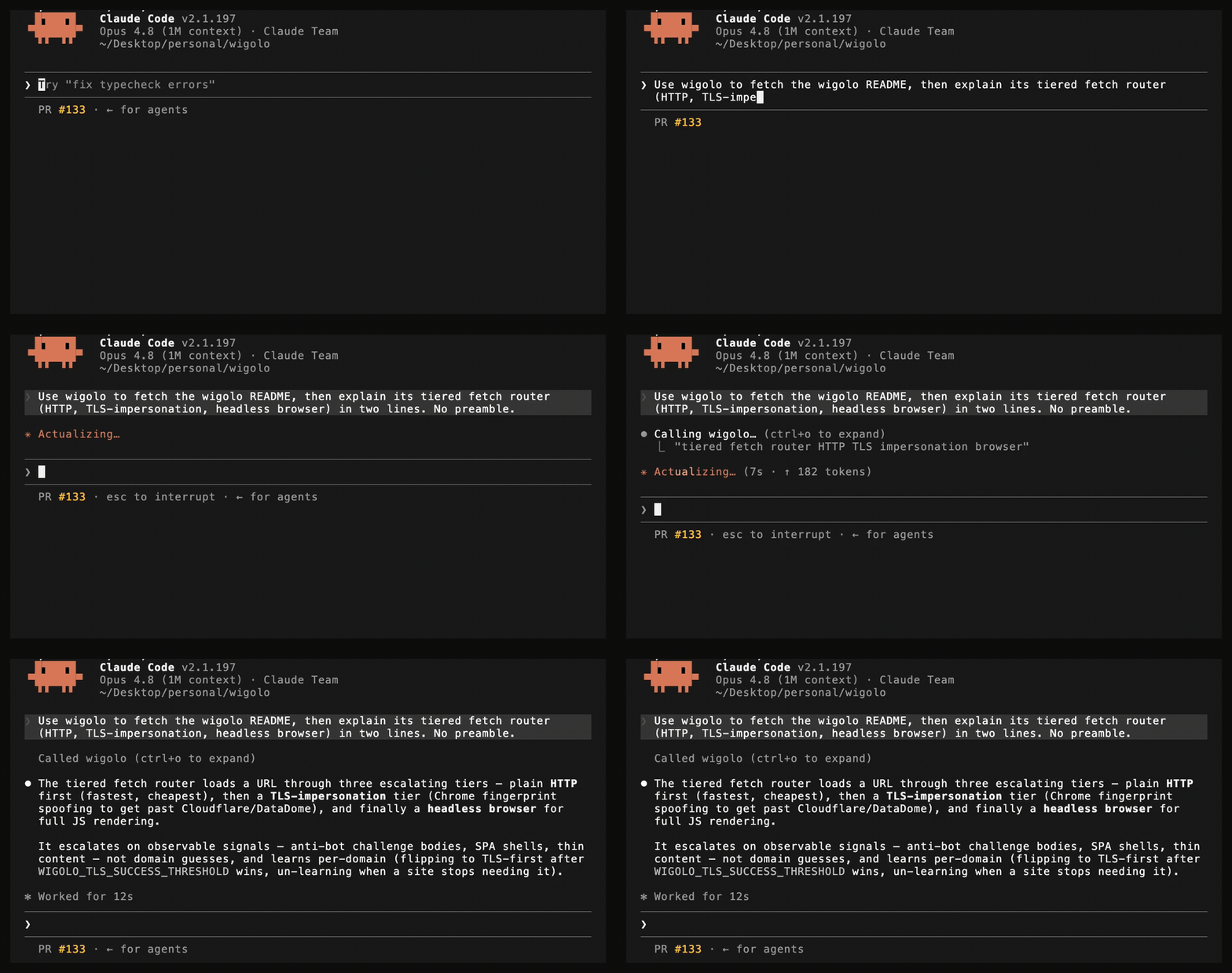
•Fetches a URL through a tiered router that escalates to a headless browser on anti-bot challenges or SPA shells, returning clean markdown, metadata, and links.
•Crawls multiple pages with BFS, DFS, sitemap, or map-only modes, respecting robots.txt and per-domain rate limits with boilerplate dedup.
•Extracts structured data such as tables, metadata, JSON-LD, named schemas, or custom JSON Schema; also caches everything seen and can detect page changes.
BEST FOR
•Giving coding agents like Claude Code and Cursor a keyless local web search and fetch capability via MCP.
•Self-hosted agents that need web tools over REST or a remote MCP endpoint.
•Running cited research or autonomous gather loops where sources are fetched and synthesized into a report.
ABOUT WIGOLO
wigolo is cataloged as an MCP server attributed to knockoutez. A local-first MCP server that provides AI agents with web search, fetching, crawling, extraction, caching, and research tools without API keys. It is categorized under search web. See the capability inspector for recorded interfaces and their independent review status; consult upstream documentation for the current interface.
HOW TO INSTALL
Installation configuration is not reviewed. No executable setup is offered for this entry; inspect the source repository before proceeding.
LICENSE
Catalog license label: GNU AGPL-3.0. Check the source repository's current license and terms before using, modifying or distributing this software.
Capability inspector
Capability definitions are not reviewed. Unreviewed imports are not exposed as trusted interfaces.
Tools (0)
No reviewed records to display. This does not establish that upstream lacks this capability.
Resources (0)
No reviewed records to display. This does not establish that upstream lacks this capability.
Prompts (0)
No reviewed records to display. This does not establish that upstream lacks this capability.
NEWSLETTER - COMING LATER
Newsletter subscriptions are not open yet
Email delivery is not connected. This page does not collect email addresses or create subscriptions.
Browse the registry for current listings instead.
Community Reviews
Coming later
Reviews for wigolo are not available yet
Review publishing and storage are not connected. This page does not collect or publish ratings or comments, including after sign-in.
FREQUENTLY ASKED QUESTIONS
Does wigolo require API keys or cloud services for its core tools?
Search, fetch, crawl, extract, cache, and find-similar work with no API key; research, agent, and search answer mode can use an LLM but also hand back a raw brief without one.
Where does the data and models live?
Cache, embeddings, models, and config live under a local directory, and nothing reaches a third party unless an LLM is explicitly opted into for synthesis.
Can it be used with remote MCP clients?
Yes, the serve process exposes MCP endpoints from the same port as its REST API, requiring a bearer token when bound beyond loopback.
Join the community on Discord — questions, help, and what's being built next.
New features and updates ship steadily. Follow @yourtowhid on X for all of it and new ways to use wigolo, and reach out there for collaborations or feedback · also on LinkedIn
wigolo gives an AI agent one surface for everything web-related: search, fetch, crawl, extract, cache, find-similar, research, and autonomous gather loops. It runs wherever your agent runs — as an MCP server next to your coding agent, as a REST/MCP endpoint on the box where your self-hosted agents live, or embedded through an SDK inside your own app. The core tools need no API keys, nothing it touches leaves ~/.wigolo/, and no bill grows with how much your agent thinks.
Quickstart
npx wigolo init                              # set up the local engine — any system
npx wigolo init --agents=claude-code,cursor  # …or set up + wire your day-to-day agents in one command
Requires Node ≥ 20 and ~1.5 GB of free disk on macOS, Linux, or Windows. Bare init sets up the local engine: it downloads the browser engine and on-device models, runs a health check, and reports each component. Adding --agents wires the named agents in the same run, so a coding agent you use daily is ready in one command.
Supported agents — --agents takes any of claude-code · cursor · codex · gemini-cli · opencode · vscode · windsurf · zed · antigravity (comma-separated); wigolo writes the MCP config and, where supported, instructions for each.
Any other setup — any MCP client, agent framework, or self-hosted agent registers npx -y wigolo in its own MCP config. The installation guide has the exact config block for every client, plus Docker, Homebrew, and single-file-binary channels.
More on the way — the supported list keeps growing, and a PR to add your agent is welcome; see CONTRIBUTING.md.
Interactive setup — --interactive is a plain-text flow; --wizard is the full terminal TUI.
Defer downloads — --no-warmup waits until first use. A failed component download never fails setup; init reports what's not ready with the exact fix and still completes.
init is unattended by default, so it's safe in scripts and CI, and any setup problem surfaces right here in the per-component report, before your agent's first call. Search, fetch, crawl, extract, cache, and find-similar work with no API key. Check it's healthy anytime:
npx wigolo doctor
To remove everything cleanly, run npx wigolo config --uninstall --yes. You can also paste the installation guide into any AI assistant and let it do the setup; it's written to be self-contained.
Recommended — a free key for research & agent
Search, fetch, crawl, extract, cache, and find-similar are fully keyless. research, agent, and search format=answer use an LLM to write the synthesized, cited answer. Without one they hand back a raw brief and evidence for your agent to assemble. A free Gemini key turns that into a finished answer:
export WIGOLO_LLM_PROVIDER=gemini
export GEMINI_API_KEY=<free-key>      # grab one at aistudio.google.com/apikey — the free tier is plenty
Any provider works (anthropic · openai · groq), or stay fully local and keyless with WIGOLO_LLM_PROVIDER=ollama (or any OpenAI-compatible URL). Set it in your shell or your agent's MCP env block. Providers, models, and the keyless local-model ladder are in the configuration guide.
What your agent gets back
Every search result is evidence the agent can act on. It carries a verbatim excerpt pinned to its exact position in the source, a citation ID the agent can quote, and a score it can inspect (abridged real shape):
Weak results get flagged as junk by wigolo's own scorer. Failed engines are reported and stale cache is labeled, so the agent always knows what it's standing on. Full response contracts per tool are in the tools reference.
Tools
Tool
What it does
🔎 search
Multi-engine web search (18 direct adapters) with rank fusion, ML reranking, and an explainable per-result score. Pass a query array for parallel breadth. Scope by domain and time range, match an exact phrase, or return image results.
📄 fetch
Load one URL through a tiered router that auto-escalates from plain HTTP to a headless browser engine on anti-bot challenges or SPA shells. Clean markdown + metadata + links. Handles PDFs, a single-heading section, authenticated sessions, and page actions (click / type / scroll / screenshot).
Structured data from a page: tables, metadata, JSON-LD, brand identity, named schemas (Article / Recipe / Product / …), or any custom JSON Schema.
💾 cache
Query everything already seen — keyword or hybrid semantic. Plus stats, clear, and change detection.
🧲 find_similar
Pages similar to a URL or a concept, via 3-way fusion of keyword + semantic + live web.
🧠 research
Decompose a question → fan out sub-queries → fetch sources → synthesize a cited report (or a structured brief the host LLM writes from).
🤖 agent
Autonomous gather loop: plan → search → fetch → extract → synthesize, with a step log, time budget, and optional output schema.
🔁 diff + ⏱️ watch
See exactly what changed on a page since last visit; re-check on demand and deliver changes to a webhook.
Every tool also runs from the terminal (wigolo search "…" --json), from an interactive shell with NDJSON piping (wigolo shell), over REST, and through the SDKs — CLI reference. Per-tool guides with the full parameter set are in docs/tools.md; runnable examples are in examples/.
Why it's different
wigolo isn't a free stand-in for the paid tools — it's built to match them. It's a focused web layer for your agents: an MCP and REST surface they call directly, with the search and extraction quality the paid services charge for. What separates it:
Built for agents. One MCP call fans out many queries across many engines in parallel, which a serial host tool-loop can't replicate. Every result carries transparent per-result scoring, and output is budget-aware.
Honest output. Stale cache, failed fetches, degraded backends, and truncation are surfaced in the result. When a bot-protected page can't be read, you get a labeled blocked_by_challenge failure, not a challenge shell returned as content.
$0 per query, free to re-query. Default search talks to public engines through direct adapters; the reranker and embeddings run on-device. Every response is cached, so asking again is instant and costs nothing.
Private by default. Cache, embeddings, models, and config live under ~/.wigolo/. Nothing reaches a third party unless you explicitly opt into an LLM for synthesis.
Here's what one real result looks like, dissected. It includes the failed engine and the weak result, because those are part of the answer too:
Benchmark
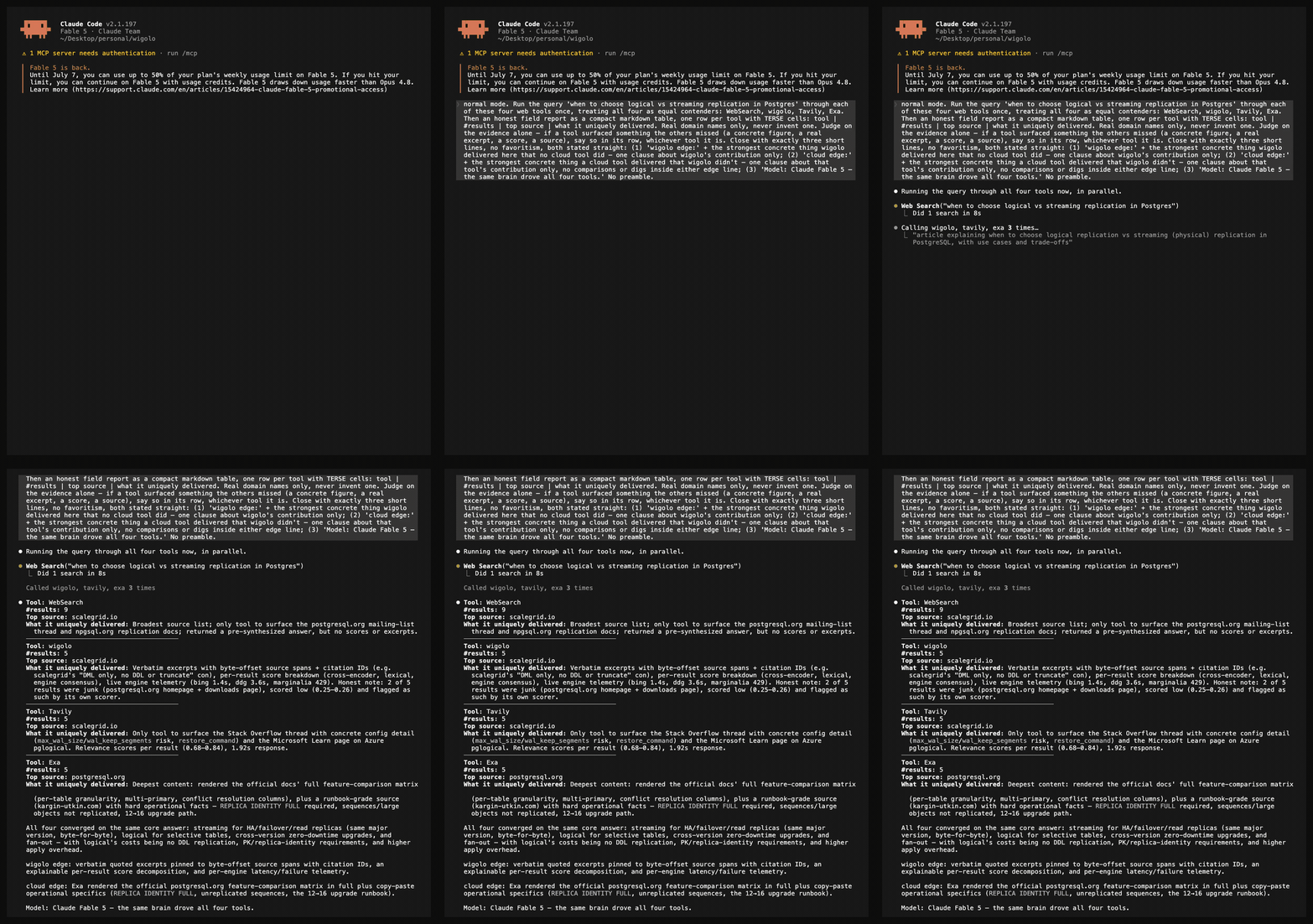
All four tools converged on the same core answer, and only one of them handed back verbatim, byte-pinned evidence while doing it.
One cold query ran live inside a single Claude Fable 5 session, fanned out to four web tools on equal footing (built-in WebSearch, wigolo, Tavily, Exa), and was judged by the agent on the evidence alone. All four converged on the same answer and the same top source, so the parity is demonstrated on-screen. wigolo alone returned verbatim excerpts pinned to byte-offset source spans, an explainable score decomposition, and live per-engine telemetry, and its own scorer flagged two weak results as junk. The cloud tools earn their place too: Exa rendered the official docs' comparison matrix in full. Run your own query and you'll see the same shape.
How it compares
wigolo
Firecrawl
Exa
Tavily
Multi-engine web search
✅
✅
✅
✅
Fetch & structured extraction
✅
✅
✅
✅
Whole-site crawl & map
✅
✅
—
✅
Verbatim excerpts pinned to byte-offset source spans
✅
—
—
—
Explainable per-result score decomposition
✅
—
—
—
Persistent local memory — re-query instantly, offline
✅
—
—
—
Query data stays on your machine
✅
—
—
—
API key / account
none
required
required
required
Cost per query
$0
metered
metered
metered
Feature standing as of July 2026 — check each vendor's docs for current state.
That last row compounds, because agents ask in bursts:
Beyond your editor
The same ten tools serve every kind of agent, over whichever surface fits: MCP for coding agents, REST for everything else, SDKs to embed, and framework wrappers to drop in.
REST API — wigolo serve
One process exposes a plain-JSON REST API next to the MCP transport. No MCP client needed, just curl:
wigolo serve                          # 127.0.0.1:3333 — loopback is open; off-loopback requires a token

curl -sX POST http://127.0.0.1:3333/v1/search \
  -H 'Content-Type: application/json' \
  -d '{"query":"local-first software","max_results":5}'
POST /v1/{tool} covers all ten tools, GET /openapi.json is the OpenAPI 3.1 contract, and /mcp + /sse serve remote MCP clients from the same port. Bind past loopback and a bearer token is required, so the server fails closed by default. Point n8n, a Hermes-style assistant, or any self-hosted agent at it. → REST API
SDKs — TypeScript & Python
Thin, typed clients with an embedded local mode that finds or starts the daemon for you. No separate serve step.
import { createLocalClient } from 'wigolo-sdk/local';

const { client, close } = await createLocalClient();   // reuse a running daemon, or spawn one
const res = await client.search({ query: 'local-first web search', max_results: 5 });
console.log(res.results.map((r) => r.title));
await close();                                          // stops the daemon only if this call spawned it
from wigolo import local_client

with local_client() as client:                          # reuse a healthy daemon, or spawn one
    res = client.search(query="local-first web search", max_results=5)
    for r in res["results"]:
        print(r["title"], r["url"])
Drop wigolo's tools into the framework you already use. You get the full ten-tool surface, including the cache / find_similar / research / agent that most framework web-tools don't ship:
Framework
Package
What you get
LangChain
wigolo-langchain
each tool as a BaseTool, plus a BaseRetriever over search / find_similar for RAG
CrewAI
wigolo-crewai
wigolo_tools() → hand the set to any crew
LlamaIndex
wigolo-llamaindex
a BaseReader that loads fetched / crawled / searched pages as documents
Vercel AI SDK
wigolo-vercel-ai-sdk
tool factories for generateText / streamText, edge-friendly
# stdio MCP — wire it into any MCP client as command: docker
docker run -i --rm -v wigolo-data:/data ghcr.io/knockoutez/wigolo

# HTTP server for remote / multi-client use
docker run -p 3333:3333 -v wigolo-data:/data \
  -e WIGOLO_API_TOKEN=a-long-random-secret \
  ghcr.io/knockoutez/wigolo serve --host 0.0.0.0
The slim image lazy-loads models into the volume; ghcr.io/knockoutez/wigolo:latest-full preinstalls the browser engine. Versioned releases use the same -full suffix (for example, 0.3.1-full). Also on Docker Hub as towhid69420/wigolo. → installation & all channels
Agent skills
An 11-pack skill catalog teaches your coding agent to drive each tool well. It's installed by init and managed with wigolo skills add|list|remove. → skills
One note for self-hosters: some challenge-protected sites score IP reputation, so a datacenter IP won't clear walls a home connection would. wigolo labels those failures, and the self-hosting guide covers the opt-in proxy answer.
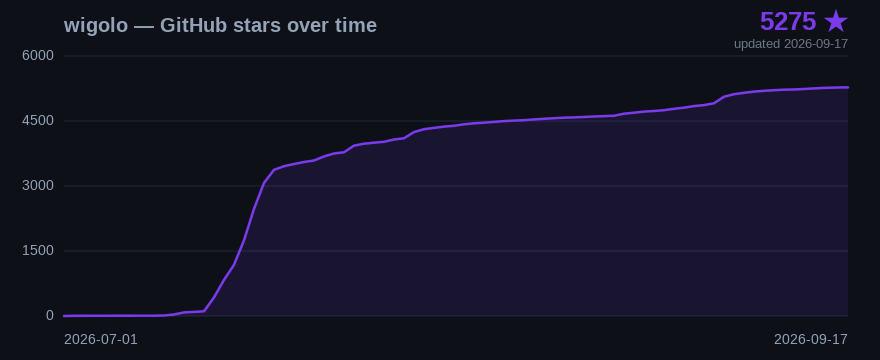
Star history
Refreshed daily from the GitHub API. Add a ⭐ if wigolo is useful to you.
Architecture
A single Node process speaks MCP (JSON-RPC over stdio). Everything heavy is local and lazy-loaded, so a zero-key install pays nothing for the parts it isn't using.
flowchart TD
    A["🤖 AI agent<br/>any MCP client · REST · SDK"]
    A -->|MCP over stdio| B["<b>wigolo</b><br/>10 tools · dynamic instructions<br/>in-process browser pool + cache + models"]

    B --> C{"Tool layer"}
    C --> T1["search · fetch · crawl · extract"]
    C --> T2["cache · find_similar · research · agent"]

    T1 --> F["⚙️ Fetch router<br/>tiered escalation, learned per domain"]
    T1 --> S["⚙️ Search<br/>18 engines → rank fusion → ML rerank<br/><i>explainable evidence score</i>"]
    T2 --> DB[("🗄️ Local cache<br/>keyword + vector index")]
    T2 --> ML["🧠 On-device ML<br/>embeddings + reranker"]

    F -.->|optional| LLM["☁️ LLM<br/>synthesis only · opt-in"]
    S -.->|optional| SX["🔀 Aggregator backend<br/>opt-in legacy / hybrid"]

    F --> WEB["🌍 Public web"]
    S --> WEB

    style B fill:#7c3aed,stroke:#5b21b6,color:#fff
    style WEB fill:#0ea5e9,stroke:#0369a1,color:#fff
    style DB fill:#1e293b,stroke:#334155,color:#fff
    style LLM stroke-dasharray: 5 5
    style SX stroke-dasharray: 5 5
Code beats model. Deterministic work stays off the LLM: canonicalization, rank fusion, dedup, and schema matching. The model is reserved for judgment, opt-in, and capped per request. LLM-filled fields are checked against the source and nulled if absent.
Signal-driven routing. The fetch ladder escalates to a real browser on observable signals, not domain guesses: SPA markers, challenge bodies, thin content. It learns per domain, unlearns when a site stops needing it, and wigolo tune list shows you exactly what it learned.
Reads pages the way a browser does. Tiered fetching waits out interstitial challenges and reuses clearances per domain, politely: robots.txt respected, per-domain rate limits, research-grade volumes. When a wall stays up, the failure is labeled and reported.
Configuration
A clean install works out of the box. Three settings raise output quality:
# 1. Synthesis — the biggest lever (research / agent / search-answer write real prose)
export WIGOLO_LLM_PROVIDER=gemini                   # or anthropic / openai / groq / ollama (keyless)
export GEMINI_API_KEY=<your-key>

# 2. Wider retrieval funnel
export WIGOLO_SEARCH=hybrid                         # core engines + aggregator fallback
export WIGOLO_GITHUB_TOKEN=...                      # GitHub code search 10 → 30 req/min

# 3. Land more fetches, stay warm
export WIGOLO_TLS_TIER=auto                         # per-domain learned fetch hardening
export WIGOLO_EAGER_WARMUP=1                        # pay the ~1s model load up front
Per-call habits that pay off: query arrays (["a","b","c"]) for parallel breadth · search_depth: "deep" for queries that matter · include_domains as a hard filter for docs lookups. The full reference covers every environment variable, config-file key, search backend, cache TTL, and serve limit; it's in the configuration guide.
examples/ — runnable, each with a README (and most with a terminal recording): one-shot CLI, NDJSON shell pipelines, REST via curl, TypeScript & Python SDKs, Vercel AI SDK tools, pointing self-hosted n8n at a remote wigolo, watch-with-webhook, and writing your own search-engine plugin. The docs are also rendered on the site at wigolo.app/docs.
Beta & feedback
wigolo is in public beta. Everything documented here works and is held to a 7,600-test suite; it's stable, and beta is about the polish bar. It stays beta until enough people have used it, kicked it, and starred it that calling it v1 means something. Your feedback shapes what comes next, and every report is read, usually the same day:
If wigolo earns a place in your setup, three things keep it going: a ⭐ star (it's how open source gets found), a ☕ coffee (the open-source version is the full product; commercial licenses fund it, not gated features), or an email that goes straight to the one developer who wrote the code.
Troubleshooting
wigolo doctor names any broken component and the exact env var or command that fixes it; wigolo doctor --fix repairs the common cases, and wigolo verify health-checks every component. A component failing during init doesn't break wigolo: init still exits 0, and core search / fetch / crawl / extract / cache work with no models and no browser. Quick hits:
Slow or failed downloads — re-run wigolo warmup --all (or --browser / --embeddings / --reranker); they resume and retry.
Browser won't launch on Linux — wigolo warmup --browser installs the OS libraries (or prints the exact command).
Native build error / unusual Node — use an LTS — Node 22 or 24 — or Node 26 (supported; Current until it becomes LTS).
Behind a proxy — USE_PROXY=true + PROXY_URL; add NODE_EXTRA_CA_CERTS for TLS-inspecting proxies.
Your agent asks permission on every call — allow the tools in your client, then restart it; rules are read at session start. Details.
The full guide covers per-symptom fixes, a "what still works when X fails" map, platform notes (incl. linux-arm64), and offline installs: docs/troubleshooting.md.
FAQ
Free? What's the catch?
No catch by design. The expensive parts (ranking, embeddings, the browser engine) run on your hardware, so there's no per-query cost to recover and no reason for a meter. It's funded by commercial licenses and sponsors, and the AGPL legally prevents a switch into a closed hosted product.
Is the quality really on par with the paid services?
The benchmark section above is a live 4-way run you can reproduce: everyday agent queries land at parity, the paid tools still win some deep-extraction edge cases, and crawling is where wigolo is strongest. Every result shows its scoring, so you don't have to take anyone's word for it.
Won't public search engines block or rot?
It's engineered for exactly that: 18 engines fused with rank fusion (any one failing barely moves results), a tiered fetch ladder with per-domain learning, and an optional aggregator fallback. Degraded backends are reported in the output, and the local cache means everything already seen keeps working regardless.
Is this kind of scraping OK?
wigolo reads the public web the way a browser does: robots.txt respected by default, per-domain rate limits, and research-grade volumes for one agent on one machine. It sits deliberately at the polite end of the spectrum.
Can I use this at work?
Yes. If you're a company or building a commercial product on wigolo, please take a commercial license or sponsor the project. See LICENSING.md.
Why 1.5 GB of disk?
That's the on-device brain: a full browser engine plus the ranking and embedding models the cloud services run on their side and bill you for. Once it's on disk, every query uses it for free.
Available on
npm — wigolo(primary channel — the Quickstart above)
Bug reports, feature requests, and PRs are all welcome; see CONTRIBUTING.md. Keep tool handlers thin, add tests, and run the suite before opening a PR. The friendliest entry point is the plugin system for custom search engines and extractors: add a search engine in ~100 lines, with a template in examples/plugin-search-engine.
License
Free and open source under the GNU AGPL-3.0, and it'll stay that way. If you're a company, or you're making money with wigolo, please take a commercial license or sponsor the project. That's what keeps it maintained. See LICENSING.md.
wigolo is open source, free, and actively maintained.
If it saves you a metered search bill, a ⭐, a sharp issue, or a ☕ coffee helps keep it sustainable.
An MCP server that merges Google Search Console history with a live first-party crawl of your site to produce a prioritised, evidence-backed technical SEO audit inside Claude, complete with paste-ready fixes.