
A directory listing describing a cancellation-letter and mailing-address service. The configured public GitHub repository returned 404 during source verification.
Repository stats unavailable
Developer Tools
Open source device layer whose built-in stdio MCP server lets AI coding agents inspect, control, debug, and verify apps on mobile, TV, web, and desktop targets.
agent-device is cataloged as an MCP server attributed to callstackincubator. Open source device layer whose built-in stdio MCP server lets AI coding agents inspect, control, debug, and verify apps on mobile, TV, web, and desktop targets. It is categorized under developer tools. See the capability inspector for recorded interfaces and their independent review status; consult upstream documentation for the current interface.
Installation configuration is not reviewed. No executable setup is offered for this entry; inspect the source repository before proceeding.
Catalog license label: MIT. Check the source repository's current license and terms before using, modifying or distributing this software.
能力定义尚未审核。未核验的采集内容不会作为可信接口展示。
暂无可展示的已审核记录。这不表示上游不支持此能力。
暂无可展示的已审核记录。这不表示上游不支持此能力。
暂无可展示的已审核记录。这不表示上游不支持此能力。
Email delivery is not connected. This page does not collect email addresses or create subscriptions.
Browse the registry for current listings instead.
Reviews for agent-device are not available yet
Review publishing and storage are not connected. This page does not collect or publish ratings or comments, including after sign-in.
It is a command-line tool and MCP server that lets AI coding agents inspect, control, and verify mobile apps and save evidence for review, supporting iOS, Android, HarmonyOS, TV, web, macOS, and Linux.
Yes. It supports native iOS and Android apps plus React Native, Expo, and Flutter apps on supported targets, with commands and evidence varying by target.
The MCP server is one entry point to the same runtime used by the CLI and typed Node.js API, keeping sessions, device ownership, selectors, evidence, replay, CI workflows, and cloud routing consistent across all three.
README.md · ed73e7912e56 · 采集于 2026-11-13 11:29:01 UTC
保留上游原文,不做 AI 改写。为安全起见过滤脚本、表单和不安全链接。
当前显示最后一次成功采集的文档快照,请以来源页面为准。
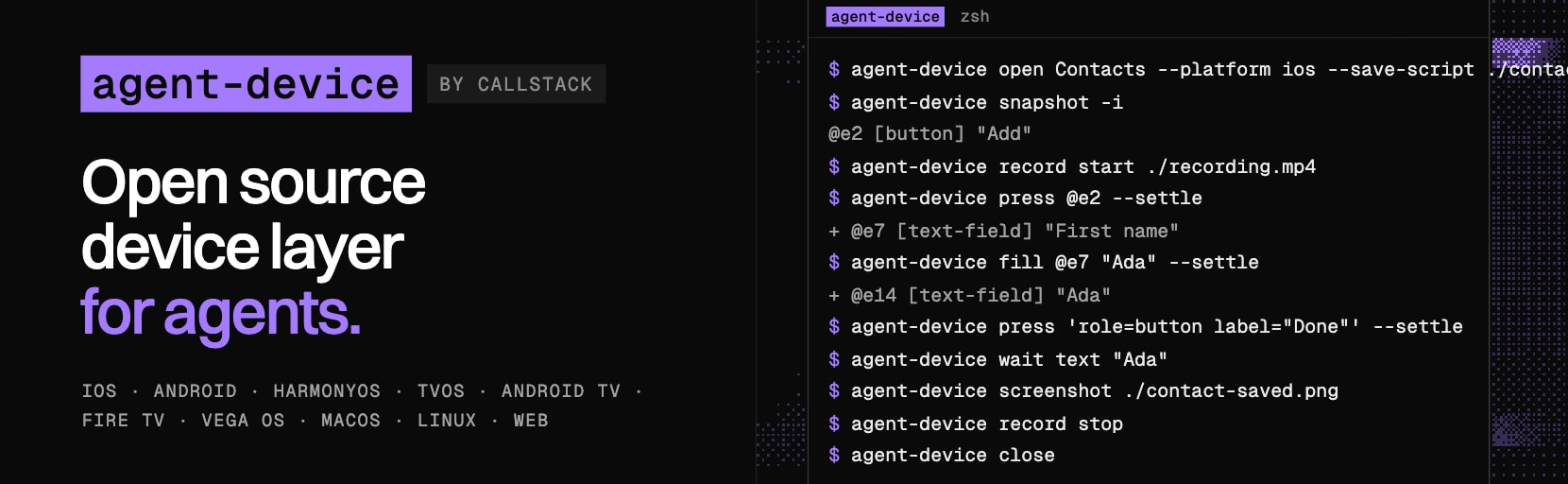


Open source device layer for AI coding agents. Let coding agents control mobile, web, TV, and desktop apps on devices and simulators, locally or in the cloud, through a CLI, built-in MCP server, or typed Node.js API.
Let your coding agent verify its changes in the running app. agent-device lets agents inspect, control, debug, and verify apps on iOS, Android, and HarmonyOS (simulators, emulators, and physical devices), plus tvOS, Android TV, Fire TV (Fire OS), Amazon Vega OS TV (Vega Virtual Device), web, macOS, and Linux. Agents read token-efficient accessibility snapshots instead of reasoning over screenshots alone, act through refs and selectors, and save evidence for review. It also coordinates device access across parallel agent worktrees and connects to remote device clouds.
Works with Claude Code, Codex, Cursor, Windsurf, Cline, Goose, and any agent that can run a CLI or connect over MCP, or as the runtime under agents you build with the AI SDK or Eve. Developers at Expensify, Shopify, and others use it to verify their apps.
agent-device powers mobile automation in

 T3 Code.
Install the CLI and check setup. It requires Node.js 22.12 or newer; web automation requires Node.js 24 or newer. See Installation for target requirements.
npm install -g agent-device@latest
agent-device doctor
agent-device help workflow
Run doctor yourself before you hand the CLI to an agent. help workflow links to the guides for debugging, replay, and profiling.
Add a contact in the built-in iOS Contacts app:
# Start a session.
agent-device open Contacts --platform ios

# Inspect the screen. The example below shows the output; refs vary.
agent-device snapshot -i
# @e2 [button] "Add"

# Use the ref and wait for the UI to settle.
agent-device press @e2 --settle
# The diff includes:
# + @e7 [text-field] "First name"

agent-device fill @e7 "Ada" --settle
# The next diff shows changed values and current refs:
# - @e7 [text-field] "First name"
# + @e14 [text-field] "Ada"
# = @e15 [text-field] "Last name"

# Capture evidence and close the session.
agent-device screenshot ./contact-form.png
agent-device close
Refs are valid only in the latest output: after a --settle command, use the refs in its diff, and take a new snapshot only if the diff omits what you need. Snapshots come from the app's accessibility tree, so clear labels, roles, and test IDs make agent runs more reliable; use screenshots and video as evidence or when accessibility data is poor.
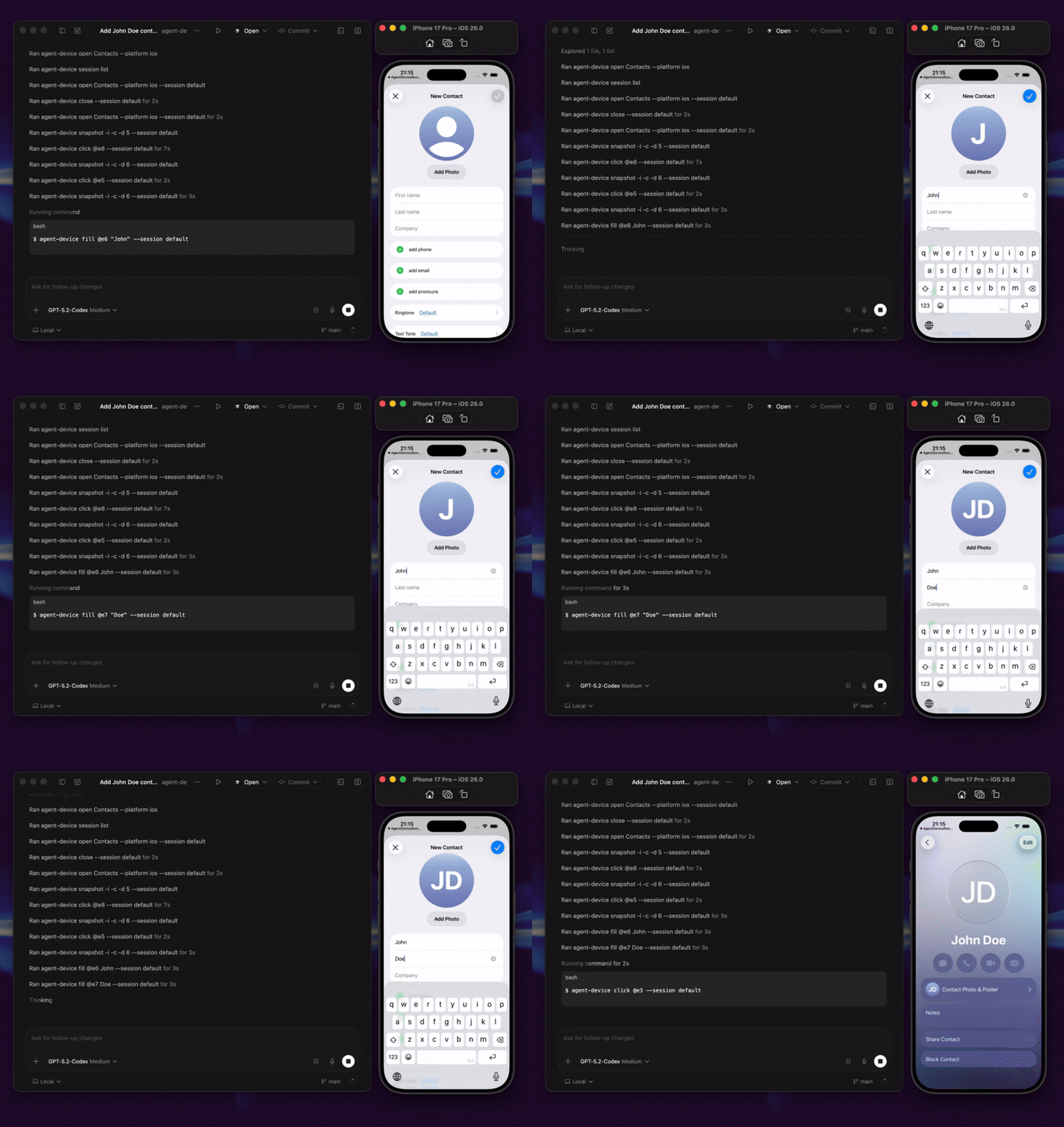
agent-device mcp starts the official stdio MCP server, exposing the installed commands as structured tools over the same execution path as the CLI:
{
  "mcpServers": {
    "agent-device": {
      "command": "agent-device",
      "args": ["mcp"]
    }
  }
}
See AI agent setup for per-client setup and when to prefer plain CLI over MCP.
createAgentDeviceClient() gives Node.js code typed access to the same commands, as model tools in your own agent or from orchestration code:
import { createAgentDeviceClient } from 'agent-device';

const client = createAgentDeviceClient({ session: 'qa-run' });
try {
  await client.apps.open({ app: 'com.apple.Preferences', platform: 'ios' });
  const snapshot = await client.capture.snapshot({ interactiveOnly: true });
  const button = snapshot.nodes.find((node) => node.role === 'button');
  if (button) await client.interactions.press({ ref: button.ref });
} finally {
  await client.sessions.close();
}
See the Node.js API, the runnable examples, and the AI SDK and Eve integration guides.
.ad scripts for local use or CI. Export strict Maestro YAML when needed.See Commands for the commands and evidence each target supports.
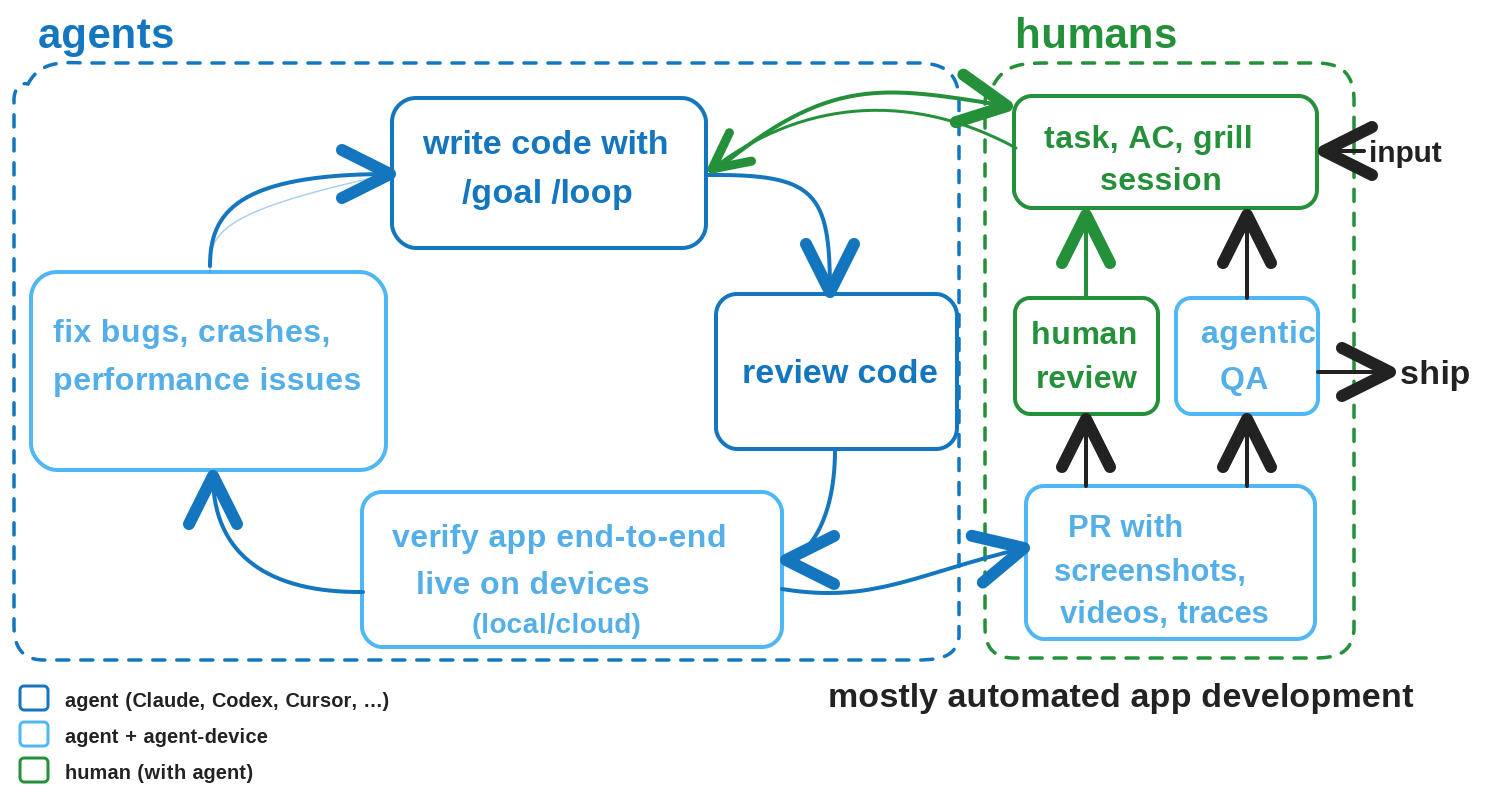
With the CLI installed, prompts like these work end to end:
The same session and evidence model works at every step: the agent explores the app, captures evidence, saves a replay, runs it in CI, and moves onto remote devices.
| Path | Best for | Start with |
|---|---|---|
| Local | Trying commands and debugging apps on simulators, emulators, physical devices, macOS, and Linux. | Follow the Quick Start. |
| CI/CD | Automated pull request and merge validation with replay scripts and captured artifacts. | Try the EAS workflow template. |
| Cloud / remote | Linux runners, managed devices, and remote jobs. | Set up a remote proxy, connect a device cloud (BrowserStack, AWS Device Farm, TestMu AI, Limrun), or contact Callstack for team QA. |
agent-device keeps device state in sessions. It uses a local accessibility bridge for iOS Simulator snapshots and XCTest for iOS interactions, physical iOS, and tvOS; ADB and the snapshot helper on Android, Android TV, and Fire OS; HDC and ArkUI uitest on HarmonyOS; Vega CLI/VDA on the Vega Virtual Device; a local helper on macOS, including Electron and other Chromium-based apps through the accessibility tree; and AT-SPI on Linux.
Support depth varies by target. Some backends, such as HarmonyOS and Vega OS, cover a subset of commands; run agent-device capabilities --platform <platform> to see what a target supports. The capabilities matrix shows which commands each target, desktop, web, and cloud provider supports.
Sessions are scoped to the caller's git worktree, and host-local device claims stop parallel agents from taking over each other's simulators and emulators. Run agent-device device status to inspect ownership without a daemon, and agent-device device release --stale to release claims whose owner is provably no longer running. The same commands drive hosted devices on BrowserStack, AWS Device Farm, TestMu AI, and Limrun.
agent-device uses the inspect-act-verify process from Vercel's agent-browser for mobile, TV, and desktop apps. Basic --platform web support runs agent-browser in the same session and replay system.
agent-device is a command-line tool and MCP server that lets AI coding agents inspect, control, and verify mobile apps and save evidence for review. It supports iOS, Android, HarmonyOS, TV, web, macOS, and Linux.
Yes. agent-device mcp starts the official stdio MCP server. The Quick start above has the client config, and AI agent setup covers per-client details.
Yes. agent-device supports native iOS and Android apps, plus React Native, Expo, and Flutter apps on supported targets. The commands and evidence vary by target.
The MCP server is one entry point to the same runtime used by the CLI and typed Node.js API. Sessions, device ownership, selectors, evidence, replay, CI workflows, and cloud routing stay consistent across all three.
Yes. The typed Node.js client is a public surface over that same runtime, so an agent you build inherits everything above. Start from the Node.js API, AI SDK, or Eve guides.
With agent-device, an agent reads app state and chooses each command at run time. For stable, repeatable test suites, use e2e, a TypeScript testing framework for web and mobile apps. agent-device can also save its runs as .ad scripts or export them as strict Maestro YAML.
Yes. Record a run as an .ad script, replay it in CI, and keep the screenshots and logs as artifacts; the EAS workflow template is a working example.
Teams and developers at Callstack, JPMorgan Chase, Expensify, Shopify, Kindred, Total Wine & More, LegendList, HerLyfe, App & Flow, and others use agent-device.
See CONTRIBUTING.md.
agent-device is open source under the MIT license. Visit agent-device.dev or contact Callstack.
Claim this server with your GitHub account to request manual ownership verification.
Link to the catalog listing for agent-device from your README. This badge does not certify ownership, compatibility or security.
[](https://awesome-mcp.com/servers/agent-device)Public repository statistics could not be verified. Check the configured source address; unavailable counts are not zero.
来源、范围和时段分别列出;不相加,不代表安装人数、活跃用户或安全审核。
尚无已审核的包 / 镜像标识,暂不展示下载统计。
Alternative and complementary servers in the same category
A directory listing describing a cancellation-letter and mailing-address service. The configured public GitHub repository returned 404 during source verification.

A hosted MCP service for browsing and searching through Singapore mobile-network proxies.

A directory listing describing a Markdown-to-PDF service. The configured public GitHub repository returned 404 during source verification.