
Store and retrieve entities, relations and observations in a persistent local knowledge graph.
create_entitiescreate_relationsadd_observations+6 more
92K
AI & Multi-Agent
An MCP server that gives AI agents persistent memory across sessions, including conversation history, durable key-value context, tagged knowledge entries, and semantic search.
Agentic Memory MCP server for persistent agent memory is cataloged as an MCP server attributed to jyswee. An MCP server that gives AI agents persistent memory across sessions, including conversation history, durable key-value context, tagged knowledge entries, and semantic search. It is categorized under ai agents-models. See the capability inspector for recorded interfaces and their independent review status; consult upstream documentation for the current interface.
Installation configuration is not reviewed. No executable setup is offered for this entry; inspect the source repository before proceeding.
Catalog license label: Proprietary — Tyga.Cloud Ltd.. Check the source repository's current license and terms before using, modifying or distributing this software.
能力定义尚未审核。未核验的采集内容不会作为可信接口展示。
暂无可展示的已审核记录。这不表示上游不支持此能力。
暂无可展示的已审核记录。这不表示上游不支持此能力。
暂无可展示的已审核记录。这不表示上游不支持此能力。
Email delivery is not connected. This page does not collect email addresses or create subscriptions.
Browse the registry for current listings instead.
Reviews for Agentic Memory MCP server for persistent agent memory are not available yet
Review publishing and storage are not connected. This page does not collect or publish ratings or comments, including after sign-in.
Yes. Spaces are shareable, so one agent can store information and another can recall it later from a different machine or interface (CLI, MCP, or REST).
No. Semantic search is impossible on zero-knowledge end-to-end encrypted spaces by design; the managed at-rest encryption option keeps search and summaries working.
README.md · c35c9b4b51d3 · 采集于 2026-11-13 11:01:37 UTC
保留上游原文,不做 AI 改写。为安全起见过滤脚本、表单和不安全链接。
当前显示最后一次成功采集的文档快照,请以来源页面为准。



Persistent memory for AI agents — conversation history, key-value context, and semantic search across sessions. As easy as git.
git remembers your code. agmry remembers everything else.
Your agent writes great code all day — then forgets every decision the moment its context window resets. So you become the memory layer: re-explaining the project, the preferences, what broke last time. Agentic Memory is the memory your agent runs itself: one install, and it stores, recalls, and searches its own state across sessions, machines, and even other agents. It can even sign itself up — one command returns a working API key, no browser, no human.
Works with: Claude Code · Cursor · Cline · Windsurf · Aider · Codex · any MCP client

Install to full recall in 60 seconds — real terminal session, no mockups. Watch all the demos.
npm install -g agmry
# Agent signs itself up — working key returned instantly, no card, no browser
agmry signup my-project --local

# Store memory
agmry store my-project "User prefers TypeScript strict mode and pnpm"

# New session? Recall everything
agmry recall my-project

# Half-remember something? Search it
agmry search my-project "how do we deploy"

# Full reference
agmry --help
No browser. No OAuth. No waiting for a human.
$ agmry signup my-project
✓ Project "my-project" created
  API key: amk_************************  (saved to .agmry/config.json)
  Live:    full access for 48h — no card, $0 today
The key works immediately — every endpoint, every tool, full access for 48 hours. Within that window, your human completes a $0 card-auth that starts the free 7-day trial on the same key. Miss the window? Nothing is deleted — the key pauses and revives the moment the card-auth completes. Add --email you@company.com and the human gets the link automatically.
A transcript dump isn't memory. Agents need different recall for different things:
# Short-term: ordered, role-aware conversation history (sub-ms reads)
agmry store my-project "Deployed v2.1, rolled back — migration locked the users table" -r assistant
agmry recall my-project -n 50

# Durable facts: typed key-value context — decisions, preferences, runbooks
agmry ctx my-project set deploy_flow "push image to registry, then ask infra to roll"
agmry ctx my-project get deploy_flow

# Long-term: titled, tagged knowledge entries that survive months
agmry entry my-project "Auth decision" "JWT not sessions — mobile clients can't hold cookies" --tags "arch,decisions"
agmry entries my-project --tags "decisions"

# Work-in-progress: scratchpad that's allowed to expire
agmry scratch my-project set "midway through the billing refactor, invoice.js next"
And semantic search stitches it together when the agent only half-remembers:
agmry search my-project "did we ever discuss rate limiting"
# → surfaces a months-old entry, with similarity score
Instead of pasting yesterday's summary into today's prompt:
agmry boot my-project --json          # messages + context + entries, one call
agmry boot my-project --semantic "billing refactor"   # or focused on a topic
~200 tokens of structured state, not top-k chunks of old transcripts.
Prefer tools over a CLI? agmry ships an MCP server. Point Claude Code (or any MCP client) at it and your agent gets 17 native tools: store, recall, search, bootstrap, context, entries, spaces, queues.
claude mcp add agenticmemory -- agmry mcp-serve
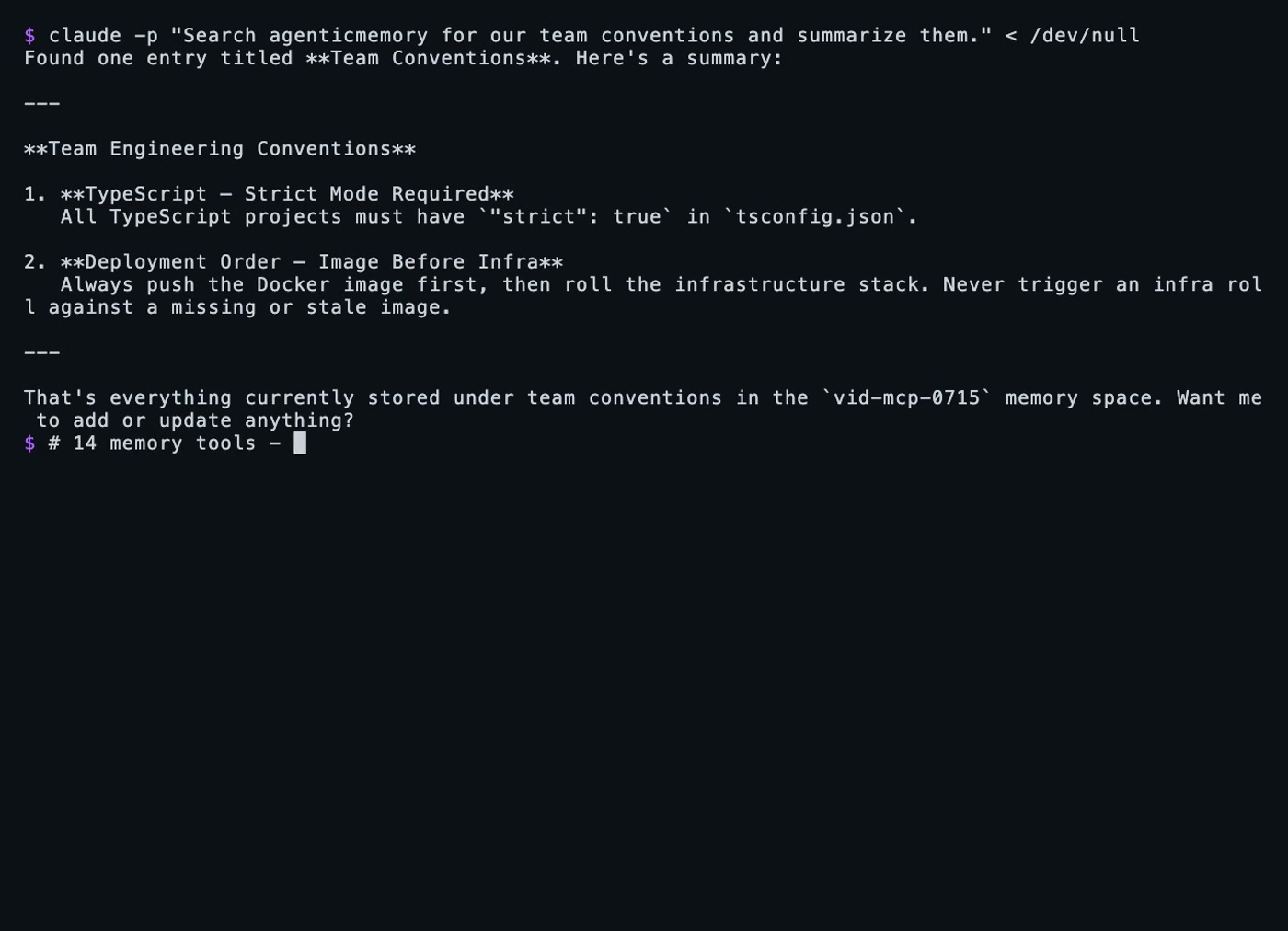
Claude Code remembering across sessions via MCP — click to watch.
For clients that use a JSON config (Cline, Cursor, Windsurf), pass your API key via the environment — the MCP server runs outside your project directory, so it won't pick up .agmry/config.json:
{
  "mcpServers": {
    "agenticmemory": {
      "command": "agmry",
      "args": ["mcp-serve"],
      "env": { "AGMRY_API_KEY": "amk_your_key_here" }
    }
  }
}
Claude Web, Claude Desktop, Raycast, or any hosted MCP client can connect straight to the remote server. Same tools, same API key, nothing to install:
URL:  https://mcp.agenticmemory.ai/sse
Auth: Authorization: Bearer YOUR_API_KEY
Create a space the server can never read. Encryption happens inside the CLI — the API only ever sees ciphertext.
agmry key generate                                  # one-time: creates + saves your key
agmry space create "Private" private --encryption e2e

agmry store SPACE "my secret"                       # encrypted before it leaves your machine
agmry recall SPACE                                  # transparently decrypted
agmry key verify SPACE                              # holding the right key?
Or derive per-space keys from a passphrase instead of storing a key:
agmry key set --passphrase "long secret phrase"
Notes:
--encryption managed — the server encrypts your data at rest and every feature (search, summaries) keeps working. No client key needed.agmry key show --reveal.Key resolution order: --enc-key / --passphrase flag → AGMRY_ENCRYPTION_KEY env → ./.agmry/config.json → ~/.agmry/config.json. Same envelope and key derivation as the Node and Python SDKs — keys are interchangeable across all three.
Spaces are shareable. One agent stores the deploy runbook; another recalls it a week later, from a different machine, over a different interface (CLI, MCP, or REST — same memory). Your agents hand off between sessions and between projects without you couriering context.
And you stay in the loop: everything your agents remember is browsable in a human dashboard.
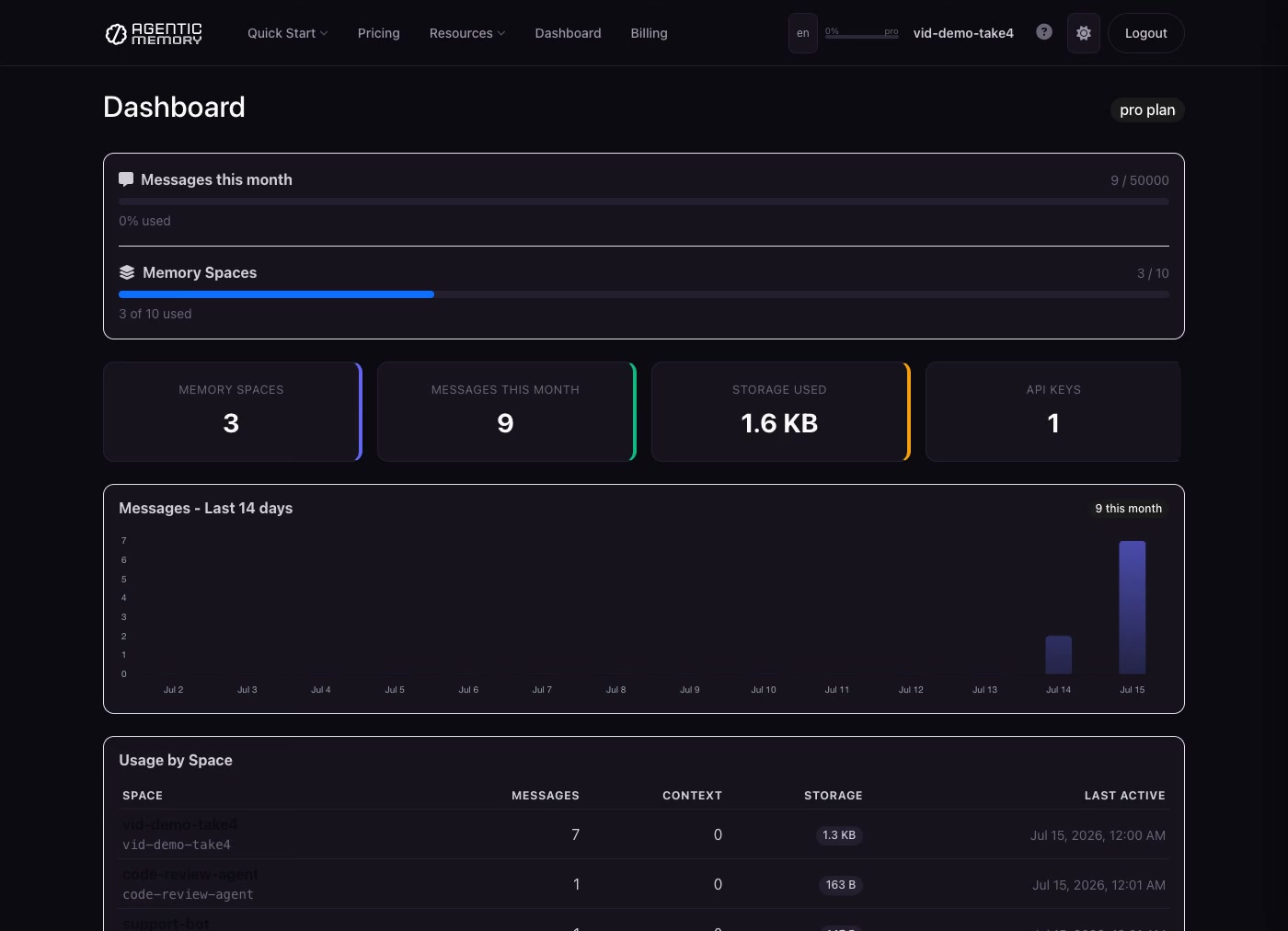
Everything your agents remember, in one dashboard — click to watch.
FIFO queues inside a space. One agent pushes work, another pops it — no polling glue, no extra infra.
agmry queue SPACE jobs push '{"task":"review PR #42"}'   # enqueue (FIFO)
agmry queue SPACE jobs pop                                # dequeue oldest — exit code 2 if empty
agmry queue SPACE jobs pop --wait 25                      # long-poll up to 25s for the next item
agmry queue SPACE jobs                                    # peek: length + head, without consuming
agmry queue SPACE jobs dlq push '{"task":"..."}' --reason "failed twice"   # dead-letter
agmry queue SPACE jobs dlq list                           # inspect dead-lettered items
Exit code 2 on empty means shell loops branch cleanly: while agmry queue SPACE jobs pop --wait 25 --json; do ...; done. Envelopes are opaque JSON — the server never inspects them.
Add to your CLAUDE.md, .cursorrules, .clinerules, .windsurfrules, or AGENTS.md:
## Agentic Memory
This project uses Agentic Memory for persistent memory across sessions.
Use the `agmry` CLI. Key is in .agmry/config.json (auto-loaded).

agmry boot SPACE --json               # load everything at session start
agmry store SPACE "what happened"     # remember something
agmry ctx SPACE set key "value"       # store a durable decision/fact
agmry search SPACE "the deadline"     # find past context
agmry queue SPACE jobs push '{...}'   # send work to another agent
agmry queue SPACE jobs pop --wait 25  # receive work (exit 2 = empty)
--key flagAGMRY_API_KEY environment variableAGENTICMEMORY_API_KEY environment variable./.agmry/config.json (project-local)~/.agmry/config.json (global)Add .agmry/ to your .gitignore.
agmry queue (exit 2 = empty)agmry mcp-serve) or fully remote (mcp.agenticmemory.ai)agmry key generate)agmry space export)Pricing: The agent's key works instantly — full access for 48h, no card. A $0 card-auth starts the free 7-day trial; after that from $24.99/mo. No data deletion, ever: your memory waits for you. Details.
Claude Memory is great — but it only works with Claude, and only Claude decides what's in it.
| Agentic Memory | Claude Memory | |
|---|---|---|
| LLM support | Any — GPT, Claude, Gemini, Llama, Mistral, DeepSeek | Claude only |
| Switch LLMs | Keep all memory | Lose everything |
| Multi-agent | Shared spaces across agents | Single user |
| Programmatic control | Full CLI + MCP + REST | Black box — Claude decides |
| Structured data | Messages + context + entries + entities + scratchpad | Free-text notes |
| Semantic search | agmry search "the deadline" | No search API |
| Data ownership | You own it, export any time | Stored by Anthropic |
I was my agents' memory. Every session started with me re-explaining my own project to my own tools — decisions, preferences, what broke last time. So I built the memory they run themselves. My own agents use it in production across a dozen projects; if something's rough or missing, open an issue — I read every one.
Proprietary — Tyga.Cloud Ltd. See LICENSE.
Claim this server with your GitHub account to request manual ownership verification.
Link to the catalog listing for Agentic Memory MCP server for persistent agent memory from your README. This badge does not certify ownership, compatibility or security.
[](https://awesome-mcp.com/servers/agenticmemory)Public repository statistics could not be verified. Check the configured source address; unavailable counts are not zero.
来源、范围和时段分别列出;不相加,不代表安装人数、活跃用户或安全审核。
尚无已审核的包 / 镜像标识,暂不展示下载统计。
Alternative and complementary servers in the same category
Store and retrieve entities, relations and observations in a persistent local knowledge graph.
Organize problem solving into revisable, branching thought steps through an MCP tool.

Query-aware context compression with an MCP plugin for coding agents, plus Python and HTTP interfaces for reducing the context sent to a language model.