
Store and retrieve entities, relations and observations in a persistent local knowledge graph.
create_entitiescreate_relationsadd_observations+6 more
92K
AI & Multi-Agent
An MCP server backed by a single SQLite file that gives agents episodic, semantic, and implicit memory with ranked retrieval and lifecycle maintenance.
Alaya MCP server for agent memory is cataloged as an MCP server attributed to securityronin. An MCP server backed by a single SQLite file that gives agents episodic, semantic, and implicit memory with ranked retrieval and lifecycle maintenance. It is categorized under ai agents-models. See the capability inspector for recorded interfaces and their independent review status; consult upstream documentation for the current interface.
Installation configuration is not reviewed. No executable setup is offered for this entry; inspect the source repository before proceeding.
Catalog license label: MIT. Check the source repository's current license and terms before using, modifying or distributing this software.
能力定义尚未审核。未核验的采集内容不会作为可信接口展示。
暂无可展示的已审核记录。这不表示上游不支持此能力。
暂无可展示的已审核记录。这不表示上游不支持此能力。
暂无可展示的已审核记录。这不表示上游不支持此能力。
Email delivery is not connected. This page does not collect email addresses or create subscriptions.
Browse the registry for current listings instead.
Reviews for Alaya MCP server for agent memory are not available yet
Review publishing and storage are not connected. This page does not collect or publish ratings or comments, including after sign-in.
It stores data in a single SQLite file at ~/.alaya/memory.db, overridable with the ALAYA_DB environment variable.
Yes; without the optional ALAYA_LLM_* variables the server runs in prompt mode and reminds the agent to call learn after 10 episodes.
README.md · 7e43e0b955dc · 采集于 2026-11-13 11:47:28 UTC
保留上游原文,不做 AI 改写。为安全起见过滤脚本、表单和不安全链接。
当前显示最后一次成功采集的文档快照,请以来源页面为准。










The only memory engine with neuroscience-grounded memory dynamics — Bjork dual-strength forgetting, retrieval-induced suppression, and Hebbian co-activation — in a zero-dependency embeddable Rust library.
Alaya (Sanskrit: alaya-vijnana, "storehouse consciousness") is an embeddable Rust library. One SQLite file. No external services. Your agent stores conversations, retrieves what matters, and lets the rest fade. The graph reshapes through use, like biological memory.
let alaya = Alaya::open("memory.db")?;
alaya.episodes().store(&episode)?;           // store
let results = alaya.knowledge().query(&query)?; // retrieve
alaya.lifecycle().consolidate(&provider)?;   // distill knowledge
alaya.lifecycle().transform()?;              // dedup, LTD, discover categories
alaya.lifecycle().forget()?;                 // decay what's stale
let cats = alaya.admin().categories(None)?;  // emergent ontology
alaya.admin().purge(PurgeFilter::Session("s1"))?; // cascade delete + tombstones
Most AI agents treat memory as flat files. OpenClaw writes to MEMORY.md.
Claudesidian writes to Obsidian. Hand-rolled systems write to JSON or
Markdown. It works at first.
Then the files grow. Context windows fill. The agent dumps everything into the prompt and hopes the LLM finds what matters.
The cost is measurable. OpenClaw injects ~35,600 tokens of workspace files into every message, 93.5% of which is irrelevant (#9157). Heavy users report $3,600/month in token costs. Community tools like QMD and memsearch cut 70-96% of that waste by replacing full-context injection with ranked retrieval (Levine, 2026).
The structure problem compounds the cost. MEMORY.md conflates decisions,
preferences, and knowledge into one unstructured blob. Users independently
invent decision.md
files, working-context.md snapshots, and
12-layer memory architectures
to compensate. Monday you mention "Alice manages the auth team." Wednesday
you ask "who handles auth permissions?" The agent retrieves both memories
by text similarity but cannot connect them
(Chawla, 2026).
| Problem | File-based memory | Alaya |
|---|---|---|
| Token waste | Full-context injection (~35K tokens/message) | Ranked retrieval returns only top-k relevant memories |
| No structure | Everything in one file (users invent decision.md workarounds) | Three typed stores: episodes, knowledge, preferences |
| No forgetting | Files grow until you manually curate | Bjork dual-strength decay separates storage strength from retrieval strength; retrieval-induced forgetting (RIF) actively suppresses competing memories |
| No associations | Flat files, no links between memories | Hebbian co-retrieval strengthening (LTP/LTD): memories retrieved together strengthen connections; spreading activation finds indirect associations |
| Brittle preferences | Agent-authored summary, easily drifts | Implicit preferences emerge from accumulated impressions via vasana (perfuming), no LLM required; crystallize at threshold |
| LLM required | Can't function without one | Graceful degradation at every level. No embeddings? BM25-only. No LLM? Episodes accumulate. Each capability independently optional |
The fastest way to add Alaya memory to any MCP-compatible agent (Claude Desktop, Claude Code, Cursor, Cline, etc.):
Add to your Claude Code config (~/.claude/claude_code_config.json):
{
  "mcpServers": {
    "alaya": {
      "command": "npx",
      "args": ["-y", "alaya-mcp"]
    }
  }
}
Or for Claude Desktop / other MCP clients (with optional LLM auto-consolidation):
{
  "mcpServers": {
    "alaya": {
      "command": "npx",
      "args": ["-y", "alaya-mcp"],
      "env": {
        "ALAYA_LLM_API_KEY": "sk-...",
        "ALAYA_LLM_API_URL": "https://api.openai.com/v1/chat/completions",
        "ALAYA_LLM_MODEL": "gpt-4o-mini"
      }
    }
  }
}
git clone https://github.com/SecurityRonin/alaya.git
cd alaya
cargo build --release --features "mcp llm"
Then add to your MCP config:
{
  "mcpServers": {
    "alaya": {
      "command": "/path/to/alaya/target/release/alaya-mcp"
    }
  }
}
The ALAYA_LLM_* env vars are optional — without them, the server works in
prompt mode (reminds the agent to call learn after 10 episodes). With an API
key and the llm feature, it auto-consolidates instead.
That's it. Your agent now has 13 memory tools:
| Tool | What it does |
|---|---|
remember | Store a conversation message (auto-prompts consolidation after 10 episodes) |
recall | Search memory with hybrid retrieval (+ category boost) |
learn | Teach extracted knowledge directly — agent extracts facts and calls this |
status | Rich memory statistics: episodes, knowledge breakdown, categories, graph, embeddings |
preferences | Get learned user preferences |
knowledge | Get distilled semantic facts (+ category filter) |
maintain | Run memory cleanup (dedup, decay) |
purge | Delete memories by session, age, or all |
categories | List emergent categories with stability filter |
neighbors | Graph neighbors via spreading activation |
node_category | Which category a node belongs to |
import_claude_mem | Import observations from a claude-mem database |
import_claude_code | Import conversation history from Claude Code JSONL files |
See docs/mcp-quickstart.md for a full walkthrough with sample interactions and recommended system prompt.
Data is stored in ~/.alaya/memory.db (override with ALAYA_DB env var).
Single SQLite file, no external services.
Example interaction — what your agent sees when using Alaya:
Agent: [calls remember(content="User prefers dark mode", role="user", session_id="s1")]
Alaya: Stored episode 1 in session 's1'

Agent: [calls recall(query="user preferences")]
Alaya: Found 1 memories:
  1. [user] (score: 0.847) User prefers dark mode

Agent: [calls status()]
Alaya: Memory Status:
  Episodes: 1 (1 this session, 1 unconsolidated)
  Knowledge: none
  Categories: 0
  Preferences: 0 crystallized, 0 impressions accumulating
  Graph: 0 links
  Embedding coverage: 0/1 nodes (0%)
Environment variables:
| Variable | Default | Description |
|---|---|---|
ALAYA_DB | ~/.alaya/memory.db | Path to SQLite database |
ALAYA_LLM_API_KEY | (none) | API key for auto-consolidation (enables ExtractionProvider). Requires llm feature. |
ALAYA_LLM_API_URL | https://api.openai.com/v1/chat/completions | OpenAI-compatible chat completions endpoint |
ALAYA_LLM_MODEL | gpt-4o-mini | Model name. Any small/fast model works (GPT-4o-mini, Haiku, Gemini Flash, etc.) |
pip install alaya-memory
See alaya-py/README.md for the full Python API.
For embedding Alaya directly into a Rust application:
[dependencies]
alaya = "0.2.2"
use alaya::{Alaya, NewEpisode, Role, EpisodeContext, Query, NoOpProvider};

// Open a persistent database (or use open_in_memory() for tests)
let alaya = Alaya::open("memory.db")?;

// Store a conversation episode
alaya.episodes().store(&NewEpisode {
    content: "I've been learning Rust for about six months now".into(),
    role: Role::User,
    session_id: "session-1".into(),
    timestamp: 1740000000,
    context: EpisodeContext::default(),
    embedding: None, // pass Some(vec![...]) if you have embeddings
})?;

// Query with hybrid retrieval (BM25 + vector + graph + RRF)
let results = alaya.knowledge().query(&Query::simple("Rust experience"))?;
for mem in &results {
    println!("[{:.2}] {}", mem.score, mem.content);
}

// Get crystallized preferences
let prefs = alaya.admin().preferences(Some("communication_style"))?;

// Run lifecycle (NoOpProvider works without an LLM)
alaya.lifecycle().consolidate(&NoOpProvider)?;
alaya.lifecycle().transform()?;
alaya.lifecycle().forget()?;
The demo walks through all eleven capabilities with annotated output and no external dependencies:
git clone https://github.com/SecurityRonin/alaya.git
cd alaya
cargo run --example demo
Alaya is a library, not a framework. Your agent owns the conversation loop, the LLM, and the embedding model. Alaya owns memory.
Your Agent                          Alaya
─────────                           ─────

Via MCP (stdio):                    alaya-mcp binary
  remember(content, role, session)    ──▶ episodic store + graph links
  recall(query, boost_category?)      ──▶ BM25 + vector + graph → RRF → rerank
  learn(facts, session_id?)           ──▶ agent-driven knowledge extraction
  status()                            ──▶ rich stats (episodes, knowledge, graph, embeddings)
  preferences(domain?)                ──▶ crystallized behavioral patterns
  knowledge(type?, category?)         ──▶ consolidated semantic nodes
  maintain()                          ──▶ dedup + decay
  purge(scope)                        ──▶ selective or full deletion
  categories(min_stability?)          ──▶ emergent ontology with hierarchy
  neighbors(node, depth?)             ──▶ graph spreading activation
  node_category(node_id)              ──▶ category assignment lookup
  import_claude_mem(path?)            ──▶ import from claude-mem.db
  import_claude_code(path)            ──▶ import from Claude Code JSONL

Via Rust library:                   Alaya coordinator
  alaya.episodes().store(ep)           ──▶ episodic store + graph links
  alaya.knowledge().query(q)           ──▶ BM25 + vector + graph → RRF → rerank
  alaya.admin().preferences(domain?)   ──▶ crystallized behavioral patterns
  alaya.knowledge().filter(f?)         ──▶ consolidated semantic nodes
  alaya.admin().categories(min?)       ──▶ emergent ontology with hierarchy
  alaya.admin().subcategories(id)      ──▶ children of a parent category
  alaya.graph().neighbors(node, d)     ──▶ graph spreading activation
  alaya.admin().node_category(id)      ──▶ category assignment lookup
  alaya.set_embedding_provider(p)      ──▶ auto-embed in store + query
  alaya.set_extraction_provider(p)     ──▶ enable auto-consolidation
  alaya.lifecycle().consolidate(p)     ──▶ episodes → semantic knowledge
  alaya.knowledge().learn(nodes)       ──▶ provider-less knowledge injection
  alaya.lifecycle().auto_consolidate() ──▶ extract + learn (needs ExtractionProvider)
  alaya.lifecycle().perfume(i, p)      ──▶ impressions → preferences
  alaya.lifecycle().transform()        ──▶ dedup, LTD, prune, split categories
  alaya.lifecycle().forget()           ──▶ Bjork strength decay + archival
  alaya.admin().purge(scope)           ──▶ cascade deletion + tombstones
| Store | Analog | Purpose |
|---|---|---|
| Episodic | Hippocampus | Raw conversation events with full context |
| Semantic | Neocortex | Distilled knowledge extracted through consolidation |
| Implicit | Alaya-vijnana | Preferences and habits that emerge through perfuming |
flowchart LR
    Q[Query] --> BM25[BM25 / FTS5]
    Q --> VEC[Vector / Cosine]
    Q --> GR[Graph Neighbors]

    BM25 --> RRF[Reciprocal Rank Fusion]
    VEC --> RRF
    GR --> RRF

    RRF --> RR[Context-Weighted Reranking]
    RR --> SA[Spreading Activation + Enrichment]
    SA --> RIF[Retrieval-Induced Forgetting]
    RIF --> OUT[Top 3-5 Results<br/>Episodes + Semantic + Preferences]
| Process | Inspiration | What it does |
|---|---|---|
| Consolidation | CLS theory (McClelland et al.) | Distills episodes into semantic knowledge |
| Perfuming | Vasana (Yogacara Buddhist psychology) | Accumulates impressions, crystallizes preferences |
| Transformation | Asraya-paravrtti | Deduplicates, LTD link decay, prunes, discovers categories |
| Forgetting | Bjork & Bjork (1992) | Decays retrieval strength, archives weak nodes |
| RIF | Anderson et al. (1994) | Retrieval-induced forgetting suppresses competing memories |
| Emergent Ontology | Vikalpa (conceptual construction) | Hierarchical categories emerge from clustering; auto-split when too broad |
The ConsolidationProvider trait connects Alaya to your LLM for knowledge
extraction:
use alaya::*;

struct MyProvider { /* your LLM client */ }

impl ConsolidationProvider for MyProvider {
    fn extract_knowledge(&self, episodes: &[Episode]) -> Result<Vec<NewSemanticNode>> {
        // Ask your LLM: "What facts/relationships can you extract?"
        todo!()
    }

    fn extract_impressions(&self, interaction: &Interaction) -> Result<Vec<NewImpression>> {
        // Ask your LLM: "What behavioral signals does this contain?"
        todo!()
    }

    fn detect_contradiction(&self, a: &SemanticNode, b: &SemanticNode) -> Result<bool> {
        // Ask your LLM: "Do these two facts contradict each other?"
        todo!()
    }
}
Use NoOpProvider without an LLM. Episodes accumulate and BM25 retrieval
works without consolidation.
The ExtractionProvider trait enables automatic knowledge extraction without
manual consolidate() calls. When configured, the MCP server auto-consolidates
after 10 unconsolidated episodes:
use alaya::*;

struct MyExtractor { /* your LLM client */ }

impl ExtractionProvider for MyExtractor {
    fn extract(&self, episodes: &[Episode]) -> Result<Vec<NewSemanticNode>> {
        // Ask your LLM: "Extract facts from these conversations"
        todo!()
    }
}

let mut alaya = Alaya::open("memory.db")?;
alaya.set_extraction_provider(Box::new(MyExtractor { /* ... */ }));

// Now auto_consolidate() works without a ConsolidationProvider
let report = alaya.lifecycle().auto_consolidate()?;
The llm feature flag provides a ready-to-use LlmExtractionProvider that
calls any OpenAI-compatible API:
use alaya::LlmExtractionProvider;

let provider = LlmExtractionProvider::builder()
    .api_key("sk-...")
    .model("gpt-4o-mini")      // default; any small model works
    .build()?;
| Method | When to call | What it does |
|---|---|---|
consolidate() | After accumulating 10+ episodes | Extracts semantic knowledge from episodes |
perfume() | On every user interaction | Extracts behavioral impressions, crystallizes preferences |
transform() | Daily or weekly | Deduplicates, LTD link decay, prunes weak links, discovers categories |
forget() | Daily or weekly | Decays retrieval strength, archives truly forgotten nodes |
purge() | On user request | Cascade deletes by session/age/all with tombstone tracking |
impl Alaya {
    // Open / create
    pub fn open(path: impl AsRef<Path>) -> Result<Self>;
    pub fn open_in_memory() -> Result<Self>;

    // Providers (on coordinator)
    pub fn set_embedding_provider(&mut self, provider: Box<dyn EmbeddingProvider>);
    pub fn set_extraction_provider(&mut self, provider: Box<dyn ExtractionProvider>);

    // Sub-manager accessors
    pub fn episodes(&self) -> Episodes<'_>;
    pub fn knowledge(&self) -> Knowledge<'_>;
    pub fn lifecycle(&self) -> Lifecycle<'_>;
    pub fn graph(&self) -> Graph<'_>;
    pub fn admin(&self) -> Admin<'_>;
}

impl Episodes<'_> {
    pub fn store(&self, episode: &NewEpisode) -> Result<EpisodeId>;
    pub fn by_session(&self, session_id: &str) -> Result<Vec<Episode>>;
    pub fn unconsolidated(&self, limit: u32) -> Result<Vec<Episode>>;
}

impl Knowledge<'_> {
    pub fn query(&self, q: &Query) -> Result<Vec<ScoredMemory>>;
    pub fn learn(&self, nodes: Vec<NewSemanticNode>) -> Result<ConsolidationReport>;
    pub fn filter(&self, filter: Option<KnowledgeFilter>) -> Result<Vec<SemanticNode>>;
}

impl Lifecycle<'_> {
    pub fn consolidate(&self, provider: &dyn ConsolidationProvider) -> Result<ConsolidationReport>;
    pub fn auto_consolidate(&self) -> Result<ConsolidationReport>;
    pub fn transform(&self) -> Result<TransformationReport>;
    pub fn forget(&self) -> Result<ForgettingReport>;
    pub fn perfume(&self, interaction: &Interaction, provider: &dyn ConsolidationProvider) -> Result<PerfumingReport>;
    pub fn dream(&self, provider: &dyn ConsolidationProvider, interaction: Option<&Interaction>) -> Result<DreamReport>;
}

impl Admin<'_> {
    pub fn status(&self) -> Result<MemoryStatus>;
    pub fn purge(&self, filter: PurgeFilter) -> Result<PurgeReport>;
    pub fn preferences(&self, domain: Option<&str>) -> Result<Vec<Preference>>;
    pub fn categories(&self, min_stability: Option<f32>) -> Result<Vec<Category>>;
    pub fn subcategories(&self, parent_id: CategoryId) -> Result<Vec<Category>>;
    pub fn node_category(&self, node_id: NodeId) -> Result<Option<Category>>;
}
Memory is a process, not a database. Every retrieval changes what is remembered. The graph reshapes through use.
Forgetting is a feature. Bjork dual-strength decay separates storage strength from retrieval strength. Retrieval-induced forgetting (RIF) actively suppresses competing memories. Both improve retrieval quality over time.
Preferences emerge, they are not declared. Behavioral patterns crystallize from accumulated impressions via vasana (perfuming), no LLM required.
The agent owns identity. Alaya stores seeds. The agent decides which seeds matter and how to present them.
Graceful degradation. No embeddings? BM25-only. No LLM? Episodes accumulate. Every feature works independently.
Architecture grounded in neuroscience, Buddhist psychology, and information retrieval. For detailed mappings, see docs/theoretical-foundations.md.
Neuroscience: Hebbian LTP/LTD (Hebb 1949, Bliss & Lomo 1973), Complementary Learning Systems (McClelland et al. 1995), spreading activation (Collins & Loftus 1975), encoding specificity (Tulving & Thomson 1973), dual-strength forgetting (Bjork & Bjork 1992), retrieval-induced forgetting (Anderson et al. 1994), working memory limits (Cowan 2001).
Yogacara Buddhist Psychology: Alaya-vijnana (storehouse consciousness), bija (seeds), vasana (perfuming), asraya-paravrtti (transformation), vijnaptimatrata (perspective-relative memory).
Information Retrieval: Reciprocal Rank Fusion (Cormack et al. 2009), BM25 via FTS5, cosine similarity vector search.
graph LR
    AGENT["AI Agent"]

    subgraph SIMPLE["Simple"]
        FILE["File-Based<br/><i>MEMORY.md<br/>OpenClaw</i>"]
    end

    subgraph INTEGRATED["Integrated"]
        FW["Framework Memory<br/><i>LangChain · CrewAI<br/>Letta</i>"]
        CODE["Coding Agent<br/><i>Beads · Engram<br/>via MCP</i>"]
    end

    subgraph ENGINES["Memory Engines"]
        DED["Dedicated Systems<br/><i><b>Alaya</b> · Vestige<br/>mem0 · Zep</i>"]
    end

    subgraph INFRA["Infrastructure"]
        VDB["Vector DBs<br/><i>Pinecone · Chroma<br/>Weaviate</i>"]
    end

    RESEARCH["Research<br/><i>Generative Agents<br/>SYNAPSE · HippoRAG</i>"]

    AGENT <--> FILE
    AGENT <--> FW
    AGENT <--> CODE
    AGENT <--> DED
    DED -.->|storage| VDB
    FW -.->|storage| VDB
    RESEARCH -.->|ideas| DED
    RESEARCH -.->|ideas| FW
Alaya is a dedicated memory engine with neuroscience-grounded memory dynamics. What differentiates it from every other system: Bjork dual-strength forgetting (separating storage from retrieval strength), retrieval-induced forgetting (retrieving A suppresses competing B and C), Hebbian co-retrieval strengthening (LTP/LTD), and implicit preference emergence without an LLM -- all in a single embeddable Rust + SQLite library. Closest peers: Vestige (Rust, FSRS-6, spreading activation) and SYNAPSE (unified episodic-semantic graph, lateral inhibition).
| Alternative | What it does well | What Alaya adds |
|---|---|---|
| MEMORY.md | Zero setup | Ranked retrieval (not full-context injection), typed stores, Bjork dual-strength decay |
| mem0 | Managed cloud memory with auto-extraction | Local-only (single SQLite file), no API keys, Hebbian graph dynamics, RIF suppression |
| Zep | Production-ready with cloud/self-hosted options | No external services, Hebbian co-retrieval graph, implicit preference emergence without LLM |
| Vestige | Rust, FSRS-6 spaced repetition | Bjork dual-strength (not FSRS), RIF, Hebbian LTP/LTD, vasana preference crystallization |
| LangChain Memory | Framework-integrated, many backends | Framework-agnostic, seven lifecycle operations, graceful degradation to BM25-only |
parent_id — categories form tree structures; auto-split when too broadMemberOf links — spreading activation traverses category boundariesembed() + embed_batch() wired into store_episode() and query()extract() enables auto-consolidation; LlmExtractionProvider (behind llm feature flag) calls any OpenAI-compatible APIremember, recall, learn, status, preferences, knowledge, maintain, purge, categories, neighbors, node_category, import_claude_mem, import_claude_codeWe evaluate two canonical baselines — full-context injection and naive vector RAG — on three benchmarks: LoCoMo (1,540 questions), LongMemEval (500 questions), and MemoryAgentBench (734 questions across 4 competencies). Generator: Gemini-2.0-Flash-001; Judge: GPT-4o-mini. Full methodology and statistical analysis: docs/benchmark-evaluation.md.
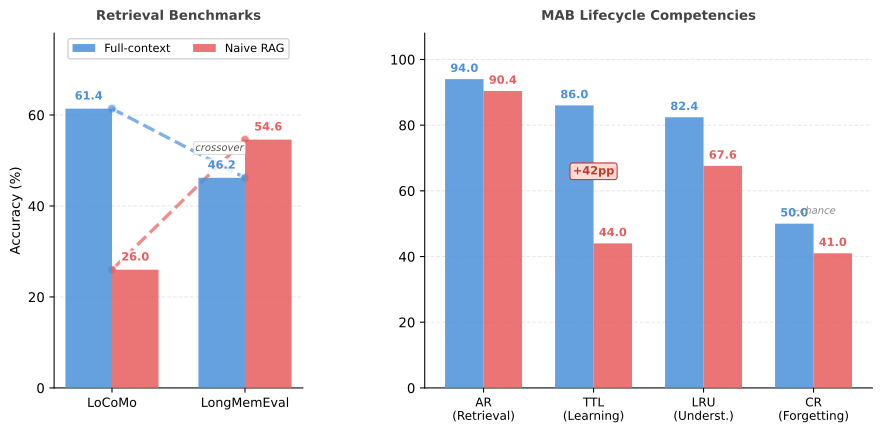
Key findings:
# Run all library tests
cargo test

# Run MCP integration tests
cargo test --features mcp

# Run LLM extraction tests
cargo test --features llm

# Run all tests
cargo test --features "mcp llm"

# Build the MCP server
cargo build --release --features mcp

# Build with auto-consolidation support
cargo build --release --features "mcp llm"

# Run the demo (no external dependencies)
cargo run --example demo
MIT
Claim this server with your GitHub account to request manual ownership verification.
Link to the catalog listing for Alaya MCP server for agent memory from your README. This badge does not certify ownership, compatibility or security.
[](https://awesome-mcp.com/servers/alaya)Public repository statistics could not be verified. Check the configured source address; unavailable counts are not zero.
来源、范围和时段分别列出;不相加,不代表安装人数、活跃用户或安全审核。
尚无已审核的包 / 镜像标识,暂不展示下载统计。
Alternative and complementary servers in the same category
Store and retrieve entities, relations and observations in a persistent local knowledge graph.
Organize problem solving into revisable, branching thought steps through an MCP tool.

Query-aware context compression with an MCP plugin for coding agents, plus Python and HTTP interfaces for reducing the context sent to a language model.