
A directory listing describing a cancellation-letter and mailing-address service. The configured public GitHub repository returned 404 during source verification.
Repository stats unavailable
Developer Tools
A Python package that generates async API clients and MCP servers from OpenAPI specifications.
AppDog is cataloged as an MCP server attributed to rodolphebarbanneau. A Python package that generates async API clients and MCP servers from OpenAPI specifications. It is categorized under developer tools. See the capability inspector for recorded interfaces and their independent review status; consult upstream documentation for the current interface.
Installation configuration is not reviewed. No executable setup is offered for this entry; inspect the source repository before proceeding.
Catalog license label: MIT License. Check the source repository's current license and terms before using, modifying or distributing this software.
能力定义尚未审核。未核验的采集内容不会作为可信接口展示。
暂无可展示的已审核记录。这不表示上游不支持此能力。
暂无可展示的已审核记录。这不表示上游不支持此能力。
暂无可展示的已审核记录。这不表示上游不支持此能力。
Email delivery is not connected. This page does not collect email addresses or create subscriptions.
Browse the registry for current listings instead.
Reviews for AppDog are not available yet
Review publishing and storage are not connected. This page does not collect or publish ratings or comments, including after sign-in.
Credentials can be configured through environment variables named with the client name, such as token or API key variables.
Yes, the dev command runs MCP applications in development mode with an inspector.
README.md · ccf5fd3afed2 · 采集于 2026-11-13 10:23:10 UTC
保留上游原文,不做 AI 改写。为安全起见过滤脚本、表单和不安全链接。
当前显示最后一次成功采集的文档快照,请以来源页面为准。





Compose and generate effortlessly async API clients and MCP servers from any OpenAPI specifications.
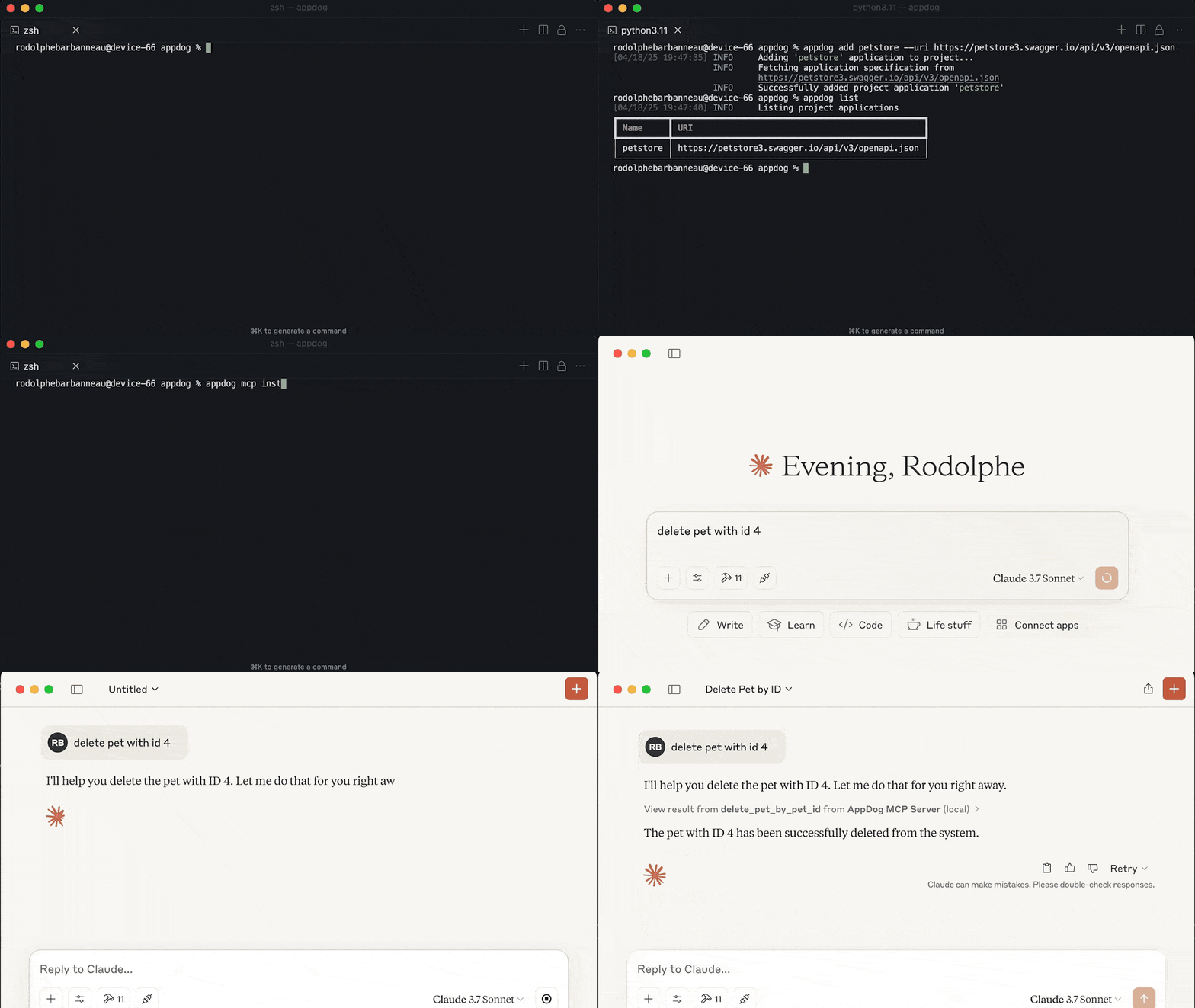
Claude Desktop doesn't handle yet resource templates (i.e. resource with parameters).
For Windows users, MCP Install command needs a manual edit of the generated Claude configuration. See this issue for more details.
AppDog is a Python package that simplifies working with OpenAPI-based APIs by:
uv add appdog
# Create a new project in the current directory
appdog init

# Or specify a project directory
appdog init --project /path/to/project
# Add a new API client from an OpenAPI spec URL or file
appdog add petstore --uri https://petstore3.swagger.io/api/v3/openapi.json
# List all API clients in the project
appdog list

# Show details for a specific API client
appdog show petstore
# Sync API clients with the project registry
appdog sync --upgrade

# Lock API clients
appdog lock --upgrade
# Generate and install an MCP server with all registered APIs
appdog mcp install -n "My API Server"

# Or run the server directly
appdog mcp run -n "My API Server"

# Or run in development mode with inspector
appdog mcp dev -n "My API Server"
After initializing a project and adding APIs, your project will have:
project/
├── apps.yaml     # Installed API appdog settings (auto-generated)
├── apps.lock     # Lock file with app specs and hashes (auto-generated)
└── ...           # Project files
After adding an API client, you can import and use it in your code:
# Import generated client
import appdog.petstore

# Use the client
async def main() -> None:
    async with appdog.petstore.client as client:
        pets = await client.get_pet_find_by_status(status='available')
        print(pets)
And compose your own MCP server:
import appdog.petstore
from mcp.server import FastMCP

mcp = FastMCP()

@mcp.tool()
async def hello_petstore() -> str:
    async with appdog.petstore.client as client:
        pets = await client.get_pet_find_by_status(status='available')
        return pets
API credentials can be configured using environment variables:
APPDOG_<CLIENT_NAME>_TOKEN=your_token
APPDOG_<CLIENT_NAME>_API_KEY=your_api_key
The package includes full support for MCP server generation:
Generate an MCP server file:
appdog mcp install -n "My API Server"
Use with FastMCP or other MCP clients:
from appdog import Project
from mcp.server import FastMCP

mcp = FastMCP()

project = Project.load(project_dir=PROJECT_DIR)
project.mount(mcp)
--verbose, -v: Enable verbose output--debug, -d: Enable all debug logs, including dependencies--project, -p: Specify project directory (defaults to current directory)appdog version
appdog init [--force] [--project PATH]
--force: Force initialization even if config already existsappdog add NAME --uri URI [--base-url URL] [OPTIONS]
NAME: Application name--uri: OpenAPI specification URL or file path--base-url: Base URL for API calls--include-methods: Methods to include--exclude-methods: Methods to exclude--include-tags: Tags to include--exclude-tags: Tags to exclude--force: Overwrite application if it already exists with a different URI--frozen: Skip adding application specification in project lock file--upgrade: Force upgrading application specification--sync: Sync application specification with project registryappdog remove NAME [OPTIONS]
NAME: Application name--frozen: Skip removing application specification from project lock file--sync: Sync application removal with project registryappdog list [--project PATH]
appdog show NAME [--project PATH]
NAME: Application nameappdog lock [OPTIONS]
--force: Overwrite application if it exists with a different URI--upgrade: Overwrite application specification with a different URIappdog sync [OPTIONS]
--force: Overwrite application if it exists with a different URI--frozen: Skip updating application specification in project lock file--upgrade: Force upgrading application specificationappdog mcp [COMMAND] [OPTIONS]
Commands:
install: Install applications in MCP clientrun: Run MCP applications in production modedev: Run MCP applications in development mode with inspectorEach command supports specific options:
--name, -n: Name of the MCP server (default: "AppDog MCP Server")--force: Overwrite server file if it exists--project, -p: Project directory (defaults to current)--output, -o: Output path for MCP server fileappdog mcp install [OPTIONS]
--env-var, -v: Environment variables in KEY=VALUE format--env-file, -f: Environment file with KEY=VALUE pairs--with: Additional packages to install in dev mode--with-editable, -e: Local packages to install in editable modeappdog mcp run [OPTIONS]
--transport, -t: Transport to use for MCP run (stdio or sse)appdog mcp dev [OPTIONS]
--with: Additional packages to install in dev mode--with-editable, -e: Local packages to install in editable modeCreate a custom apps.yaml to configure your API clients:
petstore:
  uri: https://petstore3.swagger.io/api/v3/openapi.json
  base_url: https://petstore3.swagger.io/api/v3
  include_tags:
    - pet
    - store
For MCP usage, see environment variables section
Create a client with custom authentication:
from appdog.petstore import PetstoreClient

# Custom API key
client = PetstoreClient(api_key="YOUR_API_KEY")

# Custom headers
client = PetstoreClient(
    headers={"Authorization": "Bearer YOUR_TOKEN"}
)
See CONTRIBUTING.md for information on contributing to the project.
This project is licensed under the MIT License - see the LICENSE file for details.
Claim this server with your GitHub account to request manual ownership verification.
Link to the catalog listing for AppDog from your README. This badge does not certify ownership, compatibility or security.
[](https://awesome-mcp.com/servers/appdog)Public repository statistics could not be verified. Check the configured source address; unavailable counts are not zero.
来源、范围和时段分别列出;不相加,不代表安装人数、活跃用户或安全审核。
尚无已审核的包 / 镜像标识,暂不展示下载统计。
Alternative and complementary servers in the same category
A directory listing describing a cancellation-letter and mailing-address service. The configured public GitHub repository returned 404 during source verification.

A hosted MCP service for browsing and searching through Singapore mobile-network proxies.

A directory listing describing a Markdown-to-PDF service. The configured public GitHub repository returned 404 during source verification.