
A directory listing describing a cancellation-letter and mailing-address service. The configured public GitHub repository returned 404 during source verification.
Repository stats unavailable
Developer Tools
A stdio MCP server that exposes Backstage Catalog discovery, validation, and mutation tools through the official Backstage Catalog client.
Model Context Protocol server for the Backstage Software Catalog is cataloged as an MCP server attributed to coderrob. A stdio MCP server that exposes Backstage Catalog discovery, validation, and mutation tools through the official Backstage Catalog client. It is categorized under developer tools. See the capability inspector for recorded interfaces and their independent review status; consult upstream documentation for the current interface.
Installation configuration is not reviewed. No executable setup is offered for this entry; inspect the source repository before proceeding.
Catalog license label: GPL-3.0. Check the source repository's current license and terms before using, modifying or distributing this software.
能力定义尚未审核。未核验的采集内容不会作为可信接口展示。
暂无可展示的已审核记录。这不表示上游不支持此能力。
暂无可展示的已审核记录。这不表示上游不支持此能力。
暂无可展示的已审核记录。这不表示上游不支持此能力。
Email delivery is not connected. This page does not collect email addresses or create subscriptions.
Browse the registry for current listings instead.
Reviews for Model Context Protocol server for the Backstage Software Catalog are not available yet
Review publishing and storage are not connected. This page does not collect or publish ratings or comments, including after sign-in.
It accepts a bearer token directly or a token file that takes precedence and is reread for every outgoing request.
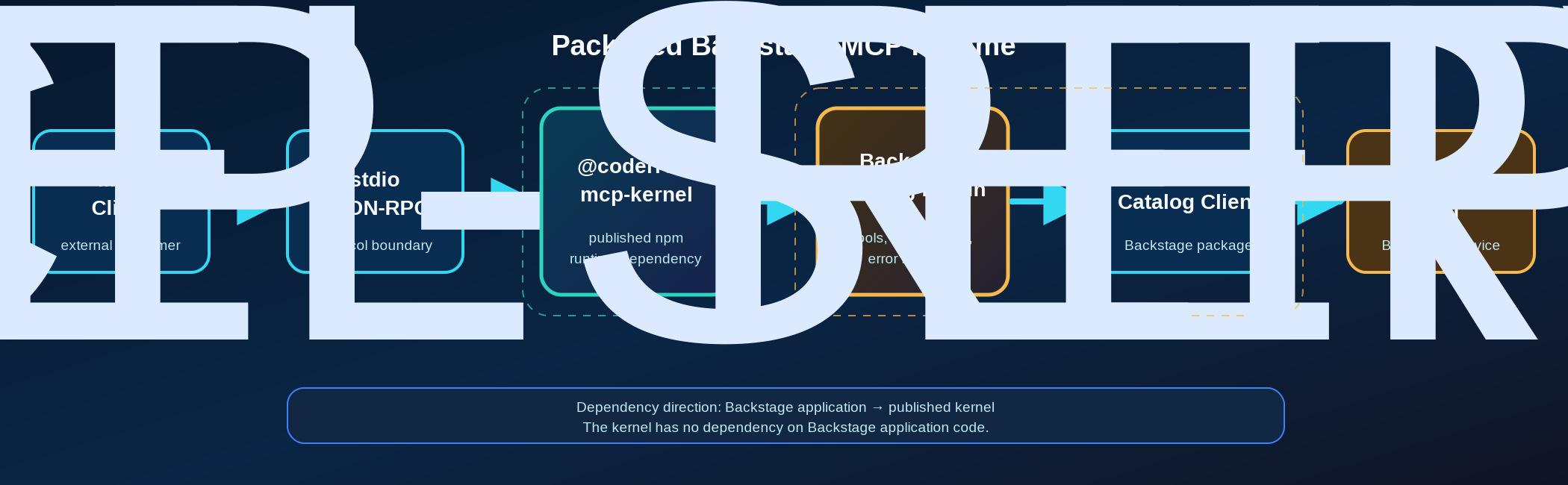
It runs as a stdio server, waiting for an MCP client on stdin/stdout and exchanging JSON-RPC.
README.md · b124c25aa9fe · 采集于 2026-11-13 11:13:28 UTC
保留上游原文,不做 AI 改写。为安全起见过滤脚本、表单和不安全链接。
当前显示最后一次成功采集的文档快照,请以来源页面为准。
A type-safe Model Context Protocol server for the Backstage Software Catalog, built on the published @coderrob/mcp-kernel runtime.
It exposes 32 Catalog tools over stdio, uses Backstage's official Catalog client, supports rotating bearer credentials, and ships with black-box SDK and MCP Inspector verification.
| Capability | Implementation |
|---|---|
| Catalog discovery | Entity queries, references, ancestry, facets, and source locations |
| Catalog operations | Add locations, refresh entities, remove entities or locations, and validate descriptors |
| Type safety | Zod schemas infer handler inputs and emit MCP-compatible JSON Schemas |
| Runtime policies | Timeouts, caller scopes, per-principal rate limits, tagged caching, and invalidation |
| Safe operations | MCP annotations distinguish read-only, mutating, idempotent, and destructive tools |
| Production boundary | Official Backstage CatalogClient, authenticated fetch, redacted stderr logging |
| Verification | Per-file coverage, SDK stdio smoke tests, every-tool execution, and MCP Inspector |
Requirements:
corepack enable
corepack yarn install --immutable
corepack yarn build
The Yarn release comes from the packageManager field in package.json; use corepack yarn so local and CI behavior stay aligned.
Set the backend root or the complete Catalog plugin URL and choose one credential source:
export BACKSTAGE_BASE_URL=https://backstage.example.com
export BACKSTAGE_TOKEN=your-token
For externally rotated credentials, point to a token file instead:
export BACKSTAGE_BASE_URL=https://backstage.example.com
export BACKSTAGE_TOKEN_FILE=/run/secrets/backstage-token
BACKSTAGE_TOKEN_FILE takes precedence when both variables are present and is reread for every outgoing request. Optional LOG_LEVEL=debug enables diagnostic logging. Logs always go to stderr because stdout carries MCP protocol traffic.
corepack yarn start
The process waits for an MCP client on stdin/stdout. For a read-only check against a real deployment, use corepack yarn test:live; see live Backstage verification.
After building, configure a stdio client with an absolute path:
{
  "mcpServers": {
    "backstage": {
      "command": "node",
      "args": ["/absolute/path/to/backstage-mcp-server/dist/cli.cjs"],
      "env": {
        "BACKSTAGE_BASE_URL": "https://backstage.example.com",
        "BACKSTAGE_TOKEN": "your-token"
      }
    }
  }
}
After global installation, use backstage-mcp-server as the command. Do not place credentials in committed client configuration; use the client's secret or environment mechanism where available.
The checked-in tools-manifest.json is generated from the runtime definitions and is the machine-readable source of truth.
| Category | Tools |
|---|---|
| Entity discovery | get_entities, get_entities_by_query, get_entities_by_refs, get_entity_by_ref, get_entity_ancestors, get_entity_facets |
| Location discovery | get_location_by_entity, get_location_by_ref |
| Validation | validate_entity |
| Catalog mutation | add_location, refresh_entity |
| Destructive mutation | remove_entity_by_uid, remove_location_by_id |
get_entities.filter follows Backstage's key-value model: keys in one record are AND conditions, values for one key are OR conditions, and multiple records are OR groups.
{
  "filter": {
    "kind": ["Component", "API"],
    "metadata.namespace": "default"
  }
}
This selects Components or APIs in the default namespace. The Backstage integration guide documents every tool-to-client mapping, cursor behavior, authentication, permissions, and error conversion.
CatalogClient and injects the bearer token at the fetch boundary.The published @coderrob/mcp-kernel package owns protocol registration, lifecycle, policies, transports, testing support, and protocol-safe logging. This repository owns only the Backstage application and Catalog integration. See the current architecture overview for the dependency boundary.
Generic server authoring, lifecycle, policies, transports, results, testing support, and logging are documented in the @coderrob/mcp-kernel repository. This package re-exports the kernel API for compatibility, but new generic consumers should install and import @coderrob/mcp-kernel directly.
To contribute a Catalog capability, follow Adding a Backstage MCP tool.
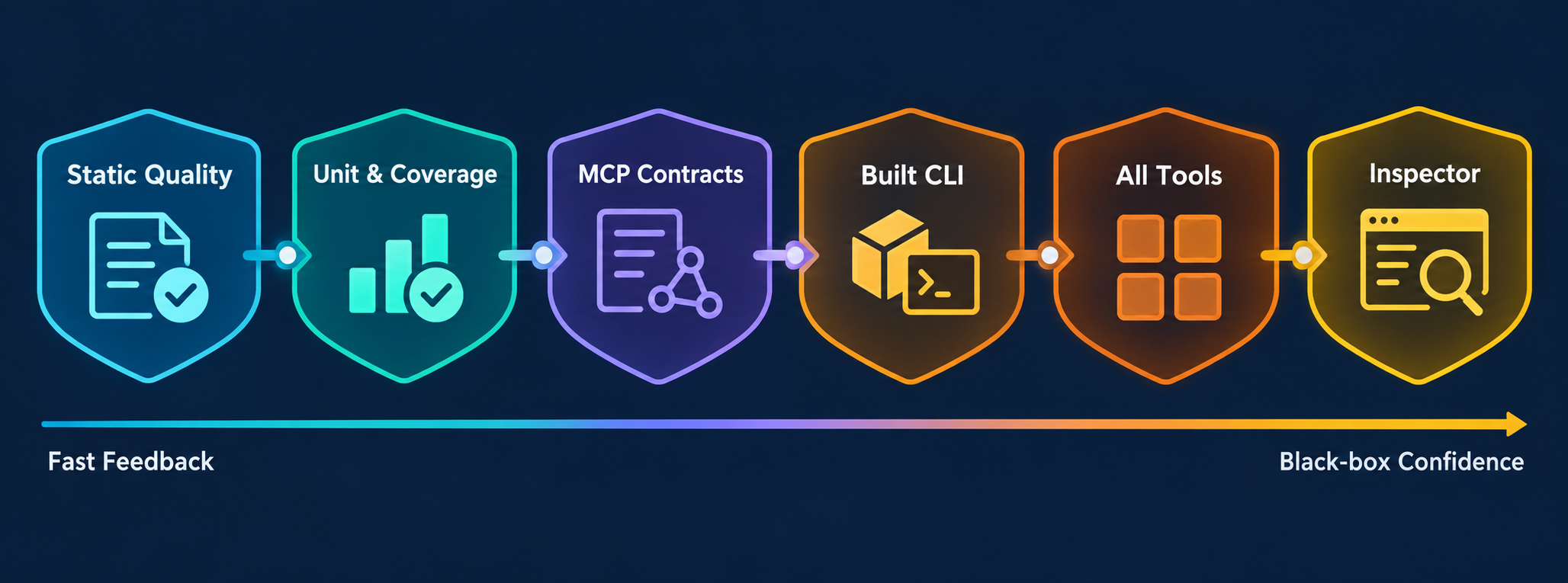
Run the normal contributor gate:
corepack yarn lint
corepack yarn typecheck
corepack yarn architecture:check
corepack yarn knip
corepack yarn test
corepack yarn test:shell
For MCP, tool, adapter, or packaging changes, also run:
corepack yarn test:mcp
corepack yarn manifest:check
test:mcp runs contract tests, builds the distribution, launches dist/cli.cjs over stdio with the official SDK client, invokes every registered tool against a deterministic authenticated Catalog stub, and performs an independent MCP Inspector check. It does not bypass the server with direct handler or HTTP calls.
See Repository tooling for the purpose and side effects of every command and MCP end-to-end testing for the exact black-box boundary.
Choose a path from the documentation hub:
GPL-3.0. See LICENSE.
The Backstage knowledge base maintains classified articles, named source citations and schema.org metadata. Repository skills in .agents/skills support catalog lookups, entity maintenance and MCP development.
The 19 contextual lookup tools cover names, System and Domain contents, Groups, ownership, dependencies, APIs, annotations and orphaned entities. See lookup contracts and examples, including pagination, ambiguity and work bounds.
Claim this server with your GitHub account to request manual ownership verification.
Link to the catalog listing for Model Context Protocol server for the Backstage Software Catalog from your README. This badge does not certify ownership, compatibility or security.
[](https://awesome-mcp.com/servers/backstage-mcp-server)Public repository statistics could not be verified. Check the configured source address; unavailable counts are not zero.
来源、范围和时段分别列出;不相加,不代表安装人数、活跃用户或安全审核。
尚无已审核的包 / 镜像标识,暂不展示下载统计。
Alternative and complementary servers in the same category
A directory listing describing a cancellation-letter and mailing-address service. The configured public GitHub repository returned 404 during source verification.

A hosted MCP service for browsing and searching through Singapore mobile-network proxies.

A directory listing describing a Markdown-to-PDF service. The configured public GitHub repository returned 404 during source verification.