
Store and retrieve entities, relations and observations in a persistent local knowledge graph.
create_entitiescreate_relationsadd_observations+6 more
92K
AI & Multi-Agent
An archived, self-hosted platform whose cairn container runs an MCP server and REST API for persistent memory, search, and knowledge features across sessions and projects.
Retired self-hosted MCP memory server is cataloged as an MCP server attributed to jasondostal. An archived, self-hosted platform whose cairn container runs an MCP server and REST API for persistent memory, search, and knowledge features across sessions and projects. It is categorized under ai agents-models. See the capability inspector for recorded interfaces and their independent review status; consult upstream documentation for the current interface.
Installation configuration is not reviewed. No executable setup is offered for this entry; inspect the source repository before proceeding.
Catalog license label: GNU General Public License v3.0. Check the source repository's current license and terms before using, modifying or distributing this software.
能力定义尚未审核。未核验的采集内容不会作为可信接口展示。
暂无可展示的已审核记录。这不表示上游不支持此能力。
暂无可展示的已审核记录。这不表示上游不支持此能力。
暂无可展示的已审核记录。这不表示上游不支持此能力。
Email delivery is not connected. This page does not collect email addresses or create subscriptions.
Browse the registry for current listings instead.
Reviews for Retired self-hosted MCP memory server are not available yet
Review publishing and storage are not connected. This page does not collect or publish ratings or comments, including after sign-in.
No. Cairn is retired and the repository is archived read-only; its successor is a separate MCP-native memory server called rill.
No. Store, search, recall, and rules work without one; an LLM is only needed for enrichment, knowledge extraction, and thinking.
README.md · 40be32a9718e · 采集于 2026-11-13 11:33:05 UTC
保留上游原文,不做 AI 改写。为安全起见过滤脚本、表单和不安全链接。
当前显示最后一次成功采集的文档快照,请以来源页面为准。





[!IMPORTANT] Cairn is retired, and this repository is archived (read-only). Its successor is rill — a faster, leaner, MCP-native memory server written in Go that learned from everything Cairn got right (and the things it got wrong). Cairn was the first; rill is where the work continues. This repo stays up as a read-only archive — explore it, fork it, but new development lives in rill.
A self-hosted persistent memory platform for AI agents and humans. Store something once, find it later, across sessions, across projects. Four containers. docker compose up. Done.
Cairn is the memory brain. Your agent runtime handles execution — Cairn handles knowing. What decisions were made, what facts are known, what patterns emerge across projects.
It's built for the systems person. The curious. The t-shaped. The ones who need a memory that works the way they do, across everything, all at once.
curl -O https://raw.githubusercontent.com/jasondostal/cairn-mcp/main/docker-compose.yml
docker compose up -d
Four containers start:
Migrations run on first boot. Ready in about a minute.
Add this to your MCP config:
{
  "mcpServers": {
    "cairn": {
      "type": "http",
      "url": "http://localhost:8000/mcp"
    }
  }
}
Where that goes:
| IDE | Config file |
|---|---|
| Claude Code | .mcp.json in your project root |
| Cursor | .cursor/mcp.json |
| Windsurf | .windsurf/mcp.json |
| Cline | MCP settings panel in VS Code |
| Continue | .continue/config.yaml |
| PiClaw | .pi/mcp.json |
Or run the setup wizard — it walks you through everything: LLM backend, database, embeddings, auth, and IDE configuration:
git clone https://github.com/jasondostal/cairn-mcp.git && ./cairn-mcp/scripts/setup.sh
Pick a tier (local dev, recommended, enterprise, or custom) and the wizard collects only what that tier needs. Supports --dry-run and --non-interactive for CI.
Tell your agent to remember something:
"Remember that we chose PostgreSQL for storage because it handles hybrid search without a separate vector DB."
Search for it later:
"What did we decide about the storage layer?"
That's it. 11 tools available. The ones you'll use most:
| Tool | What it does |
|---|---|
store | Save a memory with auto-enrichment. Supports event_at and valid_until for bi-temporal tracking |
search | Find memories (vector + keyword + recency + tags). Temporal filters: as_of, event_after, event_before |
recall | Get full content for specific memory IDs |
orient | Boot a session with rules, recent activity, beliefs, and open work |
rules | Load behavioral guardrails (global or per-project) |
beliefs | Durable epistemic state — crystallize, challenge, retract knowledge with confidence tracking |
work_items | Create, claim, and complete tasks with dependencies and gates |
working_memory | Capture ephemeral thoughts — hypotheses, questions, tensions — with salience decay |
projects | Manage project docs (briefs, PRDs, plans) |
code_query | Structural queries: dependents, impact, callers, callees, dead code, complexity, hotspots |
arch_check | Validate architecture boundary rules against imports |
The rest: modify, insights, think, status, consolidate, ingest.
Memory that persists across sessions. Your agent makes a decision at 2am. Next morning, different session, it finds that decision. That's the core. Bi-temporal tracking separates when something happened (event_at) from when you learned it (created_at). Memories that go unaccessed decay naturally; important ones are protected. Related memories get consolidated into higher-order insights automatically.
Beliefs. Durable epistemic state — knowledge held with confidence. Crystallize hypotheses into beliefs, challenge them with counter-evidence, retract them when wrong. Beliefs surface in session boot alongside rules and memories, giving agents a clear picture of what the organization knows and how confident it is.
Search that fuses signals. Vector similarity, recency, access frequency, keyword matching, and tag overlap blended via Reciprocal Rank Fusion. Filter by project, type, or time range. Temporal queries: "what did we know as of Tuesday?" via as_of, "what happened last week?" via event_after/event_before.
Knowledge graph. Entities and facts get extracted into a Neo4j graph that connects memories through shared people, places, projects, and concepts. Optional, but powerful when you're working across domains.
Thinking sequences. Structured deliberation — start with a goal, add thoughts (observations, hypotheses, analysis, alternatives), conclude. Both humans and agents contribute. The exploration itself becomes searchable memory.
Work management. Hierarchical work items with dependency tracking, gates that pause for human decisions, and activity logging. Experimental — evolving as we learn what works.
Web dashboard. Browse memories with OKLCH-colored toggle filters, score gradient bars, and shareable URL state. Explore the knowledge graph and entity relationships. View analytics, manage work items. Port 3000.
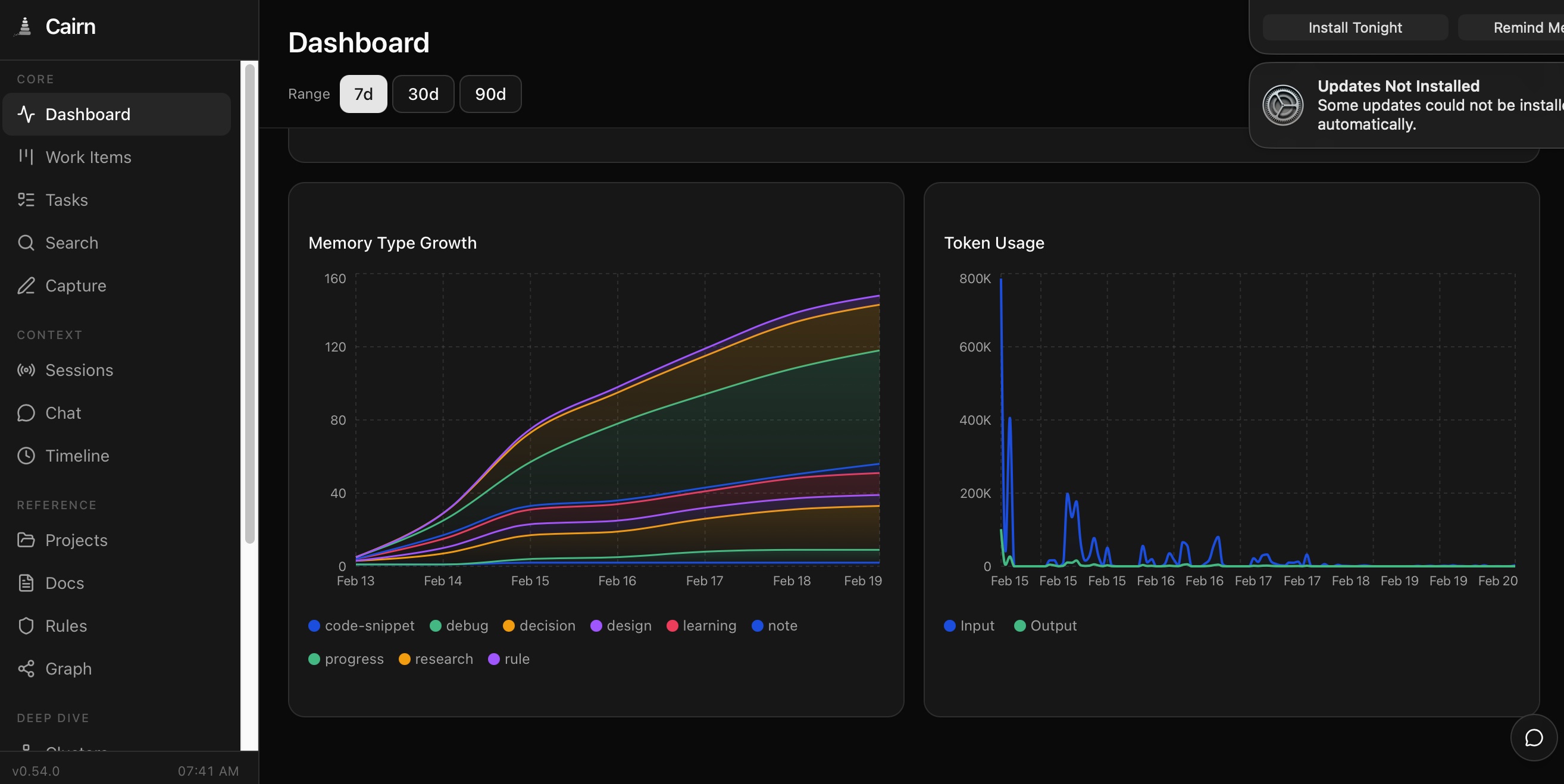
Memory growth by type, token usage tracking, and the full nav.
Code intelligence. A standalone worker indexes codebases with tree-sitter (30 languages) and builds a code graph in Neo4j. The server queries the graph without ever touching source files. Ask structural questions — "what depends on this file?", "who calls this function?", "what's the blast radius?" — and get answers from the code graph. Call graph extraction, cyclomatic complexity, dead code detection. Enforce architecture boundaries with YAML rules. Works across projects.
| Category | Languages |
|---|---|
| Systems | C, C++, Rust, Go, Zig |
| JVM | Java, Scala, Kotlin, Groovy |
| .NET | C# |
| Scripting | Python, Ruby, PHP, Lua, Bash |
| Web | TypeScript/TSX, HTML, CSS |
| Apple | Swift, Objective-C |
| ML/Scientific | OCaml, MATLAB |
| Config & Data | JSON, YAML, TOML, HCL (Terraform), Dockerfile, Makefile, SQL, Markdown |
Multi-user authentication and RBAC. Off by default, zero to enterprise in one command. ./scripts/setup.sh includes auth configuration, or run ./scripts/setup-auth.sh standalone. Auth mode selection (none / local JWT / OIDC SSO), JWT secret generation, OIDC provider validation. Personal Access Tokens for machine clients, stdio identity for MCP. Three roles, project-level scoping, first-user-becomes-admin. Groups with OIDC sync. See the Authentication Guide.
Disaster recovery. Cron-friendly scripts for PostgreSQL dump and Neo4j graph export with configurable retention. Tested restore procedures with migration safety checks. See the Backup Guide.
No. Store, search, recall, and rules work without one. You lose auto-enrichment (summaries, tags, importance scoring), knowledge extraction, and thinking.
If you want enrichment:
| Backend | Setup |
|---|---|
| Ollama (default) | Install Ollama, pull a model. Cairn connects to host.docker.internal:11434. |
| AWS Bedrock | Set CAIRN_LLM_BACKEND=bedrock, export AWS creds. |
| Google Gemini | Set CAIRN_LLM_BACKEND=gemini, add CAIRN_GEMINI_API_KEY. Free tier available. |
| OpenAI-compatible | Set CAIRN_LLM_BACKEND=openai, add key. Works with OpenAI, Groq, Together, LM Studio, vLLM. |
All via environment variables. The ones that matter:
| Variable | Default | What it does |
|---|---|---|
CAIRN_PROFILE | (empty) | Preset: vector, enriched, knowledge, enterprise. Sets capability defaults. |
CAIRN_LLM_BACKEND | ollama | LLM provider: ollama, bedrock, gemini, openai |
CAIRN_DB_PASS | cairn-dev-password | Database password. Change this for anything beyond local. |
CAIRN_AUTH_ENABLED | false | Multi-user authentication (JWT, PATs, OIDC/SSO) |
CAIRN_AUTH_JWT_SECRET | (empty) | JWT signing secret (required when auth enabled) |
CAIRN_OIDC_ENABLED | false | OIDC/SSO integration (any OIDC-compliant provider) |
CAIRN_MCP_OAUTH_ENABLED | false | OAuth2 Authorization Server for remote MCP clients (Claude.ai, mobile) |
CAIRN_GRAPH_BACKEND | (disabled) | Set to neo4j to enable knowledge graph |
CAIRN_KNOWLEDGE_EXTRACTION | false | Entity/statement extraction on store |
CAIRN_EMBEDDING_BACKEND | local | local (MiniLM, 384-dim) or bedrock (Titan V2, 1024-dim) |
CAIRN_INGEST_DIR | /data/ingest | Staging directory for file-path ingestion of large documents |
CAIRN_CODE_DIR | /data/code | Root directory for code intelligence indexing (mount codebases here) |
Full reference is in docker-compose.yml. Every variable has a sensible default.
Off by default. The fastest way to enable it is through the setup wizard:
./scripts/setup.sh          # includes auth as step 2
./scripts/setup-auth.sh     # or run auth setup standalone
Three modes — no auth, local JWT, or OIDC/SSO. Generates secrets, validates
your identity provider's discovery endpoint, writes .env. Provider-specific
URL hints for Authentik, Keycloak, Auth0, Okta, and Azure AD. Both scripts
support --dry-run and --non-interactive for CI.
First user to register becomes admin. Role-based access control enforces permissions across REST API, MCP HTTP, and the web UI. Personal Access Tokens for machine clients, groups with OIDC sync.
See the Authentication Guide for the full reference covering all auth modes, OIDC provider configuration, and MCP client examples.
Security note: Cairn's auth system is functional and production-tested but has not been independently audited. For network-exposed deployments, add TLS termination and network-level access controls.
Connect Cairn to Claude.ai, the Claude mobile app, or any OAuth2-capable MCP client. Cairn acts as an OAuth2 Authorization Server, delegating user authentication to your existing OIDC identity provider.
Prerequisites: Auth enabled (CAIRN_AUTH_ENABLED=true), OIDC configured (CAIRN_OIDC_ENABLED=true), and a public URL set (CAIRN_PUBLIC_URL).
Enable it:
CAIRN_MCP_OAUTH_ENABLED=true
Connect from Claude.ai:
https://your-cairn-domain.com/mcpThe OAuth2 flow uses Authorization Code + PKCE with Dynamic Client Registration (RFC 7591). If your identity provider supports SSO sessions, the auth redirect is invisible after the first login.
See the Remote MCP Guide for reverse proxy configuration, security hardening, and troubleshooting.
Code intelligence runs as a standalone worker that indexes source code and writes to Neo4j. The cairn server queries the graph but never touches source files directly. This separation means indexing doesn't block the event loop and the worker can run on the machine where code lives.
Requirements: Neo4j (the cairn-graph service in docker-compose) must be running.
# Index a single project (one-shot, no watching)
python -m cairn.code \
  --watch /path/to/your/repo:your-project \
  --neo4j-uri bolt://localhost:7687 \
  --cairn-url http://localhost:8000 \
  --no-watch

# Index and watch for changes (long-running)
python -m cairn.code \
  --watch /home/user/working/myproject:myproject \
  --watch /home/user/working/other:other \
  --neo4j-uri bolt://my-server:7687
| Variable | Default | What it does |
|---|---|---|
CAIRN_NEO4J_URI | bolt://localhost:7687 | Neo4j bolt URI |
CAIRN_NEO4J_USER | neo4j | Neo4j username |
CAIRN_NEO4J_PASSWORD | cairn-dev-password | Neo4j password |
CAIRN_API_URL | http://localhost:8000 | Cairn server URL (for project ID resolution) |
CAIRN_API_KEY | (empty) | API key if cairn auth is enabled |
CAIRN_CODE_PROJECTS | (empty) | Comma-separated project=path pairs (alternative to --watch) |
CAIRN_CODE_WATCH | true | Enable filesystem watching after initial index |
CAIRN_CODE_FORCE | false | Force re-index even if content hash unchanged |
Mount source code into the cairn container and set CAIRN_CODE_DIR:
# docker-compose.yml
volumes:
  - /path/to/code:/data/code:ro   # read-only mount
environment:
  CAIRN_CODE_DIR: /data/code
Or run the worker on the code host and point it at your cairn + Neo4j instances:
CAIRN_NEO4J_URI=bolt://cairn-host:7687 \
CAIRN_API_URL=http://cairn-host:8000 \
CAIRN_CODE_PROJECTS="myproject=/home/user/code/myproject" \
python -m cairn.code
IMPORTS (file-level), CALLS (function-level), CONTAINS (parent-child)code_query MCP tool)| Action | What it does |
|---|---|
dependents | Files that import the target |
dependencies | Files the target imports |
callers | Functions that call the target |
callees | Functions the target calls |
call_chain | Trace call paths between two functions |
dead_code | Functions with zero callers |
complexity | Rank functions by cyclomatic complexity |
impact | Blast radius — transitive dependents |
hotspots | PageRank — structurally important files |
search | Fulltext search over symbol names and docstrings |
MCP clients (Claude Code, Cursor, PiClaw)    REST clients (web UI, scripts)
        |                                            |
        | MCP (stdio or HTTP)                        | REST API
        |                                            |
+-------v--------------------------------------------v--------+
|  cairn.server (MCP tools)     cairn.api (FastAPI endpoints) |
|                                                             |
|  core: memory, search, enrichment, extraction, clustering   |
|        working memory, beliefs, thinking, work items        |
|                                                             |
|  embedding: local (MiniLM) or Bedrock (Titan V2)            |
|  llm: Ollama, Bedrock, Gemini, OpenAI-compatible            |
+------+----------------------------------------------+------++
       |                                              |       |
       v                                              v       |
  PostgreSQL 16 + pgvector                    Neo4j 5 <-------+
                                             (optional)       |
                                                ^             |
  code worker (python -m cairn.code)            |             |
  tree-sitter parsing, call graph      --------+             |
  watches filesystem for changes                             |
Tested against LoCoMo, a long-conversation memory benchmark with 1,986 questions across five categories.
| System | Score | LLM |
|---|---|---|
| Cairn | 81.6% | Llama-3.3-70B |
| Human baseline | 87.9% | — |
| Letta/MemGPT | 74.0% | GPT-4o-mini |
| Mem0 | 66.9% | GPT-4o |
Test configuration: Titan V2 embeddings (Bedrock, 1024-dim), episodic ingestion (raw turns + two-pass fact extraction), Search V2 with graph-primary retrieval, type routing, cross-encoder reranking, LLM-as-judge evaluation. Full results and methodology in eval/.
git clone https://github.com/jasondostal/cairn-mcp.git
cd cairn-mcp
cp .env.example .env
docker compose up -d --build
Cairn is under active development. It's a real system used daily in production, and it's evolving as I learn what actually works for agent memory. Migrations handle schema changes. If something breaks, open an issue.
Claim this server with your GitHub account to request manual ownership verification.
Link to the catalog listing for Retired self-hosted MCP memory server from your README. This badge does not certify ownership, compatibility or security.
[](https://awesome-mcp.com/servers/cairn-mcp)Public repository statistics could not be verified. Check the configured source address; unavailable counts are not zero.
来源、范围和时段分别列出;不相加,不代表安装人数、活跃用户或安全审核。
尚无已审核的包 / 镜像标识,暂不展示下载统计。
Alternative and complementary servers in the same category
Store and retrieve entities, relations and observations in a persistent local knowledge graph.
Organize problem solving into revisable, branching thought steps through an MCP tool.

Query-aware context compression with an MCP plugin for coding agents, plus Python and HTTP interfaces for reducing the context sent to a language model.