

Store and retrieve entities, relations and observations in a persistent local knowledge graph.
create_entitiescreate_relationsadd_observations+6 more
92K
AI & Multi-Agent
A platform that turns trusted source data and reviewed judgments into typed, versioned, receipted operational state that agents query and act on through an MCP server, CLI, and Python client.
Cruxible governed state engine with MCP server is cataloged as an MCP server attributed to cruxible-ai. A platform that turns trusted source data and reviewed judgments into typed, versioned, receipted operational state that agents query and act on through an MCP server, CLI, and Python client. It is categorized under ai agents-models. See the capability inspector for recorded interfaces and their independent review status; consult upstream documentation for the current interface.
Installation configuration is not reviewed. No executable setup is offered for this entry; inspect the source repository before proceeding.
Catalog license label: Apache 2.0. Check the source repository's current license and terms before using, modifying or distributing this software.
能力定义尚未审核。未核验的采集内容不会作为可信接口展示。
暂无可展示的已审核记录。这不表示上游不支持此能力。
暂无可展示的已审核记录。这不表示上游不支持此能力。
暂无可展示的已审核记录。这不表示上游不支持此能力。
Email delivery is not connected. This page does not collect email addresses or create subscriptions.
Browse the registry for current listings instead.
Reviews for Cruxible governed state engine with MCP server are not available yet
Review publishing and storage are not connected. This page does not collect or publish ratings or comments, including after sign-in.
No; the rules run as code and no model runs inside the engine.
Only according to the relationship's write policy; proposal-only relationships must enter through a governed proposal and review.
An MCP server, plus a CLI and Python client, all against the same daemon with the same credentials and permission tiers.
README.md · e848cbb67872 · 采集于 2026-11-13 10:24:20 UTC
保留上游原文,不做 AI 改写。为安全起见过滤脚本、表单和不安全链接。
当前显示最后一次成功采集的文档快照,请以来源页面为准。


cruxible.ai · quickstart · docs · kits · skills
Cruxible is a governed state engine for AI agents. It produces a Crux: an executable artifact of your domain knowledge with a code-like lifecycle — typed, reviewed, versioned, auditable, and tested against outcomes.
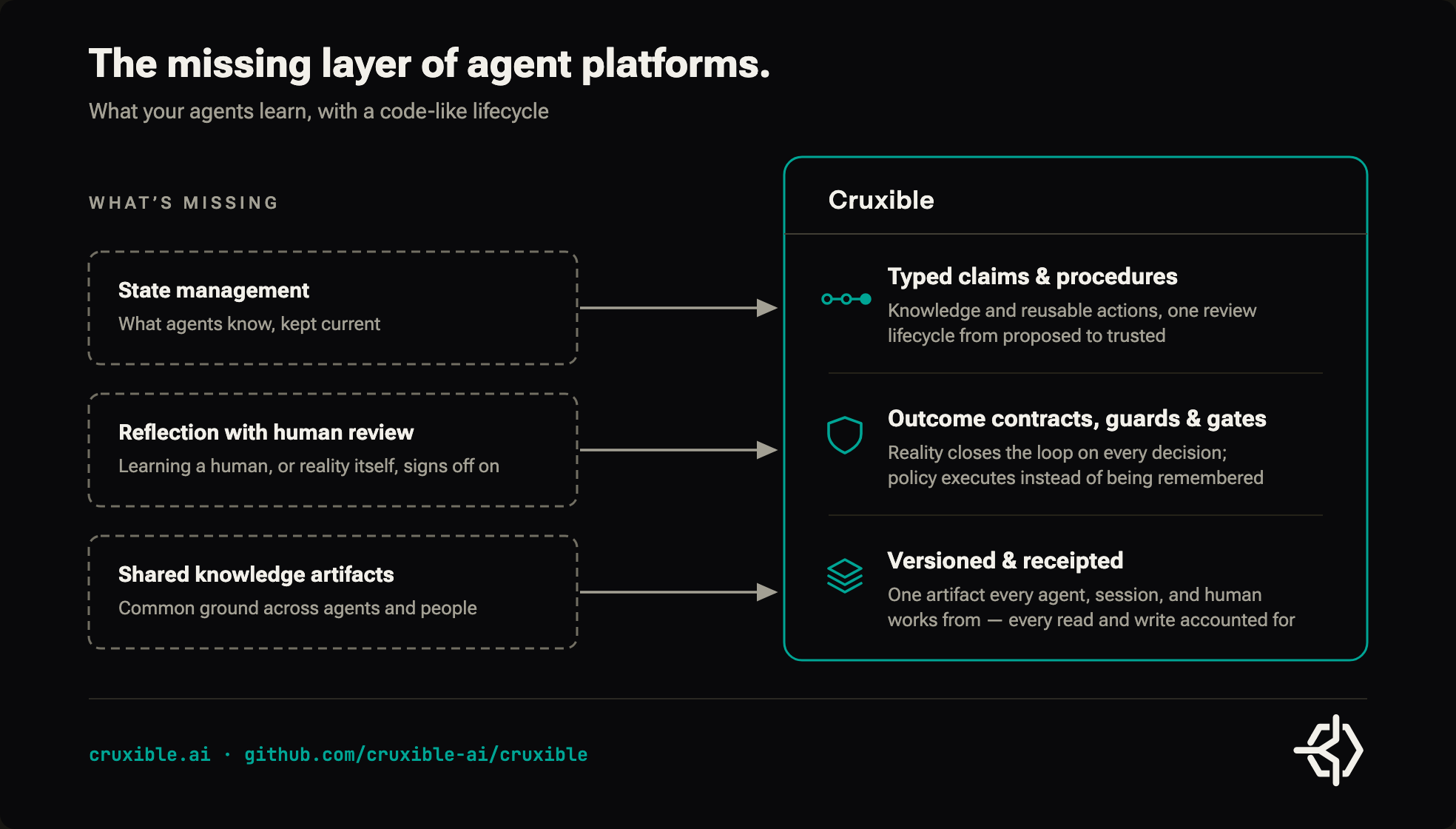
The problem. Code is typed, reviewed, and versioned; it executes deterministically, and tests verify it in seconds. The judgments, observations, reusable actions, and decisions agents produce land in prose — which doesn't execute, has no governed path from proposed to trusted, and puts no bounds on what gets repeated. Real decisions resolve over weeks or months, long after anything is still tracking them. And prose can't serve as shared ground: an organization running many agents needs them all acting on the same current claims, rules, and reviewed ways of acting, not on each agent's own reading of the documents.
How it works. You declare the domain ontology and its rules in YAML. Reproducible pipelines turn trusted source data into typed state. When an agent or human makes a judgment, Cruxible can require evidence and review before the claim becomes live. When an agent learns a way of acting that works, it can propose that too: a Procedure passes through the same review cycle as a claim and runs only within its declared inputs, preconditions, and limits. A decision can be required to declare, before it is accepted, what result will count as success; the outcome contract comes due on its own schedule and records what reality said. Queries and actions run against the same live state, and invalid changes are refused. No LLM runs inside the engine.
Why use it. Every agent works against the same live claims and can invoke the same reviewed, bounded Procedures. Invalid writes and actions are refused, contradictions remain visible until resolved, decisions can be checked against what happened, and computed answers, mutations, and action runs carry receipts that explain them. Snapshots capture exact config, lock, graph state, and procedure definitions at a revision for comparison, branching, and transfer; backups preserve the complete audit stores for recovery. The whole artifact outlives any single session or model.
One small example: a supplier inventory and incident feed build entities from pinned sources. An agent concludes that an incident impacts a supplier, but the relationship is declared a judgment call:
entity_types:
  Incident:
    id: incident_id
    properties:
      title: string indexed
  Supplier:
    id: supplier_id
    properties:
      name: string indexed

relationships:
  - incident_impacts_supplier: Incident -> Supplier
    write_policy: proposal_only        # judgment call: enters only through review

named_queries:
  incident_impacted_suppliers:
    mode: traversal
    entry_point: Incident
    returns: Supplier
    traverse:
      - relationship: incident_impacts_supplier
        direction: outgoing
Now the policy is part of the runtime. The direct write is refused, review admits the judgment, and a query computes its consequence:
  $ cruxible relationship add incident_impacts_supplier \
      Incident INC-TW-RAIL-2026-07 Supplier S-CN-DG-HARNESS
- Error: DirectWriteRefusedError: Direct write to relationship
- 'incident_impacts_supplier' is refused (write_policy=proposal_only).
- Use 'group propose' to stage a governed proposal. (receipt: RCP-…)

  $ cruxible propose --workflow propose_incident_impacts_supplier
  $ cruxible group resolve --group <GRP-id> --action approve \
      --rationale "Confirmed against supplier geography"

  $ cruxible query run incident_impacted_suppliers \
      --param incident_id=INC-TW-RAIL-2026-07 --json
+ { "items": [ { "entity_type": "Supplier", "entity_id": "S-CN-DG-HARNESS" } ],
+   "receipt_id": "RCP-2f61a90c84d3" }
The source facts came through deterministic ingest; the inferred edge entered through review. Queries can now traverse its consequences, guards and gates can act on it, and later observations can contradict it without silently rewriting history.
The complete lifecycle, abbreviated:
INGEST       pinned feeds -> Incident, Supplier, Product, and Shipment state
CLAIM        incident_impacts_supplier: pending -> live (evidence + reviewer)
QUERY        incident_impacted_suppliers -> [S-CN-DG-HARNESS]

PROCEDURE    hold_exposed_shipments v1: pending -> live (config + lock pinned)
DECISION     hold exposed shipments; success = zero exposed shipments released
RUN          bounded provider calls complete -> receipt RCP-run-...
OUTCOME      pinned query at check time -> satisfied -> receipt RCP-outcome-...

OBSERVATION  new evidence says the supplier was outside the incident boundary
ATTESTATION  contradict incident_impacts_supplier (claim remains live)
REVIEW       attestation upheld; separate adjudication rejects the claim
QUERY        incident_impacted_suppliers -> []

SNAPSHOT     exact config + lock + graph state + Procedure definitions captured
The Procedure is immutable once accepted and can call only capabilities the operator exported, within its reviewed preconditions and budgets. The outcome contract is declared before the decision becomes live and pins how success will be measured. The attestation is an append-only observation: resolving it does not silently change the claim, so the subsequent rejection is a separate, receipted decision. The old claim, observation, and reasoning remain available after live query results change.
Cruxible uses the same boundary itself: this repository refuses a push to main until state pins an approved review (how).
pip install cruxible— the Quickstart goes install to first query; Get Started below runs the seeded demo world in ~3 minutes, with no model calls or API keys.
write_policy chooses direct, proposal-only, or mint-only admission;
guards enforce evidence, transitions, and co-writes at one chokepoint
(Concepts)pip install cruxible
Build your own Crux with the
authoring skills
and Modeling State,
or run the demo — a seeded supply-chain world, ~3 minutes, with no model
calls or API keys. Sandbox writes attribute to a built-in operator
identity:
# shell 1 — local sandbox daemon
CRUXIBLE_SERVER_STATE_DIR="$HOME/.cruxible/sandbox" cruxible server start

# shell 2 — kit bundles are fetched from the release and digest-verified
# (agent-operation is the optional agent-ops layer; domain-only works too)
cruxible --server-url http://127.0.0.1:8100 init --kit agent-operation --kit supply-chain-blast-radius
cruxible context connect --server-url http://127.0.0.1:8100 --instance-id <instance-id>

# deterministic ingest: preview, then commit
cruxible run --workflow build_seed_state && cruxible apply --workflow build_seed_state --from-last-preview
cruxible run --workflow ingest_incidents && cruxible apply --workflow ingest_incidents --from-last-preview

# the incident feed can only PROPOSE impact edges; the judgment is yours, on the record
cruxible propose --workflow propose_incident_impacts_supplier
cruxible group list --status pending_review
cruxible group resolve --group <GRP-id> --action approve \
  --rationale "Confirmed against supplier geography" --expected-pending-version 1

# receipted answers through the edges you just admitted
cruxible query run open_incident_impacts --json
cruxible query run incident_impacted_suppliers --param incident_id=INC-TW-RAIL-2026-07 --json
When agents join, identity turns on: restart with CRUXIBLE_SERVER_AUTH=true,
claim the bootstrap credential, and mint each agent its own token — every
write is attributed. Details, permission tiers, and hardening:
Quickstart ·
Runtime Auth And Agent Roles.
Cruxible never asks a model to follow the rules, because the rules run as code. A rule declared in config runs at the write chokepoint on every mutation, and there is no code path around the chokepoint.
| Prompted | Enforced |
|---|---|
| "The agent knows an exposure can't be closed while unremediated" | The write chokepoint refuses the transition until the remediation claim, with its evidence, is linked |
| "The model says these sources support the claim" | The write is refused unless every reference dereferences to a content-hash-verified source chunk |
| "The agent was told not to accept claims it proposed itself" | The guard compares the acting actor against the creation receipt's recorded actor and refuses, including create-as-accepted |
| "The agent learned a reusable action sequence" | A Procedure may call only exported providers, within declared preconditions and budgets; independent acceptance pins it to the reviewed config and lock, and every run leaves a receipt |
Guards face inward (the write boundary of live state); gates face outward (an external action holds until state agrees).
gates:
  merge-review:
    kind: git-pre-push
    entity_type: ReviewRequest
    match_property: change_head
    condition: {status: approved}
    adapter: {branch_pattern: refs/heads/main}
This repository runs on that gate: it refused our own 0.2.2 release push until the review record was corrected in state. We fixed the state, not the hook.
The deep dive builds one governed truth end to end: a single
reviewed judgment lets a query walk a recursive bill of materials and
name every exposed shipment five typed hops downstream, with a receipt
you can explain.
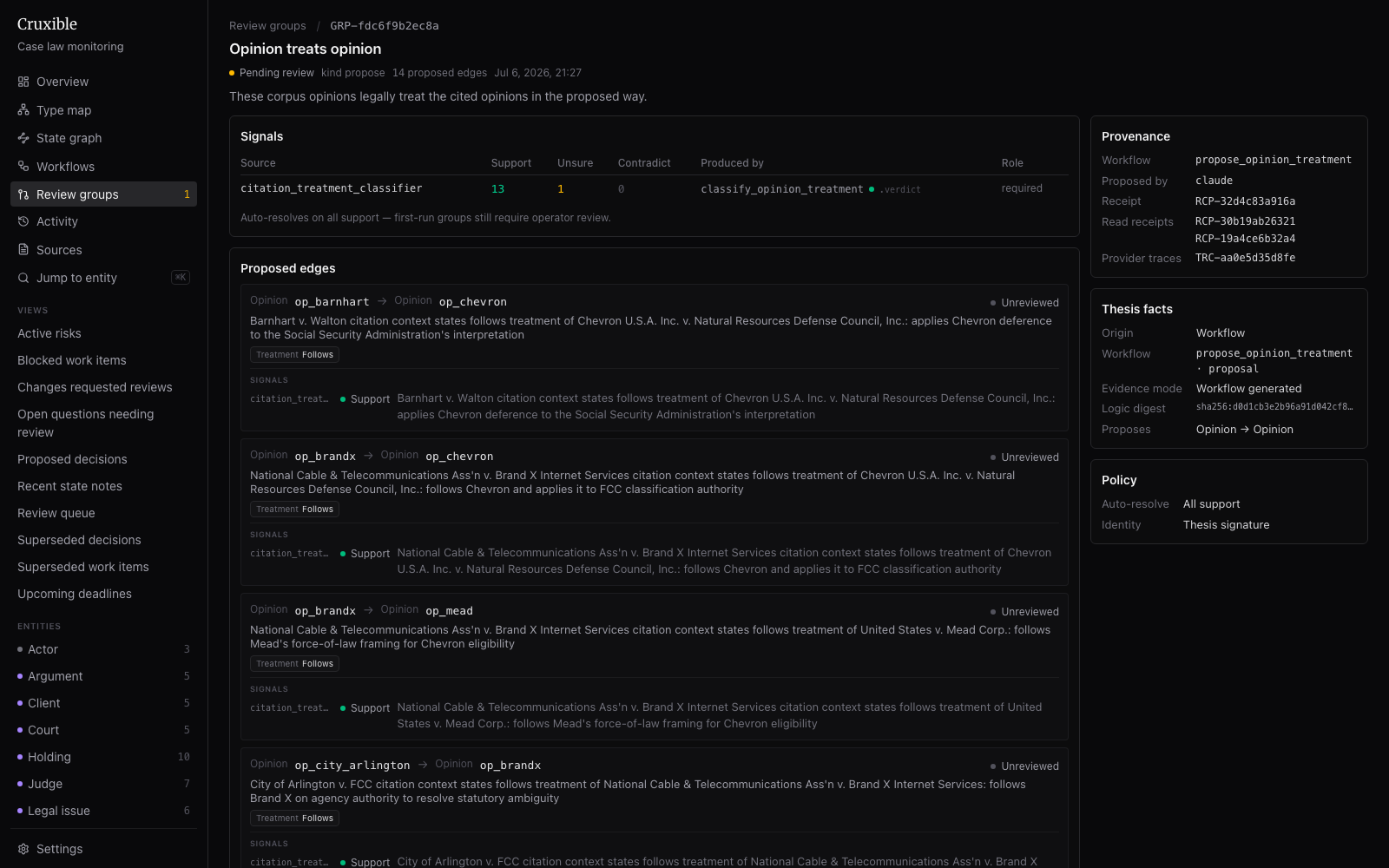
The screenshot is the review seat in the inspection UI: each proposed edge carries the evidence that matched it, with a provenance rail back to workflows, receipts, and traces.
Cruxible does not replace source systems, documents, or retrieval. Those layers help agents find and interpret evidence. Cruxible holds the smaller set of commitments that the rest of the system must query consistently, enforce, or act through.
| Layer | Job |
|---|---|
| Source systems, artifacts, and retrieval | Preserve and find the evidence |
| Agents and humans | Interpret evidence, propose claims and Procedures, review judgment |
| Cruxible | Maintain claim lifecycle, execute exact reads and bounded actions, enforce policy, and attach receipts and outcomes |
If information is only useful to read, leave it in the artifact or retrieval layer. When agents across sessions must rely on it as current, traverse its consequences, enforce it, or act through it, compile that knowledge into a Crux.
A kit is a reusable template for a Crux: it packages an ontology with its governance, queries, workflows, and providers as one versioned, composable unit. Per-kit guides run each end to end.
| Kit | Kind | What it models |
|---|---|---|
| agent-operation | Agent operating state | Work items, review requests, decisions, risks, open questions, state notes, actors, lifecycle, and dependency context. |
| project-domain | Domain overlay state | Roadmap items, milestones, release lines, and product areas composed over the agent-operation base — the project state Cruxible itself runs on. |
| agent-release | Domain overlay state | Agent systems, versions, eval suites and runs, with governed certification and promotion gates. |
| kev-reference | Domain reference state | Public known-exploited vulnerability reference data. Consumed as a published state release (state create-overlay); init the kit itself only to build offline or publish your own. |
| kev-triage | Domain overlay state | Local asset exposure, service impact, controls, incidents, findings, remediation, and governed vulnerability triage. |
| supply-chain-blast-radius | Domain state | Suppliers, components, assemblies, products, shipments, and incident blast radius. |
| case-law-monitoring | Domain state | Matter-centered case-law monitoring and authority impact. |
docs/; agent skills for authoring state from your dataCruxible uses Pydantic for validation, NetworkX for in-memory graph operations, Polars for data operations, SQLite for local durable state, FastAPI for the daemon, and FastMCP for MCP tools.
Contributions welcome — see CONTRIBUTING.md. If governed agent state is a problem you're working on, star the repo or open an issue with your use case.
Apache 2.0
Claim this server with your GitHub account to request manual ownership verification.
Link to the catalog listing for Cruxible governed state engine with MCP server from your README. This badge does not certify ownership, compatibility or security.
[](https://awesome-mcp.com/servers/cruxible-core)Public repository statistics could not be verified. Check the configured source address; unavailable counts are not zero.
来源、范围和时段分别列出;不相加,不代表安装人数、活跃用户或安全审核。
尚无已审核的包 / 镜像标识,暂不展示下载统计。
Alternative and complementary servers in the same category
Store and retrieve entities, relations and observations in a persistent local knowledge graph.
Organize problem solving into revisable, branching thought steps through an MCP tool.

Query-aware context compression with an MCP plugin for coding agents, plus Python and HTTP interfaces for reducing the context sent to a language model.