

Store and retrieve entities, relations and observations in a persistent local knowledge graph.
create_entitiescreate_relationsadd_observations+6 more
92K
AI & Multi-Agent
An MCP server exposing engram-rs memory capabilities, including memory storage, recall, and a topic tree, to MCP-compatible tools.
MCP server for a persistent AI agent memory engine is cataloged as an MCP server attributed to kael-bit. An MCP server exposing engram-rs memory capabilities, including memory storage, recall, and a topic tree, to MCP-compatible tools. It is categorized under ai agents-models. See the capability inspector for recorded interfaces and their independent review status; consult upstream documentation for the current interface.
Installation configuration is not reviewed. No executable setup is offered for this entry; inspect the source repository before proceeding.
Catalog license label: MIT. Check the source repository's current license and terms before using, modifying or distributing this software.
能力定义尚未审核。未核验的采集内容不会作为可信接口展示。
暂无可展示的已审核记录。这不表示上游不支持此能力。
暂无可展示的已审核记录。这不表示上游不支持此能力。
暂无可展示的已审核记录。这不表示上游不支持此能力。
Email delivery is not connected. This page does not collect email addresses or create subscriptions.
Browse the registry for current listings instead.
Reviews for MCP server for a persistent AI agent memory engine are not available yet
Review publishing and storage are not connected. This page does not collect or publish ratings or comments, including after sign-in.
It works without an LLM; keyword search and rule-based lifecycle still function, while adding an LLM unlocks triage, gate, merge, and topic naming.
It uses a single SQLite file with no external database or other external dependencies.
Working and Core memories are never deleted, and decay has a floor of 0.01 so memories remain retrievable under precise queries.
README.md · a9134e07a09a · 采集于 2026-11-13 13:01:50 UTC
保留上游原文,不做 AI 改写。为安全起见过滤脚本、表单和不安全链接。
当前显示最后一次成功采集的文档快照,请以来源页面为准。


Memory engine for AI agents. Two axes: time (three-layer decay & promotion) and space (self-organizing topic tree). Important memories get promoted, noise fades, related knowledge clusters automatically.
Most agent memory is a flat store — dump everything in, keyword search to get it back. No forgetting, no organization, no lifecycle. engram-rs adds the part that makes memory actually useful: the ability to forget what doesn't matter and surface what does.

Single Rust binary, one SQLite file, zero external dependencies. No Python, no Redis, no vector DB — curl | bash and it runs. ~10 MB binary, ~100 MB RSS, single-digit ms search latency.
# Install (interactive — will prompt for embedding provider config)
curl -fsSL https://raw.githubusercontent.com/kael-bit/engram-rs/main/install.sh | bash

# Store a memory
curl -X POST http://localhost:3917/memories \
  -d '{"content": "Always run tests before deploying", "tags": ["deploy"]}'

# Recall by meaning
curl -X POST http://localhost:3917/recall \
  -d '{"query": "deployment checklist"}'

# Restore full context (session start)
curl http://localhost:3917/resume
Inspired by the Atkinson–Shiffrin memory model, memories are managed across three layers by importance:
Buffer (short-term) → Working (active knowledge) → Core (long-term identity)
      ↓                       ↓                           ↑
   eviction              importance decay           LLM quality gate
Promotion isn't rule-based guesswork — an LLM evaluates each memory in context and decides whether it genuinely warrants long-term retention.
Buffer → [LLM gate: "Is this a decision, lesson, or preference?"] → Working
Working → [sustained access + LLM gate] → Core
Decay is activity-driven — it only fires during active consolidation cycles, not wall-clock time. If the system is idle, memories stay intact.
Exponential decay follows the Ebbinghaus forgetting curve — fast at first, then long-tail. Memories never fully vanish (floor = 0.01), remaining retrievable under precise queries. When a memory is recalled, it gets an activation boost, strengthening frequently-used knowledge.
| Kind | Decay rate | Half-life | Use case |
|---|---|---|---|
episodic | Fastest | ~35 epochs | Events, experiences, time-bound context |
semantic | Medium | ~58 epochs | Knowledge, preferences, lessons (default) |
procedural | Slowest | ~173 epochs | Workflows, instructions, how-to |
| Chart | What it shows |
|---|---|
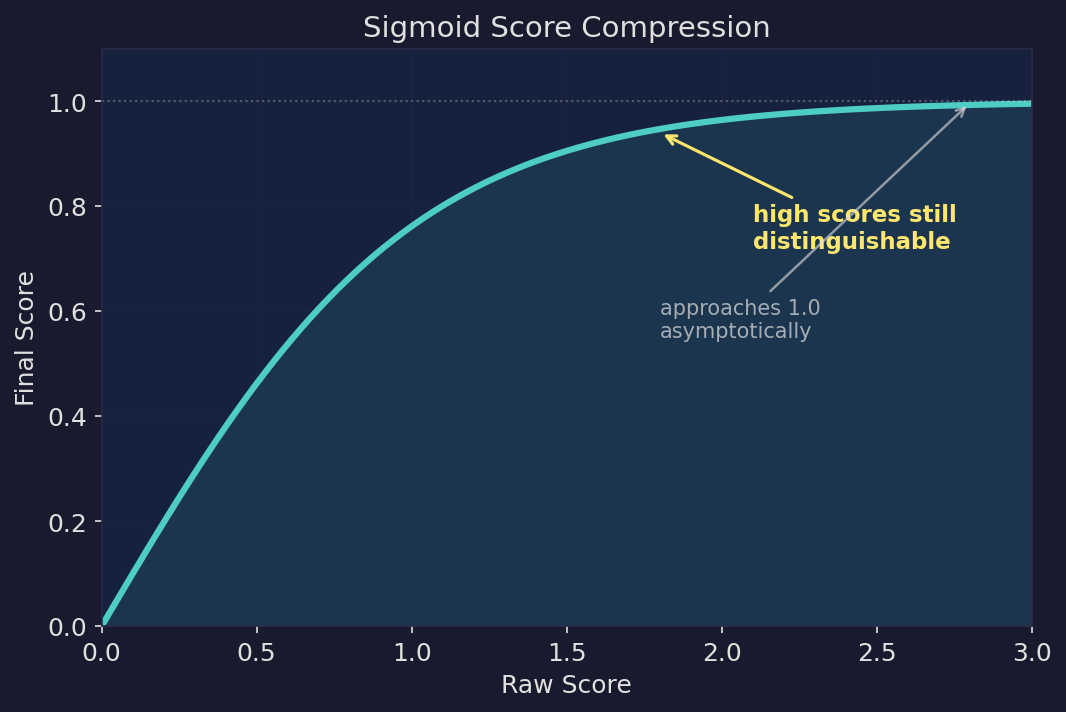 | Sigmoid score compression. Raw scores are mapped through a sigmoid function, approaching 1.0 asymptotically. High-relevance results remain distinguishable instead of being crushed into the same value. |
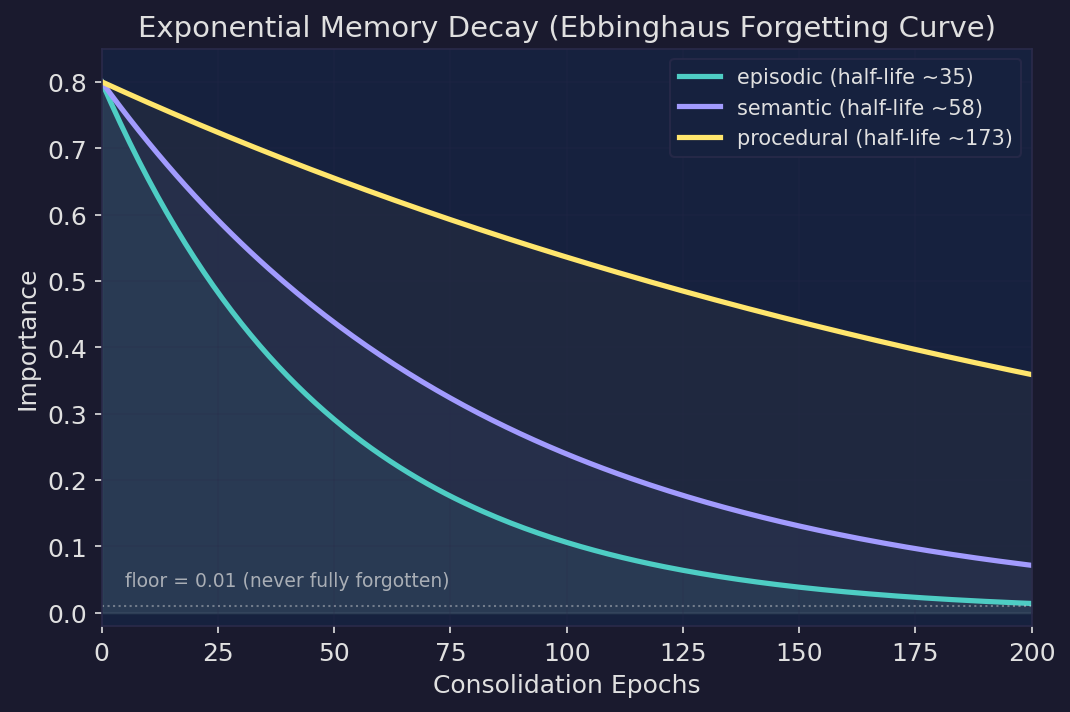 | Ebbinghaus forgetting curve. Exponential decay with kind-differentiated rates — episodic memories fade fastest, procedural slowest. Floor at 0.01 means memories never fully vanish; they remain retrievable under precise queries. |
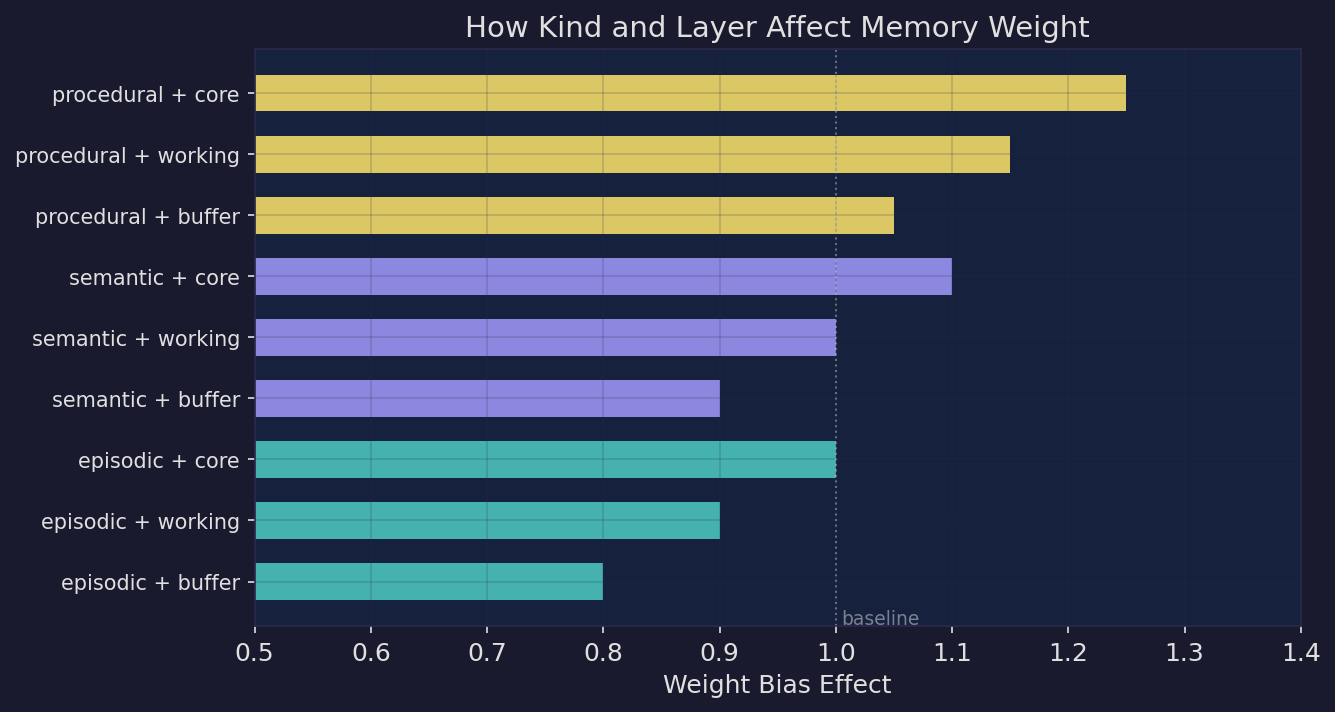 | Kind × layer weight bias. Additive biases adjust memory weight by type and layer. Procedural+core memories rank highest, episodic+buffer lowest — but the spread stays bounded so no single combination dominates. |
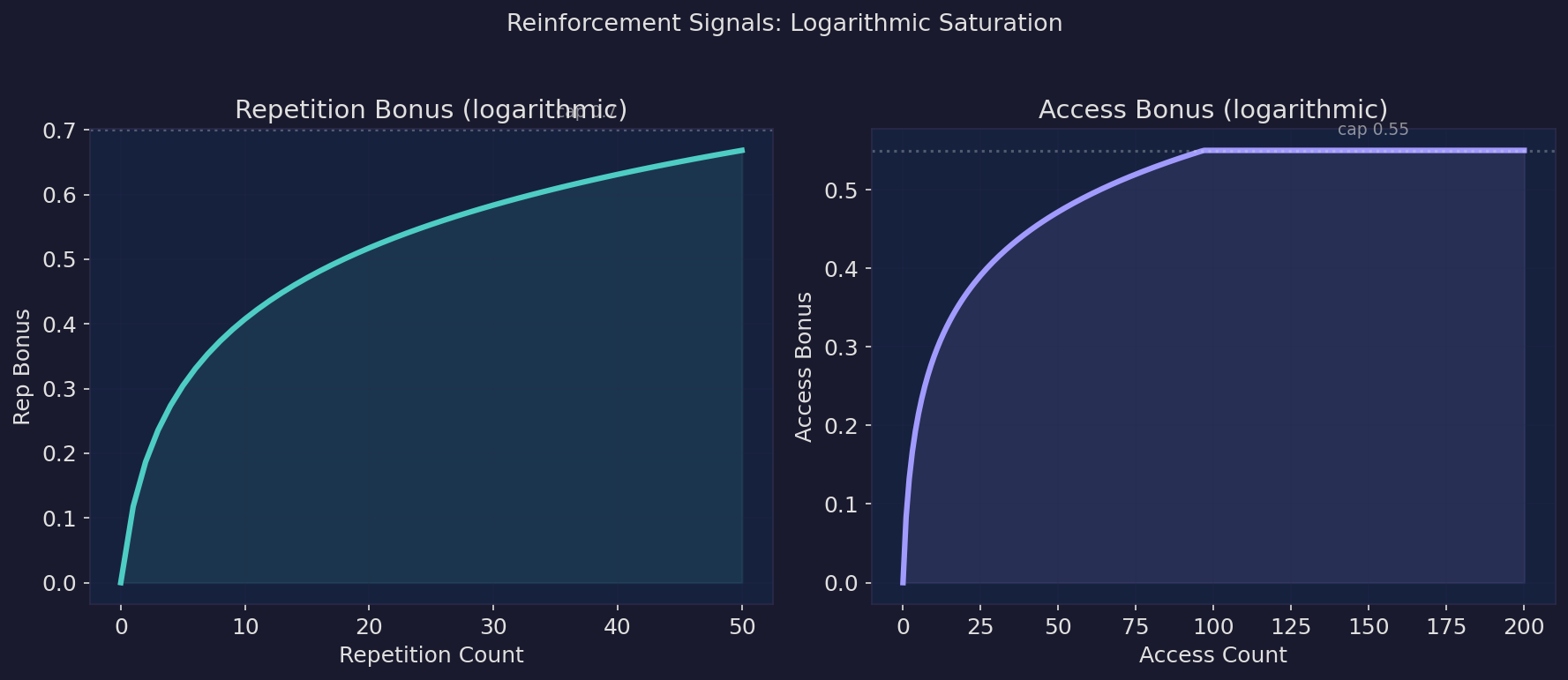 | Reinforcement signals. Repetition and access bonuses follow logarithmic saturation. Early interactions matter most; later ones contribute diminishing returns, discriminating between "used occasionally" and "used daily". |
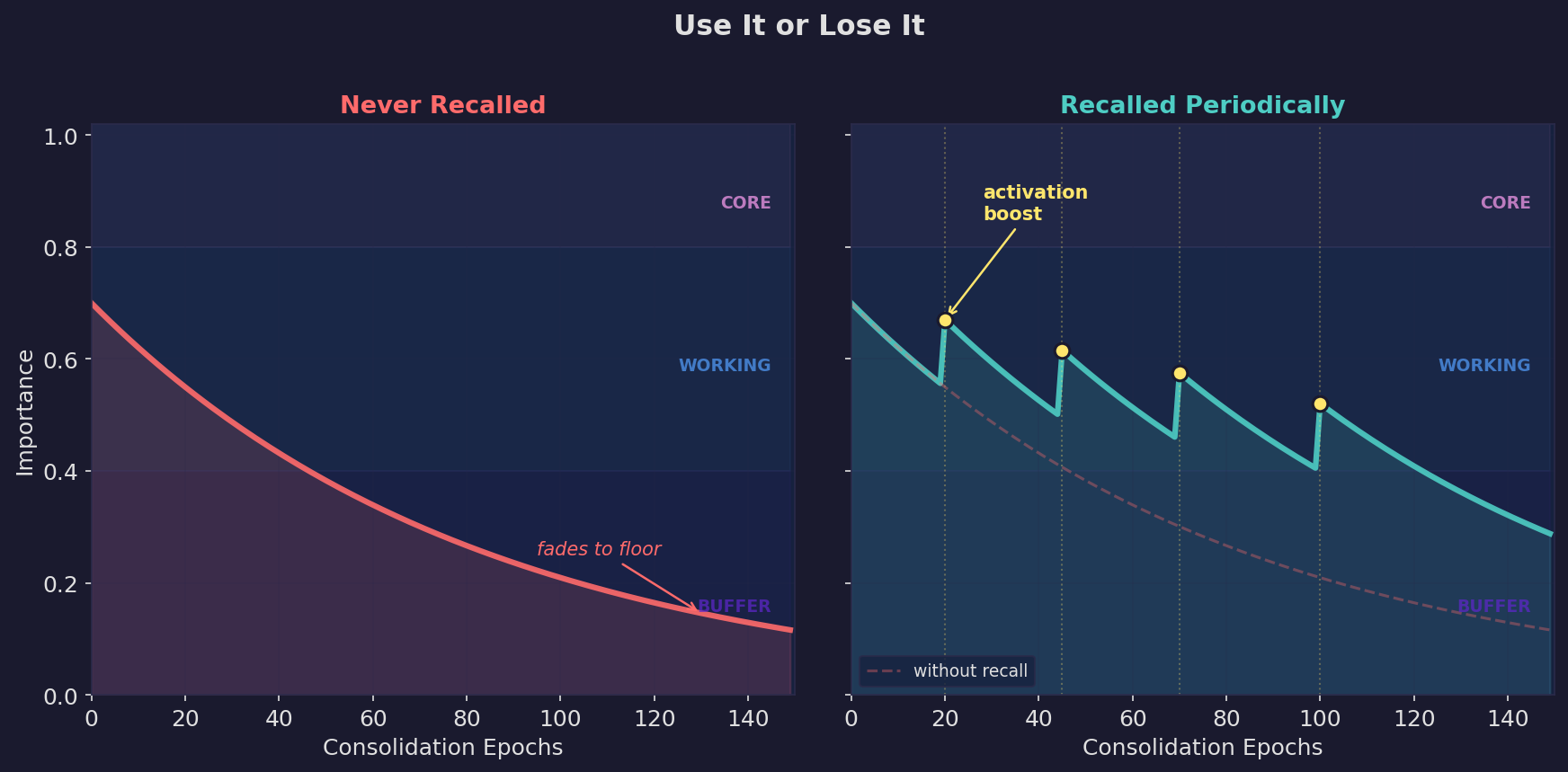 | Use it or lose it. Left: a memory that's never recalled decays into the buffer layer. Right: periodic recall triggers activation boosts that keep the memory in the working layer. Dashed line shows the unrecalled trajectory for comparison. |
Two memories saying the same thing in different words? Detected and merged automatically:
"use PostgreSQL for auth" + "auth service runs on Postgres"
→ Merged into one, preserving context from both
Vector clustering groups related memories together, LLM names the clusters. No manual tagging required:
Memory Architecture
├── Three-layer lifecycle [4]
├── Embedding pipeline [3]
└── Consolidation logic [5]
Deploy & Ops
├── CI/CD procedures [3]
└── Production incidents [2]
User Preferences [6]
The problem this solves: vector search requires asking the right question. Topic trees let agents browse by subject — scan the directory, drill into the right branch.
Tag a memory with trigger:deploy, and the agent can recall all deployment lessons before executing:
curl -X POST http://localhost:3917/memories \
  -d '{"content": "LESSON: always backup DB before migration", "tags": ["trigger:deploy", "lesson"]}'

# Pre-deployment check
curl http://localhost:3917/triggers/deploy
Agent wakes up, calls GET /resume, gets full context back. No file scanning needed:
=== Core (24) ===
deploy: test → build → stop → start (procedural)
LESSON: never force-push to main
...

=== Recent ===
switched auth to OAuth2
published API docs

=== Topics (Core: 24, Working: 57, Buffer: 7) ===
kb1: "Deploy Procedures" [5]
kb2: "Auth Architecture" [3]
kb3: "Memory Design" [8]
...

Triggers: deploy, git-push, database-migration
| Section | Content | Purpose |
|---|---|---|
| Core | Full text of permanent rules and identity | The unforgettable stuff |
| Recent | Recently changed memories | Short-term continuity |
| Topics | Topic index (table of contents) | Drill in on demand, no full load |
| Triggers | Pre-action tags | Auto-recall lessons before risky ops |
Agent reads the directory, finds relevant topics, calls POST /topic to expand on demand.
Semantic embeddings + BM25 keyword search with CJK tokenization (jieba). IDF-weighted scoring — rare terms get boosted, common terms auto-downweighted. No stopword lists to maintain.
# Semantic search
curl -X POST http://localhost:3917/recall \
  -d '{"query": "how do we handle auth", "budget_tokens": 2000}'
# Note: min_score defaults to 0.30. Use "min_score": 0.0 to get all results.

# Topic drill-down
curl -X POST http://localhost:3917/topic \
  -d '{"ids": ["kb3"]}'
Fully automatic, activity-driven — no writes means the cycle is skipped:
Consolidation (every 30 minutes)
Topic Distillation — when a topic grows too large (10+ memories), overlapping content is condensed into fewer, richer entries.
Single instance, multiple projects. Use X-Namespace to isolate:
curl -X POST http://localhost:3917/memories \
  -H "X-Namespace: my-project" \
  -d '{"content": "API uses OAuth2 bearer tokens"}'
# macOS / Linux
curl -fsSL https://raw.githubusercontent.com/kael-bit/engram-rs/main/install.sh | bash

# Windows (PowerShell)
irm https://raw.githubusercontent.com/kael-bit/engram-rs/main/install.ps1 | iex
docker run -d --name engram-rs \
  -p 3917:3917 \
  -v engram-data:/data \
  -e ENGRAM_LLM_URL=https://api.openai.com/v1 \
  -e ENGRAM_LLM_KEY=sk-... \
  ghcr.io/kael-bit/engram-rs:latest
engram-rs works without an LLM — keyword search and rule-based lifecycle still function. Adding an LLM unlocks intelligent features (triage, gate, merge, topic naming):
export ENGRAM_LLM_URL=https://api.openai.com/v1
export ENGRAM_LLM_KEY=sk-...

# Any OpenAI-compatible API (Ollama, LM Studio, etc.)
export ENGRAM_LLM_URL=http://localhost:11434/v1

# Anthropic native
export ENGRAM_LLM_PROVIDER=anthropic
export ENGRAM_LLM_KEY=sk-ant-...
Two-tier model config — strong model for judgment, lightweight for text processing:
ENGRAM_GATE_MODEL=gpt-4o          # quality decisions
ENGRAM_LLM_MODEL=gpt-4o-mini     # text processing
Add to your agent's system prompt:
Set up engram-rs (persistent memory) by following the guide at:
https://raw.githubusercontent.com/kael-bit/engram-rs/main/docs/SETUP.md
Works with Claude Code, Cursor, Windsurf, OpenClaw, and any MCP-compatible tool.
17 MCP tools (MCP docs) | Full HTTP API (Setup guide)
# MCP (Claude Code)
npx engram-rs-mcp

# MCP (Cursor / Windsurf / generic)
{"mcpServers": {"engram": {"command": "npx", "args": ["-y", "engram-rs-mcp"]}}}
Built-in web UI at http://localhost:3917/ui for browsing memories, viewing the topic tree, and monitoring LLM usage.
| Binary | ~10 MB |
| Memory | ~100 MB RSS in production |
| Storage | SQLite, no external database |
| Language | Rust |
| Platforms | Linux, macOS, Windows (x86_64 + aarch64) |
| License | MIT |
MIT
Claim this server with your GitHub account to request manual ownership verification.
Link to the catalog listing for MCP server for a persistent AI agent memory engine from your README. This badge does not certify ownership, compatibility or security.
[](https://awesome-mcp.com/servers/engram-rs)Public repository statistics could not be verified. Check the configured source address; unavailable counts are not zero.
来源、范围和时段分别列出;不相加,不代表安装人数、活跃用户或安全审核。
尚无已审核的包 / 镜像标识,暂不展示下载统计。
Alternative and complementary servers in the same category
Store and retrieve entities, relations and observations in a persistent local knowledge graph.
Organize problem solving into revisable, branching thought steps through an MCP tool.

Query-aware context compression with an MCP plugin for coding agents, plus Python and HTTP interfaces for reducing the context sent to a language model.