

Store and retrieve entities, relations and observations in a persistent local knowledge graph.
create_entitiescreate_relationsadd_observations+6 more
92K
AI & Multi-Agent
A self-hosted MCP server and dashboard that lets multiple AI agents read and write shared long-term memory stored as markdown in a git repository you own.
Self-hosted MCP server for shared agent memory over a git-backed markdown vault is cataloged as an MCP server attributed to rwnalds. A self-hosted MCP server and dashboard that lets multiple AI agents read and write shared long-term memory stored as markdown in a git repository you own. It is categorized under ai agents-models. See the capability inspector for recorded interfaces and their independent review status; consult upstream documentation for the current interface.
Installation configuration is not reviewed. No executable setup is offered for this entry; inspect the source repository before proceeding.
Catalog license label: MIT. Check the source repository's current license and terms before using, modifying or distributing this software.
能力定义尚未审核。未核验的采集内容不会作为可信接口展示。
暂无可展示的已审核记录。这不表示上游不支持此能力。
暂无可展示的已审核记录。这不表示上游不支持此能力。
暂无可展示的已审核记录。这不表示上游不支持此能力。
Email delivery is not connected. This page does not collect email addresses or create subscriptions.
Browse the registry for current listings instead.
Reviews for Self-hosted MCP server for shared agent memory over a git-backed markdown vault are not available yet
Review publishing and storage are not connected. This page does not collect or publish ratings or comments, including after sign-in.
Retire the fact with brain_supersede or set valid_until; search withholds it by default and returns it in an excluded list with a reason.
No; it uses full-text search over markdown plus a wikilink graph, with no embeddings service or vector store.
Every write is committed to git attributed to the token or human behind it, and the activity feed shows per-file diffs.
README.md · 39ddf22ce57a · 采集于 2026-11-13 10:52:40 UTC
保留上游原文,不做 AI 改写。为安全起见过滤脚本、表单和不安全链接。
当前显示最后一次成功采集的文档快照,请以来源页面为准。

The second brain your AI agents read and write.
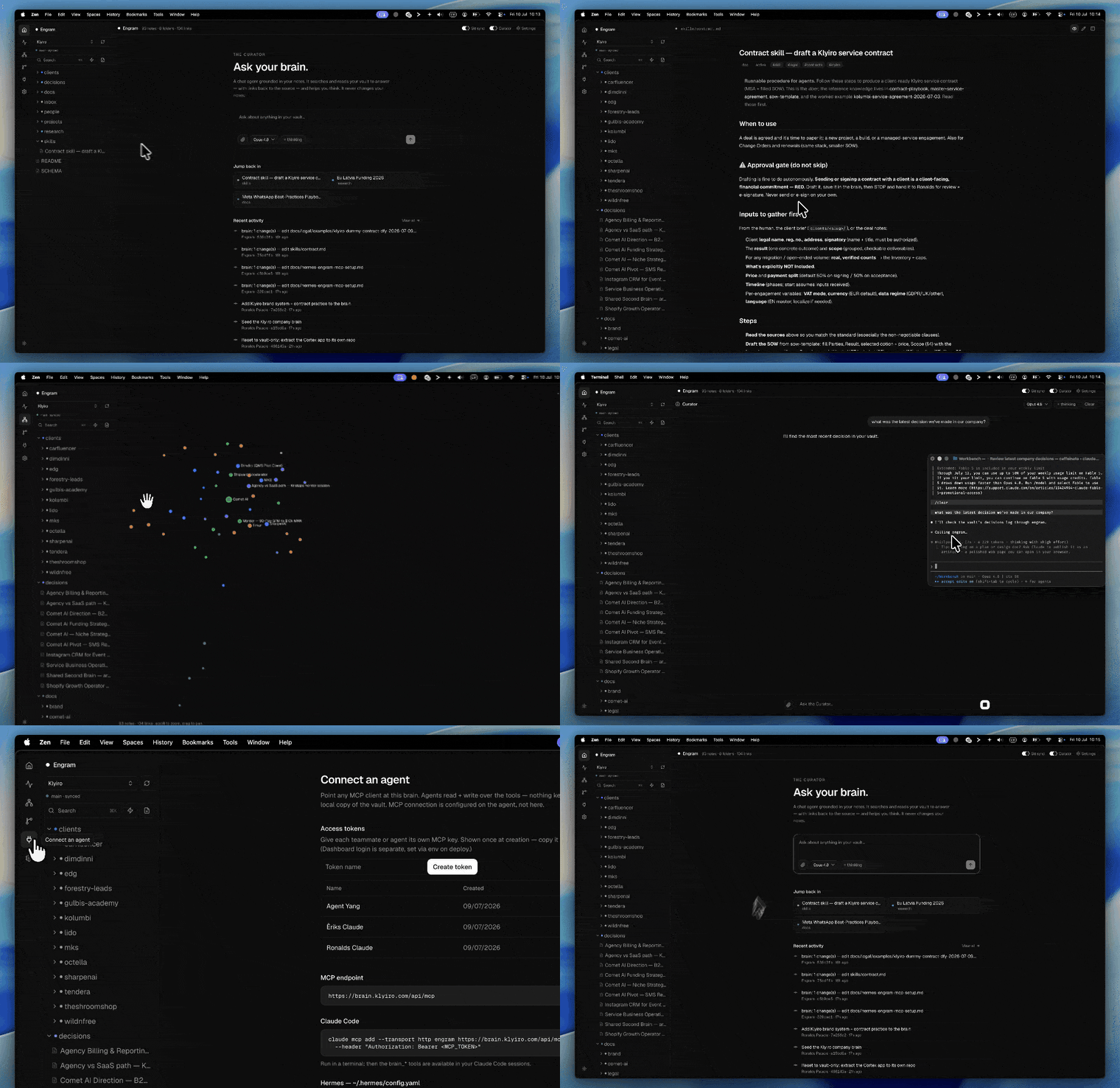
▶ Watch the full-length video (real-time, full quality)
↗ Try the live demo — no signup. Search retainer price and watch the retired note get withheld.

Engram is a self-hosted MCP server + dashboard that gives Claude Code, Cursor, Hermes, and any Model Context Protocol agent shared, long-term memory they read and write — over a plain, git-backed folder of markdown you own. Built for the case a single agent's memory never hits: a team running several agents against one brain.
Autonomous agents forget everything between sessions — and worse, they can't tell what they remember is still true. An agent pulls an old README, a retired price, an API doc you changed months ago, and quotes it with full confidence, because keyword and vector search both rank by resemblance, not truth. Engram makes "is this still true" a first-class, written property: mark a fact superseded or expired and search withholds it — and tells the agent what it skipped and why. Per-agent read/write tokens and a git audit trail of who-wrote-what keep it sane when the writers are a fleet, not just you.
Unlike a headless memory store, you can watch it happen. A fast dashboard lets you search your
brain, see exactly what every agent and teammate changed (with per-file diffs), jump back into
recent notes, and curate it all — while agents read and write the same vault over one MCP endpoint. No
database: your .md files are the source of truth, git is the durable store, and an in-memory index
powers full-text search + a wikilink knowledge graph.


Opinionated about how it stores memory — git-backed markdown, no database, agents write (not just read), self-hosted. Unopinionated about what you keep in it — any markdown vault, any folder structure, any MCP client. Point it at a fresh repo or your existing Obsidian vault: no import step, no lock-in.
What it's for · How it compares · Features · Works with · Quick start · MCP tools · Deploy · FAQ · Contributing
Most agent memory is built to answer "what did I store about this?" Engram is built to answer "what is still true about this?" — a different question, and the one that bites when an agent quotes a price you retired months ago.
| Engram | Vector-store memory (mem0, Zep, …) | Markdown memory (Basic Memory, …) | Plain RAG over docs | |
|---|---|---|---|---|
| Storage | markdown files, git is the database | embeddings in a vector DB | markdown files | embeddings in a vector DB |
| Ranking | relevance × authority | similarity | relevance | similarity |
| Knows a fact is retired | ✅ superseded_by + valid_until, enforced at search | — | — | — |
| Explains what it withheld | ✅ excluded[] with a reason per note | — | — | — |
| Retire + replace atomically | ✅ brain_supersede, one commit | — | — | — |
| Refuses contradicting writes | ✅ at write time, not read time | — | — | n/a (read-only) |
| Audit trail | ✅ git, per-write attribution, per-file diffs | varies | git, if you commit | — |
| Per-agent access control | ✅ read / write token scopes | varies | — | — |
| Human UI | ✅ dashboard, search, diffs, graph | varies | — | — |
| Runs on | your box, one container | mostly hosted SaaS | your box | your box |
The row that matters is the third one. Similarity search cannot tell a contradiction from a duplicate — a retired price and a live one are textually identical, so the retired one often outranks the live one by being longer and more detailed. That can't be fixed at read time, which is why Engram writes the retirement down when it happens.
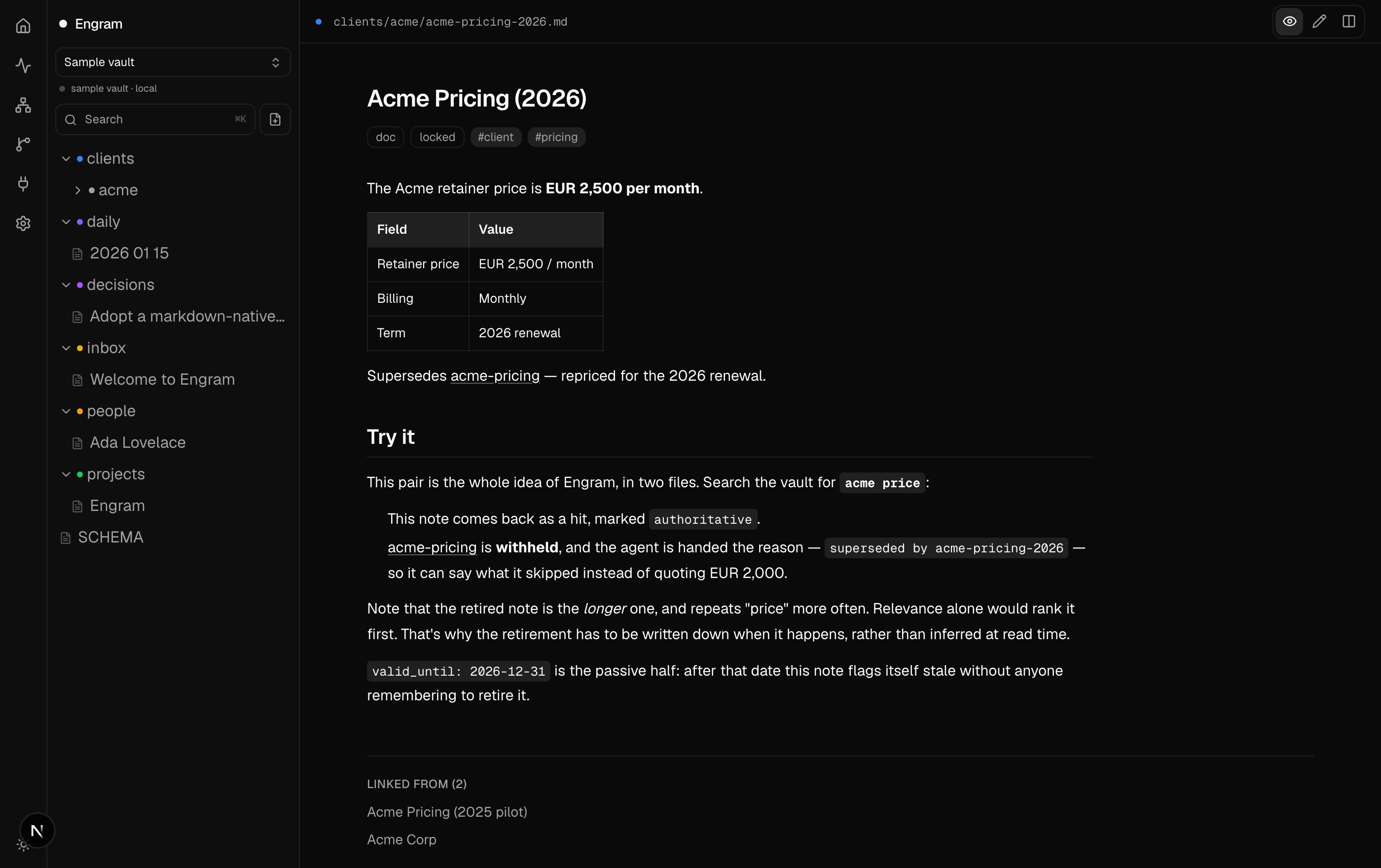
This exact pair ships in sample-vault/. Run bun dev, search acme price,
and watch the retired note get withheld with a reason.
Categories, not feature-by-feature audits of specific products, and accurate to the best of my knowledge as of July 2026. If something here misrepresents a tool you maintain, open a PR — I'll fix it.
brain_* tools over one bearer-authenticated HTTP endpoint (POST /api/mcp,
streamable HTTP JSON-RPC). Connect any MCP client to a single URL. Per-agent token scopes:
a read-only token never even sees the write tools.authoritative → current
→ provisional → superseded → archived) derived from the note's folder and frontmatter — so your
agents quote the locked doc, not the dead one. Markdown RAG that won't hand back yesterday's answer.superseded_by another note or give it a
valid_until date, and search withholds it by default (even if it's locked) — then hands the
agent an excluded list of what it skipped, each with a reason ("expired 2026-06-01"). One atomic
brain_supersede retires the old fact and links the new one in a single commit, so add-and-retire
can't drift apart. This is the difference between an agent that remembers and one that knows what's
still true.acme-pricing-2026.md-beside-acme-pricing.md bug) and
points the agent at brain_supersede instead; refuses to overwrite a note the caller hasn't read;
and warns when a status: isn't a word the ranking model knows, so a typo can't silently strip a
note's authority.brain_capture a rough dump — a meeting note, a
voice transcript — and an agentic loop searches what already exists, then files, merges, or archives
and returns a manifest of what it touched. It reads before it overwrites and never deletes. Opus /
Sonnet / Haiku, your key..md + YAML frontmatter + [[wikilinks]]. Drop in an existing
Obsidian vault and it just works.Any client that speaks the Model Context Protocol — one endpoint, bearer-token auth. Most-used first:
If it speaks MCP, it can read and write Engram as shared memory.
Want to poke at it first? There's a live demo — open, no signup, resets a few times a day. Break it all you like.
bun install
bun dev            # http://localhost:3000 — runs against ./sample-vault
Point it at your own vault:
VAULT_DIR=/path/to/your/obsidian-or-markdown/vault bun dev
Hosted mode (team): the dashboard + HTTP MCP server above — self-host it once, many agents and
teammates connect over POST /api/mcp. This is the main mode.
Local mode (stdio): a plain stdio MCP server over a folder, no HTTP/auth/git — for a single machine, Claude Desktop / Cursor, or a registry's Docker introspection:
bun run mcp:stdio /path/to/your/vault # defaults to ./sample-vault
Same brain_* tools. Built from Dockerfile.mcp.
Each mode ships as its own image, and they are not interchangeable:
| Image | Mode | Use it for |
|---|---|---|
ghcr.io/rwnalds/engram-app | HTTP — dashboard + /api/mcp | Railway, Render, Fly, any host. This is the one you deploy. |
ghcr.io/rwnalds/engram | stdio — JSON-RPC on stdin/stdout | Claude Desktop, Cursor, MCP registries. Never opens a port. |
Deploying the stdio image as a web service is the one mistake worth calling out: it can only 502, because there is nothing listening. It now refuses to start on a PaaS and tells you this instead.
Agents only ever see the active vault — no repo, workspace, or GitHub tools are exposed.
A read-scope token sees only the read tools. brain_capture appears only when the Curator is full.
| Tools | |
|---|---|
| Read | brain_search · brain_read · brain_list · brain_recent · brain_tree · brain_backlinks · brain_graph · brain_schema |
Write (needs a write-scope token) | brain_write · brain_edit · brain_append · brain_move · brain_supersede · brain_create_folder · brain_delete |
Connect an agent (the dashboard → Connect page shows the exact command + token):
claude mcp add --transport http engram https://<host>/api/mcp \
  --header "Authorization: Bearer <token>"
Runs anywhere you can run a Docker container with a persistent volume — Railway, Render, Fly, or your own box. Serverless (Vercel) won't work: Engram holds a volume, a file watcher, and an in-memory index that a serverless function can't keep alive.
Dockerfile), mount a volume at /data, set ENGRAM_DATA_DIR=/data.Most runtime config (git-sync, AI capture, GitHub OAuth, app name) is editable in the Settings page — only auth/infra bootstrap vars live on the host. Full setup: DEPLOY.md.
/data.render.yaml (Docker + a /data disk).Deploying from a prebuilt image instead of the repo? Use ghcr.io/rwnalds/engram-app:latest —
not engram:latest, which is the stdio server and cannot answer HTTP. Set the healthcheck to
/api/health.
How do I give Claude Code long-term memory?
Deploy Engram, connect a markdown vault, and claude mcp add the endpoint. The brain_* tools let
Claude Code search, read, and write persistent notes across sessions.
Can multiple AI agents share one knowledge base?
Yes. Every agent points at the same MCP URL and reads/writes the same active vault — that's the point.
Give each agent its own bearer token, read or write — a read-only token can't mutate your notes.
How do I stop an agent from quoting outdated facts?
Retire the fact and search stops surfacing it. When a value changes, call brain_supersede(old, new) —
one atomic commit marks the old note superseded_by the new one, and it's withheld from search by
default (even if it's locked). Or set valid_until: 2026-12-31 on a note and it self-expires.
Retired matches don't vanish silently: brain_search returns them in an excluded list with a
reason ("expired 2026-06-01"), so the agent can say what it ignored and why instead of quoting it.
What stops an agent just adding a second, contradicting note?
Engram refuses the write. Told "the price is now X", an agent that can't overwrite a note it never
read will happily add acme-pricing-2026.md next to acme-pricing.md — nothing is corrupted, and
you now have two live notes disagreeing about one number. That write is rejected with a pointer to
brain_supersede, which retires the old note and adds the new one in a single commit. Pass
allow_conflict: true when both notes genuinely belong.
How do I know what an agent changed? Every write is committed to git attributed to the token or human behind it, and the dashboard's activity feed shows per-file diffs — a built-in audit trail for autonomous agents.
Does it work with my Obsidian vault?
Yes. It reads plain markdown with frontmatter and [[wikilinks]], and renders Obsidian-style callouts
and backlinks. No import step.
Do I need a vector database? No. Engram uses full-text search (MiniSearch) plus a wikilink graph over human-readable markdown — no embeddings service, no vector store to run.
Can I chat with my notes? Yes — enable the optional Curator, a chat agent that searches and reads your vault to answer with wikilink citations (Opus / Sonnet / Haiku). It's read-only in chat, so it helps you think without changing anything, and it runs on your own Anthropic key.
Can I see what my agents changed? Yes — the Activity view reads your vault's git history and shows every change (agents and teammates alike), expandable to per-file diffs. Since it's just git, you get the full audit trail for free.
Is my data locked in?
No. It's just .md files in a git repo you own. Turn Engram off and you still have every note and its
full history.
Where does it run / is it self-hosted? You host it. One Docker container on Railway / Render / Fly / any VM with a volume. Your keys, your data.
Issues and PRs welcome — especially where the validity model breaks against a vault shaped differently from mine.
bun install && bun dev
bun test          # the ranking/authority suite, incl. the stale-truth fixtures
If Engram is useful to you, starring the repo genuinely helps other people find it.
Next.js 16 (App Router) · React 19 · TypeScript · Tailwind v4 · shadcn/ui · bun · MiniSearch · d3-force · MCP SDK. MIT licensed.
Keywords: MCP server · Model Context Protocol · second brain for AI agents · agent memory · long-term memory for Claude Code · shared memory for AI agents · self-hosted knowledge base · Obsidian-compatible · markdown · knowledge graph · wikilinks · PKM · Zettelkasten · git-backed notes · Hermes agent memory · Cursor memory · RAG without a vector database · chat with your markdown notes · git-backed agent activity feed · audit trail for AI agents · authority-aware search · read-only vs write MCP tokens · agent access control · self-organizing notes · agentic note capture · AI that files your notes · temporal validity · stale memory · agents quoting outdated facts · supersede · note expiry · shared memory for a team of agents · Basic Memory alternative · mem0 alternative.
Claim this server with your GitHub account to request manual ownership verification.
Link to the catalog listing for Self-hosted MCP server for shared agent memory over a git-backed markdown vault from your README. This badge does not certify ownership, compatibility or security.
[](https://awesome-mcp.com/servers/engram-rwnalds)Public repository statistics could not be verified. Check the configured source address; unavailable counts are not zero.
来源、范围和时段分别列出;不相加,不代表安装人数、活跃用户或安全审核。
尚无已审核的包 / 镜像标识,暂不展示下载统计。
Alternative and complementary servers in the same category
Store and retrieve entities, relations and observations in a persistent local knowledge graph.
Organize problem solving into revisable, branching thought steps through an MCP tool.

Query-aware context compression with an MCP plugin for coding agents, plus Python and HTTP interfaces for reducing the context sent to a language model.