
Store and retrieve entities, relations and observations in a persistent local knowledge graph.
create_entitiescreate_relationsadd_observations+6 more
92K
AI & Multi-Agent
An MCP server that provides persistent long-term memory tools for AI coding assistants and other MCP clients, storing memories in EverMemOS Cloud.
evermemos-mcp is cataloged as an MCP server attributed to tt-a1i. An MCP server that provides persistent long-term memory tools for AI coding assistants and other MCP clients, storing memories in EverMemOS Cloud. It is categorized under ai agents-models. See the capability inspector for recorded interfaces and their independent review status; consult upstream documentation for the current interface.
Installation configuration is not reviewed. No executable setup is offered for this entry; inspect the source repository before proceeding.
Catalog license label: MIT. Check the source repository's current license and terms before using, modifying or distributing this software.
能力定义尚未审核。未核验的采集内容不会作为可信接口展示。
暂无可展示的已审核记录。这不表示上游不支持此能力。
暂无可展示的已审核记录。这不表示上游不支持此能力。
暂无可展示的已审核记录。这不表示上游不支持此能力。
Email delivery is not connected. This page does not collect email addresses or create subscriptions.
Browse the registry for current listings instead.
Reviews for evermemos-mcp are not available yet
Review publishing and storage are not connected. This page does not collect or publish ratings or comments, including after sign-in.
No. It is cloud-first: all memories live in EverMemOS Cloud with no local state to lose.
recall searches memories with 6 retrieval strategies: keyword, hybrid, vector, RRF, agentic, and auto.
A sensitive content guard blocks API keys, passwords, tokens, and private keys before storing and asks the user to confirm.
README.md · 1d565111148b · 采集于 2026-11-13 10:04:18 UTC
保留上游原文,不做 AI 改写。为安全起见过滤脚本、表单和不安全链接。
当前显示最后一次成功采集的文档快照,请以来源页面为准。




Long-term memory for AI coding assistants. Remember once, recall forever.
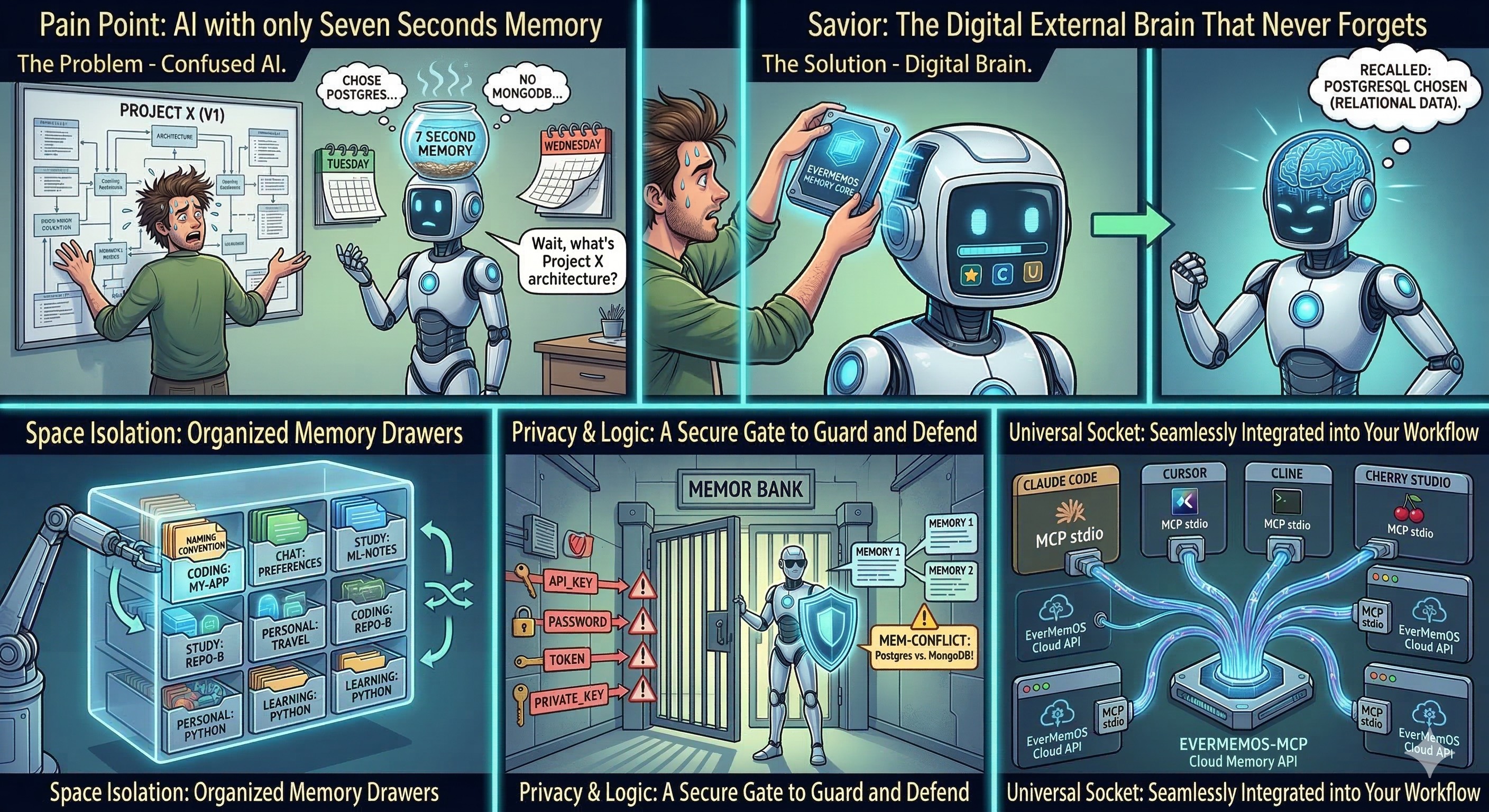
You spent thirty minutes explaining your architecture, naming conventions, and why you dropped MongoDB. Next session — gone. You explain it all over again.
evermemos-mcp fixes this. One remember call stores it. One briefing call brings it back — across any session, any client.
Benchmark: 60/60 recall vs 0/60 baseline. Zero attribution errors. P95 < 2s. (evidence)
Intro video: Watch on Bilibili
Demo video: Watch on Bilibili
Get your API key from EverMemOS Cloud, then add to your MCP client config:
{
  "mcpServers": {
    "evermemos-mcp": {
      "type": "stdio",
      "command": "uvx",
      "args": ["evermemos-mcp@latest"],
      "env": {
        "EVERMEMOS_API_KEY": "your-key-here"
      }
    }
  }
}
Or run directly:
uvx evermemos-mcp@latest
Works with Claude Code, Cursor, Cline, Cherry Studio, OpenClaw, Gemini CLI, Aider, and any MCP-compatible client or agent. See docs/05-client-integrations.md for client-specific setup.
git clone https://github.com/tt-a1i/everos-mcp.git
cd everos-mcp
cp .env.example .env   # set EVERMEMOS_API_KEY
uv run evermemos-mcp
MCP client config for source installs:
{
  "mcpServers": {
    "evermemos-mcp": {
      "type": "stdio",
      "command": "uv",
      "args": ["run", "--directory", "/path/to/evermemos-mcp", "evermemos-mcp"],
      "env": { "EVERMEMOS_API_KEY": "your-key-here" }
    }
  }
}
| Tool | What it does |
|---|---|
list_spaces | Discover available memory spaces |
remember | Store context into long-term memory. Auto-detects sensitive content (API keys, passwords) and checks for conflicting memories |
request_status | Check if a queued write has been extracted |
recall | Search memories with 6 retrieval strategies (keyword / hybrid / vector / RRF / agentic / auto) |
briefing | One-call session-start context restore: profile + episodes + facts + foresights |
forget | Targeted deletion with verification workflow |
fetch_history | Paginate through memory timeline by type |
coding:my-app, chat:preferences, study:ml-notes — memories never bleed across projectsrecall call with automatic source attributionchat:* spaces. Surfaces conflicts so the agent can decidequeued, provisional, fallback, or searchable across all toolsmemory_type, snippet, timestamp, score, source_message_id on every resultspace_id and it infers coding:<repo-name> from git remotePersistent architecture context:
You: remember we chose PostgreSQL because our data is highly relational
     [space_id: coding:my-saas]

-- next day, new session --

You: what database did we choose and why?
     → "Chose PostgreSQL — highly relational data model"
Personal preferences that stick:
You: remember I prefer dark mode, vim keybindings, and concise responses
     [space_id: chat:preferences]

-- any future session --

You: recall my UI preferences
     → "dark mode, vim keybindings, concise responses"
Cross-session learning notes:
You: remember bias-variance tradeoff — high bias = underfitting, high variance = overfitting
     [space_id: study:ml-notes]

-- later --

You: briefing for study:ml-notes
     → profile + recent episodes + key facts + foresights
There are other memory MCP servers. Here's what makes this one different:
| evermemos-mcp | Mem0 MCP | Letta/MemGPT | Official MCP memory | |
|---|---|---|---|---|
| Space isolation | domain:slug per project/topic | No | No | No |
| Lifecycle tracking | queued → provisional → fallback → searchable | No | No | No |
| Sensitive content guard | API keys, passwords, tokens blocked | No | No | No |
| Conflict detection | Auto for chat spaces | No | No | No |
| Multi-space search | Up to 10 spaces in one call | No | No | No |
| Retrieval strategies | 6 methods + auto merge | Semantic only | Semantic only | None |
| Benchmark verified | 60/60 recall, 0 errors | — | — | — |
| Setup | uvx evermemos-mcp | Cloud or self-host | Self-host required | npx |
Tested on a fixed 60-query set across coding, chat, and study spaces.
| Metric | With memory | Without memory |
|---|---|---|
| Hit rate | 60/60 (100%) | 0/60 (0%) |
| Attribution errors | 0 | — |
| P95 latency | 1958 ms | — |
Evidence:
MCP Client (Claude Code / Cursor / Cline / Cherry Studio / OpenClaw / any agent)
        │
        │  MCP stdio
        ▼
┌─────────────────────────────┐
│     evermemos-mcp server    │
│  ┌───────────────────────┐  │
│  │   7 Tool Handlers     │  │
│  └──────────┬────────────┘  │
│  ┌──────────▼────────────┐  │
│  │   Memory Service      │  │  Content guard → Conflict check → Cloud write → Lifecycle tracking
│  └──────────┬────────────┘  │
│  ┌──────────▼────────────┐  │
│  │ Space Catalog Service │  │  Space registry, metadata sync, cross-session recovery
│  └──────────┬────────────┘  │
│  ┌──────────▼────────────┐  │
│  │  EverMemOS HTTP Client│  │  Auth, retries, rate-limit backoff, error normalization
│  └──────────┬────────────┘  │
└─────────────┼───────────────┘
              │  HTTPS
              ▼
       EverMemOS Cloud API
remember queues content for AI extraction. Use request_status to track progress.| Template | Use it for |
|---|---|
chat:preferences | Durable personal preferences, names, tone, UI likes |
chat:daily | Ongoing chat context that shouldn't leak into projects |
coding:<repo> | Architecture decisions, conventions, bugs, project context |
study:<topic> | Learning notes, topic progress, revision context |
| Goal | Tool | Why |
|---|---|---|
| Start a new session | briefing | Fastest way to restore context in one call |
| Find a specific fact | recall | Relevance-ranked search across spaces |
| Review what happened | fetch_history | Chronological timeline > ranked search for audits |
| Verify before/after delete | fetch_history | Stable timeline for pre/post-delete checks |
| Variable | Default | Description |
|---|---|---|
EVERMEMOS_API_KEY | (required) | EverMemOS Cloud API key |
EVERMEMOS_USER_ID | mcp-user | Default user identity |
EVERMEMOS_DEFAULT_SPACE | (auto) | Default space. Auto-detected from git remote as coding:<repo> |
EVERMEMOS_BASE_URL | https://api.evermind.ai | API endpoint |
EVERMEMOS_DEFAULT_TIMEZONE | UTC | Timezone for metadata |
EVERMEMOS_ENABLE_CONVERSATION_META | true | Sync conversation metadata |
| Variable | Default | Description |
|---|---|---|
EVERMEMOS_API_VERSION | v1 | API version (v0 legacy) |
EVERMEMOS_LLM_CUSTOM_SETTING_JSON | — | Custom LLM extraction settings |
EVERMEMOS_USER_DETAILS_JSON | — | User profile details for conversations |
flush Rules| Scenario | flush |
|---|---|
| Mid-conversation, more messages coming | false |
| End of session / topic switch / summary | true |
| Uncertain | true (safer) |
| State | Meaning |
|---|---|
queued | Write accepted, extraction not yet confirmed |
provisional | Answer from pending_messages while extraction is in progress |
fallback | Answer from pending_messages and/or metadata fallback while formal memories are not searchable yet; on Cloud v1, only limited Groups metadata (name/description) is durably mirrored |
searchable | Answer from formal extracted memories |
All 7 tools expose compatible lifecycle blocks so agents always know memory maturity.
Cloud deletion is async and best-effort. evermemos-mcp provides a verification-first workflow:
memory_id via fetch_history or recallforget(memory_ids=[...], space_id=...)fetch_historyThis is deliberate: expose real state to the agent rather than pretend deletion is instant.
uv sync --group dev       # Install dev dependencies
uv run ruff check         # Lint
uv run pytest             # Tests (285 pass)
| Document | Description |
|---|---|
docs/02-architecture.md | Technical architecture |
docs/05-client-integrations.md | Client setup guides |
docs/auto-memory-prompt.md | Auto-memory prompt templates |
docs/06-benchmark.md | Benchmark protocol |
CHANGELOG.md | Version history |
MCO — Agent orchestration CLI. Let your main agent (Claude Code, Cursor, Aider) dispatch tasks to multiple coding agents in parallel. Pairs well with evermemos-mcp: MCO handles parallel execution, evermemos-mcp handles persistent memory.
Claim this server with your GitHub account to request manual ownership verification.
Link to the catalog listing for evermemos-mcp from your README. This badge does not certify ownership, compatibility or security.
[](https://awesome-mcp.com/servers/evermemos-mcp)Public repository statistics could not be verified. Check the configured source address; unavailable counts are not zero.
来源、范围和时段分别列出;不相加,不代表安装人数、活跃用户或安全审核。
尚无已审核的包 / 镜像标识,暂不展示下载统计。
Alternative and complementary servers in the same category
Store and retrieve entities, relations and observations in a persistent local knowledge graph.
Organize problem solving into revisable, branching thought steps through an MCP tool.

Query-aware context compression with an MCP plugin for coding agents, plus Python and HTTP interfaces for reducing the context sent to a language model.