
Filesystem MCP
Let your AI assistant work with your files, safely.
Read, search, edit, and patch files in the folders you choose.
Secret files stay hidden, and risky changes wait for your OK.








Real sessions with a real model, except the web client demo. The apply? prompt comes from the example gatekeeper client, not the server.
Undo skips a file you edited since, so your edit stays

Rename across a repo, reviewed as one diff, with dist/ and .env untouched

Bring back a deleted folder that git can't restore

Secret files stay hidden, and overwrites wait for your OK
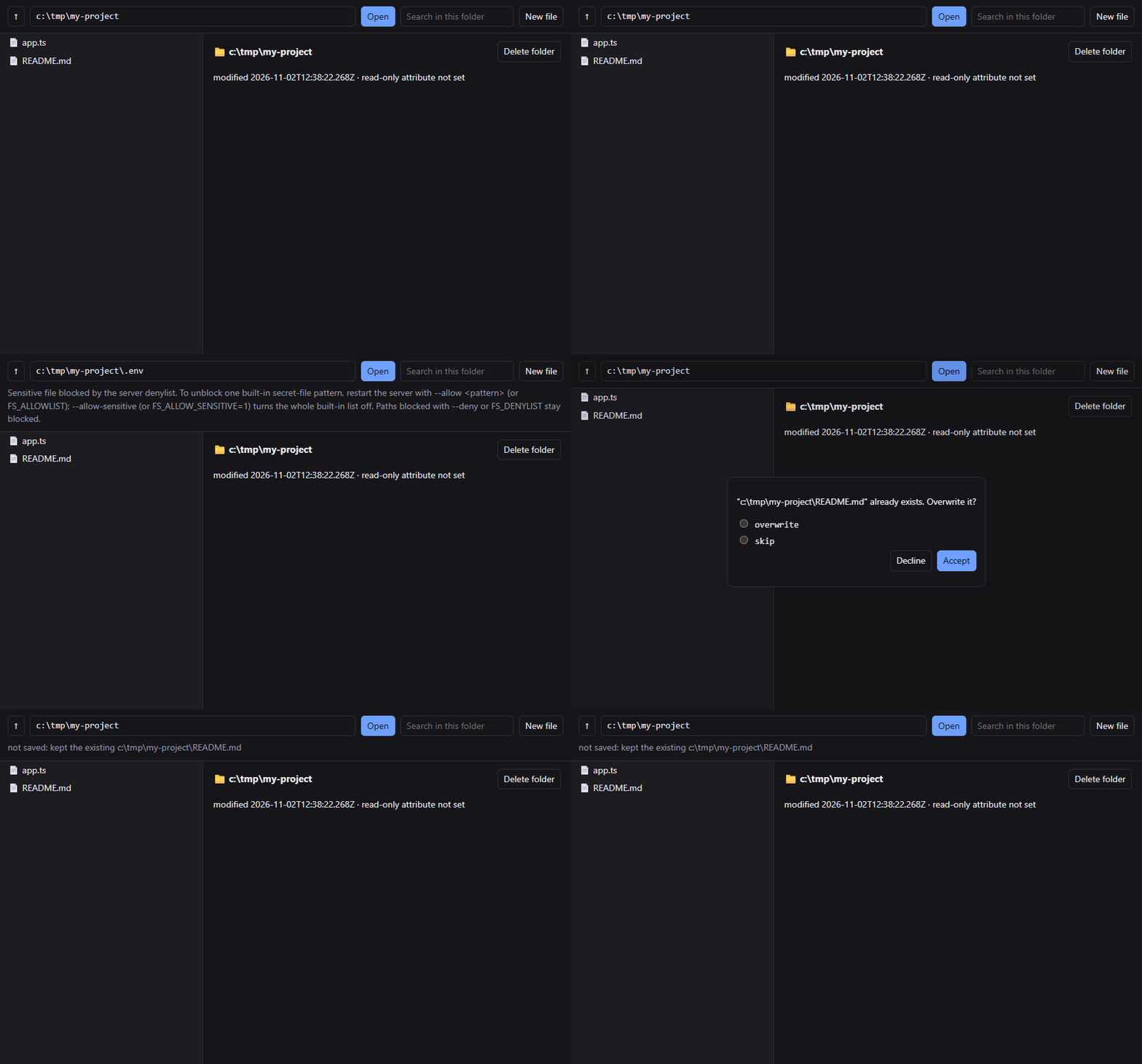
Move files into an archive, then undo a move that overwrote one

Review different edits to three files as one diff before they are written

A patch that no longer fits changes nothing

Find a crash in a 14 MB log without reading all of it

What is this?
Model Context Protocol (MCP) is how AI apps
such as Claude, GitHub Copilot in VS Code, and Cursor connect to tools.
Filesystem MCP is an MCP server: a small program that runs on your computer
and gives the AI 14 tools for working with files. You choose which folders it
can use, and everything outside them is off limits.
Once it is connected, you can ask things like:
- "Find every TODO in this repo and group them by file."
- "Rename
getUser to fetchUser in all .ts files. Show me the diff first."
- "What changed between
config.dev.json and config.prod.json?"
- "Read the last 50 lines of
server.log and explain the error."
- "Move the old screenshots into
archive/2025/."
Why Filesystem MCP?
- It is safe by default. The AI can use only the folders you allow, and
.env files, private keys, and cloud credentials are blocked. The server
asks you before the AI deletes a non-empty folder, opens a folder you did
not allow, or writes over a file with create or move. These questions
need a client that can show them. If yours cannot, the server refuses each
of those actions instead of asking. Only create and copies can skip the
question, because overwrite: true replaces a file without asking, on any
client. undo can usually restore a file that create or a copy replaced.
Edits made with edit, patch, and
replace_text apply without asking, but the AI can show you the diff first
with dryRun. If the AI should never change
anything, --read-only removes every tool that writes.
- Search and editing are made for code. The AI can search inside files like
grep, with a regex engine (RE2) that cannot hang, and by default the
server skips .gitignored files and folders like node_modules. Edits are
exact-match replacements that return an error when the text does not match,
and you can preview them as a diff first.
- It saves the AI's context. The AI can read many files in one call or
only the lines it needs, and it can check a file's size and token estimate
before reading it.
- It works with any MCP client, over stdio or HTTP, on macOS, Linux, and
Windows. You can install it with npx, Docker, or a one-click Claude Desktop
extension, or build your own client on it.
- It is private. It runs on your machine, has no telemetry, and makes no
network calls.
Compared with the reference server
How this server differs from the official
@modelcontextprotocol/server-filesystem,
checked against its README on 2026-11-05:
Quick start
[!NOTE]
You need Node.js 24 or later. Check with node --version.
- Add the server to your AI app. Pick yours below.
- Replace
/path/to/project with the folder the AI may use. You can list
several folders.
- Restart the app and ask: "Which folders can you access?"
[!TIP]
VS Code currently shares the folders you have open with the server, so the
one-click VS Code install works without a path. In other apps, or over HTTP,
put the folder in args. If the AI says it has no folders, that is the fix.
VS Code
Click Install in VS Code above, or add this to .vscode/mcp.json:
{
  "servers": {
    "filesystem": {
      "command": "npx",
      "args": ["-y", "@j0hanz/filesystem-mcp@latest", "/path/to/project"]
    }
  }
}
Or from a terminal:
code --add-mcp '{"name":"filesystem","command":"npx","args":["-y","@j0hanz/filesystem-mcp@latest","/path/to/project"]}'
Cursor
Click Install in Cursor above, then add your folder to args. Or add this
to .cursor/mcp.json in your project, or ~/.cursor/mcp.json for all
projects:
{
  "mcpServers": {
    "filesystem": {
      "command": "npx",
      "args": ["-y", "@j0hanz/filesystem-mcp@latest", "/path/to/project"]
    }
  }
}
Claude Desktop
For a one-click install, download
filesystem-mcp.mcpb,
open it with Claude Desktop, and pick the folders to allow. Claude Desktop's
built-in Node.js runs it. The extension's settings also let you turn on
read-only mode, pick read-only folders with a folder picker, block more files,
and unblock a built-in secret file.
To set it up by hand, add this to claude_desktop_config.json
(Settings → Developer → Edit Config):
{
  "mcpServers": {
    "filesystem": {
      "command": "npx",
      "args": ["-y", "@j0hanz/filesystem-mcp@latest", "/path/to/project"]
    }
  }
}
Claude Code
claude mcp add filesystem -- npx -y @j0hanz/filesystem-mcp@latest /path/to/project
Or install the plugin, which points the server at your current project:
/plugin marketplace add j0hanz/j0hanz-marketplace
/plugin install filesystem-mcp@j0hanz-marketplace
Visual Studio
Add this to .vs\mcp.json in your solution folder, or %USERPROFILE%\.mcp.json
for all solutions:
{
  "servers": {
    "filesystem": {
      "command": "npx",
      "args": ["-y", "@j0hanz/filesystem-mcp@latest", "C:/path/to/project"]
    }
  }
}
GitHub Copilot CLI and Antigravity CLI (plugin)
The filesystem-mcp plugin
sets the server up for your current project:
Docker
The container can only see the folders you mount. This setup blocks writes
twice, with the :ro mount and with the --read-only flag.
{
  "mcpServers": {
    "filesystem": {
      "command": "docker",
      "args": [
        "run",
        "-i",
        "--rm",
        "-v",
        "/path/to/project:/workspace:ro",
        "ghcr.io/j0hanz/filesystem-mcp:latest",
        "--read-only",
        "/workspace"
      ]
    }
  }
}
Drop :ro and --read-only to let the AI make changes. VS Code and Visual
Studio use "servers" instead of "mcpServers". See
Running in Docker for more.
Other MCP clients
Windsurf, Cline, and most other clients use the same mcpServers JSON as
Claude Desktop above. In any client, the server is:
- command:
npx
- args:
-y, @j0hanz/filesystem-mcp@latest, then one or more folders
You can also install it globally and run filesystem-mcp /path/to/project:
npm install -g @j0hanz/filesystem-mcp
✎ changes files. --read-only removes these tools. To refuse changes under
one folder while the rest stay writable, pass --read-only-root <dir>
(repeatable, or FS_READ_ONLY_DIRS): those tools still exist, but a call
that writes, moves, or deletes under the folder fails with
Read-only root: ..., while listing, searching, and reading keep working.
Search and listing tools skip hidden files, .gitignored files, and folders
like node_modules, dist, and .git unless the AI asks for them.
Configuration
Most people only need the folder argument. These options cover the common
cases:
Flags go in args after the package name, for example
["-y", "@j0hanz/filesystem-mcp@latest", "--read-only", "/path/to/project"].
The full configuration reference covers every flag
and environment variable, the complete secret-file list, limits, HTTP setup
with API keys, Docker, and troubleshooting.
Security
If you find a vulnerability, please report it privately.
SECURITY.md explains how.
Build your own client
You can also call Filesystem MCP from your own code: an agent, an editor
plugin, a web app, a CI job, or a script. The same rules apply as for an AI
app, so your code cannot reach outside the allowed folders or read secret
files.
import { Client } from '@modelcontextprotocol/client';
import { StdioClientTransport } from '@modelcontextprotocol/client/stdio';

const dir = '/path/to/project';
const client = new Client(
  { name: 'my-app', version: '1.0.0' },
  { capabilities: { elicitation: { form: {} } }, versionNegotiation: { mode: 'auto' } },
);
client.setRequestHandler('elicitation/create', async () => ({ action: 'decline' }));
await client.connect(
  new StdioClientTransport({
    command: 'npx',
    args: ['-y', '@j0hanz/filesystem-mcp', dir],
    cwd: dir,
  }),
);

const result = await client.callTool({ name: 'search_text', arguments: { searchPattern: 'TODO' } });
const { matches } = (result.structuredContent ?? result._meta) as { matches: unknown[] };
console.log(matches);
await client.close(); // stops the server process; without it the script never exits
The basics:
- Where the data is. The text block is written for a model. The same data
as JSON is in
_meta for tools that write their own text (list,
search_text, edit, ...) and in structuredContent for stat,
create, and list_roots. read is the exception: the file's text is
only in the text block, and _meta holds metadata about it.
- Paths. A relative path resolves against the server's working directory
when that is inside a root, and against the root otherwise. With several
roots, it must exist under exactly one of them. Absolute paths are never
ambiguous. Search results are printed relative to the root, or absolute
when a relative path would not read back, so a result can be passed straight
back. A name that differs from the one on disk only
in Unicode form (NFC or NFD) or in its space characters (U+00A0, U+202F)
finds that entry.
- Confirmations. Overwrites, recursive deletes, and paths outside the
roots are questions for the user. Declare the
elicitation capability and
answer them in a handler, or, on the 2026-07-28 protocol, take them as data
(input_required) and answer later. A client that can do neither gets a
refusal. overwrite: true on create and copies never asks.
- Protocol versions. The server speaks the 2025 protocol and 2026-07-28,
over stdio and Streamable HTTP. Over HTTP, 2025-era clients get no
confirmations or change notifications.
- Resources. Read and subscribe to any file as
filesystem-mcp://file/{+path}; internal://instructions and the
get-help prompt hold the server's guide for models.
The client guide has the details, tested with the
TypeScript and Python SDKs, and examples/ has six runnable
clients:
Privacy policy
Filesystem MCP runs entirely on your machine. This policy covers the npm
package, the Docker image, and the .mcpb desktop extension.
- Data collection: none. The server has no telemetry, analytics, or crash
reporting, and starts no network connections of its own.
SECURITY.md names
the Windows paths that make the OS contact a host.
- Use and storage: the server reads and writes files only inside the
folders you allow, and only when your MCP client calls a tool. Tool results go to that
client and nowhere else. Short-lived result caches and the undo history
(saved file contents) live in memory and disappear when the server exits.
- Third-party sharing: none by this server. Your MCP client may send tool
results to its model provider under that client's own privacy policy.
- Retention: the server keeps nothing after the process exits. Diagnostic logs go to
stderr on your machine; your MCP client may save them in its own log files.
- Contact: open an issue at
https://github.com/j0hanz/filesystem-mcp/issues, or report security
problems privately through
GitHub Security Advisories.
Contributing
Bug reports, ideas, and pull requests are welcome. Start with
CONTRIBUTING.md. It covers setup, running the server from
source, and the checks a pull request needs.
If Filesystem MCP is useful to you, a star on GitHub helps other people find it.

License
MIT


