

Store and retrieve entities, relations and observations in a persistent local knowledge graph.
create_entitiescreate_relationsadd_observations+6 more
92K
AI & Multi-Agent
A local, self-improving memory MCP server for AI agents that stores memories on your own disk with hybrid search and a quality feedback loop.
Lorekeeper is cataloged as an MCP server attributed to jessinra. A local, self-improving memory MCP server for AI agents that stores memories on your own disk with hybrid search and a quality feedback loop. It is categorized under ai agents-models. See the capability inspector for recorded interfaces and their independent review status; consult upstream documentation for the current interface.
Installation configuration is not reviewed. No executable setup is offered for this entry; inspect the source repository before proceeding.
Catalog license label: Apache-2.0. Check the source repository's current license and terms before using, modifying or distributing this software.
能力定义尚未审核。未核验的采集内容不会作为可信接口展示。
暂无可展示的已审核记录。这不表示上游不支持此能力。
暂无可展示的已审核记录。这不表示上游不支持此能力。
暂无可展示的已审核记录。这不表示上游不支持此能力。
Email delivery is not connected. This page does not collect email addresses or create subscriptions.
Browse the registry for current listings instead.
Reviews for Lorekeeper are not available yet
Review publishing and storage are not connected. This page does not collect or publish ratings or comments, including after sign-in.
No. It is local-first, storing data on your machine with SQLite and LanceDB and requiring no cloud dependency or API keys.
Yes. Namespaces let multiple agents share one store, with writes scoped to a namespace and reads including the shared pool.
README.md · d4eb1e107816 · 采集于 2026-11-13 10:44:01 UTC
保留上游原文,不做 AI 改写。为安全起见过滤脚本、表单和不安全链接。
当前显示最后一次成功采集的文档快照,请以来源页面为准。

Self-improving memory for AI agents. One command, no cloud, no config.
pip install lorekeeper-mcp && lorekeeper setup && lorekeeperYour agent remembers across sessions — and the memory gets better, not just bigger. Local. No API keys. No sign-up. Free to run forever.
Every AI agent session starts blank. You re-explain context, re-state preferences, re-teach patterns — every single time.
Files like CLAUDE.md and .cursorrules help, but they're hand-maintained, can't search themselves, and grow stale. Cloud services work, but your session data leaves your machine and you're paying per API call. Libraries are powerful, but you're writing the integration yourself.
Lorekeeper is a different shape: a local MCP server you pip install once. It connects to your existing agents, stores memories in SQLite on your own disk, and starts improving with every session:
Agent uses a memory → rates it useful or not →
scores adjust automatically → weak memories decay →
strong memories surface more often → search gets sharper
A fresh install and a six-month-old install are genuinely different products. The longer you use it, the less noise you get — and the more your agents feel like they actually know your codebase.
3 minutes, zero configuration:
# 1. Install
pip install lorekeeper-mcp

# 2. Configure your agents (auto-detects Hermes, Claude Code, Cursor)
lorekeeper setup

# 3. Start the MCP server
lorekeeper
lorekeeper setup scans for installed agents and injects the MCP entry, agent prompt, and bundled skills automatically. Use --check to preview without writing. Run lorekeeper --help or lorekeeper --version to verify the install.
Then ask your agent:
"Remember that I prefer
curl -vX GETfor debugging endpoints."
It calls lore_remember → memory stored. Next session:
"What's my preferred debug command?"
It calls lore_search → memory retrieved. ✅
Full walkthrough → docs/quickstart.md
| What | How |
|---|---|
| Hybrid search | Semantic vectors + BM25 keyword + time-decay + usage frequency + memory score — all ranked by a weighted formula |
| Self-improving | lore_update feedback adjusts scores. Bad memories fade (<2 confidence + not useful → soft-delete). Good ones rise. |
| Auto-linking | New memories are automatically linked to their closest semantic neighbor. A lightweight knowledge graph forms without effort. |
| Duplicate detection | New inserts are checked against existing memories. Near-identical content is blocked (override with force=true). |
| Dashboard | Full web UI — browse, search, edit, delete. Seven tabs including backup/restore with dedup preview. |
| Universal MCP | Works with Claude Code, Cursor, Hermes, Copilot, OpenCode — any MCP-compatible agent. |
| Local-first | Your data stays on your machine. SQLite + LanceDB. No cloud dependency, no API keys. |
| Namespaces | Multiple agents share one store with isolated namespaces. Writes go to your namespace; reads include the shared pool. |
| Reflection | Agents auto-extract learnings from sessions. Discoveries and lessons become searchable memories. |
You set up your auth layer on Monday. Wednesday, a different agent starts fresh with no idea. With Lorekeeper, it already knows the middleware path, the token format, and which test covers the edge case — because you told it once.
"Remember that our JWT uses jose middleware in src/middleware/auth.ts
 and refresh tokens expire in 7 days."
→ lore_remember stores it
→ Every future session, on any agent: already in context
Claude Code for review, Cursor for implementation, Hermes for planning — they shouldn't each start from zero. Lorekeeper namespaces let them share one store. One agent's discovery becomes every agent's knowledge.
→ Engineer agent notes a performance quirk in the search service
→ lore_remember stores it under the shared namespace
→ PM agent surfaces it during sprint planning
→ No briefing, no copy-paste
You fixed a subtle CORS bug three weeks ago and your agent helped. Neither of you remembers the details.
"What did we figure out about the CORS issue?"
→ lore_search returns the root cause, the fix, and the context around it
New repo, new agent session. Instead of re-explaining the architecture, you run a few lore_remember calls after the first session. The next session — and every agent after it — starts with the right foundation.
"Remember: the payment service requires X-Idempotency-Key on all POST requests."
→ Claude Code, Cursor, and Codex all read from the same store
You, if you use:
Not for you yet, if:
There are great tools in this space — each makes different trade-offs. Here's where Lorekeeper sits:
| File-based | Cloud services | Docker servers | Library (Mem0) | agentmemory (Node) | Lorekeeper | |
|---|---|---|---|---|---|---|
| Setup | Built-in | API key + cloud config | docker compose | Write integration code | npx agentmemory | pip install |
| Data | Local | Cloud | Local | Your call | Local | Local |
| Search | grep | Vector | Vector | Vector | Hybrid | Hybrid + time-decay + usage + score |
| Self-improving | ❌ | ❌ | ❌ | ❌ | ❌ | ✅ Quality loop |
| Knowledge graph | ❌ | Paid | ❌ | Paid | ❌ | ✅ Free auto-link |
| Dashboard | ❌ | ✅ | ❌ | ❌ | Viewer | ✅ Full web UI |
| Dependencies | None | ~300MB | ~2GB | ~1.4GB | ~200MB | ~1.4GB (embeddings) |
| Built by agents | ❌ | ❌ | ❌ | ❌ | ❌ | ✅ Dogfooded daily |
Cloud services and Docker-based solutions are strong choices for teams or production apps. Lorekeeper is optimised for the other end: solo developers and agent workflows where zero ops, zero cloud, and a self-improving store matter most.
Dependency note: ~1.4GB is from the sentence-transformers embedding model (PyTorch). This is the same weight class as any local embedding solution. We're honest about it.
Lorekeeper exposes 10 MCP tools covering the full memory lifecycle:
| Tool | Purpose |
|---|---|
lore_search | Hybrid semantic + keyword search with relevance scores |
lore_remember | Fast one-shot memory save (auto-titles, auto-links) |
lore_insert | Bulk structured insert with custom scores and links |
lore_update | Feedback loop — rate memories, drive quality |
lore_forget | Soft-delete wrong or outdated memories |
lore_reflect | End-of-session: extract learnings, auto-save discoveries |
lore_processed_sessions | Check which sessions are already processed |
lore_recommend_links | Suggest candidate links between related memories |
lore_get_suggestions | List pending link suggestions from the sweep engine |
lore_review_suggestion | Accept or reject one or more link suggestions (batch) |
Full API reference → docs/api-reference.md
A local web UI to browse, search, edit, and manage your memory store.
lorekeeper-dashboard
# → http://127.0.0.1:7777
Seven tabs:
| Tab | What it does |
|---|---|
| Memories | Sortable table with live filter — title, score, confidence, usage, dates |
| Detail | Edit a memory's content, manage its links, soft-delete or hard-delete |
| Links | Browse the knowledge graph — source → relation → target |
| Query | Ad-hoc semantic + keyword searches with per-result score breakdown |
| Sessions | All processed agent sessions with extracted learnings |
| Config | Live tuning of search weights, quality thresholds, limits |
| Backup | Export/import memories as JSON with dedup preview |
| Suggestions | Review AI-generated link candidates from the sweep engine — accept or reject one-by-one or in bulk |
The Suggestions tab surfaces link candidates generated automatically by the background sweep engine. Each candidate is a pair of memories the engine considers related, scored by cosine similarity, BM25 keyword overlap, entity co-occurrence, and temporal proximity.
Workflow:
LORE_SUGGEST_INTERVAL_HOURS, default 12).Sweep configuration (via LORE_-prefixed env vars or the Config tab):
| Setting | Default | Description |
|---|---|---|
LORE_SUGGEST_INTERVAL_HOURS | 12 | How often the sweep runs (hours) |
LORE_SUGGEST_MIN_SCORE | 0.55 | Minimum weighted score to surface a candidate |
LORE_SUGGEST_MAX_CANDIDATES | 500 | Maximum candidates per sweep run |
LORE_SUGGEST_TTL_DAYS | 30 | Days before unreviewed suggestions are pruned |
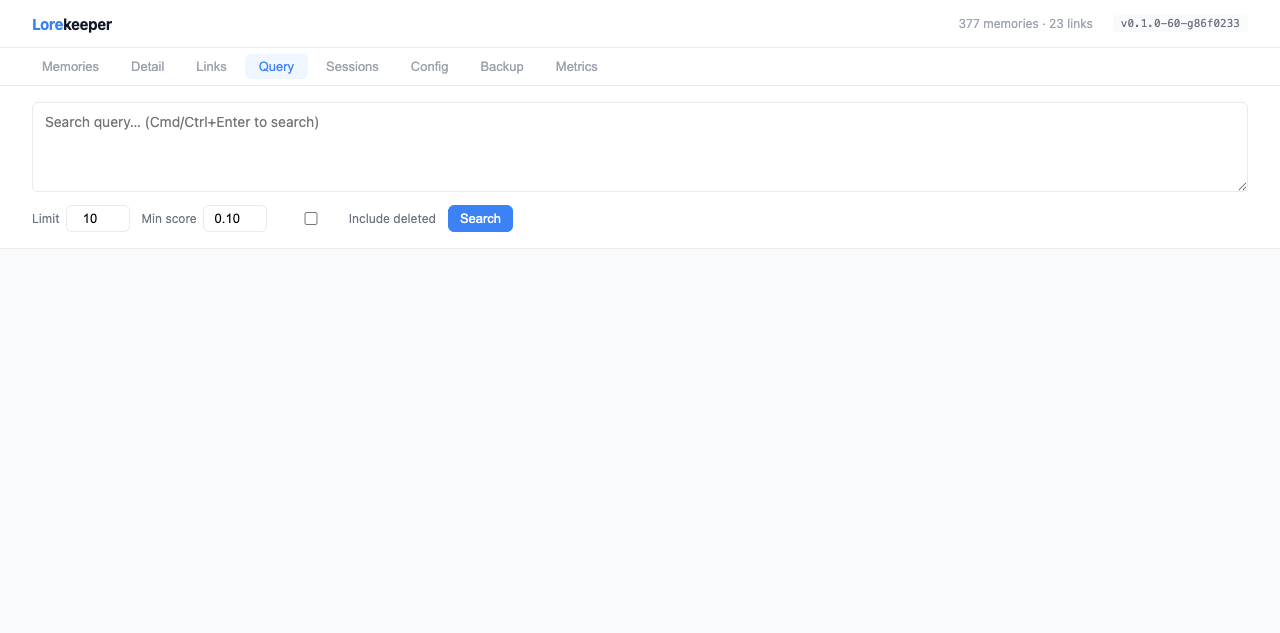
Lorekeeper is developed using AI agents — Claude Code, Hermes, and our own agent team. The development cycle is itself a working demo of what it does:
agent builds a feature → uses Lorekeeper to capture what it learned →
searches those memories next session →
builds the next feature with the context already there
This isn't a marketing line. Every tool schema, return type, and workflow in Lorekeeper was shaped by agents using it daily — not by humans reading specs. When something was annoying to use, we changed it. When search returned noise, we tuned the weights. The product is what it is because the agents that build it depend on it.
The agentic development loop documented in this repo is how we actually work — and it's what Lorekeeper is designed to support for you.
Clone, run from source, or contribute:
git clone https://github.com/Jessinra/Lorekeeper.git
cd Lorekeeper
bash scripts/setup.sh
# Tests
uv run pytest

# Lint
uv run ruff check src tests

# Type check
uv run mypy src

# Dashboard dev
uv sync --extra dashboard
uv run lorekeeper-dashboard
src/lorekeeper/
├── __main__.py          # Entrypoint — init_service() + mcp.run(stdio)
├── server.py            # FastMCP tool definitions (8 tools)
├── config.py            # Settings (pydantic-settings, LORE_ prefix)
├── models.py            # Pydantic models
├── dashboard/           # Web UI (FastAPI + uvicorn)
└── services/
    ├── orchestrator.py  # MemoryService — coordinates sub-services
    ├── memory_engine.py # Vector store abstraction
    ├── lancedb_engine.py# LanceDB backend
    ├── link_store.py    # SQLite — memories, links, suggestions
    ├── keyword_index.py # BM25 index
    ├── search.py        # Hybrid ranking
    └── ...
All settings via LORE_-prefixed env vars or the dashboard Config tab:
| Variable | Default | Description |
|---|---|---|
LORE_DATA_DIR | ~/.lorekeeper | Data directory (SQLite + vectors) |
LORE_NAMESPACE | shared | Agent namespace — writes scoped, reads union with shared |
LORE_SEARCH_LIMIT | 5 | Default result count from lore_search |
LORE_LINK_TOP_M | 10 | Max candidates returned by lore_recommend_links |
LORE_LINK_SCORE_THRESHOLD | 0.3 | Minimum score for link candidates to surface |
LORE_LINK_TEMPORAL_TAU_DAYS | 30 | Decay half-life for temporal proximity scoring (days) |
Full list → src/lorekeeper/config.py and CLAUDE.md.
All 500 LongMemEval-S questions, default hybrid weights (sem=0.45, kw=0.30):
| Metric | Value | Latency |
|---|---|---|
| R@1 | 84.6% | 32.9 ms/query |
| R@3 | 93.6% | |
| R@5 | 96.6% | |
| R@10 | 98.8% |
Full per-category breakdown → docs/research/2026-06-11-retrieval-benchmark-results.md
Apache-2.0 — see LICENSE.
Built by agents, for agents. Manifesto · Strategy
Last verified: 2026-06-20
Claim this server with your GitHub account to request manual ownership verification.
Link to the catalog listing for Lorekeeper from your README. This badge does not certify ownership, compatibility or security.
[](https://awesome-mcp.com/servers/lorekeeper)Public repository statistics could not be verified. Check the configured source address; unavailable counts are not zero.
来源、范围和时段分别列出;不相加,不代表安装人数、活跃用户或安全审核。
尚无已审核的包 / 镜像标识,暂不展示下载统计。
Alternative and complementary servers in the same category
Store and retrieve entities, relations and observations in a persistent local knowledge graph.
Organize problem solving into revisable, branching thought steps through an MCP tool.

Query-aware context compression with an MCP plugin for coding agents, plus Python and HTTP interfaces for reducing the context sent to a language model.