
Store and retrieve entities, relations and observations in a persistent local knowledge graph.
create_entitiescreate_relationsadd_observations+6 more
92K
AI & Multi-Agent
A stdio MCP server that exposes tools for querying many AI providers, routing tasks to the best-fit model, comparing models, and generating images and videos from text prompts.
Multi-model MCP server for model routing, media generation and web search is cataloged as an MCP server attributed to k1vin1906. A stdio MCP server that exposes tools for querying many AI providers, routing tasks to the best-fit model, comparing models, and generating images and videos from text prompts. It is categorized under ai agents-models. See the capability inspector for recorded interfaces and their independent review status; consult upstream documentation for the current interface.
Installation configuration is not reviewed. No executable setup is offered for this entry; inspect the source repository before proceeding.
Catalog license label: MIT. Check the source repository's current license and terms before using, modifying or distributing this software.
能力定义尚未审核。未核验的采集内容不会作为可信接口展示。
暂无可展示的已审核记录。这不表示上游不支持此能力。
暂无可展示的已审核记录。这不表示上游不支持此能力。
暂无可展示的已审核记录。这不表示上游不支持此能力。
Email delivery is not connected. This page does not collect email addresses or create subscriptions.
Browse the registry for current listings instead.
Reviews for Multi-model MCP server for model routing, media generation and web search are not available yet
Review publishing and storage are not connected. This page does not collect or publish ratings or comments, including after sign-in.
Yes. The delegate tool picks the best-fit model by category, and the README says you don't pick the model because the routing does it for you.
Yes. Any OpenAI-compatible local runner works, including Ollama, LM Studio, llama.cpp and vLLM, and local and cloud models can be mixed.
README.md · 9afb531ec9c5 · 采集于 2026-11-13 10:39:58 UTC
保留上游原文,不做 AI 改写。为安全起见过滤脚本、表单和不安全链接。
当前显示最后一次成功采集的文档快照,请以来源页面为准。
Give your AI coding agent superpowers — image gen, video gen, web search, and smart multi-model routing. Works with Claude Code, Codex CLI, Gemini CLI, Grok Build, Cursor and any MCP host.
One MCP server. All the models you need. Zero tab-switching.
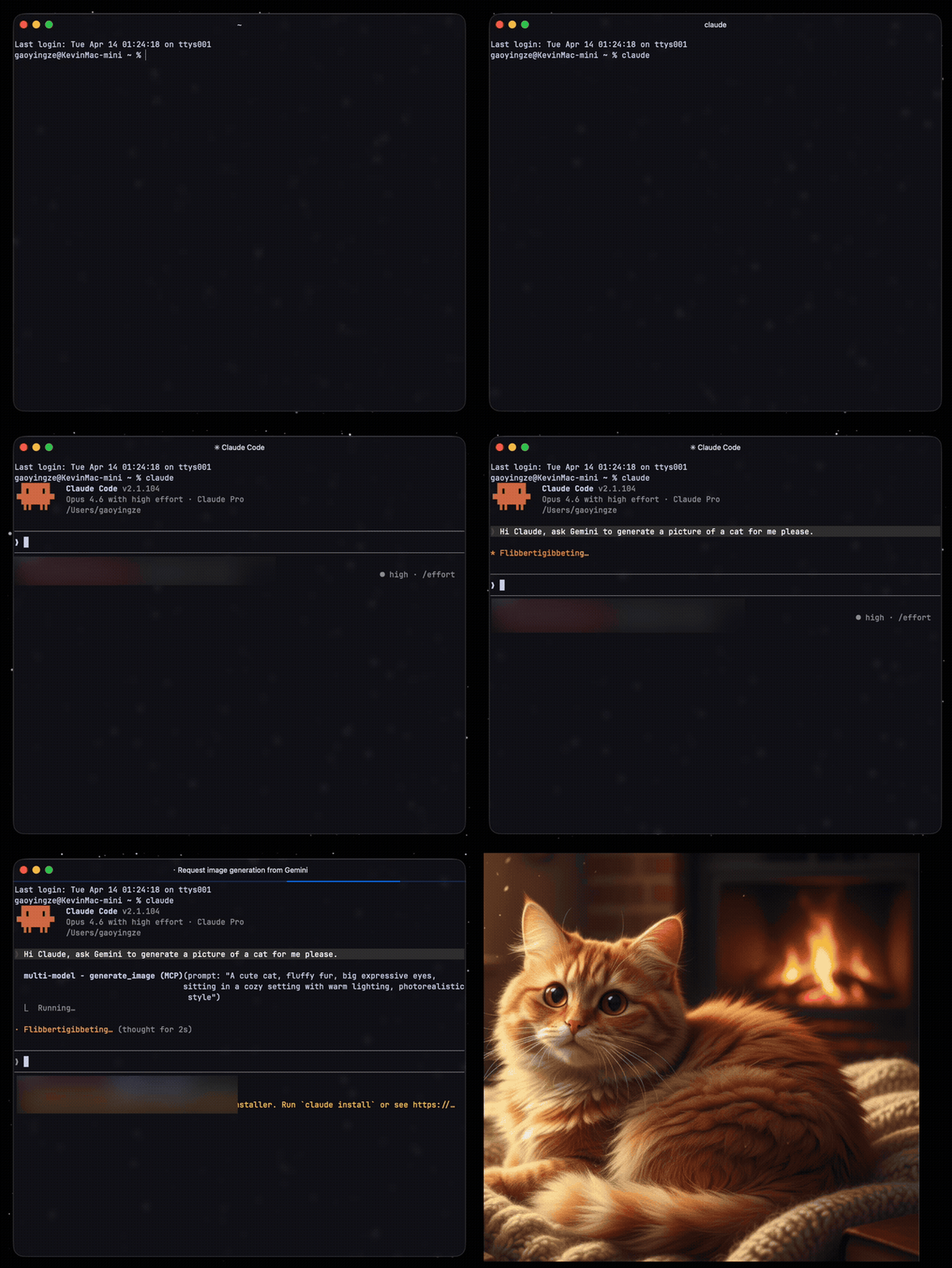
npx mcp-multi-model
If you find this useful, please give it a ⭐ — it helps others discover the project!
"Generate a macOS app icon with a glowing indigo orb"
Claude calls Nano Banana 2 / Nano Banana Pro / GPT Image 2, saves the PNG, and opens it. No browser, no Figma, no context switch.
Video too — Veo 3.1 generates short clips from a text prompt.
Need reasoning / agentic coding → it routes to OpenAI GPT-6 / GPT-5.6 / o-series (auto-handles max_completion_tokens, skips temperature where unsupported).
Tell Claude to research something → it routes to Gemini (Google Search grounding).
Ask it to write code cheaply → it routes to DeepSeek (fast, cheap, great at code).
Need real-time info in Chinese → it routes to Kimi (web search).
You don't pick the model. The routing does it for you.
"Ask both DeepSeek and Gemini how to implement a B-tree"
Two answers, one terminal. See which model gives you a better solution.
Gemini uses Google Search grounding. OpenAI GPT-5.6 / GPT-6 search via the Responses API web_search tool (openai-search / openai-pro-search, source URLs attached). Kimi searches the Chinese web. No separate browser-use MCP needed.
{
  "mcpServers": {
    "multi-model": {
      "command": "npx",
      "args": ["-y", "mcp-multi-model"],
      "env": {
        "DEEPSEEK_API_KEY": "sk-...",
        "GEMINI_API_KEY": "AI..."
      }
    }
  }
}
That's it. No git clone, no build step.
12+ providers preconfigured in config.example.yaml. Models without an API key are skipped automatically.
| Provider | Adapter | Why use it |
|---|---|---|
| OpenAI | openai, openai-responses | GPT-6 Astra / GPT-5.6 reasoning, o-series, GPT Image 2. openai-responses adds Responses API web search with cited sources. Reasoning param handling is automatic (max_completion_tokens, temperature skipped where unsupported). |
| Gemini | gemini | Long context, Google Search grounding. Image (Nano Banana 2 / 2 Lite / Pro) and video (Veo 3.1) generation built in. |
| DeepSeek | openai | Code, math, logic — extremely low cost |
| Kimi (Moonshot) | openai | Kimi K2.6 Chinese web search (tool-calling loop) + Kimi K3 flagship reasoning |
| Grok (xAI) | openai | Real-time X/Twitter context, reasoning |
| Perplexity | openai | Sonar models with built-in web search and citations |
| Anthropic (via OpenRouter) | openai | Claude models routed through OpenRouter |
| Mistral / Groq / Qwen / GLM / Together | openai | EU AI, ultra-fast inference, Chinese-native, open-source aggregators |
| Ollama / LM Studio / llama.cpp / vLLM | openai | Local — no API key, no cost, full privacy |
Adding a new model is one block in config.yaml — see Configuration.
The routing.categories table in config.yaml is backed by a small benchmark in eval/: 5 task types × 4 prompts × 6 models, run through the server's own adapters (same timeouts, retries, flags and pricing that delegate uses). Code is scored by hidden tests in a node --permission sandbox, extraction by field-level JSON match, reasoning by exact answer, research and creative by a blind rubric grade. First run 2026-10-21: 120 calls, $0.78 total.
| model | code | extraction | reasoning | research | creative | overall | avg $/call | median s | timeouts |
|---|---|---|---|---|---|---|---|---|---|
DeepSeek V4 Flash (deepseek) | 100 | 97 | 100 | 100 | 65 | 92 | $0.0003 | 2.5 | 0/20 |
Gemini 3.8 Flash (gemini) | 75 | 100 | 100 | 95 | 85 | 91 | $0.0059 | 11.7 | 1/20 |
GPT-5.6 Luna (openai) | 85 | 97 | 100 | 100 | 65 | 89 | $0.0004 | 5.1 | 0/20 |
Kimi K2.6 + web search (kimi) | 50 | 100 | 100 | 90 | 55 | 79 | $0.0064 | 33.9 | 3/20 |
DeepSeek V4 Pro (deepseek-pro) | 75 | 100 | 100 | 90 | 80 | 89 | $0.0012 | 9.9 | 1/20 |
Gemini 3.1 Pro (gemini-pro) | 100 | 100 | 100 | 70 | 70 | 88 | $0.0247 | 17.2 | 0/20 |
Quality in %, n = 4 per cell, a 60 s timeout counts as 0. What it means for the defaults:
code → deepseek — confirmed. 100% on every hidden test, cheapest and fastest of the six; thinking models (Gemini Flash, DeepSeek Pro, Kimi) blew the 60 s timeout on the spec-heavy parser task.research → gemini — kept for Google Search grounding, which v0 did not test. On knowledge-stable comparisons DeepSeek and GPT-5.6 Luna scored 100% at 1/15 of Gemini's cost, so for questions that don't need the live web ask_deepseek is the cheaper call.creative → gemini — confirmed. Best blind creative score (4.25/5); DeepSeek Pro was close at 1/5 the cost but 4× slower.realtime → kimi — not measured (no live-web tasks in v0). Kimi K2.6 is the slowest entry (34 s median, 3/20 timeouts), which is why nothing else is routed to it.deepseek-pro matched Flash quality 4× slower, and gemini-pro scored lowest on research by ignoring length limits at 4× Flash cost.Method, caveats (n = 4, single latency samples, one blind grader) and per-task results: eval/README.md. Re-run with node eval/run.js run.
Tools are dynamically generated from your config. With the default setup:
| Tool | What it does |
|---|---|
ask_ai | Query any model — unified entry with temperature / top_p control |
ask_deepseek | Query DeepSeek directly |
ask_gemini | Query Gemini directly |
ask_kimi | Query Kimi directly |
ask_all | Query all models in parallel, compare results |
ask_both | Query any two models in parallel |
delegate | Smart routing — offloads a self-contained task to the best-fit model by category |
generate_image | Text → image via Gemini Nano Banana (default: Nano Banana 2 Lite) |
generate_video | Text → video via Gemini Veo |
translate | CN ↔ EN translation |
research | Deep research with web search |
check_health | Ping all models, report status and latency |
Every chat tool also takes effort: "fast" | "deep". fast (the default for the everyday entries) maps to low reasoning effort on each provider (Gemini thinking_level, OpenAI reasoning_effort, Kimi K3 reasoning_effort); deep turns the same knobs up for hard analysis. Flagship entries (gemini-pro, openai-pro, openai-pro-search, kimi_k3) default to deep; ask_all runs everything at fast.
Add to your MCP host config. Claude Code reads ~/.mcp.json; snippets for Codex CLI, Gemini CLI, Grok Build, Cursor and Cline are under Works with any MCP host.
{
  "mcpServers": {
    "multi-model": {
      "command": "npx",
      "args": ["-y", "mcp-multi-model"],
      "env": {
        "DEEPSEEK_API_KEY": "sk-...",
        "GEMINI_API_KEY": "AI..."
      }
    }
  }
}
git clone https://github.com/K1vin1906/mcp-multi-model.git
cd mcp-multi-model
npm install
npm run setup   # Interactive setup wizard — validates your API keys
Then add to your MCP config:
{
  "mcpServers": {
    "multi-model": {
      "command": "node",
      "args": ["/path/to/mcp-multi-model/index.js"]
    }
  }
}
API keys can be set via
envin the config above, or in a.envfile in the project directory.
The server speaks plain stdio MCP, so every host can run it. Two things differ between hosts: how long they let one tool call run, and whether they read the server's built-in instructions. Some calls here are slow by design (ask_all 10-20 s at the default fast effort but a minute or more at deep, openai-pro-search up to 3 min, generate_video several minutes), so check the timeout column. Checked against official docs in October 2026; items marked (secondary) come from community sources.
| Host | Config | Default tool timeout | Reads server instructions |
|---|---|---|---|
| Claude Code | ~/.mcp.json | long enough | yes (tested 2026-10-23) |
| Codex CLI | ~/.codex/config.toml | 60 s, raise it | no (v0.163, tested 2026-10-23), install the skill |
| Gemini CLI | ~/.gemini/settings.json | 600 s | yes (tested 2026-10-23) |
| Grok Build | ~/.grok/config.toml, also reads .mcp.json | 6000 s | not documented |
| Cursor | ~/.cursor/mcp.json | not documented | not documented |
| Cline | MCP Servers panel | 60 s, raise it | not documented |
Codex CLI — ~/.codex/config.toml
[mcp_servers.multi-model]
command = "npx"
args = ["-y", "mcp-multi-model"]
startup_timeout_sec = 30   # default 10; npx cold start can exceed it
tool_timeout_sec = 300     # default 60; ask_all / openai-pro-search / video need more
Codex CLI 0.163 does not inject the server's instructions into the model's context (tested 2026-10-23), so install the skill below: Codex discovers ~/.codex/skills/multi-model/SKILL.md and reads it before calling the tools.
Gemini CLI — ~/.gemini/settings.json
{
  "mcpServers": {
    "multi-model": { "command": "npx", "args": ["-y", "mcp-multi-model"], "timeout": 600000 }
  }
}
Grok Build
grok mcp add multi-model -- npx -y mcp-multi-model
grok mcp doctor multi-model
Grok Build also picks up ~/.claude.json, .cursor/mcp.json and project .mcp.json automatically.
Cursor uses the same JSON shape as Claude Code in ~/.cursor/mcp.json. Its tool timeout is not documented, so keep calls short and avoid ask_all there. Cline users: open the server card in the MCP Servers panel and set Network Timeout to 5 minutes or more.
API keys work the same everywhere: an env block in the host config, or a .env file next to the server.
multi-model skillTools are hands; the skill is the brain. skills/multi-model/SKILL.md is an Agent Skills file that tells the agent when to delegate, which model to pick, what each tier costs, how to fact-check with two web-grounded models, why ask_all is for bias detection rather than evidence, and how to handle slow calls on each host. The server also sends a short version of these rules as MCP instructions at startup, so hosts that read it get the basics with zero setup.
Install the full skill once per host (one file, same content everywhere):
| Host | Skill path |
|---|---|
| Claude Code | ~/.claude/skills/multi-model/SKILL.md, or load the repo as a plugin: claude --plugin-dir /path/to/mcp-multi-model |
| Codex CLI | ~/.codex/skills/multi-model/SKILL.md (secondary) |
| Gemini CLI | ~/.gemini/skills/multi-model/SKILL.md (secondary) |
| Grok Build | ~/.grok/skills/multi-model/SKILL.md, and it reads Claude Code skills and plugins directly |
| Cursor | ~/.cursor/skills/multi-model/SKILL.md, partial support (secondary) |
# example: Codex CLI
curl -fsSL https://raw.githubusercontent.com/K1vin1906/mcp-multi-model/main/skills/multi-model/SKILL.md \
  --create-dirs -o ~/.codex/skills/multi-model/SKILL.md
cp config.example.yaml config.yaml
defaults:
  max_tokens: 4000
  temperature: 0.7
  timeout_ms: 60000        # per-model `timeout_ms` overrides this (web / thinking models ship with 120000)
  max_retries: 2
  thinking_headroom: 4000  # added on top of max_tokens for thinking models, so reasoning tokens never eat the answer
  # cache_ttl_ms: 300000   # Cache identical prompts for 5 min
  # daily_budget_usd: 5.0  # Daily spending limit in USD

models:
  deepseek:
    name: DeepSeek
    adapter: openai
    endpoint: https://api.deepseek.com/chat/completions
    api_key_env: DEEPSEEK_API_KEY
    model: deepseek-chat
    description: "Code, math, logic. Low cost."
    fallback_to: gemini
    pricing:
      input: 0.14    # $/M tokens
      output: 0.28

  gemini:
    name: Gemini
    adapter: gemini
    endpoint: https://generativelanguage.googleapis.com/v1beta
    api_key_env: GEMINI_API_KEY
    model: gemini-2.5-flash-preview-04-17
    description: "Long context, broad knowledge, Google Search."
    features:
      - google_search
    timeout_ms: 120000
    effort:                       # per-level overrides of this model's own fields; callers pass effort="fast" | "deep"
      fast: { thinking_level: low }
      deep: { thinking_level: high }
    default_effort: fast          # OpenAI-style models use { reasoning_effort: low | high }; any other field goes in extra_body
    pricing:
      input: 0.10
      output: 0.40

  # Local models — no API key needed:
  # ollama:
  #   name: Ollama
  #   adapter: openai
  #   endpoint: http://localhost:11434/v1/chat/completions
  #   model: llama3.2
Two endpoint families are routed automatically based on the model ID:
GEMINI_API_KEY)| Model ID | Endpoint | Notes |
|---|---|---|
gemini-3.1-flash-lite-image (Nano Banana 2 Lite) | :generateContent | Default, ~$0.034/image, lowest latency |
gemini-3.1-flash-image (Nano Banana 2) | :generateContent | ~$0.067/image, reference-image editing |
gemini-3-pro-image (Nano Banana Pro) | :generateContent | ~$0.134/image, up to 4K |
Imagen 4 (
imagen-4.0-*) was retired by Google (all IDs return 404 as of 2026-09) and removed in 3.9.0.
OPENAI_API_KEY)| Model ID | Endpoint | Notes |
|---|---|---|
gpt-image-2 | /v1/images/generations | Best text rendering. Requires OpenAI org verification. |
Supports aspect_ratio: 1:1, 3:2, 4:3, 16:9, 9:16. quality and size forwarded to OpenAI image endpoints.
Generate short video clips using Gemini Veo 3.1 (uses GEMINI_API_KEY).
| Parameter | Type | Notes |
|---|---|---|
prompt | string | Text description of the desired video |
aspect_ratio | 16:9 / 9:16 / 1:1 | |
duration | 4 / 6 / 8 (seconds) | Must be even — Veo only accepts even durations |
save_path | string? | Defaults to /tmp/mcp-media/videos/ |
Any OpenAI-compatible local runner works — Ollama, LM Studio, llama.cpp, vLLM:
models:
  ollama:
    name: Ollama
    adapter: openai
    endpoint: http://localhost:11434/v1/chat/completions
    model: llama3.2
Mix local and cloud models freely — use ask_all to compare Ollama vs DeepSeek vs Gemini in one call.
delegate / research retry once with the category's fallback_chain when the routed model times out or errors, and say so in the reply[⚠️ Output truncated ...], an all-reasoning answer comes back as a diagnostic, a stalled stream aborts after the model's timeout instead of returning half a replythinking_headroom extra output tokens so max_tokens means visible answereffort on every chat tool — fast (default) or deep, mapped to each provider's own reasoning knobconversation_id (30min expiry, up to 10 turns)openai-responses web search is non-streaming)This is a local relay. No telemetry, no analytics, no data is sent to the author. Everything the server sends or runs:
conversation_id, the earlier turns of that conversation to the one provider that serves the model you asked for. With the default config.yaml that is OpenAI, Google (Gemini), DeepSeek and Moonshot (Kimi); ask_all sends the same prompt to every chat model at once. Any endpoint you add yourself (Ollama, OpenRouter, ...) receives the same. API keys are read from your environment or .env and sent only to their own provider.https://registry.npmjs.org/mcp-multi-model/latest so it can tell you when a newer version exists. Nothing is sent but the request itself. Set MCP_MULTI_MODEL_NO_UPDATE_CHECK=1 to turn it off.generate_image and generate_video write the file under /tmp/mcp-media/ and, on macOS, run open on it so it shows up right away. Pass save_path to choose the location and skip the auto-open. No other local commands are run.Full policy: k1vin1906.github.io/mcp-multi-model/privacy.html
MIT
Claim this server with your GitHub account to request manual ownership verification.
Link to the catalog listing for Multi-model MCP server for model routing, media generation and web search from your README. This badge does not certify ownership, compatibility or security.
[](https://awesome-mcp.com/servers/mcp-multi-model)Public repository statistics could not be verified. Check the configured source address; unavailable counts are not zero.
来源、范围和时段分别列出;不相加,不代表安装人数、活跃用户或安全审核。
尚无已审核的包 / 镜像标识,暂不展示下载统计。
Alternative and complementary servers in the same category
Store and retrieve entities, relations and observations in a persistent local knowledge graph.
Organize problem solving into revisable, branching thought steps through an MCP tool.

Query-aware context compression with an MCP plugin for coding agents, plus Python and HTTP interfaces for reducing the context sent to a language model.