
This is a Model Context Protocol (MCP) server for interacting with AIStor object stores.
Repository stats unavailable
Databases & Storage
A lightweight Model Context Protocol server for ODBC databases built with FastAPI, pyodbc, and SQLAlchemy, compatible with Virtuoso and other DBMS backends.
MCP Server ODBC via SQLAlchemy is cataloged as an MCP server attributed to openlinksoftware. A lightweight Model Context Protocol server for ODBC databases built with FastAPI, pyodbc, and SQLAlchemy, compatible with Virtuoso and other DBMS backends. It is categorized under databases storage. See the capability inspector for recorded interfaces and their independent review status; consult upstream documentation for the current interface.
Installation configuration is not reviewed. No executable setup is offered for this entry; inspect the source repository before proceeding.
Catalog license label: Not specified. Check the source repository's current license and terms before using, modifying or distributing this software.
能力定义尚未审核。未核验的采集内容不会作为可信接口展示。
暂无可展示的已审核记录。这不表示上游不支持此能力。
暂无可展示的已审核记录。这不表示上游不支持此能力。
暂无可展示的已审核记录。这不表示上游不支持此能力。
Email delivery is not connected. This page does not collect email addresses or create subscriptions.
Browse the registry for current listings instead.
Reviews for MCP Server ODBC via SQLAlchemy are not available yet
Review publishing and storage are not connected. This page does not collect or publish ratings or comments, including after sign-in.
It targets Virtuoso and other DBMS backends that implement a SQLAlchemy provider, using pyodbc URL formats.
Yes; it supports JSONL for structured responses and Markdown tables for reporting and visualization.
README.md · 753425162042 · 采集于 2026-11-13 09:54:28 UTC
保留上游原文,不做 AI 改写。为安全起见过滤脚本、表单和不安全链接。
当前显示最后一次成功采集的文档快照,请以来源页面为准。
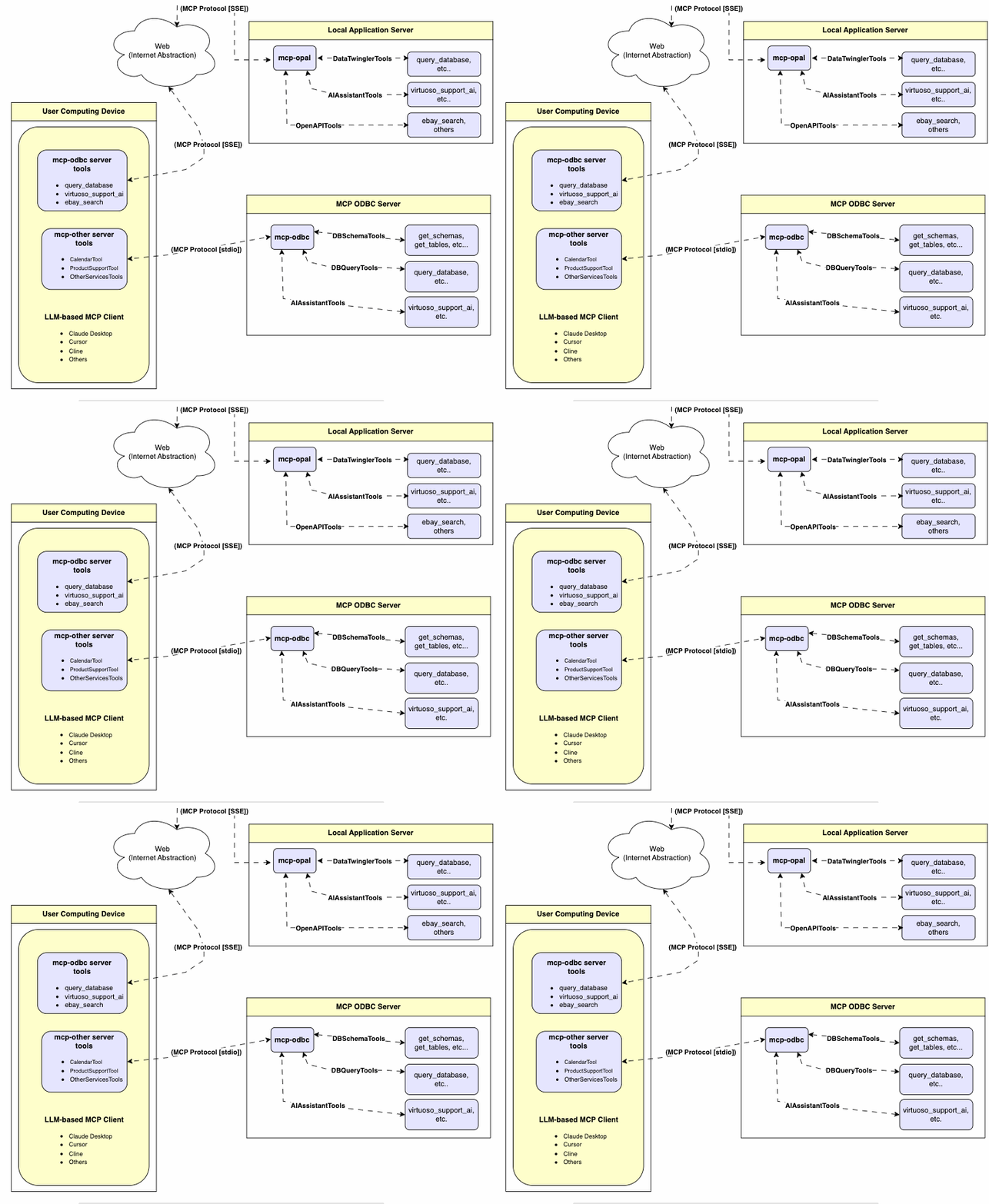
A lightweight MCP (Model Context Protocol) server for ODBC built with FastAPI, pyodbc, and SQLAlchemy. This server is compatible with Virtuoso DBMS and other DBMS backends that implement a SQLAlchemy provider.
Install uv:
pip install uv
Or use Homebrew:
brew install uv
unixODBC Runtime Environment Checks:
Check installation configuration (i.e., location of key INI files) by running: odbcinst -j
List available data source names by running: odbcinst -q -s
ODBC DSN Setup: Configure your ODBC Data Source Name (~/.odbc.ini) for the target database. Example for Virtuoso DBMS:
[VOS]
Description = OpenLink Virtuoso
Driver = /path/to/virtodbcu_r.so
Database = Demo
Address = localhost:1111
WideAsUTF16 = Yes
SQLAlchemy URL Binding: Use the format:
virtuoso+pyodbc://user:password@VOS
Clone this repository:
git clone https://github.com/OpenLinkSoftware/mcp-sqlalchemy-server.git
cd mcp-sqlalchemy-server
Update your .envby overriding the defaults to match your preferences
ODBC_DSN=VOS
ODBC_USER=dba
ODBC_PASSWORD=dba
API_KEY=xxx
For Claude Desktop users:
Add the following to claude_desktop_config.json:
{
  "mcpServers": {
    "my_database": {
      "command": "uv",
      "args": ["--directory", "/path/to/mcp-sqlalchemy-server", "run", "mcp-sqlalchemy-server"],
      "env": {
        "ODBC_DSN": "dsn_name",
        "ODBC_USER": "username",
        "ODBC_PASSWORD": "password",
        "API_KEY": "sk-xxx"
      }
    }
  }
}
Here are the pyodbc URL examples for connecting to DBMS systems that have been tested using this mcp-server.
| Database | URL Format |
|---|---|
| Virtuoso DBMS | virtuoso+pyodbc://user:password@ODBC_DSN |
| PostgreSQL | postgresql://user:password@localhost/dbname |
| MySQL | mysql+pymysql://user:password@localhost/dbname |
| SQLite | sqlite:///path/to/database.db |
| Once connected, you can interact with your WhatsApp contacts through Claude, leveraging Claude's AI capabilities in your WhatsApp conversations. |
| name | description |
|---|---|
| podbc_get_schemas | List database schemas accessible to connected database management system (DBMS). |
| podbc_get_tables | List tables associated with a selected database schema. |
| podbc_describe_table | Provide the description of a table associated with a designated database schema. This includes information about column names, data types, nulls handling, autoincrement, primary key, and foreign keys |
| podbc_filter_table_names | List tables, based on a substring pattern from the q input field, associated with a selected database schema. |
| podbc_query_database | Execute a SQL query and return results in JSONL format. |
| podbc_execute_query | Execute a SQL query and return results in JSONL format. |
| podbc_execute_query_md | Execute a SQL query and return results in Markdown table format. |
| podbc_spasql_query | Execute a SPASQL query and return results. |
| podbc_sparql_query | Execute a SPARQL query and return results. |
| podbc_virtuoso_support_ai | Interact with the Virtuoso Support Assistant/Agent -- a Virtuoso-specific feature for interacting with LLMs |
podbc_get_schemas
user (string, optional): Database username. Defaults to "demo".password (string, optional): Database password. Defaults to "demo".dsn (string, optional): ODBC data source name. Defaults to "Local Virtuoso".podbc_get_tables
schema (string, optional): Database schema to filter tables. Defaults to connection default.user (string, optional): Database username. Defaults to "demo".password (string, optional): Database password. Defaults to "demo".dsn (string, optional): ODBC data source name. Defaults to "Local Virtuoso".podbc_filter_table_names
q (string, required): The substring to search for within table names.schema (string, optional): Database schema to filter tables. Defaults to connection default.user (string, optional): Database username. Defaults to "demo".password (string, optional): Database password. Defaults to "demo".dsn (string, optional): ODBC data source name. Defaults to "Local Virtuoso".podbc_describe_table
schema (string, required): The database schema name containing the table.table (string, required): The name of the table to describe.user (string, optional): Database username. Defaults to "demo".password (string, optional): Database password. Defaults to "demo".dsn (string, optional): ODBC data source name. Defaults to "Local Virtuoso".podbc_query_database
query (string, required): The SQL query string to execute.user (string, optional): Database username. Defaults to "demo".password (string, optional): Database password. Defaults to "demo".dsn (string, optional): ODBC data source name. Defaults to "Local Virtuoso".podbc_query_database_md
query (string, required): The SQL query string to execute.user (string, optional): Database username. Defaults to "demo".password (string, optional): Database password. Defaults to "demo".dsn (string, optional): ODBC data source name. Defaults to "Local Virtuoso".podbc_query_database_jsonl
query (string, required): The SQL query string to execute.user (string, optional): Database username. Defaults to "demo".password (string, optional): Database password. Defaults to "demo".dsn (string, optional): ODBC data source name. Defaults to "Local Virtuoso".podbc_spasql_query
query (string, required): The SPASQL query string.max_rows (number, optional): Maximum number of rows to return. Defaults to 20.timeout (number, optional): Query timeout in milliseconds. Defaults to 30000.user (string, optional): Database username. Defaults to "demo".password (string, optional): Database password. Defaults to "demo".dsn (string, optional): ODBC data source name. Defaults to "Local Virtuoso".Demo.demo.execute_spasql_query).podbc_sparql_query
query (string, required): The SPARQL query string.format (string, optional): Desired result format. Defaults to 'json'.timeout (number, optional): Query timeout in milliseconds. Defaults to 30000.user (string, optional): Database username. Defaults to "demo".password (string, optional): Database password. Defaults to "demo".dsn (string, optional): ODBC data source name. Defaults to "Local Virtuoso"."UB".dba."sparqlQuery").podbc_virtuoso_support_ai
prompt (string, required): The prompt text for the AI function.api_key (string, optional): API key for the AI service. Defaults to "none".user (string, optional): Database username. Defaults to "demo".password (string, optional): Database password. Defaults to "demo".dsn (string, optional): ODBC data source name. Defaults to "Local Virtuoso".DEMO.DBA.OAI_VIRTUOSO_SUPPORT_AI).For easier troubleshooting:
Install the MCP Inspector:
npm install -g @modelcontextprotocol/inspector
Start the inspector:
npx @modelcontextprotocol/inspector uv --directory /path/to/mcp-sqlalchemy-server run mcp-sqlalchemy-server
Access the provided URL to troubleshoot server interactions.
Claim this server with your GitHub account to request manual ownership verification.
Link to the catalog listing for MCP Server ODBC via SQLAlchemy from your README. This badge does not certify ownership, compatibility or security.
[](https://awesome-mcp.com/servers/mcp-server-odbc)Public repository statistics could not be verified. Check the configured source address; unavailable counts are not zero.
来源、范围和时段分别列出;不相加,不代表安装人数、活跃用户或安全审核。
尚无已审核的包 / 镜像标识,暂不展示下载统计。
Alternative and complementary servers in the same category
This is a Model Context Protocol (MCP) server for interacting with AIStor object stores.

A Model Context Protocol server that lets AI assistants run SQL queries against AWS Athena databases and retrieve results.

A Model Context Protocol (MCP) server that exposes access to an InfluxDB v2 instance using the InfluxDB OSS API v2.