
Store and retrieve entities, relations and observations in a persistent local knowledge graph.
create_entitiescreate_relationsadd_observations+6 more
92K
AI & Multi-Agent
open-zk-kb is an MCP server that gives agents a local memory of corrections, preferences, and decisions so later sessions start with relevant context.
open-zk-kb is cataloged as an MCP server attributed to mrosnerr. open-zk-kb is an MCP server that gives agents a local memory of corrections, preferences, and decisions so later sessions start with relevant context. It is categorized under ai agents-models. See the capability inspector for recorded interfaces and their independent review status; consult upstream documentation for the current interface.
Installation configuration is not reviewed. No executable setup is offered for this entry; inspect the source repository before proceeding.
Catalog license label: MIT License. Check the source repository's current license and terms before using, modifying or distributing this software.
能力定义尚未审核。未核验的采集内容不会作为可信接口展示。
暂无可展示的已审核记录。这不表示上游不支持此能力。
暂无可展示的已审核记录。这不表示上游不支持此能力。
暂无可展示的已审核记录。这不表示上游不支持此能力。
Email delivery is not connected. This page does not collect email addresses or create subscriptions.
Browse the registry for current listings instead.
Reviews for open-zk-kb are not available yet
Review publishing and storage are not connected. This page does not collect or publish ratings or comments, including after sign-in.
No. Local embeddings work out of the box with no API key, and the tool runs offline with no cloud.
It combines SQLite FTS5 full-text indexing with local vector embeddings using MiniLM-L6-v2 for semantic matching.
Markdown files are the source of truth, while the database is a rebuildable index.
README.md · a4b0b41e4c4b · 采集于 2026-11-13 08:09:56 UTC
保留上游原文,不做 AI 改写。为安全起见过滤脚本、表单和不安全链接。
当前显示最后一次成功采集的文档快照,请以来源页面为准。




You open a new session and your agent has no idea who you are. Again. You re-explain your stack, your conventions, that one edge case you've corrected five times.
open-zk-kb gives your agent a memory — so corrections stick, context compounds, and every session starts smarter than the last.
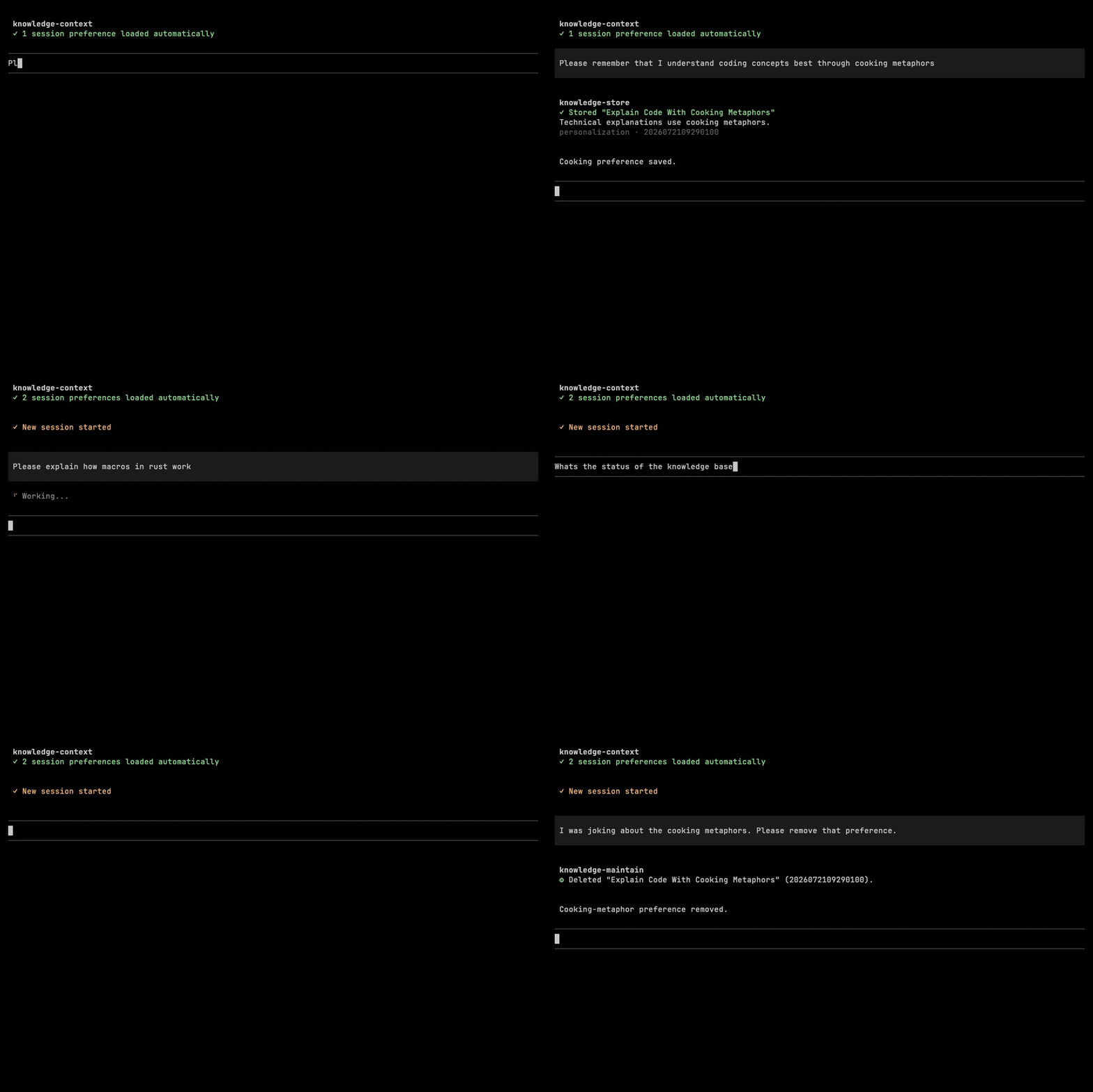
The full loop in Pi: store a preference, carry it into a fresh session, inspect the vault, and remove it when it stops being useful.
Requires Bun — install with
curl -fsSL https://bun.sh/install | bash
bunx open-zk-kb@latest
The installer configures your selected clients, installs agent instructions, and creates a local vault. Supported clients: OpenCode, Claude Code, Cursor, Windsurf, Zed, Pi, and OMP.
See the Setup Guide for manual installation and troubleshooting.
Your agent starts from zero every session. No memory, no learning curve. You correct the same mistakes, re-explain the same conventions, re-teach the same context. Switch tools and it's even worse — your Cursor agent doesn't know what your Claude agent learned.
open-zk-kb fixes that.
Install the Pi package, then restart Pi:
pi install npm:open-zk-kb
The extension exposes all ten knowledge-* tools directly in Pi. Results use Pi-native compact rendering: search, store, context, and health have focused summaries and expandable detail, while the other tools show concise status output. The MCP server and local SQLite/embedding work still run with Bun >= 1.0; Pi itself runs under its supported Node.js runtime. Installing Bun is therefore required even when using the Pi package.
Pi also loads active project preferences automatically when a session starts and injects them into model context without requiring a model-initiated search. The visible knowledge-context entry reports what happened without fabricating a tool call.
See the Pi experience guide for the complete preference workflow and renderer examples. For installer-managed instructions, verification, and troubleshooting, see Pi installation.
Zero configuration required. Local embeddings work out of the box with no API key.
See the Configuration Guide for embeddings, vault path, lifecycle tuning, and server settings.
Built on the Zettelkasten method — atomic, linked notes with structured kinds. Each note captures one concept (a decision, a preference, a gotcha) and links to related notes, building an interconnected knowledge graph.
Search combines SQLite FTS5 full-text indexing with local vector embeddings (MiniLM-L6-v2) for semantic matching. Markdown files are the source of truth; the database is a rebuildable index.
When enabled (telemetry.enabled: true and telemetry.share: true), open-zk-kb sends one anonymous event for each completed session to PostHog (EU Cloud) on a later startup. It includes a canonical client, bounded model IDs, vault size, and counts for all ten tools—not note content, queries, paths, names, or email addresses. Runtime defaults are disabled; the interactive installer enables sharing only after affirmative consent, while unattended and direct package installs remain disabled unless configured separately. Set DO_NOT_TRACK=1 to unconditionally block sharing (local SQLite counters are unaffected), or keep both flags false. See Telemetry for the full event schema and details.
Claim this server with your GitHub account to request manual ownership verification.
Link to the catalog listing for open-zk-kb from your README. This badge does not certify ownership, compatibility or security.
[](https://awesome-mcp.com/servers/open-zk-kb)Public repository statistics could not be verified. Check the configured source address; unavailable counts are not zero.
来源、范围和时段分别列出;不相加,不代表安装人数、活跃用户或安全审核。
尚无已审核的包 / 镜像标识,暂不展示下载统计。
Alternative and complementary servers in the same category
Store and retrieve entities, relations and observations in a persistent local knowledge graph.
Organize problem solving into revisable, branching thought steps through an MCP tool.

Query-aware context compression with an MCP plugin for coding agents, plus Python and HTTP interfaces for reducing the context sent to a language model.