
Store and retrieve entities, relations and observations in a persistent local knowledge graph.
create_entitiescreate_relationsadd_observations+6 more
92K
AI & Multi-Agent
Inspectable project memory for coding agents, with an MCP interface for saving, searching and correcting records stored as Markdown in a separate Git repository.
Palinode is cataloged as an MCP server attributed to phasespace-labs. Inspectable project memory for coding agents, with an MCP interface for saving, searching and correcting records stored as Markdown in a separate Git repository. It is categorized under ai agents-models. See the capability inspector for recorded interfaces and their independent review status; consult upstream documentation for the current interface.
Installation configuration is not reviewed. No executable setup is offered for this entry; inspect the source repository before proceeding.
Catalog license label: MIT. Check the source repository's current license and terms before using, modifying or distributing this software.
能力定义尚未审核。未核验的采集内容不会作为可信接口展示。
暂无可展示的已审核记录。这不表示上游不支持此能力。
暂无可展示的已审核记录。这不表示上游不支持此能力。
暂无可展示的已审核记录。这不表示上游不支持此能力。
Email delivery is not connected. This page does not collect email addresses or create subscriptions.
Browse the registry for current listings instead.
Reviews for Palinode are not available yet
Review publishing and storage are not connected. This page does not collect or publish ratings or comments, including after sign-in.
Palinode is described as inspectable, correctable project memory for coding agents. It lets a project decision and its reason be saved once so a later session can find it, inspect where it came from, and correct it when it is wrong.
The README says memory is stored as Markdown files with YAML frontmatter in a separate Git repository. It describes typed records including decisions, insights, people, and projects.
The source says agents connect through an MCP interface for saving, searching, and correcting memory. The README also describes CLI, REST, and inspector interfaces.
Palinode runs as a local service by default. Its MCP interface supports stdio or Streamable HTTP, and the README describes reaching an inspector on another machine through an SSH tunnel to its loopback port.
No, according to the README. Archiving removes a memory from default recall but keeps the file, audit history, and Git history so it can be restored. Permanent removal is described as a separate manual procedure.
The README says the inspector is read-only and has no edit, save, or archive buttons. Corrections are made through other interfaces.
The README says automatic capture and recall are opt-in per client, with the specifics depending on the client and setup. It does not present automatic capture as the default behavior for every client.
The README lists Python 3.11+ and Git. Hybrid indexing and search use Ollama with bge-m3 or another supported embedding endpoint; explicit lexical mode is available for keyword/FTS retrieval without embeddings.
The README warns that private or restricted labels control discovery by scope but do not provide encryption or per-user/per-agent authentication. It also says a caller with API access could still read a hidden memory by its known path. The store, backups, and credentials should be protected.
README.md · 6455dda012e0 · 采集于 2026-11-13 02:31:32 UTC
保留上游原文,不做 AI 改写。为安全起见过滤脚本、表单和不安全链接。
当前显示最后一次成功采集的文档快照,请以来源页面为准。
┌─ palinode ─┐
│ ░░░░░░░░░░ │
│ ▓▓▓▓▓▓▓▓▓▓ │
│ ██████████ │
└────────────┘
Inspectable, correctable project memory for coding agents.
Save a project decision and its reason once. A later session, in the same coding agent or a different one, can find it. You can see what was remembered, trace where it came from, and correct it when it is wrong.
Last week, you chose SQLite for a cache because it avoided operating a database. This week, a changed requirement makes PostgreSQL the better choice. Without the decision and its reason, a fresh agent can repeat the old approach. With Palinode, you save the replacement, retire the original without losing its history, and the next session searches and finds the current decision.
Palinode runs as a local service on your machine, and your coding agent connects
to it as an MCP server. By default the agent saves and searches only by calling
Palinode's tools: when you ask, or when the instructions palinode init adds to
your project tell it to (search at the start of a session, save a decision once
it is settled). Automatic capture and recall are opt-in per client:
palinode init --hook for Claude Code, palinode init --codex-hook for Codex.
With them on, a session that did real work leaves a short summary when it ends, and memories you
mark to always load (--core), plus memories that closely match each prompt, are
added to the agent's context. Memory stays in Markdown files in its own Git
repository, separate from your code, on a machine you control.
Start here: the Quickstart walks you through installing, starting the service, saving a decision, opening a fresh session, inspecting the decision, and correcting it.
A palinode is a poem that retracts what was said before and says it better. Palinode does that for decisions: the replacement becomes current, and the original stays in the history.
Built by Paul Kyle at phasespace-labs. See AUTHORS.
While Palinode is running, open the local inspector at
http://127.0.0.1:6340/ui/ (the default address; the port follows
PALINODE_API_PORT). Browse and search what was saved, then open a memory to
see its source file, the Git commit that saved it, and what it replaced.
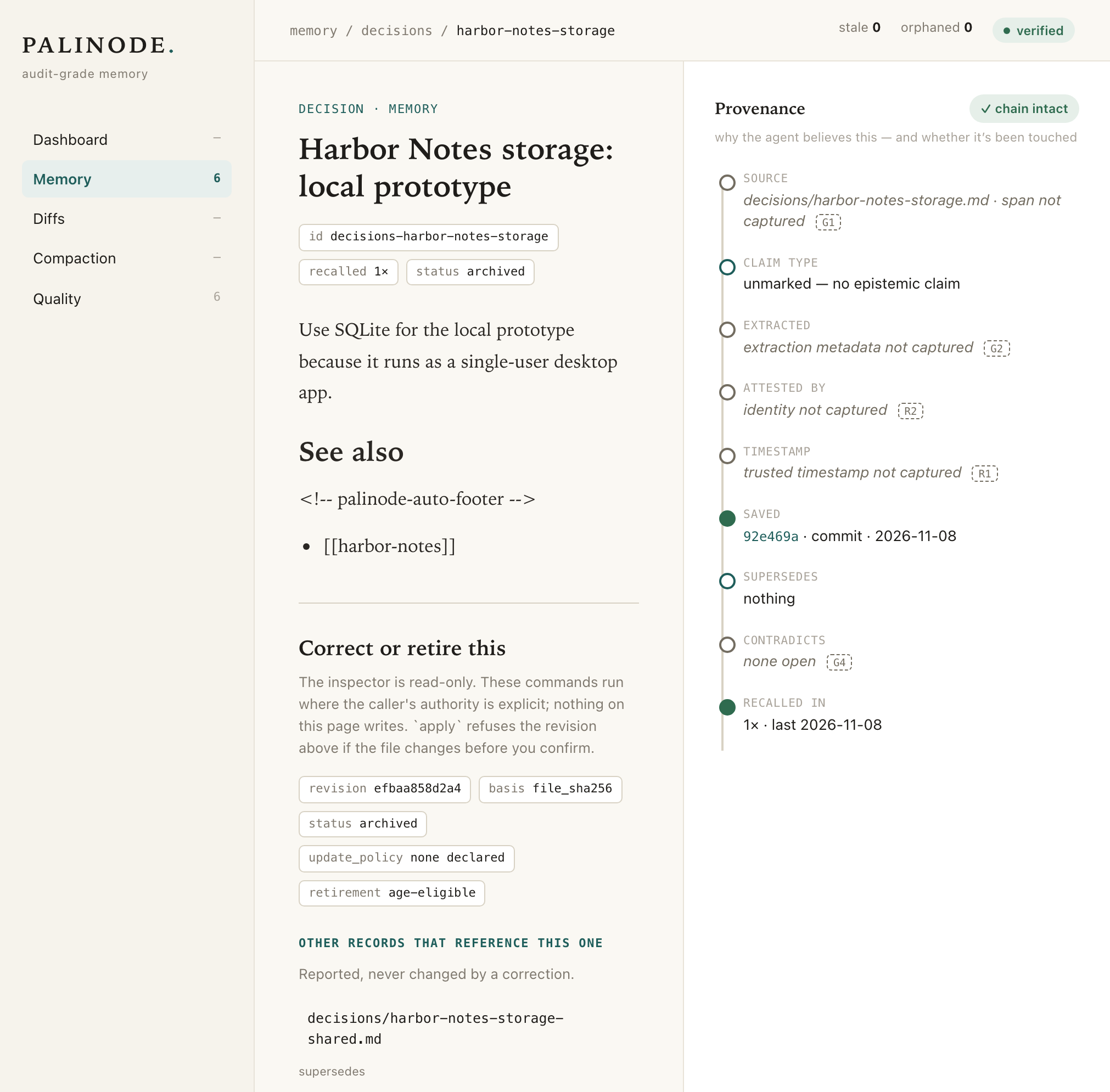
The screenshot uses fictional sample data. It shows the initial SQLite decision after it was archived in favour of a separately saved PostgreSQL decision.
The inspector is read-only: it has no edit, save or archive buttons. Each
memory page lists the commands to run instead. To correct or retire a memory, ask
your connected agent (for example, "archive decisions/harbor-notes-storage.md,
superseded by decisions/harbor-notes-storage-shared.md, because the shared
service needs concurrent writes"). The agent does this with the
palinode_archive tool. Or use the CLI:
# Preview first; nothing is written
palinode archive decisions/harbor-notes-storage.md --reason "..." --dry-run
# Retire it, naming the replacement (omit --superseded-by for a plain retirement)
palinode archive decisions/harbor-notes-storage.md \
  --superseded-by decisions/harbor-notes-storage-shared.md --reason "..."
# Changed your mind? Bring it back into recall
palinode restore decisions/harbor-notes-storage.md
Archiving is not erasure. An archived memory leaves default recall, but the file, its audit history and its Git history all remain, so you can restore it. Removing data permanently, Git history included, is a separate manual procedure with no single command; see the data lifecycle. For a reviewed replace-in-one-step flow, see CORRECTIONS.md.
The inspector only serves on loopback; reach a store on another machine through an SSH tunnel to that machine's loopback port. When the API has a bearer token configured, the inspector has no sign-in form: every browser request must already carry the token header. The inspector guide covers views, access limits and troubleshooting.
| Platform | Session Skill Path | MCP Config |
|---|---|---|
| Claude Code CLI | ~/.claude/skills/ | ~/.claude.json |
| Claude Desktop | ~/.claude/skills/ | claude_desktop_config.json |
| Cursor | .cursor/skills/ | .cursor/mcp.json |
| VS Code + Claude (Continue / Cline) | ~/.claude/skills/ | see MCP-INSTALL-RECIPES.md |
| JetBrains + Claude | ~/.claude/skills/ | ~/.claude.json |
| Antigravity IDE | .agent/skills/ | native 3-dot MCP menu |
| Codex CLI | N/A (no skills) | ~/.codex/config.toml |
| Pi | N/A (native extension) | plugins/pi/ — per-turn recall via lifecycle hooks |
| Cline CLI / SDK | N/A (native plugin) | plugins/cline/ — per-turn recall via AgentPlugin hooks |
All platforms share the same MCP server — install once on your server, connect from any IDE. docs/HARNESSES.md is the cross-harness map: what each harness gets (native hooks vs. plugin vs. MCP), how the tiers stack, and where to start. Per-client config snippets: docs/MCP-SETUP.md and docs/MCP-INSTALL-RECIPES.md.
Palinode treats plain files as the source of truth and builds its index and interfaces from those files.
Files (markdown + YAML frontmatter)
  ↓ watched
Index (SQLite-vec vectors + FTS5 keywords, single .db file)
  ↓ queried by
Interfaces (MCP server, REST API, CLI, OpenClaw plugin)
  ↓ compacted by
Consolidation (structured operations → validation and application → git commits)
That's the whole architecture. One directory of .md files, one SQLite database, one API server. No Postgres, no Redis, no cloud dependency.
Palinode doesn't care how you talk to it. The full toolkit — save, search, doctor, dedup-suggest, orphan-repair, diff, blame, rollback, and more — works through every interface:
| Interface | Transport | Best For |
|---|---|---|
| MCP Server | Streamable HTTP or stdio | Claude Code, Claude Desktop, Cursor, Windsurf, Zed, VS Code (Continue/Cline) |
| REST API | HTTP on :6340 | Scripts, webhooks, custom integrations |
| CLI | Wraps REST API | Cron jobs, SSH, shell scripts |
| Plugin | OpenClaw lifecycle hooks | Agent frameworks with inject/extract patterns |
Set up once on a server. Connect from any machine, any IDE, any agent framework. The MCP server is a pure HTTP client — it holds no state, no database connection, no embedder. Point it at the API and go.
{
  "mcpServers": {
    "palinode": { "type": "http", "url": "http://your-server:6341/mcp/" }
  }
}
That's the entire client config. Works with Claude Code, Claude Desktop, Cursor, Windsurf, Zed, and VS Code (Continue/Cline). palinode-mcp-http serves streamable-HTTP at /mcp/ — use "type": "http", not "type": "sse". Always include the trailing slash in the URL. See docs/MCP-SETUP.md for editor-specific install recipes.
Store — Typed markdown files (people, projects, decisions, insights) with YAML frontmatter. Git-versioned. Human-readable. Editable in Obsidian, VS Code, vim, or anything.
Index — A file watcher indexes with FTS5 as you save. Content-hash dedup skips re-embedding unchanged files. The index is a local SQLite file; embeddings can use a local BGE-M3 endpoint or a configured remote provider.
Search — Hybrid BM25 + vector search merged with Reciprocal Rank Fusion. The two arms have different jobs: on full-sentence questions the vector arm can retrieve semantic matches while BM25 catches exact terms and identifiers. See benchmarks for the evaluation context and limitations. Optional associative entity graph and prospective triggers.
Compact — Weekly consolidation where an LLM returns structured operations and Palinode validates and applies them. Every compaction is a git commit you can review, blame, or revert.
Dream — If you've met "dreaming" as the name for this, palinode dream is an alias for palinode consolidate. Use --dry-run to inspect the proposed operations; each completed pass lands as a git commit, so a bad consolidation is a diff to review and a commit to revert.
Audit — git blame any fact. git diff any change. rollback any mistake. These aren't just git-compatible files — palinode_diff, palinode_blame, and palinode_rollback are first-class tools your agent can call. A memory with no explicit claim type is shown as unmarked; nothing is silently promoted from an unmarked note to a fact.
bge-m3 (ollama pull bge-m3, ≈1.2 GB), or another supported
embedding endpoint — for hybrid indexing and search. Since v0.21 you can
instead choose explicit lexical mode; it is keyword/FTS retrieval, not a
fallback when hybrid's endpoint fails. Saves persist without an
embedder, but hybrid search returns HTTP 503 until it is reachable
(palinode resolve degrades to keyword-only and says so). See the
Homebrew setup guide for installation and verification.Optional extras: a chat model for weekly consolidation (any 7B+ that outputs JSON), OpenClaw for agent plugin hooks.
Before your first capture: Palinode stores readable Markdown and Git history. private/restricted control discovery by scope; a caller with API access can still read a hidden memory by its known path and use full-store maintenance tools. These labels provide no encryption or per-user/per-agent authentication. Protect the store, backups and API credentials; use separate instances or filesystem permissions for stronger separation. See the privacy contract.
The Quickstart is the authoritative first-use sequence. It covers the separate private store, second-terminal environment, supported lexical preview and hybrid model paths, editor connection, fresh-session check, inspector, and correction workflow. Do not combine a code checkout and a memory store. For a released Homebrew installation, begin with docs/HOMEBREW.md; for an autonomous agent bootstrap, see llms-install.md.
Three long-running processes (API, watcher, embedder) shouldn't live in terminal tabs. Pick one:
| Platform | How | Details |
|---|---|---|
| Anywhere with Docker | docker compose up -d from the repo root — API + watcher + Ollama, with the bge-m3 pull handled for you (≈1.2 GB on first run) | docker-compose.yml header comments |
| Linux | systemd units via deploy/systemd/install.sh --enable | deploy/systemd/README.md |
| macOS | launchd LaunchAgents from templates | deploy/launchd/README.md |
| Windows | use Docker Compose (set PALINODE_DATA_DIR to a Windows path) | docker-compose.yml header comments |
With compose, your memory stays on the host at ~/.palinode (override with PALINODE_DATA_DIR) — the containers mount it; files remain the source of truth. Already running Ollama on the host? OLLAMA_URL=http://host.docker.internal:11434 docker compose up -d palinode-api palinode-watcher skips the bundled one. Verify any of the three the same way: palinode doctor (or curl http://127.0.0.1:6340/status).
Palinode speaks MCP. Follow the connection step in the
Quickstart: palinode mcp-config generates a native
fragment for the selected client, and the recipes keep the supported manual
configuration. It is read-only; it never edits a client configuration file.
Connecting to a server on another machine over HTTP? Pass your project:
palinode mcp-config --http --project <slug> adds an X-Palinode-Project
header. Since v0.22 a remote server no longer scopes recall to its own working
directory, so a client without the header gets unscoped results, reported as
Scope: none. See the v0.22.0 compatibility notes. Full per-harness detail:
docs/MCP-INSTALL-RECIPES.md.
Merge the Palinode entry into existing settings; redirecting generated output onto an existing configuration file would overwrite it.
Already installed with palinode-api running? Scaffold any project in one command:
cd your-project
palinode init
By default that scaffolds .claude/CLAUDE.md (memory instructions, appended if one exists), the palinode-session skill, the /wrap command, and .mcp.json (points Claude Code at the palinode MCP server). The agent then saves and recalls through explicit tool calls. It installs no automatic hooks unless you opt in.
palinode init --hook opts in to the Claude Code hooks (.claude/settings.json registration plus the scripts). The SessionStart hook injects your core: true memories into each fresh session (startup and /clear). The UserPromptSubmit hook recalls relevant memory before each prompt: prospective triggers plus a strict-threshold search, injected as compact snippets and silent when nothing matches. The SessionEnd hook captures a transcript-derived summary on /clear, logout, and exit, and PostCompact saves a compaction checkpoint. Run palinode controls status before enabling them; the Quickstart shows how to pause or remove them. Re-run with --dry-run to preview, --force to overwrite, or --no-mcp to scope it. See examples/hooks/ for tuning knobs.
Projects that use other harnesses get the same memory instructions automatically: when AGENTS.md (or a .agent/ directory) exists, init appends a harness-neutral memory block to AGENTS.md (read by Codex, Antigravity, and other AGENTS.md-aware agents), and when a .cursor/ directory exists it writes .cursor/rules/palinode.md for Cursor. Force or skip with --agents/--no-agents and --cursor/--no-cursor — same recall/save/session-end contract, minus the Claude-Code-only machinery (/clear, /wrap, hooks).
A few common flows. Every command and option is in docs/CLI.md.
# During a session — save a decision
palinode save --type Decision "Chose SQLite over Postgres for the cache layer. \
  Reason: no ops burden, single-file deployment, good enough for our scale."

# Next week — search for it
palinode search "database decision for cache"
# Agent calls at end of coding session
palinode session-end \
  --summary "Migrated auth from JWT to session tokens" \
  --decisions "Session tokens stored server-side, 24h expiry" \
  --blockers "Need to update mobile client auth flow"
# Trace a fact back to when it was recorded
palinode blame decisions/auth-migration.md

# Compose the full provenance lineage of a fact — sources, saved/changed
# commits, supersession trail, typed links, and recall — in one view
palinode trace decisions/auth-migration.md

# See what changed across all memory in the last week
palinode diff --days 7

# Retire a memory that turned out to be wrong — it leaves recall but stays
# on disk, in git, and in the index. Never a hard delete.
palinode archive insights/stale-finding.md --reason "superseded by the re-run" \
  --superseded-by insights/corrected-finding.md
Tools available through every interface (the full inventory, with parameters, is the table in docs/MCP-SETUP.md — a prose count here only drifts):
| Tool | What It Does |
|---|---|
session_init | Session-start context digest for the resolved project scope |
search | Hybrid BM25 + vector search with category filter; resolve attaches bounded evidence and a resolution per hit |
resolve | What memory holds right now for a question or one record — what stands, what replaced what, conflicts with both sides intact, and what is explicitly unknown |
save | Store a typed memory (person, decision, insight, project) |
list | Browse memory files by type, filter by core status |
read | Read the full content of a memory file |
ingest | Fetch a URL and save as research |
status | Health check — file counts, index stats, service status |
entities | Entity graph — cross-references between memories |
consolidate | Preview or run LLM-powered compaction |
archive | Retire one memory that's wrong or obsolete — archive it, or supersede it with a named replacement |
restore | Bring an archived memory back into default recall — the inverse of archive |
unretract | Withdraw one preference's mention-level retraction from one memory |
forget_withdraw | Take a forget request back — restore what it archived, un-strike what it retracted |
archive_expired | Archive ephemeral memories whose TTL has expired |
diff | What changed in the last N days |
blame | Trace a fact back to the commit that recorded it |
trace | Compose a fact's full provenance lineage — sources, saved/changed commits, supersession, typed links, recall |
history | Git history for a file with diff stats and rename tracking |
rollback | Revert a file to a previous commit (safe, creates new commit) |
push | Sync memory to a remote git repo |
trigger | Prospective recall — auto-inject when a topic comes up |
lint | Health scan — orphans, stale files, missing fields |
review | Advisory project-memory review that proposes corrective operations without writing them |
session_end | Capture summary, decisions, and blockers at end of session |
prompt | List, show, or activate versioned LLM prompts |
dedup_suggest | Before saving, surface existing files that overlap the draft |
orphan_repair | Find semantic matches for broken [[wikilinks]] |
doctor | Fast diagnostic pass — 18+ checks across paths, services, config, index |
doctor_deep | Full diagnostic with canary write test (~10–15s) |
cluster_neighbors | Find top-K semantically related files NOT already wiki-linked — surface implicit relationships for cross-link proposals |
topic_coverage | Given a short topic phrase, return whether any existing wiki page already covers it (binary covered / best_match / similarity) |
depends | Dependency tree (or unblocked-items list) from depends_on / blocks / parallel_with frontmatter on ProjectSnapshots |
Every tool is accessible as palinode_<name> via MCP, palinode <name> via CLI (hyphenated: palinode archive-expired; session_init is palinode prime; doctor_deep has no separate CLI command), or POST/GET /<name> via the REST API.
The CLI has more commands than the tool list — service control, migration, repair, and wiki-maintenance helpers. docs/CLI.md is the full command reference, one entry per command with options, defaults, and output behaviour.
| Layer | Choice | Why |
|---|---|---|
| Source of truth | Markdown + YAML frontmatter | Human-readable, git-versioned, portable |
| Vector index | SQLite-vec (embedded) | No server, single file, zero config |
| Keyword index | SQLite FTS5 (embedded) | BM25 for exact terms, zero dependencies |
| Embeddings | BGE-M3 via Ollama, or any OpenAI-compatible /v1/embeddings server | Local, private, no API key needed |
| API | FastAPI | Lightweight, async, one process |
| MCP | Python MCP SDK (Streamable HTTP) | Works with every IDE over the network |
| CLI | Click (wraps REST API) | Shell-native, TTY-aware output |
| Behavior | PROGRAM.md | What to remember, how to extract, how to compact — edit one file to change all behavior |
---
id: project-palinode
category: project
name: Palinode
core: true
status: active
entities: [person/alice]
last_updated: 2026-04-05T00:00:00Z
summary: "Persistent memory for AI agents."
canonical_question: "What is Palinode and what does it do?"
---
# Palinode

Your content here. As detailed or brief as you want.
Files marked `core: true` are included in the session-start digest.
Everything else is retrieved on demand via hybrid search.
The `canonical_question` field anchors the file to the question it answers, improving search relevance.
Palinode stores every memory as a plain markdown file — which means your memory directory is already a valid Obsidian vault. Point Obsidian at the folder and you get graph view, backlinks, and Bases on top of Palinode's hybrid search and compaction. No sync job, no plugin to install, no two-source-of-truth problem.
palinode init --obsidian --dir ~/palinode-vault
This scaffolds the vault directory layout, an _index.md Map of Content, a _README.md orientation page, and an opinionated .obsidian/ config (graph view colour-coded by category, daily-notes wired to daily/). Then open the directory in Obsidian.
The LLM follows a wiki-maintenance contract — it keeps entities: frontmatter and [[wikilinks]] in the note body in sync so the Obsidian graph stays accurate as new memories are saved. When you save a memory with entity references, Palinode appends an idempotent ## See also block linking them as wikilinks.
Two embedding-aware tools support wiki hygiene: palinode_dedup_suggest checks whether a draft overlaps an existing file before creating a duplicate, and palinode_orphan_repair finds semantic matches for broken [[wikilinks]]. Both are callable via MCP, CLI, and REST.
See docs/OBSIDIAN.md for the comprehensive guide: quickstart, wiki contract details, migration paths, and FAQ.
Silent misconfiguration — a db_path pointing at the wrong file, a watcher indexing a stale directory, a phantom DB file — is the most common reason Palinode doesn't behave as expected after an upgrade or server move. palinode doctor catches this entire class of bugs.
palinode doctor
The command runs 18+ checks across paths, services, config consistency, index health, and disk state, and emits a structured report with a pass/warn/fail status for each. --fix mode applies safe automated repairs (creates missing directories, appends the CLAUDE.md Palinode block) — it never moves user data; phantom DB files and DB-path mismatches print suggested mv commands but never execute them.
Run palinode doctor after every install, upgrade, or server migration. See docs/DOCTOR.md for the full check catalog and --fix reference.
All behavior is in palinode.config.yaml:
memory_dir: "~/.palinode"
ollama_url: "http://localhost:11434"
embedding_model: "bge-m3"

search:
  hybrid_enabled: true
  hybrid_weight: 0.5         # 0.0 = vector only, 1.0 = BM25 only

consolidation:
  llm_model: "llama3.1:8b"   # any chat model that outputs JSON
  llm_url: "http://localhost:11434"
  llm_fallbacks:              # tried in order if primary fails
    - model: "qwen2.5:14b-instruct"
      url: "http://localhost:11434"
All models are swappable. Any Ollama embedding model, any OpenAI-compatible chat endpoint. The default search floors (search.mcp_threshold=0.4 and search.api_threshold=0.5) were measured against real bge-m3 embeddings; if you change the embedding model, re-check those floors and review any trigger threshold separately — the trigger default was not part of this calibration.
Every search delivery also reports a match-confidence verdict — confident,
weak or none — in receipt.retrieval, read from each arm's own pre-fusion
score rather than the fused rank, with the arm evidence beside it. Results are
never withheld for it by default; search.abstain_on_no_confident_match: true
opts the MCP surface into withholding a none slate. See
docs/lexical-retrieval.md.
To re-check the search floors against your configured embedding endpoint, run
python -m bench.abstention. It measures false positives for no-answer queries
and retention of true results for answer-present controls as per-arm search
thresholds increase; it does not calibrate trigger thresholds. See
palinode.config.yaml.example for the full
reference.
Embeddings without Ollama. llama.cpp (llama-server --embedding), vLLM, and LM Studio all expose the OpenAI-compatible /v1/embeddings shape; select it with dialect: openai (default ollama, so existing setups are unchanged). Retry, circuit breaker, and per-input error handling are identical to the Ollama path. The Ollama tag bge-m3 is not a llama-server model name — point llama-server at a BGE-M3 GGUF instead:
embeddings:
  primary:
    dialect: openai
    url: "http://localhost:8080"   # a trailing /v1 is fine too
    model: "bge-m3"                # llama-server ignores it; vLLM / LM Studio match it
    dimensions: 1024
Hosted OpenAI-compatible embedding providers can also use bearer
authentication and provider-specific endpoint paths. Credentials stay out of
YAML: set PALINODE_EMBEDDING_API_KEY, or set
PALINODE_EMBEDDING_API_KEY_FILE to the path of a file containing the key.
For providers whose embedding endpoint is not /v1/embeddings, set
endpoint_path. When it is omitted, the existing bare-host and trailing-/v1
behavior is unchanged.
embeddings:
  primary:
    dialect: openai
    url: "https://generativelanguage.googleapis.com/v1beta/openai"
    endpoint_path: "/embeddings"
    model: "gemini-embedding-001"
When exposing the API beyond loopback (PALINODE_API_HOST other than 127.0.0.1), set PALINODE_API_TOKEN — the server refuses to start unauthenticated on a non-loopback bind unless you opt out explicitly with PALINODE_API_ALLOW_UNAUTH=1. See SECURITY.md for the bearer-token auth model and the bind gate.
| Method | Path | Description |
|---|---|---|
GET | /status | Health check + stats |
POST | /search | Hybrid search with filters |
POST | /search-associative | Entity graph traversal |
POST | /save | Create a typed memory file. Schema: {content, type, slug?, entities?, title?}. Body cap 5 MB (override via PALINODE_MAX_REQUEST_BYTES). |
POST | /ingest-url | Fetch URL, save as research. The URL and each redirect target (five hops at most) are validated before they are requested: a host must resolve only to globally routable addresses, and the connection is made to the address that was validated rather than by name. Pinning is skipped for HTTPS requests through an HTTP CONNECT proxy; address validation still runs (see the CLI guide). |
GET/POST | /triggers | Prospective recall triggers |
POST | /consolidate | Run or preview compaction |
GET | /list | Browse files by type |
GET | /read?file_path=... | Read a memory file |
GET | /history/{file_path} | Git log for a file |
GET | /diff | Recent changes |
GET | /blame/{file_path} | Git blame |
GET | /trace/{file_path} | Composed provenance lineage for a file |
POST | /rollback | Revert a file |
POST | /push | Push to git remote |
POST | /reindex | Rebuild indices |
POST | /session-end | Capture session summary |
POST | /lint | Health scan |
Files are truth. Not databases, not vector stores. Markdown files that humans can read, edit, and version with git.
Typed, not flat. People, projects, decisions, insights — each has structure. This enables reliable retrieval and consolidation.
Consolidation, not accumulation. 100 sessions should produce 20 well-maintained files, not 100 unread dumps.
Out of the way when working. The human talks to their agent; the agent calls Palinode's tools, and opt-in client hooks can do the routine capture and recall.
Graceful degradation. Vector index down? Read files directly. Embedding service down? Grep. Machine off? It's a git repo, clone it anywhere.
Zero taxonomy burden. The system classifies. The human reviews. If the human has to maintain a taxonomy, the system dies.
cp. Backup is git push. Whatever happens to any tool in this ecosystem, your data is plain text on your filesystem.diff, blame, rollback, push exposed via MCP, so the agent can audit and revert memory itself.<!-- fact:slug --> IDs inline in markdown, invisible in rendering, preserved by git, targetable by compaction.cat still works.Measured, not asserted: docs/BENCHMARKS.md has LongMemEval results
with methodology, cost, and the losses. For what Palinode does and does not guarantee
about forged, planted, or borrowed-authority content reaching an agent through memory,
see SECURITY.md#memory-poisoning-and-trust-limitations.
Palinode builds on ideas from Karpathy's LLM Knowledge Bases, Letta (tiered memory), and LangMem (typed schemas + background consolidation). See docs/ACKNOWLEDGMENTS.md for the full list.
See also the epistemic integrity discussion in the Karpathy gist thread — particularly the problem of LLM wikis that "synthesise without citing, drift from sources without knowing it, and present false certainty where disagreement exists." Git-based provenance is Palinode's answer to that problem.
If you know of prior art we missed, please open an issue.
MIT — Privacy Policy
Built by Paul Kyle with help from AI agents who use Palinode to remember building Palinode.
Claim this server with your GitHub account to request manual ownership verification.
Link to the catalog listing for Palinode from your README. This badge does not certify ownership, compatibility or security.
[](https://awesome-mcp.com/servers/palinode)GitHub API evidence checked 2026-11-13 04:11:28.663Z (UTC). Repository-level counts are shared by all components, not individual server installs. Open issues including pull requests: 9.
来源、范围和时段分别列出;不相加,不代表安装人数、活跃用户或安全审核。
尚无已审核的包 / 镜像标识,暂不展示下载统计。
Alternative and complementary servers in the same category
Store and retrieve entities, relations and observations in a persistent local knowledge graph.
Organize problem solving into revisable, branching thought steps through an MCP tool.

Query-aware context compression with an MCP plugin for coding agents, plus Python and HTTP interfaces for reducing the context sent to a language model.