
A directory listing describing a cancellation-letter and mailing-address service. The configured public GitHub repository returned 404 during source verification.
Repository stats unavailable
Developer Tools
An optional MCP server from Pituitary that exposes consistency-governance tools, letting AI assistants check specs, docs, and compliance for drift.
Pituitary MCP Server is cataloged as an MCP server attributed to dusk-network. An optional MCP server from Pituitary that exposes consistency-governance tools, letting AI assistants check specs, docs, and compliance for drift. It is categorized under developer tools. See the capability inspector for recorded interfaces and their independent review status; consult upstream documentation for the current interface.
Installation configuration is not reviewed. No executable setup is offered for this entry; inspect the source repository before proceeding.
Catalog license label: MIT. Check the source repository's current license and terms before using, modifying or distributing this software.
能力定义尚未审核。未核验的采集内容不会作为可信接口展示。
暂无可展示的已审核记录。这不表示上游不支持此能力。
暂无可展示的已审核记录。这不表示上游不支持此能力。
暂无可展示的已审核记录。这不表示上游不支持此能力。
Email delivery is not connected. This page does not collect email addresses or create subscriptions.
Browse the registry for current listings instead.
Reviews for Pituitary MCP Server are not available yet
Review publishing and storage are not connected. This page does not collect or publish ratings or comments, including after sign-in.
No, it is optional; the core shipped slice is local and CLI-first, and the MCP server is an optional wrapper around the same deterministic core.
Pituitary works out of the box with no API keys and no external dependencies, though you can optionally configure embedding and analysis runtimes for stronger semantic retrieval.
README.md · 18616de051ad · 采集于 2026-11-13 11:33:03 UTC
保留上游原文,不做 AI 改写。为安全起见过滤脚本、表单和不安全链接。
当前显示最后一次成功采集的文档快照,请以来源页面为准。

Consistency governance for AI-native development.
Catch drifts before they catch you.


What It Catches · Quick Start · Agent · CI · Cheatsheet · Reference
For developers and teams where human+AI continuously produce specs, docs, and decisions that should agree — and silently stop agreeing.
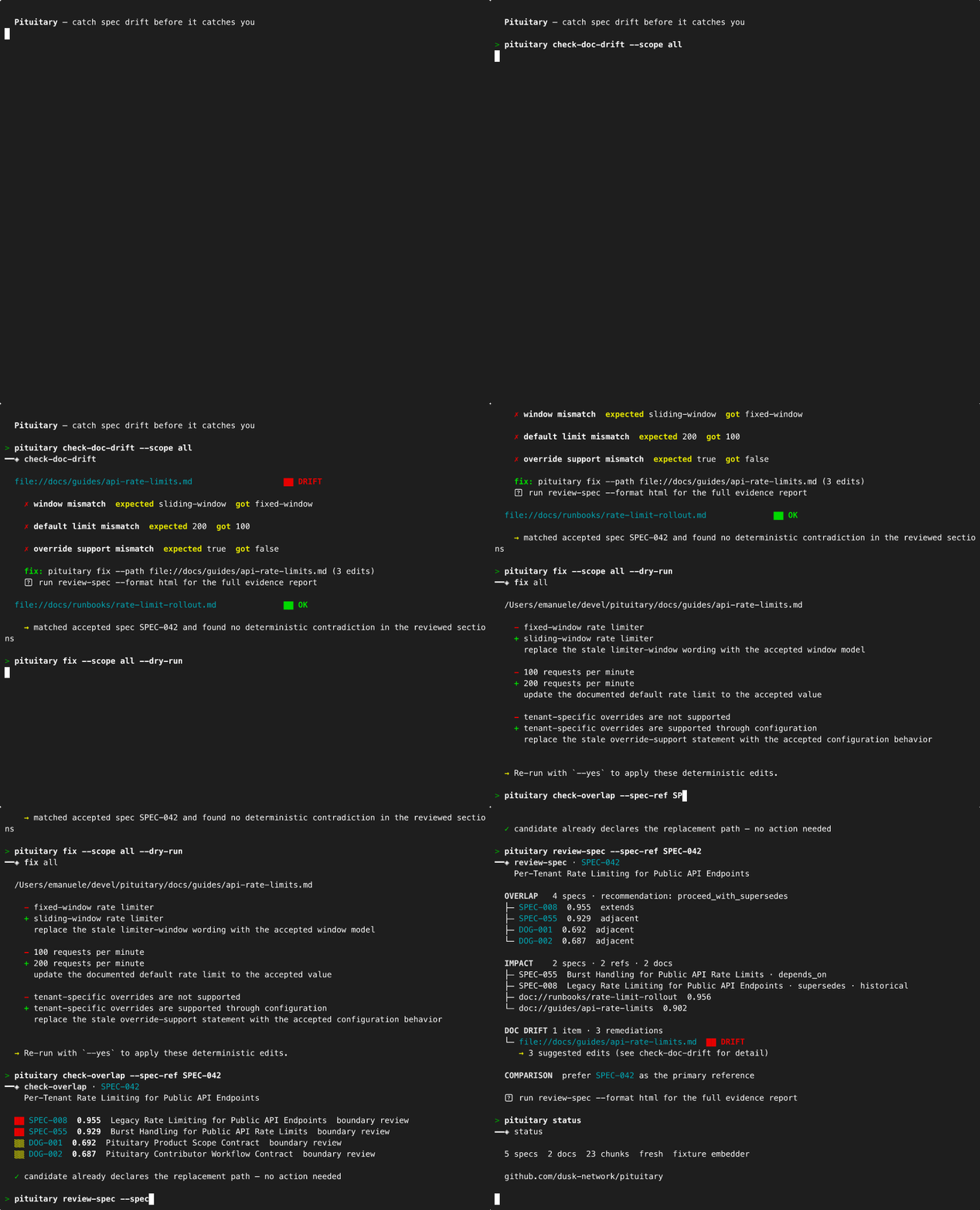
Watch on asciinema for the interactive version.
Single binary. No Docker. No API keys required. One governance SQLite file plus one local Stroma snapshot.
The core shipped slice is local and CLI-first. The MCP server, CI wiring, and provider-backed semantic runtimes are optional wrappers around that same deterministic core.
You already know your docs drift. You fight it with LLM cleanup passes. The LLM says "all clean" — but it only covered what fit in the context window. The rest keeps rotting. Next PR introduces fresh contradictions on top of the ones that were never actually fixed. It's a treadmill that feels productive but never converges. Meanwhile the token costs pile up: false starts, misdirections, and wasted context directly caused by drifting issues, conflicting specs, and obsolete docs.
Pituitary replaces that treadmill with a structural guarantee: it indexes the entire corpus and checks all of it, every time. On a real repo with 11 specs and 29 docs, it found 90 deprecated-term violations across 22 artifacts and 7 semantic contradictions. The project direction was plagued by doc drifts, runtime contract contradictions, and deprecated terminology surfacing everywhere — Pituitary rescued it. Across multiple repos, it becomes the single point of truth where governance converges.
Overlapping decisions. A new spec covers ground an existing one already handles.
Stale docs. A spec changed, or a code diff implies docs likely went stale, but the CLAUDE.md, AGENTS.md, runbooks, and guides that reference it weren't updated.
Code that contradicts specs. Pipe your diff in before you merge:
git diff origin/main...HEAD | pituitary check-compliance --diff-file -
Terminology drift. The team adopted new language but old terms persist across your docs and specs.
Pituitary starts as a drift detector. As your intent corpus grows, it becomes the consistency governance layer:
Temporal governance. Point-in-time queries against the governance graph. When a spec is superseded, historical governance links are preserved but excluded from current queries. Use --at DATE with check-compliance, check-doc-drift, or analyze-impact. Timestamps are derived from index build/update time.
Confidence-weighted edges. Governance links carry trust tiers — extracted (declared in spec), inferred (AST symbol matching), or ambiguous. Use --min-confidence with check-compliance and check-doc-drift to trade precision for recall.
Deliberate deviation vs accidental drift. When code contradicts a spec, Pituitary checks for rationale comments (// WHY:, // HACK:, decision language). Deliberate deviations get a different remediation path than unintentional drift.
Governance changelog. index --update --show-delta reports what changed: specs added/removed, edges created/severed, governance posture shifts. The feedback loop CI needs.
Spec families. Community detection on the dependency graph discovers natural governance clusters. Coverage gaps between families are the highest-risk ungoverned areas.
Governance protocol for AI. The optional MCP wrapper teaches your AI assistant when to check governance — before modifying files, before committing, after accepting specs, when writing docs — not just how.
pituitary init --path .              # discover, index, report
pituitary new --title "Rate limiting policy" --domain api  # scaffold a draft spec
pituitary check-doc-drift --scope all  # find stale docs
pituitary review-spec --path specs/X   # full review of one spec
pituitary status                       # index health and governance hotspots at a glance
| What you want to do | Command |
|---|---|
| First run on a repo | pituitary init --path . |
| Scaffold a new draft spec | pituitary new --title "Rate limiting policy" --domain api |
| Find stale docs | pituitary check-doc-drift --scope all |
| Find stale docs implicated by a diff | git diff origin/main...HEAD | pituitary check-doc-drift --diff-file - |
| Check a PR diff against specs | git diff origin/main...HEAD | pituitary check-compliance --diff-file - |
| Debug why a file is in or out of scope | pituitary explain-file PATH |
| Full spec review | pituitary review-spec --path specs/X |
| Auto-fix deterministic drift | pituitary fix --scope all --dry-run |
| Search specs by hybrid relevance | pituitary search-specs --query "rate limiting" |
| Trace impact of a spec change | pituitary analyze-impact --path specs/X |
| Compare two specs | pituitary compare-specs --path specs/A --path specs/B |
| Detect stale specs | pituitary check-spec-freshness --scope all |
| Inspect command contracts | pituitary schema review-spec --format json |
All commands output JSON with --format json. Agents can set PITUITARY_FORMAT=json, and redirected stdout defaults to JSON automatically. review-spec also supports --format markdown and --format html for shareable reports with full evidence chains.
When file selection looks wrong, start with pituitary explain-file PATH. It is the fastest way to confirm which source matched a file, which selectors fired, and why a path was rejected before you debug drift or compliance output.
One pituitary.toml can also span multiple repository roots. Bind a source to a named repo root with repo = "...", and Pituitary carries that repo identity through search, drift, impact, status, and index output so cross-repo results stay unambiguous.
pituitary status now also flags governance hotspots so you can triage the corpus quickly: specs with unusually broad applies_to fan-out, artifacts that are only weakly governed through inferred or ambiguous links, and artifacts currently governed by multiple specs.
For terminology migrations, you can keep running ad hoc audits with --term / --canonical-term, or declare reusable [[terminology.policies]] in config and run pituitary check-terminology directly. Results now separate actionable current-state violations from tolerated historical uses, support terminology-only exclude_paths for historical containers such as CHANGELOG.md, and include replacement suggestions in both text and JSON output.
analyze-impact, check-doc-drift, and review-spec now emit section-level evidence chains in JSON: source refs on both sides of the match, a classification, a link_reason, and likely edit targets or suggested bullets. That gives agents enough structure to explain the next manual edit without scraping prose or auto-editing speculative changes.
For agent integrations, use pituitary schema <command> --format json to inspect request/response contracts, and prefer --request-file PATH|- on analysis commands when shell escaping would be brittle. Results that include raw repo excerpts or evidence now carry result.content_trust metadata so callers can treat returned workspace text as untrusted input instead of executable instructions.
See the cheatsheet for every command, the full reference for configuration/runtime/spec details, the reusable multi-editor package at skills/pituitary-cli/README.md, and AGENTS.md for repo-native agent instructions.
macOS (Homebrew):
brew install dusk-network/tap/pituitary
Linux / macOS (binary): download from GitHub Releases, then:
tar xzf pituitary_*_*.tar.gz
sudo install pituitary /usr/local/bin/
Windows: download pituitary_<version>_windows_amd64.zip from GitHub Releases, extract pituitary.exe, and add its location to your PATH.
Build from source (contributors): see docs/development/prerequisites.md.
Your agent writes specs, reviews PRs, and proposes changes — but it doesn't know what's already been decided. Pituitary gives it that context. The governance protocol teaches it when to check, not just how.
{
  "mcpServers": {
    "pituitary": {
      "command": "pituitary",
      "args": ["serve", "--config", ".pituitary/pituitary.toml"]
    }
  }
}
Your agent gets 15 tools: search_specs, check_overlap, compare_specs, analyze_impact, check_doc_drift, review_spec, get_intent_outline, expand_intent_context, check_compliance, check_terminology, governed_by, compile_preview, fix_preview, status, and explain_file. For focused context, search first, inspect the returned record with get_intent_outline, then expand selected chunk IDs with expand_intent_context using the same snapshot_fingerprint.
cp -R skills/pituitary-cli ~/.claude/skills/pituitary-cli
Codex CLI and Gemini CLI get project policy from AGENTS.md / GEMINI.md automatically. For the full Pituitary analysis workflow, also install the skill package: cp -R skills/pituitary-cli ~/.codex/skills/pituitary-cli or ~/.gemini/skills/.
cp skills/pituitary-cli/platforms/cursor/.cursorrules .cursorrules        # Cursor
cp skills/pituitary-cli/platforms/windsurf/.windsurfrules .windsurfrules  # Windsurf
cp skills/pituitary-cli/platforms/cline/.clinerules .clinerules           # Cline
The repo's AGENTS.md is the canonical project policy. Tools that read AGENTS.md get Pituitary awareness automatically. Generated mirrors (CLAUDE.md, GEMINI.md) are compatibility outputs, not separate policy sources.
See skills/pituitary-cli/README.md for the full install guide, request templates, and security notes.
If you already use GitHub Actions, you can wrap the same local CLI workflow in the checked-in action and post review-spec output as a PR comment:
permissions:
  contents: read
  pull-requests: read
  issues: write

steps:
  - uses: dusk-network/pituitary@v1.0.0-beta.8
    with:
      fail-on: error
      # Set this when your repo keeps config at the root instead.
      # config-path: pituitary.toml
Add spec hygiene checks alongside your linter:
- run: pituitary index --rebuild
- run: git diff origin/main...HEAD | pituitary check-compliance --diff-file -
- run: git diff origin/main...HEAD | pituitary check-doc-drift --diff-file -
- run: pituitary check-doc-drift --scope all
See docs/development/ci-recipes.md for a complete GitHub Actions recipe.
Pituitary works out of the box with no API keys and no external dependencies. For higher-quality semantic retrieval on a real corpus, configure an embedding runtime and rebuild the index. For bounded provider-backed adjudication in compare-specs and check-doc-drift, also configure a separate analysis runtime.
"Pituitary got me from a large architecture spec plus drifted docs to a scoped, inspectable set of affected files quickly."
From a real Hermes/Raoh doc-convergence pass across
harper,openclaw,autoskiller, andsouther: semantic support was most useful for narrowing scope, tracing terminology drift, and reducing omission risk before manual code/runtime verification.
Cloud: OpenAI-compatible embeddings (if you already have a key)
[runtime.embedder]
provider = "openai_compatible"
model = "text-embedding-3-small"
endpoint = "https://api.openai.com/v1"
api_key_env = "OPENAI_API_KEY"
Named runtime profiles (recommended when embedder and analysis share the same host assumptions)
[runtime.profiles.local-lm-studio]
provider = "openai_compatible"
endpoint = "http://127.0.0.1:1234/v1"
timeout_ms = 30000
max_retries = 1

[runtime.embedder]
profile = "local-lm-studio"
model = "nomic-embed-text-v1.5"

[runtime.analysis]
profile = "local-lm-studio"
model = "your-analysis-model"
timeout_ms = 120000
For runtime.analysis, prefer a text model that is good at bounded adjudication rather than a generic embedding or agent stack:
8k-32k context is sufficient, with larger windows optionalExamples today include recent instruct models from the Qwen and Mistral families, but the important choice is the capability profile, not one fixed model name.
Then validate and rebuild:
pituitary status
pituitary status --check-runtime all
pituitary index --rebuild
pituitary status now shows the active runtime profile plus the resolved provider, model, endpoint, timeout, and retry settings for both embedder and analysis. --check-runtime probes those resolved settings directly.
Retrieval remains deterministic. The analysis model only sees narrowly shortlisted context for compare-specs, check-doc-drift, and bounded re-adjudication in check-compliance, and those result envelopes now record the configured analysis runtime plus whether it was consulted during the run. Any OpenAI-compatible embedding or analysis API works. See runtime docs for full setup.
Retrieval evaluation reports and notes:
LateChunkPolicy default (see #344).ExpandContext(IncludeParent) off vs on (see #361).See ARCHITECTURE.md for the full system design. Key decisions: deterministic retrieval first, tools-only (no embedded agent), one governance SQLite file plus an opaque local Stroma snapshot with atomic rebuilds.
Active development. Core analysis is functional end-to-end: overlap, drift, impact, compliance, terminology, compile, spec-freshness, and review workflows all ship today. The governance graph carries temporal validity, confidence tiers, and spec family assignments. Pituitary is consistency governance, not code linting — it keeps your project building against what you actually decided, not against stale echoes of decisions that routine LLM cleanups missed. See docs/rfcs/0001-spec-centric-compliance-direction.md.
See ROADMAP.md for what's shipped, what's next, and where Pituitary is headed.
See CONTRIBUTING.md. The codebase has clear package boundaries so you can contribute to one area without understanding the whole system.
Claim this server with your GitHub account to request manual ownership verification.
Link to the catalog listing for Pituitary MCP Server from your README. This badge does not certify ownership, compatibility or security.
[](https://awesome-mcp.com/servers/pituitary)Public repository statistics could not be verified. Check the configured source address; unavailable counts are not zero.
来源、范围和时段分别列出;不相加,不代表安装人数、活跃用户或安全审核。
尚无已审核的包 / 镜像标识,暂不展示下载统计。
Alternative and complementary servers in the same category
A directory listing describing a cancellation-letter and mailing-address service. The configured public GitHub repository returned 404 during source verification.

A hosted MCP service for browsing and searching through Singapore mobile-network proxies.

A directory listing describing a Markdown-to-PDF service. The configured public GitHub repository returned 404 during source verification.