
Store and retrieve entities, relations and observations in a persistent local knowledge graph.
create_entitiescreate_relationsadd_observations+6 more
92K
AI & Multi-Agent
An MCP server that adds statistical verification of tool-calling LLM outputs via Similarity-Distance-Magnitude estimators, with locally updatable calibration.
Reexpress MCP Server is cataloged as an MCP server attributed to reexpressai. An MCP server that adds statistical verification of tool-calling LLM outputs via Similarity-Distance-Magnitude estimators, with locally updatable calibration. It is categorized under ai agents-models. See the capability inspector for recorded interfaces and their independent review status; consult upstream documentation for the current interface.
Installation configuration is not reviewed. No executable setup is offered for this entry; inspect the source repository before proceeding.
Catalog license label: Not specified. Check the source repository's current license and terms before using, modifying or distributing this software.
能力定义尚未审核。未核验的采集内容不会作为可信接口展示。
暂无可展示的已审核记录。这不表示上游不支持此能力。
暂无可展示的已审核记录。这不表示上游不支持此能力。
暂无可展示的已审核记录。这不表示上游不支持此能力。
Email delivery is not connected. This page does not collect email addresses or create subscriptions.
Browse the registry for current listings instead.
Reviews for Reexpress MCP Server are not available yet
Review publishing and storage are not connected. This page does not collect or publish ratings or comments, including after sign-in.
The SDM estimator processing runs locally, while data is sent via standard LLM API calls to Azure/OpenAI and Google.
Yes, calling the ReexpressAddTrue or ReexpressAddFalse tools after a verification lets future Reexpress calls take your updates into account.
It runs on Linux and macOS and requires the ability to locally run a small 3 million parameter PyTorch model, so compute requirements are minimal.
README.md · 2727613470f5 · 采集于 2026-11-13 10:23:11 UTC
保留上游原文,不做 AI 改写。为安全起见过滤脚本、表单和不安全链接。
当前显示最后一次成功采集的文档快照,请以来源页面为准。
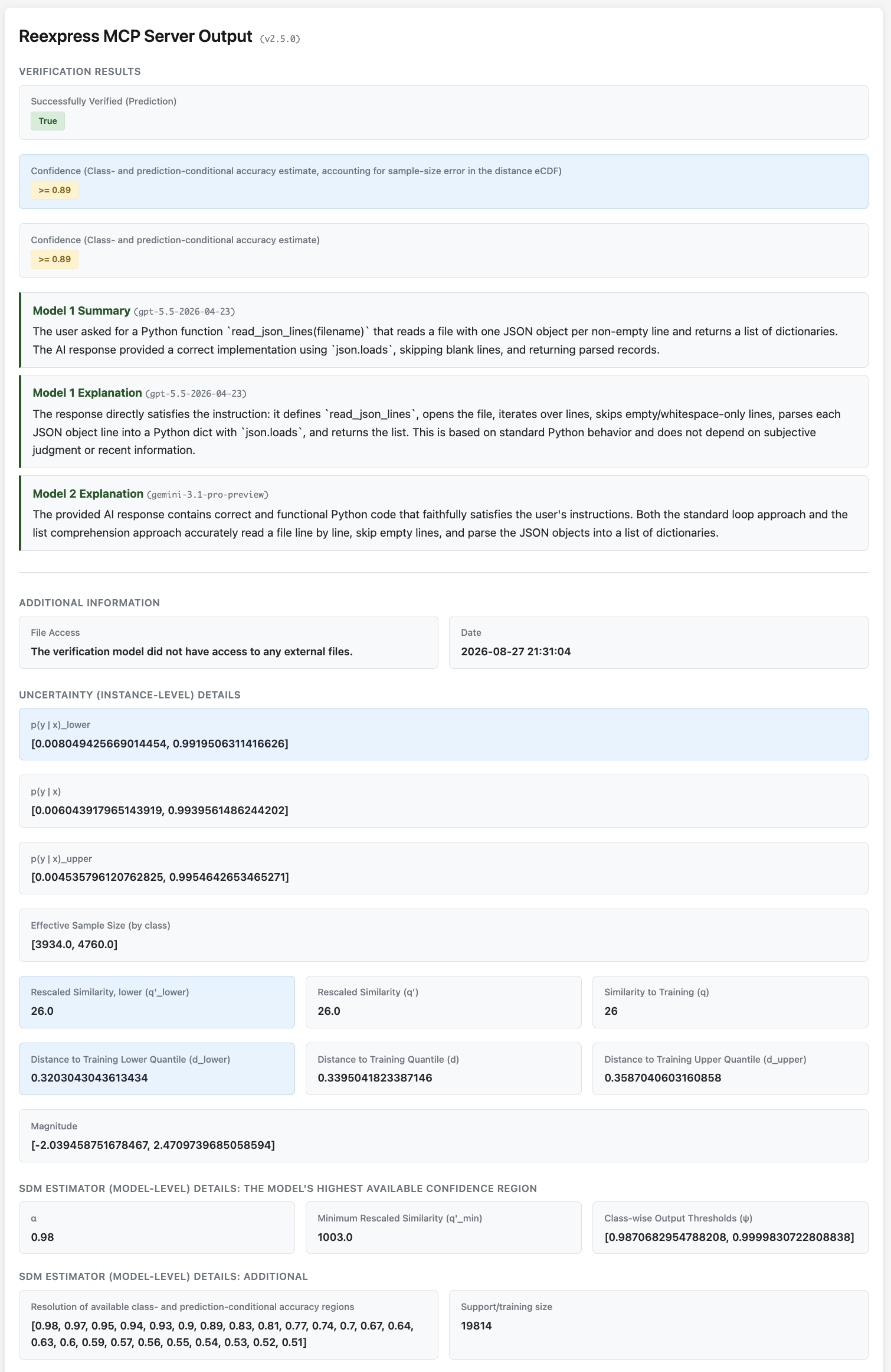

Reexpress MCP Server is a drop-in solution to add state-of-the-art statistical verification to your complex LLM pipelines, as well as your everyday use of LLMs for search and QA for software development and data science settings. It's the first reliable, statistically robust AI second opinion for your AI workflows.
Simply install the MCP server and then add the Reexpress prompt to the end of your chat text. The tool-calling LLM (e.g., Anthropic's LLM model Claude Fable 5) will then check its response with the provided pre-trained Reexpress Similarity-Distance-Magnitude (SDM) estimator, which ensembles gpt-5.5-2026-04-23, gemini-3.1-pro-preview, and gemini-embedding-2, along with the output from the tool-calling LLM, and calculates a robust estimate of the predictive uncertainty against a database of training and calibration examples from the OpenVerification1 dataset. Unique to the Reexpress method, you can easily adapt the model to your tasks: Simply call the ReexpressAddTrue or ReexpressAddFalse tools after a verification has completed, and then future calls to the Reexpress tool will dynamically take your updates into consideration when calculating the verification probability. We also include the training scripts for the model, so that you can run a full retraining when more substantive changes are needed, or you want to use alternative underlying LLMs.
[!NOTE] In addition to providing you (the user) with a principled estimate of confidence in the output given your instructions, the tool-calling LLM itself can use the verification output to progressively refine its answer, determine if it needs additional outside resources or tools, or has reached an impasse and needs to ask you for further clarification or information. That's what we call reasoning with SDM verification --- an entirely new capability in the AI toolkit that we think will open up a much broader range of use-cases for LLMs and LLM agents, for both individuals and enterprises.
Data is only sent via standard LLM API calls to Azure/OpenAI and Google, with the gemini-3.1-pro-preview calls given standard web search access through the API; all of the processing for the SDM estimator is done locally on your computer. Reexpress MCP has a simple and conservative, but effective, file access system: You control which additional files (if any) get sent to the LLM APIs by explicitly specifying files via the file-access tools ReexpressDirectorySet() and ReexpressFileSet().
The version 2.5.0 release implements nested estimators as described in Research Note: Nested Similarity-Distance-Magnitude Estimators. This approach simply runs the calibration algorithm for descending probability thresholds on the class- and prediction-condition accuracy. The result is that rather than a single region, the vast majority of calibration points can be assigned to a region with a class- and prediction-condition accuracy estimated to be at least some value greater than 0.5. The remaining points not assigned to any region can be viewed as effectively out-of-distribution. The most conservative region retains its interpretation and behavior as before, and we find that the nested regions provide a meaningful ranking for adjudicating the relative probability of the remaining points.
Additionally, the code base has been streamlined, with the language model post-training code removed. A separate repo will be released for fine-training the underlying weights of networks.
The released model is otherwise the same as version 2.4.x. It is calibrated using the same data and with gpt-5.5-2026-04-23 and gemini-3.1-pro-preview as the generative models. Refer to the Version 2.4.0 model card for details.
Additional notes in changelog.md.
The MCP server runs on Linux and macOS. The primary requirement is that the machine running the MCP server needs to be able to locally run a small 3 million parameter PyTorch model, so the compute requirements are minimal. (That is as written: Only 3 million parameters; not 3 billion parameters. The model consists of an SDM activation over gemini-embedding-2 and the classification output of the two API language models.)
See INSTALL.md.
[!TIP] The Reexpress MCP server is straightforward to setup relative to other MCP servers, but we assume some familiarity with LLMs, MCP, and command-line tools. Our target audience is developers and data scientists. Only add other MCP servers from sources that you trust, and keep in mind that other MCP tools could alter the behavior of our MCP server in unexpected ways.
See CONFIG.md.
See documentation/HOW_TO_USE.md.
See documentation/OUTPUT_HTML.md.
See documentation/GUIDELINES.md.
See documentation/FAQ.md.
A copy of our system demonstration paper "Introspectable, Updatable, and Uncertainty-aware Classification of Language Model Instruction-following", which focuses in particular on version 2.1.0 of the Reexpress MCP Server, is included here. The support scripts to replicate the analysis are included here.
The model card for version 2.4.0, which highlights the changes since the system demonstration paper, is available here.
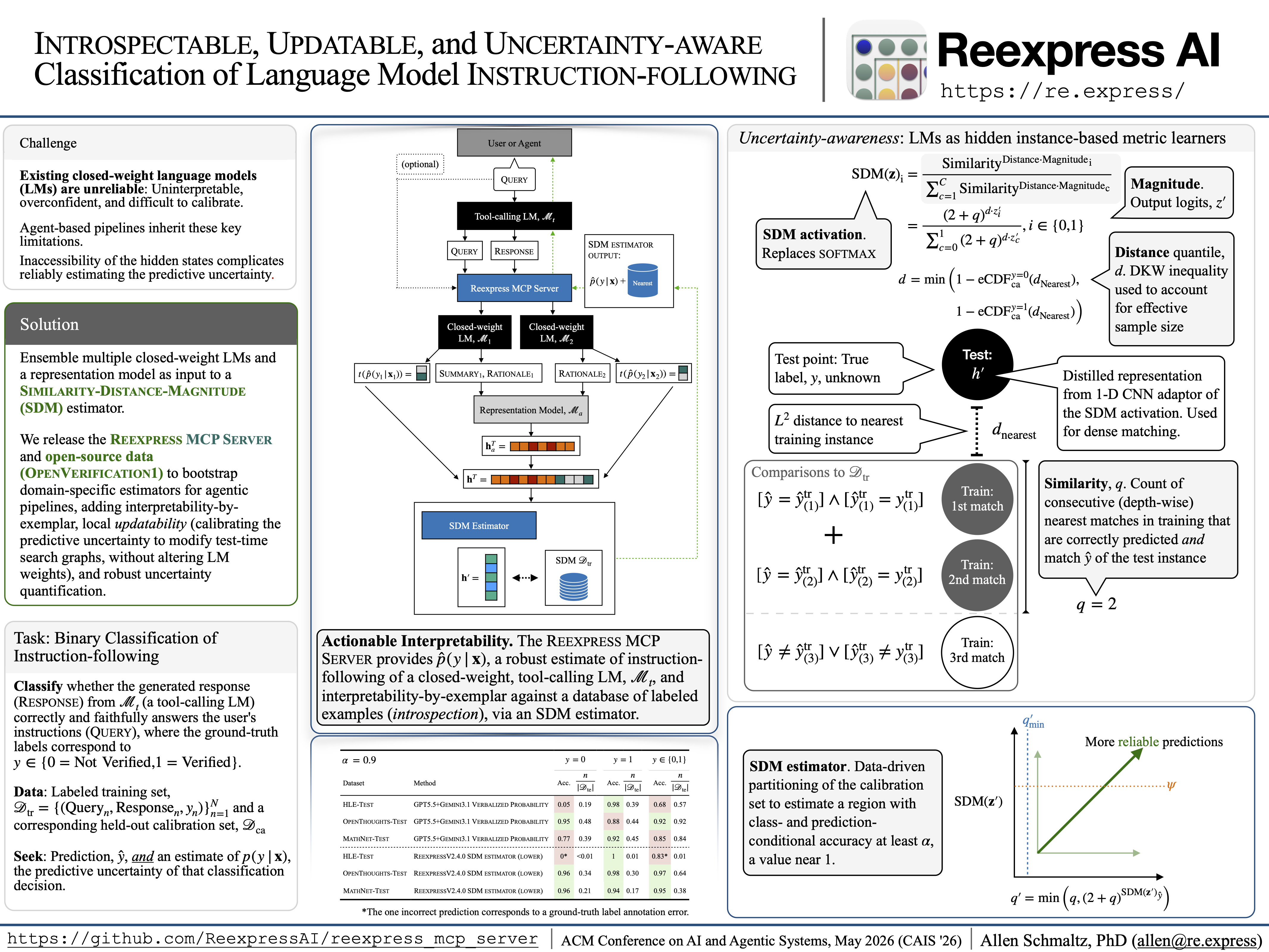
If you find this software useful, consider citing the following peer-reviewed papers:
@inproceedings{Schmaltz-2026-SimilarityDistanceMagnitudeActivations,
    title = "Similarity-Distance-Magnitude Activations",
    author = "Schmaltz, Allen",
    editor = "Liakata, Maria  and
      Moreira, Viviane P.  and
      Zhang, Jiajun  and
      Jurgens, David",
    booktitle = "Findings of the {A}ssociation for {C}omputational {L}inguistics: {ACL} 2026",
    month = jul,
    year = "2026",
    address = "San Diego, California, United States",
    publisher = "Association for Computational Linguistics",
    url = "https://aclanthology.org/2026.findings-acl.1109/",
    doi = "10.18653/v1/2026.findings-acl.1109",
    pages = "22037--22057",
    ISBN = "979-8-89176-395-1",
    abstract = "We introduce the Similarity-Distance-Magnitude (SDM) activation function, a more robust and interpretable formulation of the standard softmax activation function, adding Similarity (i.e., correctly predicted depth-matches into training) awareness and Distance-to-training-distribution awareness to the existing output Magnitude (i.e., decision-boundary) awareness, and enabling interpretability-by-exemplar via dense matching. We further introduce the SDM estimator, based on a data-driven partitioning of the class-wise empirical CDFs via the SDM activation, to control the class- and prediction-conditional accuracy among selective classifications. When used as the final-layer activation over pre-trained language models for selective classification, the SDM estimator is more robust to covariate shifts and out-of-distribution inputs than existing calibration methods using softmax activations, while remaining informative over in-distribution data."
}
@inproceedings{Schmaltz-2026-ReexpressMCPServer,
    author = {Schmaltz, Allen},
    title = {Introspectable, Updatable, and Uncertainty-aware Classification of Language Model Instruction-following},
    year = {2026},
    isbn = {9798400724152},
    publisher = {Association for Computing Machinery},
    address = {New York, NY, USA},
    url = {https://doi.org/10.1145/3786335.3813214},
    doi = {10.1145/3786335.3813214},
    abstract = {In this system demonstration paper, we introduce an open-source implementation for training and testing Similarity-Distance-Magnitude (SDM) estimators for the task of binary classification of instruction-following of closed-weight language models (LMs). This SDM estimator provides an approximately conditional estimate of the predictive uncertainty over instruction-following, conditional on multiple closed-weight LMs and the representation space of an open-weight model. While it would be more robust to use as input to the SDM estimator the hidden-states of the underlying models, this indirect, compositional proxy is more reliable than verbalized uncertainty and adds a means of auditing the predictions against data with known labels. We release the code as an MCP Server to simplify adding interpretability-by-exemplar and locally updatable, uncertainty-aware instruction-following to agent-based pipelines. We further release OpenVerification1, a balanced set of over two million examples of instruction-following and associated rationales from recent closed-weight LMs, for bootstrapping domain-specific estimators. Finally, we discuss limitations of estimating the predictive uncertainty without access to the hidden-states of the tool-calling LM and provide practical guidance for applications.},
    booktitle = {Proceedings of the ACM Conference on AI and Agentic Systems},
    pages = {1259–1269},
    numpages = {11},
    keywords = {Approximately conditional calibration, Interpretability-by-exemplar, Classification of instruction-following, Model ensembles},
    location = {
    },
    series = {CAIS '26}
}
The output format has changed since v1.0.0 used in the video. See changelog.md. ↩
Claim this server with your GitHub account to request manual ownership verification.
Link to the catalog listing for Reexpress MCP Server from your README. This badge does not certify ownership, compatibility or security.
[](https://awesome-mcp.com/servers/reexpress_mcp_server)Public repository statistics could not be verified. Check the configured source address; unavailable counts are not zero.
来源、范围和时段分别列出;不相加,不代表安装人数、活跃用户或安全审核。
尚无已审核的包 / 镜像标识,暂不展示下载统计。
Alternative and complementary servers in the same category
Store and retrieve entities, relations and observations in a persistent local knowledge graph.
Organize problem solving into revisable, branching thought steps through an MCP tool.

Query-aware context compression with an MCP plugin for coding agents, plus Python and HTTP interfaces for reducing the context sent to a language model.