
A directory listing describing a cancellation-letter and mailing-address service. The configured public GitHub repository returned 404 during source verification.
Repository stats unavailable
Developer Tools
Semble runs as an MCP server so agents can search local or remote codebases with natural-language or code queries, returning only relevant code chunks.
Semble: fast code search MCP server for agents is cataloged as an MCP server attributed to minishlab. Semble runs as an MCP server so agents can search local or remote codebases with natural-language or code queries, returning only relevant code chunks. It is categorized under developer tools. See the capability inspector for recorded interfaces and their independent review status; consult upstream documentation for the current interface.
Installation configuration is not reviewed. No executable setup is offered for this entry; inspect the source repository before proceeding.
Catalog license label: MIT. Check the source repository's current license and terms before using, modifying or distributing this software.
能力定义尚未审核。未核验的采集内容不会作为可信接口展示。
暂无可展示的已审核记录。这不表示上游不支持此能力。
暂无可展示的已审核记录。这不表示上游不支持此能力。
暂无可展示的已审核记录。这不表示上游不支持此能力。
Email delivery is not connected. This page does not collect email addresses or create subscriptions.
Browse the registry for current listings instead.
Reviews for Semble: fast code search MCP server for agents are not available yet
Review publishing and storage are not connected. This page does not collect or publish ratings or comments, including after sign-in.
No. Everything runs on CPU with no API keys, GPU, or external services required.
Yes. Running the server in HTTP mode lets one server be shared across agent sessions.
Searches can target code, docs, config, or all content types.
README.md · a1ba6c18a4b0 · 采集于 2026-11-13 11:27:24 UTC
保留上游原文,不做 AI 改写。为安全起见过滤脚本、表单和不安全链接。
当前显示最后一次成功采集的文档快照,请以来源页面为准。



Quickstart • CLI • MCP Server • Installation • Benchmarks
Semble is a code search library built for agents. It returns the exact code snippets they need instantly, using ~99% fewer tokens than grep+read. Indexing and searching a full codebase end-to-end takes under a second for most repos, matching the retrieval quality of a code-specialized transformer while indexing ~480x faster and querying ~23x faster (see benchmarks). Everything runs on CPU with no API keys, GPU, or external services. Use it as an MCP server, a CLI tool via AGENTS.md, or a dedicated sub-agent, and any coding agent (Claude Code, Cursor, Codex, OpenCode, etc.) gets instant access to any repo.
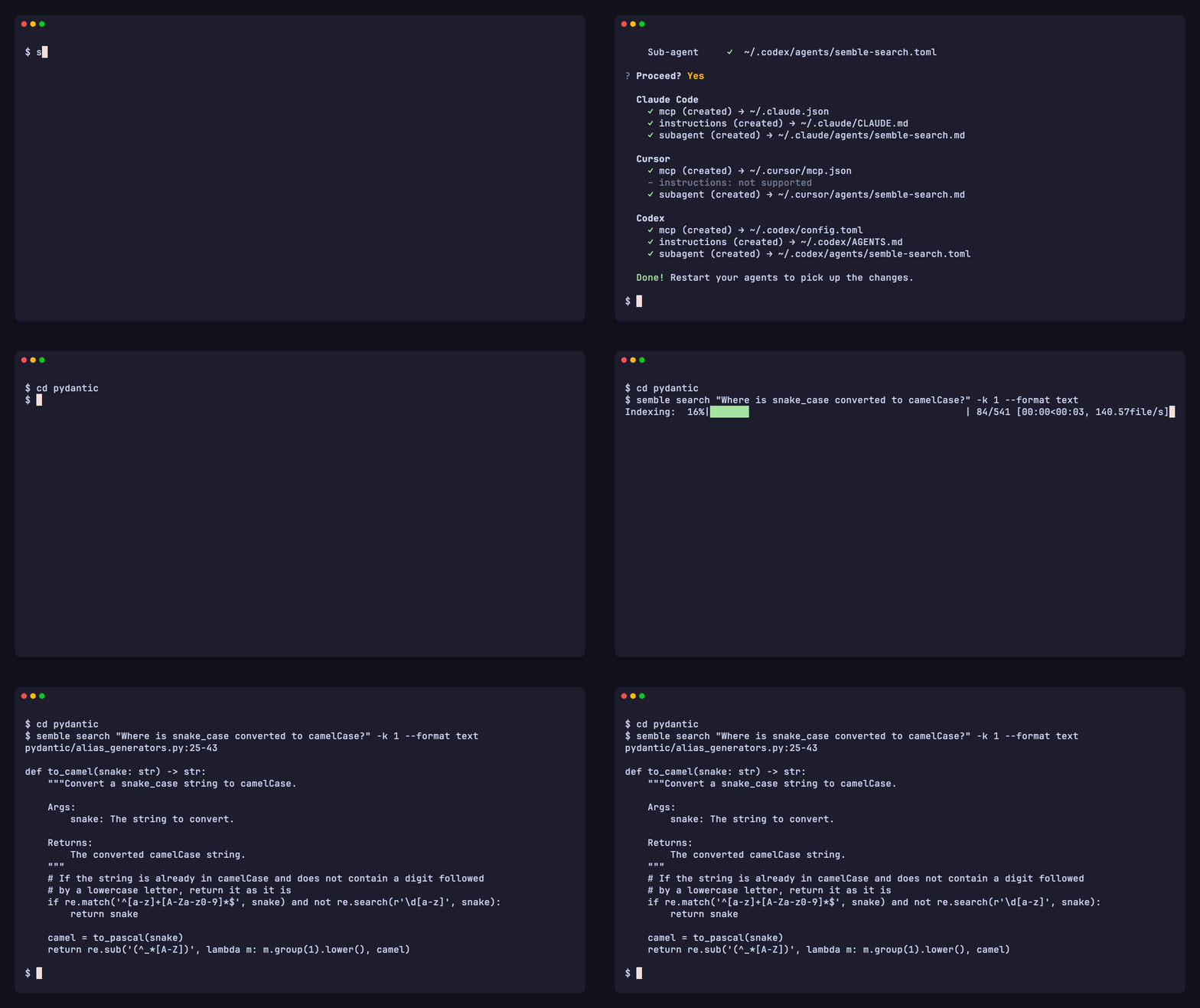
Your agent queries Semble in natural language (e.g. "How is authentication handled?") and gets back only the relevant code snippets, without grepping or reading full files.
The fastest way to get started is the interactive installer. Install uv, then run:
uv tool install semble
semble install
semble install detects installed coding agents such as Claude Code, Codex, and OpenCode, and then lets you choose which integrations to enable:
semble-search sub-agent.semble skill plus a one-line pointer to it in AGENTS.md / CLAUDE.md, instead of the full instructions.To undo the setup, run semble uninstall.
For manual setup instructions (MCP config per agent, AGENTS.md snippet, sub-agent files), see the installation docs.
uv tool upgrade semble   # upgrade
uv cache clean semble    # for MCP users (restart your MCP client after)
For sandboxed or scripted environments, skip the prompts with --agent and, optionally, --type:
semble install --agent claude --type mcp subagent --yes
--agent accepts one or more agent ids (e.g. claude, codex, pi); --type accepts mcp, instructions, subagent, skill, or all (default: all but skill); --yes skips the confirmation prompt (requires --agent for a fully non-interactive run).
Semble also ships as a standalone CLI. This is useful in scripts or anywhere you want search results without an MCP session. Indexes are built and cached on first run, and invalidated automatically when files change.
# Search a local repo (index is built and cached automatically)
semble search "authentication flow" ./my-project

# Search a remote repo (cloned on demand)
semble search "save model to disk" https://github.com/MinishLab/model2vec

# Search several repos at once (results are prefixed with the repo name)
semble search "invoice endpoint" ./service-a ./service-b

# Limit results
semble search "save model to disk" ./my-project --top-k 10

# Search docs/config/everything instead of just code
semble search "deployment guide" ./my-project --content docs   # or: config, all

# Find code similar to a known location
semble find-related src/auth.py 42 ./my-project

# Show only the first N lines of each result's snippet (0 = path/line range only)
semble search "authentication flow" ./my-project --max-snippet-lines 10
--content accepts code (default), docs, config, or all. --format accepts json (default) or text. path defaults to the current directory when omitted; git URLs are accepted. If semble is not on $PATH, use uvx --from "semble[mcp]" semble in its place. semble --version (or -V) prints the installed version.
Passing several paths or URLs searches them as one corpus, so a query from repo A can find an endpoint defined in repo B. Each index is cached per repo and merged at query time. Result paths are prefixed with the repo name (service-b/api/invoices.py) and the output includes a repos map from prefix to absolute path or URL. Pass the prefixed path to find-related to search across all repos from a known location.
Semble reads .gitignore and .sembleignore files to determine which files to index. Both files use standard gitignore syntax and their patterns are merged. .sembleignore lets you add semble-specific rules without touching .gitignore. Rules are applied recursively, so a .sembleignore in a subdirectory applies to that subtree.
Excluding files: add patterns the same way you would in .gitignore:
# .sembleignore
generated/     # exclude generated dir
*.pb.go.       # exclude Go protobuf files
Including non-default extensions: prefix the extension pattern with ! to force-include files that semble wouldn't index by default:
# .sembleignore
!*.proto       # include Protobuf files
!*.cob         # include COBOL files
Run semble file-types to see which extensions are indexed per content type. Extensions not listed (including data files such as .json and .csv) are not indexed by default and can be force-included with a ! pattern as above.
Semble also always skips a set of well-known non-source directories regardless of ignore files (e.g. node_modules/, .venv/, dist/, build/, __pycache__/, and similar).
semble savings shows how many tokens semble has saved across all your searches:
semble savings
  Semble Token Savings
  ════════════════════════════════════════════════════════════════════════

  Total saved:  ~714.2M tokens  (94%)
  Total calls:  14.3k
  Efficiency:  ███████████████████████░  94%

  By Period
  ────────────────────────────────────────────────────────────────────────
  Period             Calls           Saved  Ratio
  ────────────────────────────────────────────────────────────────────────
  Today                198    ~1.4M tokens  ███████████████████████░  95%
  Last 7 days        13.1k  ~707.2M tokens  ███████████████████████░  94%
  All time           14.3k  ~714.2M tokens  ███████████████████████░  94%

  By Call Type
  ────────────────────────────────────────────────────────────────────────
  #     Call type            Calls  Share
  ────────────────────────────────────────────────────────────────────────
  1.    search               14.1k  ████████████████    99%
  2.    find_related           205  █░░░░░░░░░░░░░░░     1%
  ════════════════════════════════════════════════════════════════════════
Savings are calculated as follows: for each call, semble records the total character count of the unique files containing returned chunks and the character count of the snippets returned. Estimated tokens saved is (file chars − snippet chars) / 4 (4 chars per token). This is a conservative estimate: the baseline is reading matched files in full, which is how coding agents often explore unfamiliar code.
By default, your Semble savings statistics and any saved indexes are stored in the OS cache folder (~/Library/Caches/semble/ on macOS, ~/.cache/semble/ on Linux, %LOCALAPPDATA%\semble\Cache\ on Windows). To override this location you can supply an environment variable SEMBLE_CACHE_LOCATION which should be the full path to the target cache location e.g. ~/my-folder/my-caches/semble.
Files larger than 1 MB are skipped during indexing to keep index builds lean. Skipped files are reported as a warning at index time. If you work with large generated or ingested documents, you can raise (or lower) this limit with the SEMBLE_MAX_FILE_BYTES environment variable (in bytes).
On first use, Semble also downloads the embedding model from Hugging Face and caches it in the standard Hugging Face cache (~/.cache/huggingface/ by default, or $HF_HOME if set); this only happens once and requires network access.
Use semble clear to remove cached data: semble clear index (saved indexes), semble clear savings (usage stats), semble clear orphans (indexes for repos no longer present on disk), or semble clear all (everything).
Semble can also be used as a Python library for programmatic access, useful when building custom tooling or integrating search directly into your own code.
from semble import ContentType, SembleIndex

# Index a local directory (code only, the default)
index = SembleIndex.from_path("./my-project")

# Index docs and prose (markdown, rst, etc.)
index = SembleIndex.from_path("./my-project", content=ContentType.DOCS)

# Index everything (code, docs, and config)
index = SembleIndex.from_path("./my-project", content=[ContentType.CODE, ContentType.DOCS, ContentType.CONFIG])

# Index code and docs together
index = SembleIndex.from_path("./my-project", content=[ContentType.CODE, ContentType.DOCS])

# Index a remote git repository
index = SembleIndex.from_git("https://github.com/MinishLab/model2vec")

# Merge indexes from several repos into one (chunk paths are prefixed with the repo name)
index = SembleIndex.merge([("./service-a", SembleIndex.from_path("./service-a")), ("./service-b", SembleIndex.from_path("./service-b"))])

# Search the index with a natural-language or code query
results = index.search("save model to disk", top_k=3)

# Find code similar to a specific result
related = index.find_related(results[0], top_k=3)

# Each result exposes the matched chunk
result = results[0]
result.chunk.file_path   # "model2vec/model.py"
result.chunk.start_line  # 127
result.chunk.end_line    # 150
result.chunk.content     # "def save_pretrained(self, path: PathLike, ..."
When many files need indexing, the CLI and MCP server chunk them in 4 worker processes (SEMBLE_INDEX_WORKERS sets the number, 0 turns them off). In the Python API they are off by default. To turn them on, set SEMBLE_INDEX_WORKERS and call Semble from inside an if __name__ == "__main__": block, since each worker re-imports your script.
Semble runs as an MCP server so agents can search any codebase directly as a native tool call. Repos are indexed on demand and cached; local paths are re-indexed automatically on file changes.
| Tool | Description |
|---|---|
search | Search a codebase with a natural-language or code query. Pass repo as a local path or an https:// git URL (or a list of them to search several repos together) and content as code, docs, config, or all (default: code). |
find_related | Given a file path and line number, return chunks semantically similar to the code at that location. |
For per-agent setup instructions, see the installation docs. To share one server across agent sessions, run semble --http; see Shared server (HTTP).
We benchmark quality and speed across ~1,250 queries over 63 repositories in 19 languages (left), and token efficiency against grep+read at equivalent recall levels (right).
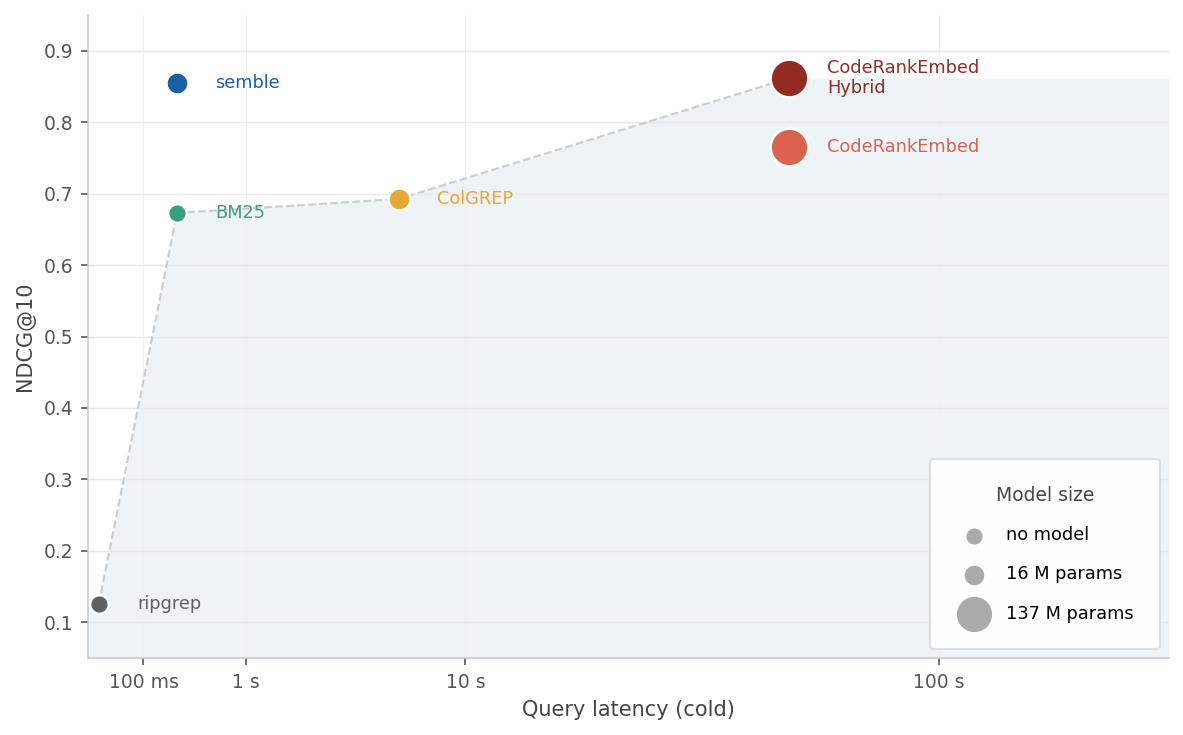 | 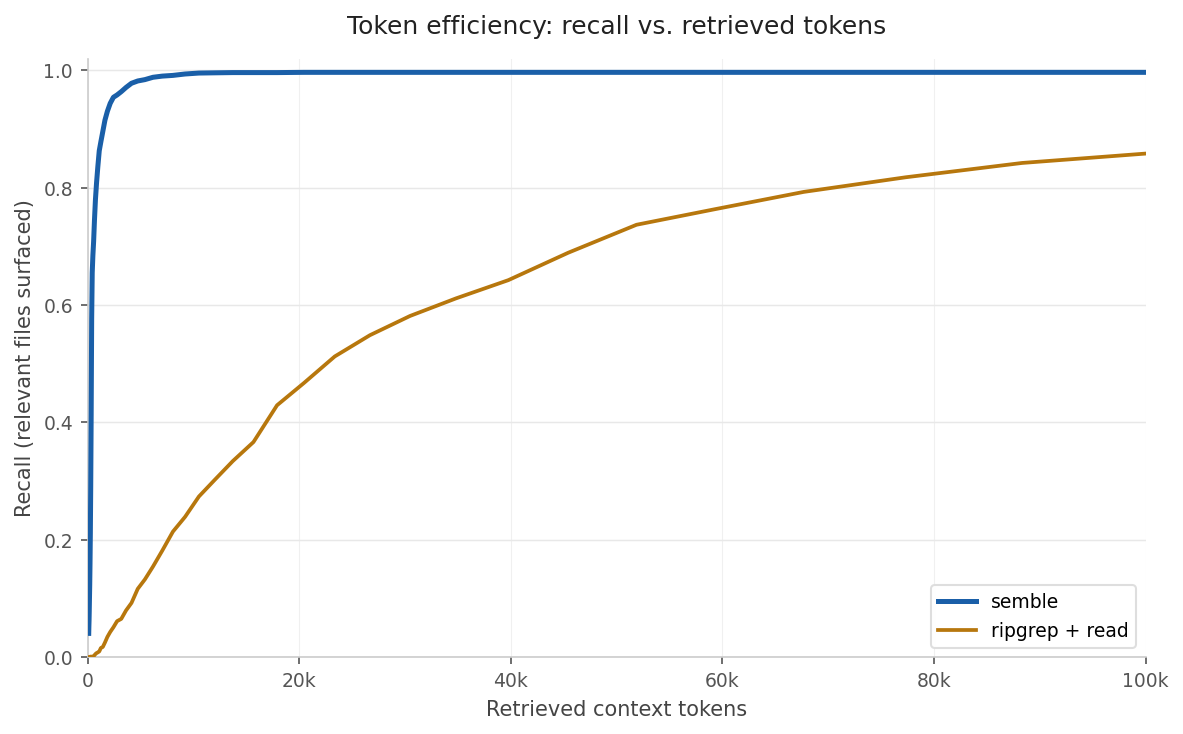 |
The quality benchmark (left) scores retrieval quality (NDCG@10) against total latency; semble matches the quality of the 137M-parameter CodeRankEmbed while indexing 480x faster. The token efficiency benchmark (right) measures how many tokens each method needs to reach a given recall level; semble uses 99% fewer tokens on average and hits 96% recall at only 2k tokens, while grep+read needs a full 100k context window to reach 85%. See benchmarks for per-language results, ablations, and full methodology.
Semble splits each file into code-aware chunks using tree-sitter, then scores every query against the chunks with two complementary retrievers: static Model2Vec embeddings using the code-specialized potion-code-16M-v2 model for semantic similarity, and BM25 for lexical matches on identifiers and API names. The two score lists are fused with Reciprocal Rank Fusion (RRF).
After fusing, results are reranked with a set of code-aware signals:
Foo::bar, _private, getUserById) get more lexical weight, while natural-language queries stay balanced between semantic and lexical retrievers.class, def, func, etc.) is ranked above chunks that merely reference it.parse config boosts chunks containing parseConfig, ConfigParser, or config_parser.compat//legacy/ shims, example code, and .d.ts declaration stubs are down-ranked so canonical implementations surface first.Because the embedding model is static with no transformer forward pass at query time, all of this runs in milliseconds on CPU.
Indexes are cached to disk automatically on the first search. On subsequent runs, Semble walks the file tree and compares modification times; added, removed, or changed files are reindexed incrementally, without rebuilding the rest of the index. A full rebuild only happens if the indexing settings change (e.g., after a semble upgrade that changes the model, chunking, or cache format). In MCP mode, the index is checked and refreshed automatically as files change, so results stay current across the session.
If you would like to use another model, you can set your SEMBLE_MODEL_NAME environment variable to a local path or Hugging Face repository. This path is read verbatim, and should contain a Model2Vec compatible model. This is particularly useful if you can't access Hugging Face at runtime.
Thanks to Greptile for providing free access to their AI code review platform.
MIT
If you use Semble in your research, please cite the following:
@software{minishlab2026semble,
  author       = {{van Dongen}, Thomas and Stephan Tulkens},
  title        = {Semble: Fast and Accurate Code Search for Agents},
  year         = {2026},
  publisher    = {Zenodo},
  doi          = {10.5281/zenodo.19785932},
  url          = {https://github.com/MinishLab/semble},
  license      = {MIT}
}
Claim this server with your GitHub account to request manual ownership verification.
Link to the catalog listing for Semble: fast code search MCP server for agents from your README. This badge does not certify ownership, compatibility or security.
[](https://awesome-mcp.com/servers/semble)Public repository statistics could not be verified. Check the configured source address; unavailable counts are not zero.
来源、范围和时段分别列出;不相加,不代表安装人数、活跃用户或安全审核。
尚无已审核的包 / 镜像标识,暂不展示下载统计。
Alternative and complementary servers in the same category
A directory listing describing a cancellation-letter and mailing-address service. The configured public GitHub repository returned 404 during source verification.

A hosted MCP service for browsing and searching through Singapore mobile-network proxies.

A directory listing describing a Markdown-to-PDF service. The configured public GitHub repository returned 404 during source verification.