
This is a Model Context Protocol (MCP) server for interacting with AIStor object stores.
Repository stats unavailable
Databases & Storage
A template PostgreSQL MCP server exposing query tools, schema resources and query-generation prompts.
Simple PostgreSQL MCP Server is cataloged as an MCP server attributed to netanelbollag. A template PostgreSQL MCP server exposing query tools, schema resources and query-generation prompts. It is categorized under databases storage. See the capability inspector for recorded interfaces and their independent review status; consult upstream documentation for the current interface.
Installation configuration is not reviewed. No executable setup is offered for this entry; inspect the source repository before proceeding.
Catalog license label: MIT. Check the source repository's current license and terms before using, modifying or distributing this software.
能力定义尚未审核。未核验的采集内容不会作为可信接口展示。
暂无可展示的已审核记录。这不表示上游不支持此能力。
暂无可展示的已审核记录。这不表示上游不支持此能力。
暂无可展示的已审核记录。这不表示上游不支持此能力。
Email delivery is not connected. This page does not collect email addresses or create subscriptions.
Browse the registry for current listings instead.
Reviews for Simple PostgreSQL MCP Server are not available yet
Review publishing and storage are not connected. This page does not collect or publish ratings or comments, including after sign-in.
No; the README calls it experimental, notes that it only checks that queries start with SELECT, and warns to be careful about SQL injection.
It connects using a PostgreSQL DSN and a schema name.
README.md · c66995f818f3 · 采集于 2026-11-13 09:46:18 UTC
保留上游原文,不做 AI 改写。为安全起见过滤脚本、表单和不安全链接。
当前显示最后一次成功采集的文档快照,请以来源页面为准。
This is a template project for those looking to build their own MCP servers. I designed it to be dead simple to understand and adapt - the code is straightforward with MCP docs attached so you can quickly get up to speed.
TL;DR - It's a way to write plugins for AI
Model Context Protocol (MCP) is a standard way for LLMs to interact with external tools and data. In a nutshell:
This PostgreSQL MCP server implements:
Tools
execute_query - Run SQL queries against your databasetest_connection - Verify the database connection is workingResources
db://tables - List of all tables in the schemadb://tables/{table_name} - Schema information for a specific tabledb://schema - Complete schema information for all tables in the databasePrompts
Create a virtual environment and install dependencies:
# Create a virtual environment with uv
uv venv

# Activate the virtual environment
source .venv/bin/activate  # On Windows: .venv\Scripts\activate

# Install dependencies
uv pip install -r requirements.txt
Run the server with the MCP Inspector:
# Replace with YOUR actual database credentials
npx @modelcontextprotocol/inspector uv --directory . run postgres -e DSN=postgresql://username:password@hostname:port/database -e SCHEMA=public
Note: If this is your first time running npx, you'll be prompted to approve the installation. Type 'y' to proceed.
After running this command, you'll see the MCP Inspector interface launched in your browser. You should see a message like:
MCP Inspector is up and running at http://localhost:5173
If the browser doesn't open automatically, copy and paste the URL into your browser. You should see something like this:
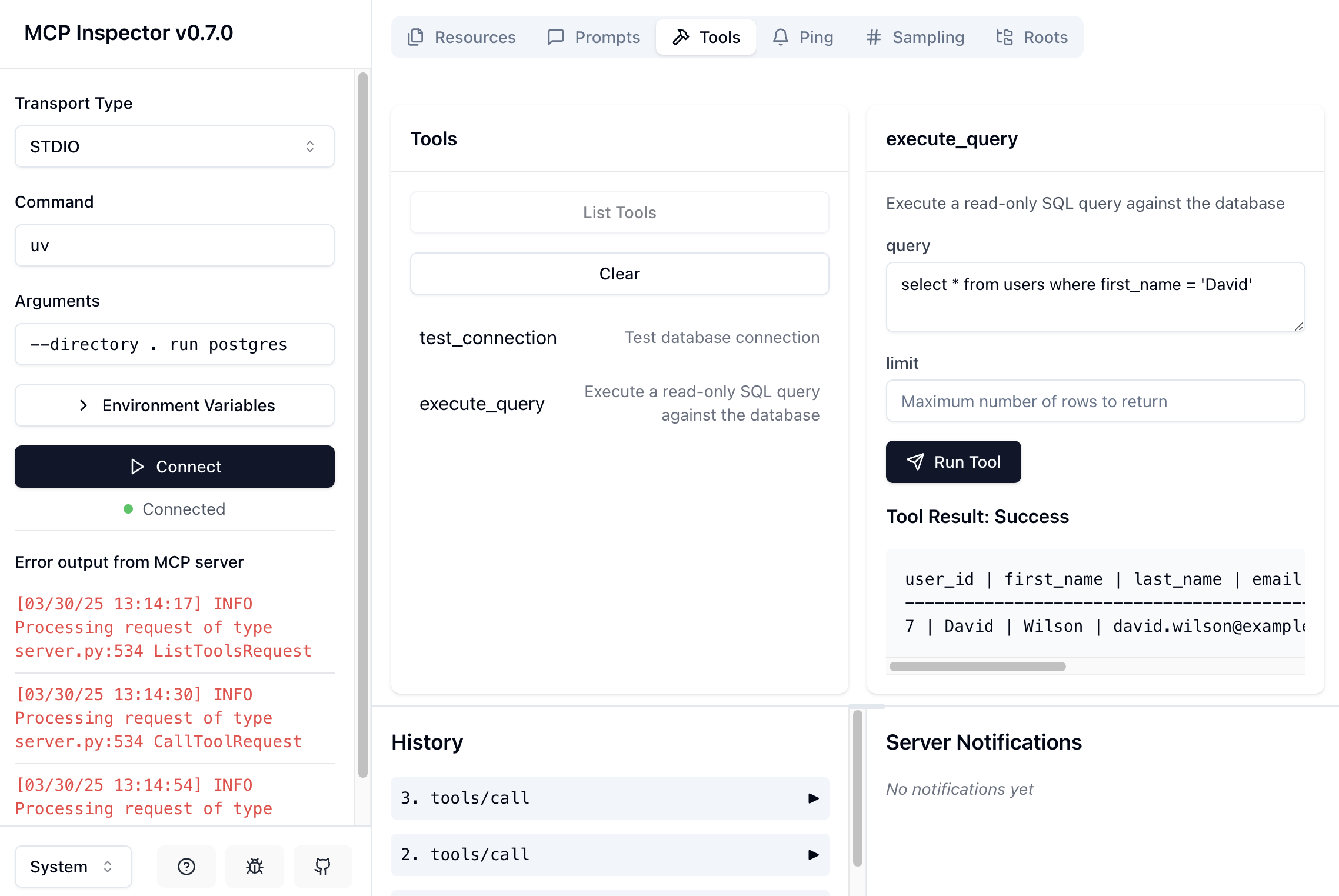
Using the Inspector:
Take a look at the official docs
Official server developers guide: https://modelcontextprotocol.io/quickstart/server
More on the inspector: https://modelcontextprotocol.io/docs/tools/inspector
You can configure the MCP server for your AI assistant by creating an MCP configuration file:
{
   "mcpServers": {
      "postgres": {
         "command": "/path/to/uv",
         "args": [
            "--directory",
            "/path/to/simple-psql-mcp",
            "run",
            "postgres"
         ],
         "env": {
            "DSN": "postgresql://username:password@localhost:5432/my-db",
            "SCHEMA": "public"
         }
      }
   }
}
Alternatively, you can generate this config file using the included script:
# Make the script executable
chmod +x generate_mcp_config.sh

# Run the configuration generator
./generate_mcp_config.sh
When prompted, enter your PostgreSQL DSN and schema name.
You can now ask the LLM questions about your data in natural language:
For testing, Claude Desktop supports MCP natively and works with all features (tools, resources, and prompts) right out of the box.
If you don't have a database ready or encounter connection issues, you can use the included example database:
# Make the script executable
chmod +x example-db/create-db.sh

# Run the database setup script
./example-db/create-db.sh
This script creates a Docker container with a PostgreSQL database pre-populated with sample users and addresses tables. After running, you can connect using:
npx @modelcontextprotocol/inspector uv --directory . run postgres -e DSN=postgresql://postgres:postgres@localhost:5432/user_database -e SCHEMA=public
To extend this project with your own MCP servers:
/src (e.g., /src/my-new-mcp)pyproject.toml:[project.scripts]
postgres = "src.postgres:main"
my-new-mcp = "src.my-new-mcp:main"
You can then run your new MCP with:
npx @modelcontextprotocol/inspector uv --directory . run my-new-mcp
This is an experimental project meant to empower developers to create their own MCP server. I did minimum to make sure it won't die immediately when you try it, but be careful - it's very easy to run SQL injections with this tool. The server will check if the query starts with SELECT, but beyond that nothing is guaranteed. TL;DR - don't run in production unless you're the founder and there are no paying clients.
MIT
Claim this server with your GitHub account to request manual ownership verification.
Link to the catalog listing for Simple PostgreSQL MCP Server from your README. This badge does not certify ownership, compatibility or security.
[](https://awesome-mcp.com/servers/simple-psql-mcp)Public repository statistics could not be verified. Check the configured source address; unavailable counts are not zero.
来源、范围和时段分别列出;不相加,不代表安装人数、活跃用户或安全审核。
尚无已审核的包 / 镜像标识,暂不展示下载统计。
Alternative and complementary servers in the same category
This is a Model Context Protocol (MCP) server for interacting with AIStor object stores.

A Model Context Protocol server that lets AI assistants run SQL queries against AWS Athena databases and retrieve results.

A Model Context Protocol (MCP) server that exposes access to an InfluxDB v2 instance using the InfluxDB OSS API v2.